


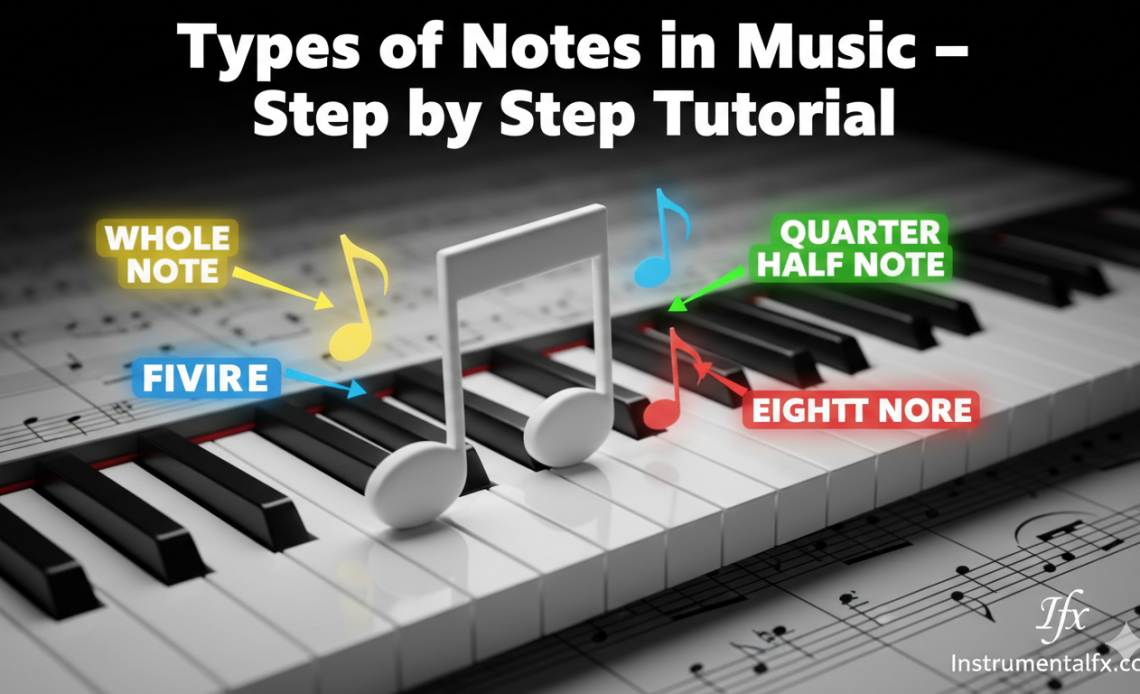
Types of notes in music are the fundamental building blocks that determine how long each sound lasts in a musical piece.
Understanding the different types of notes in music is essential for anyone learning to read sheet music, play an instrument, or compose their own songs.
The main types of notes in music include whole notes, half notes, quarter notes, eighth notes, and sixteenth notes, each with specific duration values that shape rhythm and timing.
Learning these types of notes in music allows musicians to accurately interpret written music and communicate musical ideas effectively.
This comprehensive tutorial will guide you through every aspect of types of notes in music, from basic concepts to advanced applications.
What Are Musical Notes
Musical notes represent both pitch and duration in written music. Every type of note tells musicians exactly which sound to play and how long to hold it.
The types of notes in music form a systematic hierarchy where each note value relates mathematically to others. This relationship creates the foundation for all rhythmic patterns in music.
Understanding types of notes in music requires recognizing that each note symbol conveys specific information. The shape, color, and additional markings on notes communicate their duration precisely.
The Staff and Note Placement
Understanding the Musical Staff
The musical staff consists of five horizontal lines and four spaces where types of notes in music are placed. Each line and space represents a different pitch.
The staff provides the framework for reading types of notes in music. Notes can sit on lines, in spaces, or above and below the staff using ledger lines.
Treble clef (G clef) and bass clef (F clef) are the two most common clefs. These symbols tell musicians which pitches the lines and spaces represent.
How Notes Indicate Pitch
The vertical position of types of notes in music on the staff indicates their pitch. Higher positions mean higher sounds, lower positions mean lower sounds.
Notes placed on the same line or space represent the same pitch. The staff’s five lines and four spaces accommodate nine different note positions.
Ledger lines extend the staff above and below for notes outside the standard range. These short lines allow notation of very high or very low pitches.
Note Names and the Musical Alphabet
The musical alphabet uses letters A through G to name notes. After G, the pattern repeats starting again at A.
In treble clef, the lines represent E-G-B-D-F (Every Good Boy Does Fine). The spaces spell out F-A-C-E for easy memorization.
Bass clef lines are G-B-D-F-A (Good Boys Do Fine Always). The spaces are A-C-E-G, requiring different memorization techniques.
Basic Components of Musical Notes
The Notehead
The notehead is the oval-shaped part of types of notes in music. It can be either open (hollow) or filled (solid black).
Open noteheads indicate longer durations while filled noteheads represent shorter durations. This visual difference helps musicians quickly identify note values.
The notehead’s position on the staff determines pitch. Its shape and fill communicate duration information essential for rhythm.
The Stem
The stem is a thin vertical line attached to most types of notes in music. It extends either upward or downward from the notehead.
Stem direction follows specific rules: notes below the middle staff line have stems pointing up on the right side. Notes above the middle line have stems pointing down on the left.
Some types of notes in music, like whole notes, don’t have stems. The absence or presence of a stem helps identify note duration.
Flags and Beams
Flags are curved lines attached to stems of faster types of notes in music. Each flag halves the note’s duration.
Eighth notes have one flag, sixteenth notes have two flags, and thirty-second notes have three flags. More flags equal faster notes.
Beams connect multiple flagged notes together, replacing individual flags. Beaming makes music easier to read by grouping notes into beats visually.
The Six Main Types of Notes in Music
Whole Note (Semibreve)
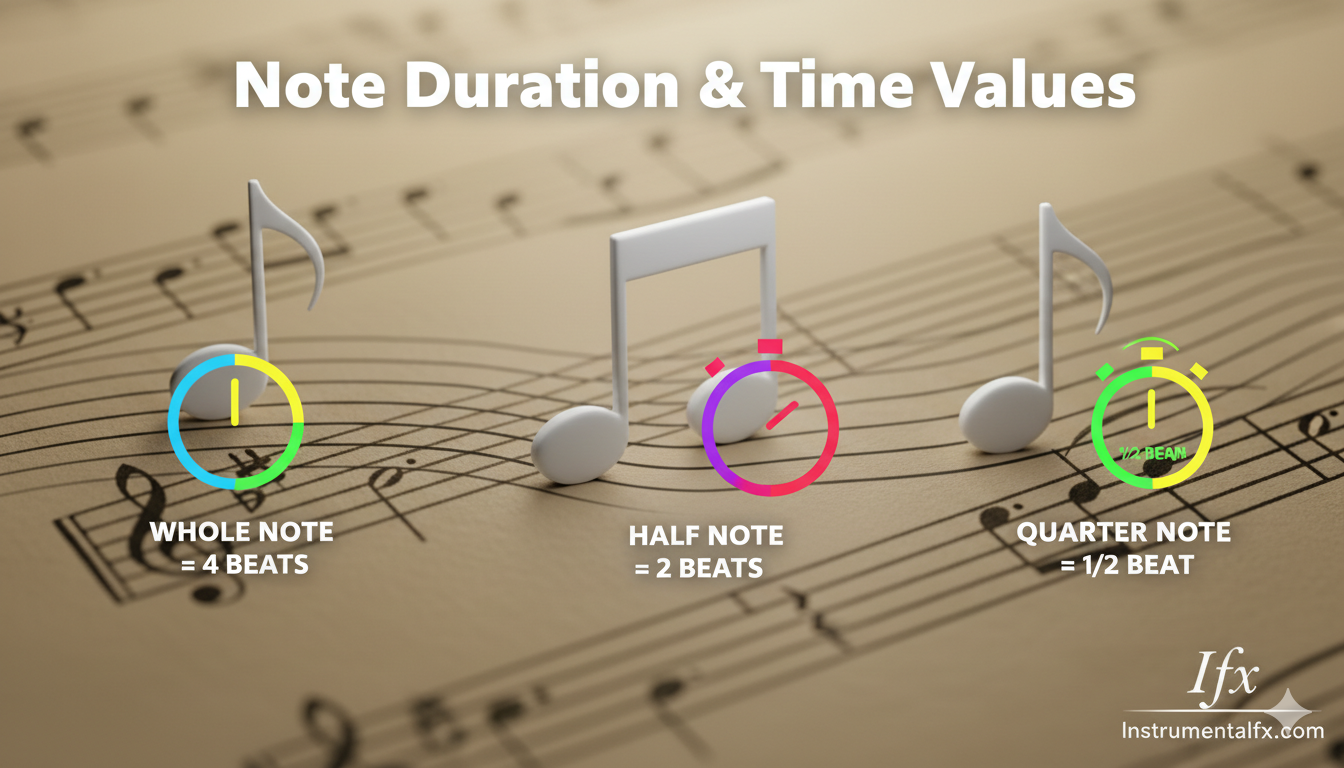
The whole note is the longest common type among types of notes in music. It lasts for four beats in standard 4/4 time.
A whole note appears as an open oval without a stem. Its hollow appearance distinguishes it from shorter note values.
In a 4/4 measure, one whole note fills the entire bar. This makes whole notes perfect for sustained, long-duration sounds.
Half Note (Minim)
The half note lasts for two beats, exactly half the duration of a whole note. It’s one of the most common types of notes in music.
Half notes have an open notehead like whole notes but include a stem. This stem differentiates them visually from whole notes.
Two half notes equal one whole note in duration. In 4/4 time, two half notes completely fill one measure.
Quarter Note (Crotchet)
Quarter notes last for one beat each and serve as the basic counting unit. They’re the most fundamental types of notes in music for beginners.
Quarter notes feature a filled (black) notehead with a stem. The solid notehead distinguishes them from longer note values.
Four quarter notes equal one whole note. In 4/4 time, four quarter notes fill one complete measure perfectly.
Eighth Note (Quaver)
Eighth notes last for half a beat, requiring two eighth notes to equal one quarter note. They add rhythmic complexity to music.
Eighth notes have filled noteheads, stems, and one flag. When grouped, beams replace flags connecting multiple eighth notes.
Eight eighth notes equal one whole note. These types of notes in music create faster, more intricate rhythmic patterns.
Sixteenth Note (Semiquaver)
Sixteenth notes last for one-quarter of a beat. They represent some of the fastest common types of notes in music.
Sixteenth notes have filled noteheads, stems, and two flags or beams. The double flag/beam distinguishes them from eighth notes.
Sixteen sixteenth notes equal one whole note. These notes create very rapid passages and complex rhythmic textures.
Thirty-Second Note (Demisemiquaver)
Thirty-second notes last for one-eighth of a beat. These extremely fast types of notes in music appear in advanced pieces.
Thirty-second notes feature filled noteheads, stems, and three flags or beams. The triple marking indicates their short duration.
Thirty-two thirty-second notes equal one whole note. These notes appear in virtuosic passages requiring exceptional technical skill.
Note Duration and Time Values
Understanding Beat and Tempo
A beat is the basic unit of time in music. The tempo indicates how fast or slow beats occur.
Types of notes in music relate directly to beats. In 4/4 time, quarter notes equal one beat by default.
Tempo markings like “Allegro” (fast) or “Adagio” (slow) tell musicians the intended speed. This affects how long each note actually lasts.
The Mathematical Relationship Between Notes
Each type of note has a specific mathematical relationship to others. Understanding these relationships is crucial for reading rhythm.
One whole note equals two half notes, four quarter notes, eight eighth notes, or sixteen sixteenth notes. This doubling/halving pattern continues throughout all types of notes in music.
This mathematical precision allows musicians worldwide to interpret rhythm consistently. The system creates a universal language for musical timing.
Time Signatures and Note Values
Time signatures appear at the beginning of music, showing beats per measure. The top number indicates beats per bar, the bottom shows which note gets one beat.
In 4/4 time, there are four beats per measure and the quarter note receives one beat. Different time signatures change how types of notes in music are counted.
In 3/4 time, measures contain three beats. In 6/8 time, there are six eighth notes per measure, creating different rhythmic feels.
Dotted Notes and Tied Notes
Dotted Notes Explained
A dot placed after any of the types of notes in music adds half of that note’s original value to its duration.
A dotted half note equals three beats (two beats plus one beat). A dotted quarter note equals one and a half beats.
Dotted notes create rhythmic variety beyond basic note values. They’re essential for playing specific rhythmic patterns correctly.
Double Dotted Notes
Double dots are rare but add even more duration. The second dot adds half of the first dot’s value.
A double-dotted half note equals three and three-quarter beats. This extended duration creates very specific rhythmic effects.
Double dots appear primarily in classical and baroque music. Modern music rarely uses this notation convention.
Tied Notes
Ties are curved lines connecting two notes of the same pitch. Tied notes should be played as one continuous sound.
The tied note’s duration equals the sum of both connected notes. A half note tied to a quarter note lasts three beats total.
Ties allow durations that single notes can’t represent. They’re crucial for rhythms extending across bar lines.
Rests in Music
Whole Rest (Semibreve Rest)
Rests indicate silence for specific durations. Each type of note has a corresponding rest symbol with equal duration.
A whole rest appears as a filled rectangle hanging below the fourth staff line. It represents four beats of silence.
Whole rests can also indicate a full measure of rest regardless of time signature. Context determines the exact interpretation.
Half Rest (Minim Rest)
Half rests look like filled rectangles sitting on the third staff line. They indicate two beats of silence.
The position on the staff distinguishes half rests from whole rests. This positioning prevents confusion between similar symbols.
Half rests divide measures into contrasting sections of sound and silence. They’re essential for creating rhythmic interest.
Quarter Rest (Crotchet Rest)
Quarter rests represent one beat of silence. They have a distinctive squiggly appearance unlike note-shaped rests.
This unique symbol can’t be mistaken for other rest values. Its clear visual design aids quick recognition while reading.
Quarter rests are the most common rest value in popular music. They create breathing space within melodic phrases.
Eighth Rest (Quaver Rest)
Eighth rests indicate half a beat of silence. They look like a slash with a flag, similar to eighth note flags.
These rests create quick moments of silence within faster passages. They’re crucial for syncopated rhythmic patterns.
Eighth rests combine with eighth notes to create intricate rhythmic textures. Together they form the foundation of groove-based music.
Sixteenth Rest (Semiquaver Rest)
Sixteenth rests represent one-quarter beat of silence. They feature two flags, matching sixteenth notes’ double flag design.
These very short silences appear in complex rhythmic passages. They’re essential for advanced rhythmic articulation.
Sixteenth rests require precise execution. Even brief silence at fast tempos contributes significantly to rhythmic clarity.
Reading Note Durations in Different Time Signatures
Common Time (4/4)
4/4 time, also called “common time,” is the most prevalent time signature. Four beats per measure with quarter notes receiving one beat.
In 4/4 time, types of notes in music follow standard duration values. One whole note, two half notes, or four quarter notes fill one measure.
Most popular, rock, and classical music uses 4/4 time. Understanding note durations in this signature is fundamental.
Three-Four Time (3/4)
3/4 time contains three beats per measure with quarter notes getting one beat. This creates waltz-like rhythmic feel.
Types of notes in music in 3/4 time follow the same duration relationships. However, measures accommodate only three quarter notes.
A dotted half note perfectly fills one 3/4 measure. This creates a strong sense of one-two-three rhythmic pattern.
Six-Eight Time (6/8)
6/8 time has six beats per measure with eighth notes receiving one beat. This compound meter feels different from 4/4.
In 6/8 time, eighth notes are the basic pulse. Quarter notes last two beats, dotted quarter notes last three beats.
This time signature creates a lilting, flowing quality. Types of notes in music group naturally into two sets of three eighth notes.
Cut Time (2/2)
Cut time, or alla breve, has two beats per measure with half notes getting one beat. It’s essentially 4/4 played twice as fast.
Types of notes in music maintain their relationships but feel faster. Quarter notes become the equivalent of eighth notes in 4/4.
Cut time appears in marches and faster classical pieces. The notation simplifies reading rapid tempos.
Advanced Note Concepts
Tuplets and Triplets
Tuplets divide beats into irregular subdivisions. Triplets are the most common, playing three notes in the time of two.
Quarter note triplets fit three equal notes into one half note’s duration. This creates rhythmic patterns impossible with standard note values.
Tuplets are marked with brackets and numbers indicating the irregular division. They add rhythmic complexity and interest to music.
Grace Notes and Ornaments
Grace notes are small types of notes in music played quickly before main notes. They add decoration without receiving separate beat time.
Acciaccaturas (crushed notes) and appoggiaturas (leaning notes) are common ornament types. Each has specific performance practices.
These ornamental notes appear throughout classical music. They require special technique but enrich melodic expression.
Fermatas and Holds
Fermatas (hold signs) appear above or below types of notes in music. They extend the note’s duration beyond its written value.
The exact length of a fermata depends on musical context and conductor/performer judgment. They create expressive pauses.
Fermatas add dramatic emphasis at phrase endings. They’re crucial for expressive, rubato-style playing.
Note Articulation Markings
Articulation marks tell performers how to attack and release types of notes in music. Staccato dots mean short and detached.
Accents emphasize specific notes, tenuto marks mean full value, and slurs connect notes smoothly. Each affects how notes sound.
These markings transform identical note sequences into different musical expressions. They’re essential for stylistic accuracy.
Practical Tips for Learning Note Values
Counting Methods
Counting aloud helps internalize types of notes in music. For quarter notes, count “1-2-3-4” in 4/4 time.
For eighth notes, add “and” between beats: “1-and-2-and-3-and-4-and.” This subdivision makes faster notes manageable.
For sixteenth notes, count “1-e-and-a-2-e-and-a.” This detailed subdivision ensures accurate rhythm.
Using a Metronome
Metronomes provide steady beats for practicing types of notes in music. Start at slow tempos around 60 BPM.
Practice each note type separately with metronome accompaniment. This builds internal timing before combining different values.
Gradually increase metronome speed as accuracy improves. Never sacrifice precision for speed during practice.
Clapping and Body Percussion
Clapping rhythms before playing instruments reinforces understanding of types of notes in music. Physical involvement aids learning.
Try different body parts for different note values: stomps for quarter notes, claps for eighth notes. This creates kinesthetic memory.
Practice complex rhythms through body percussion first. It’s easier than coordinating instrument technique with rhythm simultaneously.
Sight-Reading Practice
Daily sight-reading exercises develop fluency with types of notes in music. Start with simple rhythms and gradually increase difficulty.
Don’t stop for mistakes during sight-reading. Keeping steady tempo is more important than perfection during initial readings.
Use method books with progressive difficulty levels. Consistent practice transforms confusion into automatic recognition.
Common Mistakes When Learning Note Types
Rushing Through Fast Notes
Students often rush eighth and sixteenth notes, compressing their duration. Each note deserves its full time value.
Use slow practice to internalize correct spacing between fast types of notes in music. Speed develops naturally from accuracy.
Record yourself playing and compare timing with a metronome. Self-assessment reveals rushing tendencies clearly.
Holding Notes Too Long or Too Short
Beginners frequently release notes early or hold them too long. Each type has specific mathematical duration.
Practice with a metronome to develop precise note length awareness. Count beats while playing initially.
Focus on smooth transitions between types of notes in music. The ending of one note should flow into the beginning of the next.
Ignoring Rest Values
Rests are as important as sounding notes. Silence shapes music just as much as sound does.
Practice rests as actively as notes. Count through silent measures with the same attention as playing passages.
Rests create breathing space in music. Rushing through them destroys the rhythmic integrity of the piece.
Misreading Stem Direction
Stem direction doesn’t affect note duration, only indicating voice or hand assignment. Focus on notehead shape and flags.
Some beginners think up-stems and down-stems represent different note types. They’re identical in duration value.
Learn to identify types of notes in music by notehead fill, stems, and flags/beams. Stem direction is secondary information.
How to Practice Note Recognition
Flashcard Method
Create or purchase flashcards showing different types of notes in music. Quiz yourself daily on note identification.
Include both note symbols and their duration values. This dual approach reinforces both visual and conceptual understanding.
Start with basic notes, gradually adding more complex values. Consistent daily practice yields better results than occasional long sessions.
Rhythm Apps and Software
Many apps teach types of notes in music through interactive exercises. Popular options include Rhythm Trainer, ReadRhythm, and Complete Rhythm Trainer.
These tools provide immediate feedback on rhythm accuracy. The gamification makes learning engaging and trackable.
Set daily goals using these apps. Ten minutes daily produces significant improvement over weeks and months.
Writing Music Notation
Copying rhythms by hand reinforces understanding of types of notes in music. The physical act of drawing notes aids memorization.
Start by copying simple rhythm patterns from method books. Progress to transcribing rhythms from songs you hear.
Creating your own simple compositions using different note values demonstrates true understanding. Application cements knowledge.
Types of Notes in Music Across Genres
Classical Music Note Usage
Classical music employs all types of notes in music extensively. Complex orchestral works feature every note value from whole notes to sixty-fourth notes.
Classical notation is highly precise, leaving little to performer interpretation. Understanding note values is absolutely essential.
Study scores from different eras to see how note usage evolved. Baroque music differs significantly from Romantic period compositions.
Jazz and Swing Feel
Jazz modifies written types of notes in music through swing feel. Eighth notes become uneven, creating lilting rhythm.
Triplet feel is implied even when eighth notes are written straight. This “swing eighth” interpretation is fundamental to jazz.
Jazz charts often include style markings explaining the intended rhythmic feel. Context determines how literally to interpret notation.
Rock and Pop Music
Rock and pop typically use simpler types of notes in music. Quarter notes and eighth notes dominate popular song notation.
Syncopation—emphasizing unexpected beats—is crucial in these genres. Understanding note placement relative to strong and weak beats matters.
Lead sheets in pop often show just basic rhythmic outline. Performers add stylistic interpretation based on genre conventions.
World Music Traditions
Different cultures have unique approaches to types of notes in music. Some traditions don’t use Western notation systems at all.
When Western notation is used for world music, it approximates sounds that may not fit perfectly. Oral tradition often preserves subtle timing.
Learning notation from various traditions expands rhythmic vocabulary. Expose yourself to diverse musical systems for well-rounded understanding.
Frequently Asked Questions
What are the main types of notes in music?
The six main types of notes in music are whole notes (4 beats), half notes (2 beats), quarter notes (1 beat), eighth notes (1/2 beat), sixteenth notes (1/4 beat), and thirty-second notes (1/8 beat). Each note value has specific duration and visual appearance.
How do you read note durations in sheet music?
Note durations are determined by the notehead shape (open or filled), presence of stem, and number of flags or beams attached. Whole notes are hollow without stems, while shorter notes have filled noteheads with stems and potentially flags or beams.
What is the difference between American and British note names?
American names include whole note, half note, quarter note, eighth note, and sixteenth note. British names are semibreve, minim, crotchet, quaver, and semiquaver respectively. Both systems describe the same note durations.
How many beats does each type of note get?
In 4/4 time, a whole note gets 4 beats, half note gets 2 beats, quarter note gets 1 beat, eighth note gets 1/2 beat, and sixteenth note gets 1/4 beat. These values change in different time signatures.
What do dotted notes mean?
A dot after any note adds half of that note’s original value to its duration. A dotted half note equals 3 beats (2 + 1), and a dotted quarter note equals 1.5 beats (1 + 0.5).
How do you count sixteenth notes?
Count sixteenth notes as “1-e-and-a, 2-e-and-a, 3-e-and-a, 4-e-and-a” in 4/4 time. Each syllable represents one sixteenth note, with four sixteenth notes fitting into one quarter note beat.
What are rests and how do they relate to notes?
Rests represent silence with durations equal to their corresponding note values. A whole rest equals four beats of silence, half rest equals two beats, quarter rest equals one beat, and so on.
Why do some notes have stems pointing up and others down?
Stem direction follows conventions: notes below the middle staff line have upward stems on the right, notes above have downward stems on the left. This improves readability and can indicate which hand plays on keyboard instruments.
Can I learn to read types of notes in music quickly?
Learning note values takes consistent practice over weeks or months. Daily practice with flashcards, rhythm exercises, and actual music reading accelerates the learning process. Most beginners gain basic fluency in 2-3 months.
How do types of notes in music work in different time signatures?
Note relationships remain constant across time signatures, but which note receives “one beat” changes. In 4/4, quarter notes get one beat; in 6/8, eighth notes get one beat; in 2/2, half notes get one beat.
Conclusion
Types of notes in music form the essential foundation for all rhythmic understanding in Western musical notation.
Mastering these note values—from whole notes to sixteenth notes and beyond—enables musicians to accurately read, interpret, and perform written music across all genres and styles.
Understanding types of notes in music requires consistent practice, patience, and systematic study. Start with basic note values like whole, half, and quarter notes before progressing to faster subdivisions.
Use metronomes, apps, and daily practice to develop fluency with note recognition and duration. Remember that rhythm is as important as pitch in creating beautiful music.
With dedication and proper guidance, anyone can master types of notes in music and unlock the ability to read and perform any piece of written music confidently.


