


Easy violin sheet music is essential for beginners and intermediate players looking to build their repertoire without overwhelming complexity.
Whether you’re just starting your violin journey or seeking accessible arrangements of your favorite songs, the right sheet music makes all the difference in maintaining motivation and developing proper technique.
In 2026, violinists have access to an incredible variety of free and paid resources featuring classical masterpieces, modern pop hits, traditional fiddle tunes, and movie soundtracks—all simplified for easier playability.
This comprehensive guide explores the best sources for easy violin sheet music, popular songs perfect for beginners, tips for reading music effectively, and how to choose arrangements that match your current skill level.
What Makes Violin Sheet Music “Easy”
Easy violin sheet music typically stays within first position playing. This means you don’t need to shift your hand up and down the fingerboard, making notes more accessible for beginners.
Simple key signatures like D major, G major, and A major are commonly used. These keys work naturally with the violin’s open strings and require fewer accidentals (sharps and flats).
Easy arrangements avoid complex rhythms like thirty-second notes or syncopation. Instead, they focus on quarter notes, half notes, whole notes, and simple eighth note patterns that are easier to count and execute.
The bow patterns in beginner sheet music use basic strokes. You’ll find mostly detached (staccato) bowing or smooth (legato) bowing without advanced techniques like spiccato or sautillé.
Limited string crossings make pieces more manageable. Easy violin music minimizes jumping between strings, allowing you to focus on intonation and bow control.
Benefits of Using Easy Violin Sheet Music
Starting with appropriately leveled music builds confidence quickly. When you can play a recognizable melody within your first few weeks, it reinforces that learning violin is achievable.
Easy arrangements teach fundamental techniques properly. Simple pieces allow you to focus on bow hold, left-hand position, and tone production without being overwhelmed by technical demands.
Beginner-friendly sheet music keeps practice sessions enjoyable. Playing songs you recognize and love makes daily practice something you look forward to rather than dread.
These arrangements develop sight-reading skills progressively. As patterns repeat across different easy pieces, you’ll start recognizing intervals and rhythms more quickly.
Simple music allows focus on musicality, not just notes. Even beginners can work on dynamics, phrasing, and expression when the technical demands are manageable.
Top Classical Pieces for Beginner Violinists
Beethoven’s “Ode to Joy” is the quintessential beginner classical piece. The melody primarily uses the D string with simple finger patterns that beginners can master quickly.
This famous theme teaches students to play stepwise motion smoothly. The notes move one position at a time, making it perfect for developing left-hand finger placement accuracy.
Mozart’s “Twinkle Twinkle Little Star” variations provide excellent practice material. The familiar melody helps beginners focus on technique rather than struggling to learn new notes.
Vivaldi’s “Spring” from The Four Seasons can be simplified for beginners. Easy arrangements capture the essence of this Baroque masterpiece while staying in first position.
Bach’s “Minuet in G Major” introduces students to Baroque style. The piece teaches both detached and smooth bowing patterns within an accessible technical framework.
Pachelbel’s “Canon in D” in simplified form is incredibly popular. Arranged for beginners, it teaches repetitive patterns that build muscle memory and confidence.
“Für Elise” by Beethoven translates beautifully to violin. Even though originally written for piano, simplified violin arrangements make this beloved melody accessible to beginners.
Modern and Pop Songs for Easy Violin
“Let It Be” by The Beatles works wonderfully on violin. The slow tempo and simple melody line make it perfect for beginners who love classic rock.
The chord progression is repetitive, allowing violinists to focus on tone quality. Playing familiar modern songs helps bridge the gap between classical training and contemporary music interests.
“Hallelujah” by Leonard Cohen is extremely popular among students. The emotional melody sits comfortably in first position and teaches expressive playing.
“A Thousand Years” by Christina Perri appeals to romantic music lovers. This modern ballad’s gentle melody line translates beautifully to violin without complex techniques.
“Perfect” by Ed Sheeran has become a wedding favorite. Simplified arrangements make this contemporary hit accessible while maintaining its romantic character.
“Someone Like You” by Adele teaches emotional expression. The powerful melody allows beginners to work on dynamics and phrasing with a song they recognize.
Disney songs like “Let It Go” and “A Whole New World” are student favorites. These familiar melodies keep young learners engaged while developing essential skills.
“Shallow” from A Star Is Born provides modern repertoire. The memorable melody and moderate tempo make it suitable for early intermediate players.
Traditional Folk and Fiddle Tunes
“Amazing Grace” is one of the easiest and most beautiful violin pieces. This hymn uses simple intervals and a slow tempo perfect for developing tone quality.
The spiritual quality of “Amazing Grace” teaches students about musical expression. Even beginners can communicate emotion through careful bow control and dynamics.
“Scarborough Fair” is a hauntingly beautiful traditional melody. The piece stays in a comfortable range and teaches minor key playing without excessive difficulty.
“Danny Boy” (Londonderry Air) is beloved by violinists worldwide. The lyrical melody teaches smooth bow changes and legato playing while staying technically accessible.
“Oh! Susanna” brings cheerful energy to practice sessions. This Stephen Foster classic teaches quick bow changes and rhythmic precision with a familiar tune.
“She’ll Be Coming ‘Round the Mountain” is perfect for young beginners. The repetitive melody and simple rhythm make it ideal for first-year students.
“Old Joe Clark” introduces basic fiddle techniques. This traditional Appalachian tune teaches rhythm and string crossings in an authentic folk music context.
“Swallowtail Jig” is one of the most popular Irish fiddle tunes. While slightly more advanced, simplified versions make this energetic piece accessible to motivated beginners.
Christmas and Holiday Violin Music
“Jingle Bells” is the perfect first Christmas song for violinists. The simple melody uses mostly quarter and eighth notes with minimal string crossing.
Playing holiday music during December keeps students motivated. Performing for family gatherings gives beginners a meaningful goal and performance opportunity.
“Silent Night” teaches smooth, flowing bow work. The slow tempo and gentle melody make it ideal for practicing legato bowing technique.
“We Wish You a Merry Christmas” has a cheerful, energetic feel. The piece teaches quick bow changes while maintaining a light, bouncy character.
“Joy to the World” uses descending scale patterns. This makes it excellent for teaching finger patterns and building left-hand muscle memory.
“O Come, All Ye Faithful” works well for church performances. The hymn-like quality teaches reverential playing and breath-like phrasing.
“Deck the Halls” with its “fa la la” sections teaches rhythmic precision. The repetitive patterns make it easy to memorize and perform confidently.
Where to Find Free Easy Violin Sheet Music
Musescore.com offers over 1.5 million free sheet music pieces. The community-driven platform allows you to filter by difficulty level, making it easy to find beginner-appropriate music.
Users can download, print, and even transpose sheet music for free. The playback feature lets you hear how pieces should sound before attempting them.
8notes.com provides high-quality free violin sheet music organized by difficulty. Their beginner and easy categories feature classical, folk, and popular music with accompanying audio files.
The site includes practice tips and performance notes for each piece. This additional guidance helps beginners understand what to focus on when learning new music.
ViolinSheetMusic.org specializes in public domain classical music. The archive includes scans of original editions plus newly created arrangements specifically for beginners.
IMSLP (International Music Score Library Project) hosts thousands of classical pieces. While some editions are complex, searching for “easy” or “beginner” arrangements yields excellent results.
Violinspiration.com offers free PDF downloads with video tutorials. The combination of sheet music and visual instruction helps beginners learn pieces more effectively.
Paid Resources for Quality Easy Violin Sheet Music
Meadowlark Violin Studio offers 60+ easy songs with online membership. The arrangements are professionally transposed into violin-friendly keys with clear fingering guides.
The membership includes video tutorials for each piece. This comprehensive approach combines sheet music with step-by-step instruction for better learning outcomes.
Troy Nelson Music publishes “Super Easy Classical Violin Sheet Music.” This book features 30 classical themes in large print with letter notes for absolute beginners.
The collection includes free audio downloads from their website. Having accompaniment tracks helps beginners play in time and hear how pieces should sound.
Sheet Music Plus stocks thousands of graded violin arrangements. Their filtering system allows you to search specifically for Grade 1-3 pieces suitable for beginners.
JW Pepper offers educational music with detailed difficulty ratings. Teachers can find classroom-appropriate materials and students can order individual pieces.
Lindsey Stirling Sheet Music provides simplified versions of modern hits. These arrangements bridge classical technique with contemporary violin styles that appeal to younger players.
Understanding Violin Sheet Music Notation
The treble clef (G clef) is used for all violin music. The clef wraps around the G line, indicating that notes on that line represent the pitch G above middle C.
Understanding staff lines and spaces is fundamental to reading music. From bottom to top, the lines are E-G-B-D-F (Every Good Boy Does Fine) and spaces are F-A-C-E.
Time signatures tell you how beats are organized in each measure. Common time (4/4) means four quarter note beats per measure, the most common time signature for beginners.
Note values determine how long to hold each note. Whole notes get four beats, half notes get two, quarter notes get one, and eighth notes get half a beat.
Rests indicate periods of silence within the music. Quarter rests, half rests, and whole rests correspond to their note value counterparts in duration.
Key Signatures and Beginner-Friendly Keys
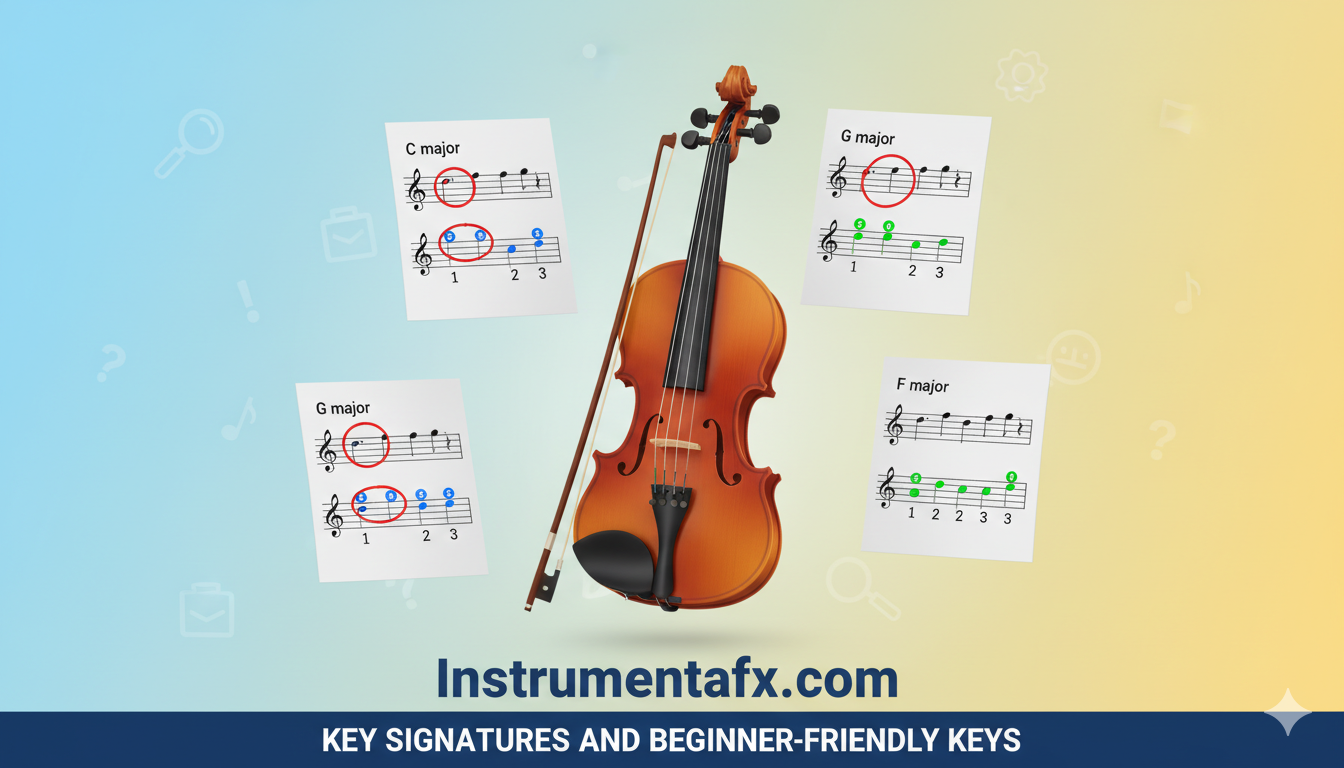
D major is the most violin-friendly key for beginners. With two sharps (F# and C#), it uses the open D and A strings extensively and sits naturally under the fingers.
The D major scale teaches basic first position finger patterns. Students learn where to place fingers 1, 2, and 3 to create the major scale sound.
G major with one sharp (F#) is another beginner favorite. The key incorporates the open G string and provides easy melodic movement across strings.
A major uses three sharps but feels natural on violin. The open A string serves as the tonic, and the key signature creates comfortable finger spacing.
C major, while having no sharps or flats, can be tricky. The key requires low first finger placement throughout, which can challenge beginners’ intonation.
Keys with more than four sharps or flats should be avoided initially. Complex key signatures add unnecessary difficulty when students are still developing basic technique.
Fingering Numbers and Position Markers
Fingering numbers (1, 2, 3, 4) appear above or below notes. These numbers indicate which left-hand finger to use, with 1 being the index finger and 4 the pinky.
Violin fingering uses 0 to represent open strings. When you see a 0, it means play the string without pressing down any fingers.
First position is where beginners spend most of their time. In this position, first finger plays one whole step above the open string on each string.
Some easy sheet music includes string indicators. Letters like “G,” “D,” “A,” or “E” above notes specify which string to play the note on.
Position markers become important as you advance. Roman numerals (I, II, III, etc.) indicate when to shift your hand to different positions on the fingerboard.
Bow Markings and Articulations in Easy Music
Down-bow (П) and up-bow (V) markings indicate bow direction. Following these markings helps create proper phrasing and maintains good bow distribution.
Slurs connect multiple notes to be played in one bow stroke. The curved line over or under notes indicates smooth connection without stopping the bow.
Staccato dots above notes mean play them short and detached. These notes should be separated with space between them, creating a light, bouncy effect.
Accents (>) emphasize specific notes. Play accented notes with slightly more bow pressure or speed to make them stand out from surrounding notes.
Dynamic markings tell you how loud or soft to play. Piano (p) means soft, forte (f) means loud, and mezzo-forte (mf) means moderately loud.
Tips for Learning Easy Violin Sheet Music
Start by clapping or tapping the rhythm before playing. This separates rhythm-learning from pitch-learning, making each element easier to master independently.
Spend time looking at the sheet music away from your violin. Identify patterns, repeated sections, and potential trouble spots before you start practicing.
Practice in small sections rather than attempting entire pieces. Master 2-4 measures at a time, gradually connecting sections as each becomes comfortable.
Use a metronome to develop steady timing. Start slower than the marked tempo and gradually increase speed as accuracy improves.
Play with backing tracks or piano accompaniments when available. This makes practice more musical and helps you develop ensemble playing skills early.
Record yourself playing and listen back critically. You’ll notice intonation issues, rhythm problems, and tone quality concerns more easily when listening versus playing.
Common Mistakes When Using Easy Violin Sheet Music
Rushing through pieces faster than your skill level allows. Playing slowly with good tone and intonation is far better than playing fast with mistakes.
Ignoring fingering suggestions provided in the music. Published fingerings are carefully chosen to facilitate smooth playing and good intonation.
Neglecting to count rests properly. Beginners often skip over rest symbols, not realizing that silence is as important as sound in music.
Playing without attention to bow direction markings. Random bowing creates awkward string crossings and prevents musical phrasing.
Failing to observe dynamic markings even in easy pieces. Music should have expression, volume variation, and character from the very beginning.
Avoiding repetitive practice of difficult measures. Problem spots don’t improve without focused, repetitive practice at slow tempos.
How to Choose the Right Difficulty Level
Assess your current technical abilities honestly. Can you play in first position comfortably? Do you read notes fluently? How smooth are your string crossings?
Look for pieces with mostly stepwise motion at first. Melodies that move from one note to the next adjacent note are easier than those with large interval jumps.
Check the rhythm complexity before committing to a piece. If you see many sixteenth notes, syncopation, or complex rhythmic patterns, it may be too advanced.
Consider the tempo marking. A piece marked “Allegro” (fast) requires more technical facility than one marked “Andante” (walking pace) even with similar notes.
Start with shorter pieces of 16-32 measures. Building success with complete shorter pieces motivates more than struggling through long, difficult works.
Practicing Easy Pieces for Maximum Improvement
Warm up with scales in the key of your piece. This prepares your fingers for the specific note patterns you’ll encounter in the music.
Practice difficult passages in different rhythms. Playing a challenging section in dotted rhythms or triplets helps build muscle memory and evenness.
Work backwards from the end of pieces. Often the ending becomes the weakest part because students focus practice time on beginnings.
Practice troublesome measures in various positions of your practice session. Don’t always tackle difficult sections when fresh; practice them when tired too.
Play familiar pieces regularly to maintain technique. Even after learning a new piece well, return to it periodically to keep it performance-ready.
Visualize playing the piece away from your instrument. Mental practice reinforces muscle memory and helps you internalize the music more deeply.
Building a Balanced Repertoire
Include a mix of classical and contemporary music in your practice. This keeps sessions interesting and exposes you to different musical styles and techniques.
Balance technical études with musical pieces. While scales and exercises build skills, playing actual music develops artistry and expression.
Don’t neglect folk and traditional music. Fiddle tunes teach different bow techniques and musical sensibilities than classical pieces.
Learn some duets and ensemble music. Playing with others develops listening skills and is more socially enjoyable than solo practice alone.
Memorize some pieces while sight-reading others regularly. Both skills are important for becoming a well-rounded violinist.
Progressive Learning with Sheet Music
Create a practice journal tracking pieces you’ve learned. Document the date started, date mastered, and specific challenges you overcame with each piece.
Notice patterns in what makes pieces challenging for you. If string crossings consistently cause problems, seek out easier pieces that specifically practice that skill.
Gradually increase complexity as skills develop. Move from pieces with only quarter and half notes to those incorporating eighth notes, then sixteenth notes.
Don’t rush to advance to harder music prematurely. Solid mastery of easier material creates a foundation that makes advanced playing possible later.
Revisit “outgrown” easy pieces with more advanced technique. Playing simple melodies with beautiful tone and mature expression is more musical than playing difficult pieces poorly.
Teaching Easy Violin Music to Students
Assign pieces that students will enjoy playing. When students connect emotionally with music, they practice more willingly and progress faster.
Provide historical and cultural context for pieces. Knowing that “Amazing Grace” was written by a former slave trader who found redemption makes it more meaningful.
Break down complex pieces into manageable practice sections. Give students specific, achievable daily goals rather than just assigning the entire piece.
Use the “practice pyramid” approach for difficult passages. Students should play trouble spots many more times than easier sections within a piece.
Encourage students to perform easy pieces for family and friends. Performance experience builds confidence and gives practice sessions real-world purpose.
Record student performances and track progress over time. Hearing improvement from month to month provides powerful motivation to continue practicing.
Technology Tools for Easy Violin Sheet Music
Apps like ForScore and unrealBook organize digital sheet music. Tablets eliminate the need for physical binders and make page turns easier during performance.
These apps allow annotations directly on the music. Mark fingerings, bowings, and practice notes without writing on paper copies.
MuseScore software lets you create and edit sheet music. You can transpose pieces into more comfortable keys or simplify overly complex arrangements yourself.
YouTube tutorials complement written sheet music perfectly. Seeing and hearing how passages should be played clarifies ambiguities in printed music.
Slowdowner apps let you practice with recordings. You can reduce tempo without changing pitch, making it easier to play along with favorite artists.
Tuner and metronome apps are essential practice companions. Staying in tune and in time are fundamental skills developed through regular use of these tools.
Sight-Reading Easy Violin Music
Set aside 10-15 minutes of each practice session for sight-reading. Regular practice develops the skill progressively and builds confidence with unfamiliar music.
Choose music slightly below your current level for sight-reading practice. The goal is reading fluently, not struggling through difficult passages.
Scan the entire piece before playing. Note the key signature, time signature, tempo, and look for patterns or repeated sections.
Don’t stop when you make mistakes during sight-reading. The skill is about continuing forward and catching the next note, not perfecting every measure.
Focus on rhythm and bow direction first, don’t worry about perfect intonation. In sight-reading, keeping time and following bowings matters more than hitting every note precisely.
Adapting Piano or Vocal Music for Violin
Many songs exist only in piano or vocal arrangements. With some knowledge, you can adapt these for violin, expanding your repertoire significantly.
Look for the melody line in piano scores. This is usually the top line of the treble clef staff and often includes lyrics in vocal arrangements.
Check if the key signature is violin-friendly. If the piece has many flats or uncommon sharps, consider transposing to D, G, or A major.
Simplify complex rhythms if needed. You can modify syncopated patterns or rapid note passages while keeping the essential melodic character intact.
Adjust the range if notes go too high or low. Transpose up or down an octave to keep the melody within comfortable playing range.
Creating Your Own Easy Arrangements
Start with simple melodies you know well. Familiar tunes are easier to arrange because you already hear how they should sound.
Write out the basic melody first in a violin-friendly key. Use notation software or staff paper to create a clean, readable version.
Add bowings that make musical sense. Consider which notes should be grouped together and where natural breathing points occur in the phrase.
Include fingerings for tricky passages. Mark unusual finger patterns or string choices that might not be obvious to other players.
Test your arrangement by playing it through. Make adjustments based on what feels awkward or sounds wrong when performed.
Violin Sheet Music for Different Musical Genres
Classical music develops foundational technique and musicianship. Baroque pieces teach articulation, Classical era works emphasize phrasing, and Romantic music develops expression.
Jazz standards introduce swing rhythms and improvisation concepts. Even simple jazz melodies expose violinists to syncopation and chromatic movement not found in classical music.
Celtic and Irish fiddle music teaches ornamentation. Cuts, rolls, and grace notes add character to melodies and develop finger agility.
Country and bluegrass emphasize rhythm and drive. These American traditions teach energetic bowing and characteristic shuffle rhythms.
Movie and game soundtracks provide contemporary classical experience. Composers like John Williams and Hans Zimmer create accessible yet musically sophisticated material.
Performance Tips for Easy Violin Pieces
Practice performing easy pieces from memory. Memorization frees you to focus on musical expression and connecting with your audience rather than reading notes.
Perform even simple pieces with full commitment and expression. The music may be easy technically, but it deserves passionate, heartfelt performance.
Make eye contact with your audience during performance. This creates connection and shows confidence, transforming a technical display into musical communication.
Breathe naturally while playing as if singing the melody. Physical breathing supports musical phrasing and helps prevent tension during performance.
Choose pieces you can play comfortably above performance level. What feels challenging in practice will feel even harder with performance nerves.
Overcoming Frustration with Difficult Passages
Identify exactly which notes or transitions cause problems. Vague frustration doesn’t help; specific identification of problem spots allows targeted practice.
Slow the passage down to a tempo where you can play it perfectly. Gradual tempo increase from perfection is more effective than repeatedly playing at speed with mistakes.
Practice problem spots with different rhythms and articulations. This multi-angle approach builds flexibility and deeper understanding of the passage.
Take breaks when frustration builds. Continuing to practice when angry or discouraged reinforces bad habits and tension.
Remember that difficulty is temporary and normal. Every advanced violinist struggled with passages that seem easy to them now.
Maintaining Motivation with Easy Violin Music
Set specific, achievable weekly goals. Rather than “practice more,” aim for “master the first 8 measures of Amazing Grace.”
Celebrate small victories along your learning journey. Reward yourself when you complete a new piece or master a challenging section.
Join online violin communities for support and inspiration. Sharing progress and hearing others’ experiences makes the journey less isolating.
Perform for friends and family regularly. Having an audience, even a small one, gives your practice purpose and deadline motivation.
Keep a practice journal documenting progress. Looking back at where you started reminds you how far you’ve come during discouraging moments.
Future Trends in Violin Sheet Music
Digital sheet music continues to replace physical books. Tablets and apps offer convenience, portability, and interactive features that paper cannot match.
Interactive sheet music with embedded audio and video is growing. Technology allows instant playback, synchronized scrolling, and slow-down features within the music itself.
AI-powered transposition and arrangement tools are emerging. These technologies can instantly adapt any piece to your skill level and preferred key signature.
Augmented reality applications may soon overlay fingerings and bowings. Visual guidance projected onto your violin could revolutionize how beginners learn new pieces.
Collaborative online platforms will expand. Real-time practice sessions with remote teachers and fellow students will become increasingly common and sophisticated.
Frequently Asked Questions
What is the easiest violin song for absolute beginners?
“Twinkle Twinkle Little Star” is the easiest violin song, using primarily the D string with simple finger patterns that beginners learn first.
Where can I find free easy violin sheet music?
Musescore.com, 8notes.com, IMSLP.org, and Violinspiration.com offer thousands of free violin pieces organized by difficulty level with PDF downloads.
How do I know if sheet music is too hard for me?
If music contains notes outside first position, complex rhythms beyond eighth notes, or many accidentals, it’s likely too advanced for beginners.
Should I learn to read music or play by ear first?
Learning both simultaneously is ideal; reading music provides structure while ear training develops musical intuition and understanding.
What key signatures are easiest for beginner violinists?
D major, G major, and A major are easiest because they align naturally with violin’s open strings and require comfortable finger placement.
How long should I practice each piece of sheet music?
Practice individual pieces 10-15 minutes per session, rotating through 3-4 pieces weekly to maintain variety and prevent boredom.
Can I use piano sheet music for violin?
Yes, but you must identify the melody line, check if the key works for violin, and adapt the range and rhythm as needed.
What does “first position” mean in violin playing?
First position means your hand stays in the basic starting position where first finger plays one whole step above each open string.
How many pieces should beginners learn simultaneously?
Work on 2-3 pieces at different stages: one being perfected, one in progress, and one being sight-read for the first time.
Do I need a teacher to learn from easy violin sheet music?
While self-teaching is possible with quality resources, a teacher prevents bad habits and accelerates progress significantly, especially for beginners.
Conclusion
Easy violin sheet music serves as the essential foundation for developing violinists at every stage of their musical journey.
Whether you’re exploring classical masterpieces like Beethoven’s “Ode to Joy,” contemporary favorites like Ed Sheeran’s “Perfect,” or traditional fiddle tunes like “Amazing Grace,” accessible arrangements keep practice sessions engaging while building fundamental technique.
The wealth of free resources available online through platforms like Musescore, 8notes, and IMSLP means cost never has to be a barrier to expanding your repertoire.
Success with easy violin music comes from choosing appropriately leveled pieces, practicing methodically with attention to rhythm and intonation, and maintaining a balanced repertoire across different musical genres.
Remember that even simple pieces deserve musical expression and committed performance. The technical ease of beginner arrangements provides the perfect opportunity to focus on beautiful tone production, dynamic variation, and emotional communication through your playing.


