

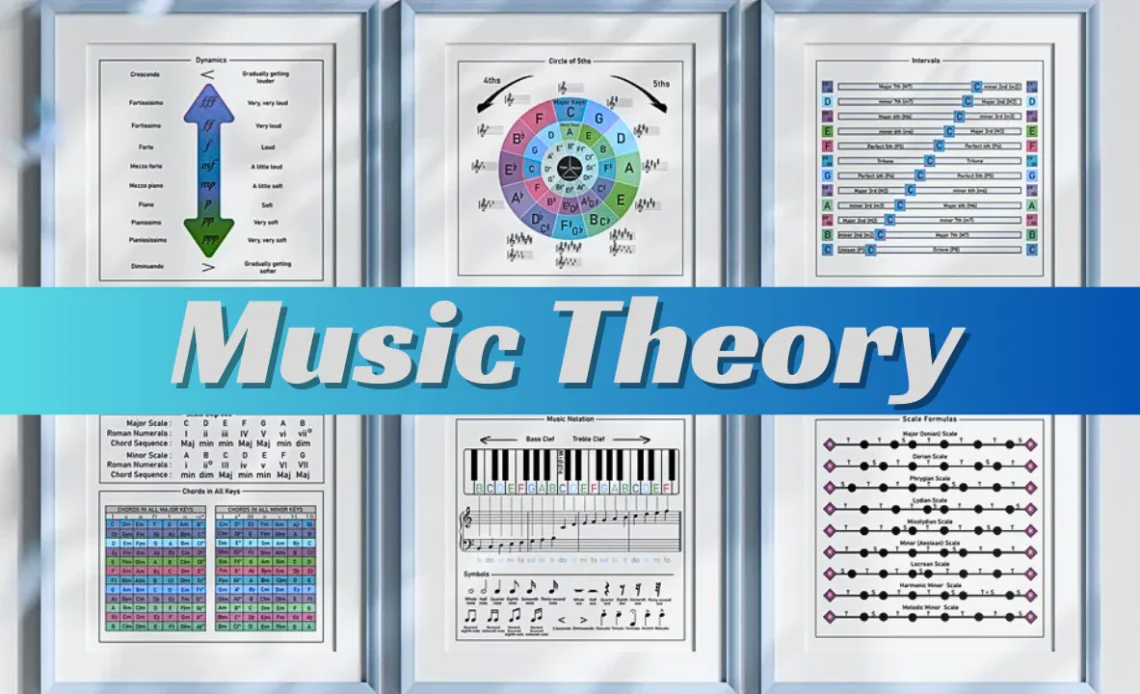
What is music theory and why does it matter for musicians in 2026? Music theory is the universal language that explains how music works, connecting notes, rhythms, and harmonies into meaningful compositions.
Whether you’re a beginner picking up your first instrument or a seasoned musician looking to deepen your understanding, music theory provides the foundation for creating, performing, and appreciating music.
This comprehensive guide breaks down essential concepts from scales and chords to rhythm and notation, helping you unlock your musical potential without overwhelming jargon or complicated formulas.
What Is Music Theory?
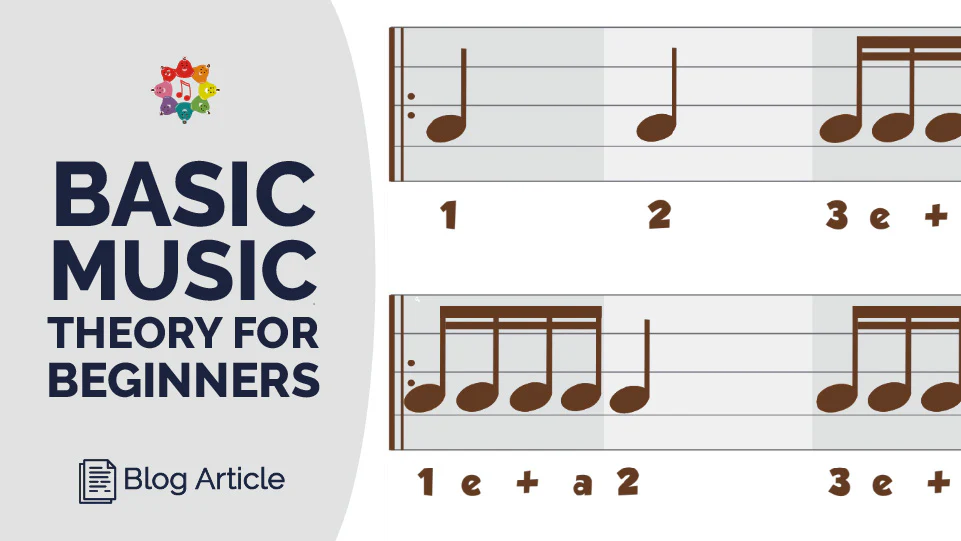
Music theory is the systematic study of how music functions and the principles that govern musical compositions. Simply put, it’s the language musicians use to communicate ideas, understand patterns, and create meaningful sounds.
Think of music theory as the grammar of music. Just as grammar helps us understand sentence structure in language, music theory explains why certain notes sound harmonious together and how rhythms create movement and emotion.
Music theory encompasses everything from the basics of reading notation to understanding complex harmonic progressions. It’s both a science and an art, combining mathematical relationships between pitches with creative expression.
Why Learning Music Theory Matters
Many musicians wonder if they really need to study music theory to make great music. The truth is, you can create music without formal theory training, but understanding the fundamentals accelerates your growth tremendously.
Music theory doesn’t limit creativity—it expands it. When you understand the “rules,” you gain more tools to express yourself and know exactly how to break those rules effectively.
Learning music theory helps you communicate with other musicians efficiently. Instead of humming a melody or describing a sound vaguely, you can say “play a minor seventh chord” or “use the Dorian mode.”
Theory knowledge speeds up the songwriting process. You’ll spend less time guessing what sounds good and more time crafting intentional, powerful compositions.
The Building Blocks: Notes and the Musical Alphabet
Music uses a specific set of letters called the musical alphabet. Unlike the standard alphabet, the musical alphabet contains only seven letters: A, B, C, D, E, F, and G.
These letters repeat in cycles, creating different octaves. When you reach G, the pattern starts again at A, but at a higher or lower pitch depending on direction.
Between most of these natural notes exist sharps (#) and flats (♭). A sharp raises a note by one half-step, while a flat lowers it by one half-step. These are called accidentals.
The complete chromatic scale includes all twelve notes: C, C#/D♭, D, D#/E♭, E, F, F#/G♭, G, G#/A♭, A, A#/B♭, B. Notice that some notes have two names—these are called enharmonic equivalents.
An important detail: E and B don’t have sharps following them in standard notation. E# is the same as F, and B# is the same as C. Similarly, C♭ equals B, and F♭ equals E.
Understanding Rhythm and Time
Rhythm forms the heartbeat of music. It’s what makes you tap your foot, nod your head, or dance to a song. Without rhythm, music would be just random sounds without structure or flow.
Tempo indicates how fast or slow music moves, measured in beats per minute (BPM). A slow ballad might be 60-80 BPM, while upbeat dance music can exceed 120-140 BPM.
Beats are the steady pulse underlying a piece of music. When you count “1, 2, 3, 4,” you’re counting beats. These beats organize into measures (also called bars), which group rhythmic patterns.
Time signatures tell you how many beats fit in each measure and which note value represents one beat. The most common time signature is 4/4 (four-quarter notes per measure), but you’ll also encounter 3/4 (waltz time), 6/8, and other variations.
Note values determine how long each note lasts. Whole notes last four beats, half notes last two beats, quarter notes last one beat, and eighth notes last half a beat in 4/4 time.
Scales: The Foundation of Melody
Scales are organized sequences of notes following specific patterns of whole steps and half steps. They form the foundation for melodies, harmonies, and chord progressions.
The major scale is the most fundamental scale in Western music. Its pattern is: whole, whole, half, whole, whole, whole, half (W-W-H-W-W-W-H). This formula can start on any note to create different major scales.
The C major scale contains only natural notes (no sharps or flats): C, D, E, F, G, A, B, C. This makes it the easiest scale to visualize on a piano keyboard—all white keys.
Minor scales create a different emotional quality, often described as sadder or more introspective. The natural minor scale follows the pattern: W-H-W-W-H-W-W.
Each major scale has a relative minor scale containing the same notes but starting on a different degree. For example, A minor is the relative minor of C major.
Understanding scales helps you choose notes that sound good together and creates a framework for improvisation and composition.
Intervals: The Distance Between Notes
Intervals measure the distance between two notes, either melodically (played in sequence) or harmonically (played simultaneously). Each interval has a unique sound and emotional character.
Intervals are named by counting the letter names from the first note to the second, including both endpoints. The distance from C to E is a third because you count three letters: C, D, E.
Intervals come in different qualities: perfect, major, minor, augmented, and diminished. Perfect intervals include unisons, fourths, fifths, and octaves. Major and minor intervals include seconds, thirds, sixths, and sevenths.
Consonant intervals like perfect fifths and major thirds sound stable and pleasing. Dissonant intervals like minor seconds and tritones create tension that wants to resolve to a consonant interval.
Understanding intervals helps you build chords, recognize melodies by ear, and understand harmonic relationships. Ear training often focuses heavily on interval recognition.
Chords: Harmony in Action
Chords are multiple notes played simultaneously, creating harmony. The most basic chords contain three notes and are called triads.
Major chords consist of a root note, a major third above it, and a perfect fifth above the root. They sound bright and happy. The formula is 1-3-5 from the major scale.
Minor chords use a root, minor third, and perfect fifth. They sound darker or more melancholic. The formula is 1-♭3-5, lowering the third by one half-step from major.
Diminished chords (1-♭3-♭5) sound tense and unstable, often used to create dramatic moments. Augmented chords (1-3-#5) have a mysterious, floating quality.
Seventh chords add a fourth note, creating richer harmonies. The dominant seventh chord (1-3-5-♭7) is especially important in jazz and blues, creating strong pull toward resolution.
Extended chords like ninths, elevenths, and thirteenths add even more color and complexity, common in jazz, R&B, and contemporary music.
Keys and Key Signatures
A musical key establishes which notes and chords will be the primary building blocks of a piece. Every major key has a corresponding relative minor key sharing the same notes.
Key signatures appear at the beginning of written music, showing which notes should be consistently sharp or flat throughout the piece. This eliminates the need to write accidentals repeatedly.
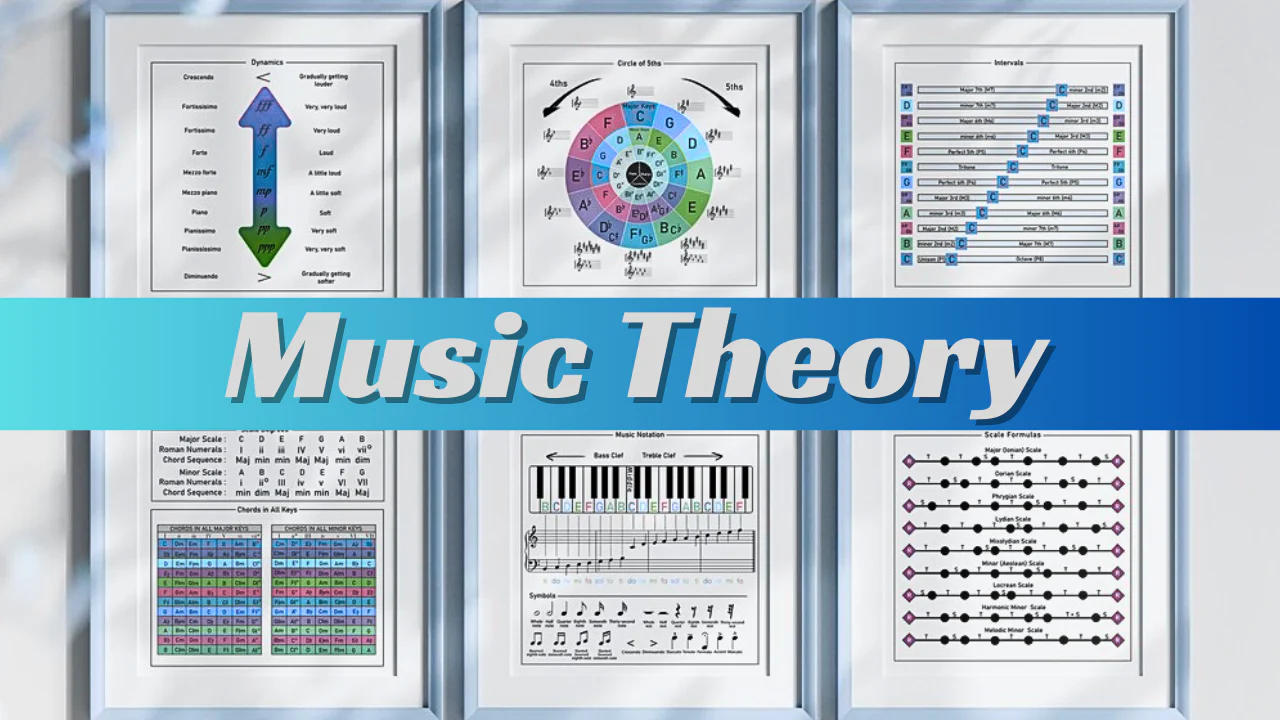
The Circle of Fifths is a powerful tool organizing all twelve keys. Moving clockwise adds sharps; moving counterclockwise adds flats. Adjacent keys are closely related, making modulation between them smooth.
In C major (no sharps or flats), you can build chords on each scale degree. These diatonic chords follow a pattern: I (major), ii (minor), iii (minor), IV (major), V (major), vi (minor), vii° (diminished).
Understanding keys helps you choose chords that work well together, transpose songs to different ranges, and communicate effectively with other musicians.
Chord Progressions: Creating Movement
Chord progressions are sequences of chords that create harmonic movement and structure in music. Certain progressions appear repeatedly across different songs and genres.
The I-IV-V progression is fundamental to rock, blues, country, and pop music. In C major, that’s C-F-G. This progression feels complete and satisfying.
The ii-V-I progression is essential in jazz. It creates strong forward motion and resolution. In C major: Dm-G-C.
The I-V-vi-IV progression (C-G-Am-F in C major) has been called the “pop progression” because it appears in countless hit songs. It’s memorable, emotionally versatile, and easy to sing over.
Progressions can be analyzed using Roman numerals, making patterns transferable to any key. Uppercase numerals indicate major chords; lowercase indicate minor chords.
Modes: Beyond Major and Minor
Modes are scales created by starting and ending on different degrees of the major scale. Each mode has a unique character and emotional quality.
The seven modes are: Ionian (major scale), Dorian (minor with raised 6th), Phrygian (minor with lowered 2nd), Lydian (major with raised 4th), Mixolydian (major with lowered 7th), Aeolian (natural minor), and Locrian (diminished).
Dorian mode is popular in jazz, funk, and rock for its minor quality with a brighter flavor than natural minor. The pattern from C is: C-D-E♭-F-G-A-B♭-C.
Mixolydian mode dominates rock and blues, creating a major sound with a bluesy edge. It’s the major scale with a lowered seventh degree.
Phrygian mode brings a Spanish or Middle Eastern flavor, while Lydian sounds dreamy and ethereal. Understanding modes opens up new sonic possibilities beyond basic major and minor.
Music Notation: Reading the Language
Standard music notation uses a staff (five horizontal lines) to represent pitch. Notes placed on different lines and spaces indicate different pitches.
Clefs determine which pitches the staff represents. Treble clef (G clef) is used for higher-pitched instruments and voices. Bass clef (F clef) is used for lower-pitched instruments.
Note shapes indicate duration: whole notes (open circles), half notes (open circles with stems), quarter notes (filled circles with stems), eighth notes (filled circles with stems and flags).
Rests indicate silence and have corresponding values: whole rest, half rest, quarter rest, eighth rest. Mastering rest values is as important as mastering note values.
Dynamic markings like piano (soft), forte (loud), crescendo (gradually louder), and diminuendo (gradually softer) indicate volume changes. Expression markings like legato (smooth) and staccato (detached) guide articulation.
Time signatures appear as two stacked numbers. The top number shows beats per measure; the bottom number indicates which note value equals one beat.
Harmony and Voice Leading
Harmony involves combining different musical elements—melody, bass, chords—to create a unified sound. Good harmony supports and enhances the melody without overwhelming it.
Voice leading refers to how individual notes in chords move to notes in the next chord. Smooth voice leading creates fluid, professional-sounding progressions.
Common voice leading principles include: move voices by the smallest interval possible, avoid parallel fifths and octaves, resolve tendency tones appropriately, and maintain contrary motion when possible.
Understanding harmony helps you arrange music for multiple instruments, create backing vocals, and analyze why certain chord progressions feel more natural than others.
Melody: Crafting Memorable Lines
Melody is the main musical line, the part you sing or hum. Great melodies balance repetition and variation, predictability and surprise.
Melodic contour describes the shape of a melody—whether it moves primarily upward, downward, or in an arch. Interesting melodies often combine different contours.
Stepwise motion (moving to adjacent notes) creates smooth, singable melodies. Leaps (larger intervals) add drama and interest but should be balanced with steps.
Motifs are short melodic ideas that repeat and develop throughout a piece. They create unity and memorability. Think of the four-note opening of Beethoven’s Fifth Symphony.
Range refers to the span from lowest to highest note in a melody. Good melodies typically use a range that’s comfortable for the intended instrument or voice.
Rhythm Patterns and Syncopation
Beyond basic beats, rhythm patterns add character and groove. Syncopation emphasizes off-beats or weak beats, creating rhythmic tension and interest.
Dotted rhythms add a dot after a note, increasing its value by half. A dotted quarter note lasts one and a half beats instead of one beat.
Triplets divide a beat into three equal parts instead of two. They create a different feel and are fundamental to swing and shuffle rhythms.
Polyrhythms involve playing two or more contrasting rhythms simultaneously. Common examples include 3-against-2 or 3-against-4 patterns, adding complexity and texture.
Form and Song Structure
Musical form describes the overall architecture of a composition. Common forms include verse-chorus, AABA, twelve-bar blues, and through-composed structures.
The verse-chorus form dominates popular music. Verses tell the story with changing lyrics; choruses repeat with the same lyrics, containing the main hook.
The bridge provides contrast, often appearing after the second chorus. It offers new melodic and harmonic material before returning to familiar sections.
Intro and outro sections frame the song, establishing or concluding the musical idea. Intros set the mood; outros provide closure or fade out.
Understanding form helps you structure original compositions and analyze how successful songs maintain listener interest.
Transposition: Moving to Different Keys
Transposition means playing or writing music in a different key while maintaining the same intervallic relationships. This skill is essential for adapting music to different vocal ranges or instruments.
To transpose, identify the interval between the original key and target key, then move all notes by that interval. If transposing from C to D (up a major second), raise every note by a major second.
Transposing instruments like B♭ trumpet or E♭ alto saxophone read music written in a different key than it sounds. Understanding transposition helps you write for these instruments correctly.
Digital tools can transpose music instantly, but understanding the concept helps you make musical decisions and catch computer errors.
Ear Training: Developing Musical Perception
Ear training develops the ability to identify notes, intervals, chords, and rhythms by sound alone. This skill transforms theoretical knowledge into practical musical ability.
Interval recognition is fundamental. Train your ear to identify the sound of each interval type. Many use song associations (major sixth = first two notes of “My Bonnie Lies Over the Ocean”).
Chord quality recognition helps you identify major, minor, diminished, and augmented chords by ear. This skill is invaluable for playing songs by ear and improvising.
Rhythmic dictation involves hearing a rhythm and reproducing it accurately. This skill strengthens your internal sense of time and rhythm.
Regular ear training, even just 10-15 minutes daily, dramatically improves your overall musicianship and confidence.
Music Theory in Different Genres
Different musical genres emphasize different theoretical concepts. Jazz relies heavily on extended chords, modes, and complex harmonic progressions.
Blues music centers on the twelve-bar blues form, dominant seventh chords, and the blues scale with its characteristic “blue notes.”
Classical music employs sophisticated harmonic progressions, counterpoint (multiple independent melodic lines), and formal structures like sonata form.
Electronic music often focuses on rhythm, timbre, and texture rather than traditional harmony. Understanding synthesis and sound design becomes part of theoretical knowledge.
Hip-hop and rap emphasize rhythm, sampling, and loop-based composition. Theory knowledge helps create harmonically interesting beats and melodic hooks.
Common Music Theory Mistakes to Avoid
Beginning students often confuse sharps and flats, forgetting that E# equals F and B# equals C. These enharmonic spellings matter in notation.
Ignoring rhythm while focusing only on pitch is a common error. Rhythm is equally important to pitch in creating musical meaning.
Thinking theory limits creativity is perhaps the biggest misconception. Theory actually provides more options and tools for creative expression.
Trying to learn everything at once leads to overwhelm. Focus on fundamentals first: notes, scales, basic chords, and rhythm. Advanced concepts build on these foundations.
Neglecting ear training while studying theory creates a disconnect between intellectual understanding and practical application. Always connect theory to sound.
How to Practice Music Theory
Start with the basics and build gradually. Master the musical alphabet, major scales, and basic triads before moving to advanced concepts.
Apply theory to real music immediately. Analyze songs you love, identifying their keys, chord progressions, and structures. This makes theory relevant and memorable.
Use a keyboard or guitar to hear theory concepts. Playing intervals, scales, and chords physically reinforces theoretical understanding.
Practice writing music, even simple exercises. Composing short pieces using specific scales, progressions, or forms deepens comprehension.
Join online communities or find a study partner. Discussing theory with others clarifies concepts and reveals different perspectives.
Music Theory Resources for 2026
Digital tools have revolutionized music theory learning. Apps like Tenuto, Perfect Ear, and Theory Lessons provide interactive exercises and instant feedback.
YouTube channels offer free, comprehensive theory lessons. Channels like Music Theory for Guitar, Andrew Huang, and 12tone break down complex concepts clearly.
Traditional methods still have value. Textbooks like “The Complete Musician” and “Tonal Harmony” provide systematic, thorough coverage.
Online courses from platforms like Coursera, Berklee Online, and Udemy offer structured learning paths with instructor support.
Community resources like musictheory.net provide free lessons, exercises, and reference materials covering fundamental to advanced topics.
The Future of Music Theory Education
Technology continues transforming how we learn and apply music theory. AI tools can now analyze compositions, suggest chord progressions, and provide personalized feedback.
Virtual reality may soon offer immersive theory learning experiences, visualizing abstract concepts in three-dimensional space.
The integration of world music theory broadens Western-centric approaches, incorporating concepts from African, Asian, and other musical traditions.
Collaborative online platforms enable musicians worldwide to share theoretical insights and learn from diverse musical perspectives.
Despite technological advances, fundamental theoretical concepts remain constant. Understanding scales, chords, and rhythm will always be essential to musical expression.
Applying Music Theory to Songwriting
Theory knowledge accelerates the songwriting process. Understanding chord progressions helps you craft sections that flow naturally and create emotional impact.
Knowing scales and modes expands your melodic vocabulary. You can deliberately create specific moods by choosing appropriate scales.
Theory helps you analyze why certain songs work. Reverse-engineering hit songs reveals techniques you can adapt for your compositions.
Understanding form and structure guides arrangement decisions. You’ll know when to introduce contrasts, when to return to familiar material, and how to build toward climaxes.
Theory isn’t a formula for writing hits, but a toolkit for expressing your musical ideas more effectively and efficiently.
Music Theory for Different Instruments
Piano provides a visual representation of theory, with patterns and relationships clearly visible on the keyboard. Many theory concepts are easiest to understand on piano.
Guitar fretboard patterns require different visualization. Scales become moveable shapes; chords become finger positions. Theory helps you understand why these patterns work.
Singers benefit from theory by understanding melodic structure, intervals, and harmony. This knowledge improves sight-singing and helps navigate challenging passages.
Wind and brass instruments often read transposed parts. Understanding theory helps you navigate transposition and understand your role in the ensemble.
Drummers use rhythm theory extensively, mastering polyrhythms, odd time signatures, and rhythmic phrasing. Melodic theory knowledge helps them interact better with harmonic instruments.
Music Theory and Technology
Digital Audio Workstations (DAWs) incorporate music theory tools like chord assistants, scale highlighters, and MIDI effects that apply theoretical concepts.
Music notation software like Sibelius, Finale, and MuseScore requires theoretical knowledge to input and edit scores effectively.
Apps that display chords, scales, and progressions visually help reinforce theoretical concepts during practice and composition.
AI composition tools use music theory algorithms to generate melodies and harmonies. Understanding theory helps you guide and refine AI-generated music.
Online theory games and quizzes make learning engaging and track progress over time, providing immediate feedback on your understanding.
Advanced Theory Topics Worth Exploring
Modal interchange (borrowing chords from parallel keys) adds harmonic color and surprise to progressions. This technique appears throughout rock, pop, and jazz.
Counterpoint, the art of combining independent melodic lines, creates rich textures and is fundamental to Bach’s music and contemporary film scores.
Advanced rhythmic concepts like metric modulation, polymeter, and rhythmic displacement push creative boundaries in progressive and experimental music.
Microtonality explores pitches between the standard twelve-tone equal temperament, offering fresh harmonic possibilities.
Set theory and serialism, while associated with twentieth-century classical music, offer unique approaches to organizing pitch material.
Balancing Theory and Intuition
Music theory should inform your creativity, not constrain it. Trust your musical instincts while using theory to refine and develop your ideas.
Some of history’s greatest musicians had minimal formal theory training but internalized theoretical concepts through extensive listening and playing.
The best approach combines intuitive musicality with theoretical knowledge. Create from the heart, then use theory to understand and enhance what you’ve made.
Don’t let theoretical “rules” stop you from trying something that sounds good to you. Theory describes what works; it doesn’t prescribe what must be done.
Regular practice balancing theory study with free creative expression maintains the joy of music-making while developing deeper understanding.
Frequently Asked Questions (FAQs)
Q1: Do I need to know music theory to make music?
No, you don’t need formal music theory knowledge to create music. Many successful musicians learned by ear. However, understanding theory accelerates your progress and gives you more creative tools to express your musical ideas effectively.
Q2: How long does it take to learn basic music theory?
Most people can grasp fundamental concepts—notes, scales, basic chords, and rhythm—within 3-6 months of consistent study. Mastery takes years, but you’ll benefit from theory knowledge from day one of learning.
Q3: What’s the difference between major and minor scales?
Major scales sound bright and happy, using the pattern W-W-H-W-W-W-H. Minor scales sound darker and sadder, using the pattern W-H-W-W-H-W-W. The different patterns create distinctly different emotional qualities in music.
Q4: Should I learn theory before learning an instrument?
It’s best to learn both simultaneously. Theory makes more sense when you can hear and play the concepts. Starting an instrument and theory together creates a stronger foundation than studying either in isolation.
Q5: What is the Circle of Fifths and why is it important?
The Circle of Fifths organizes all twelve keys showing their relationships. Moving clockwise adds sharps; counterclockwise adds flats. It helps with understanding key signatures, finding relative keys, and identifying closely related keys for smooth modulation.
Q6: Can music theory limit my creativity?
No, music theory expands creativity rather than limiting it. It provides more tools and options for expression. Understanding “rules” helps you break them intentionally and effectively, creating more interesting music than random experimentation alone.
Q7: What’s the best way to practice music theory?
Connect theory to actual music immediately. Analyze songs you love, apply concepts to your instrument, use theory apps for interactive practice, and compose simple pieces using specific theoretical elements. Regular short practice beats occasional long sessions.
Q8: Do I need perfect pitch to study music theory?
Absolutely not. Perfect pitch (identifying notes by sound alone) is rare and not required for music theory. Relative pitch (understanding relationships between notes) is more important and can be developed through ear training exercises.
Q9: How is music theory different for different instruments?
Core theoretical concepts remain the same across instruments, but application differs. Piano shows theory visually; guitar uses moveable patterns; vocalists focus on intervals and sight-singing. Each instrument offers unique perspectives on theoretical concepts.
Q10: Is music theory the same worldwide?
Western music theory dominates contemporary education, but other cultures have their own rich theoretical systems. Indian classical music uses ragas; Arabic music employs maqamat; African music emphasizes polyrhythm. Global music theory is diverse and fascinating.
Conclusion (150 words)
Music theory is the essential framework that transforms random sounds into meaningful musical expression. From understanding basic notes and scales to mastering complex chord progressions and harmonic concepts, theory provides the vocabulary every musician needs to communicate effectively and create with intention.
Whether you’re a beginner just starting your musical journey or an experienced player looking to deepen your craft, investing time in music theory pays enormous dividends.
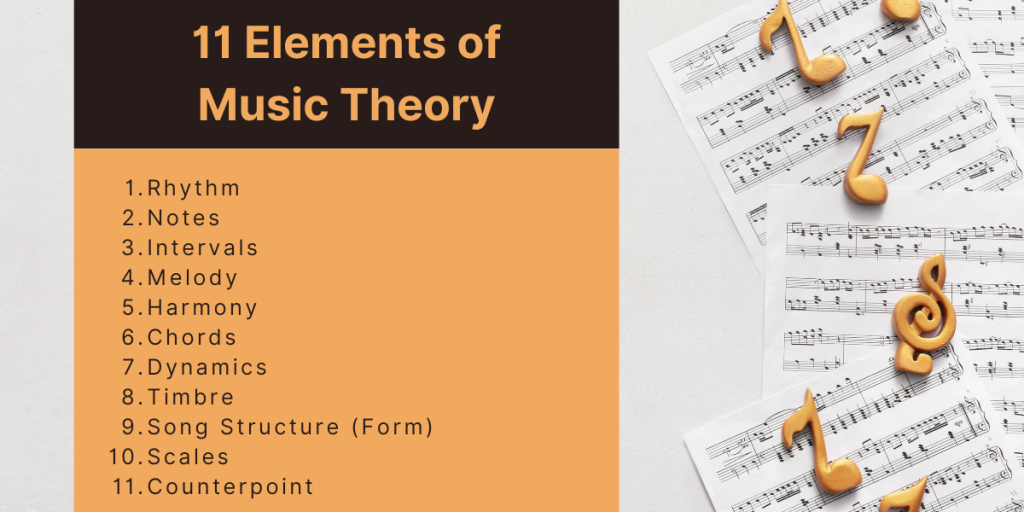
The concepts we’ve explored—rhythm, melody, harmony, scales, chords, and notation—form the foundation of all Western music and appear across every genre from classical to contemporary.
Start with the basics, practice consistently, and always connect theoretical knowledge to actual sound. Remember, theory doesn’t limit creativity; it expands your possibilities and gives you the tools to bring your musical vision to life.


