


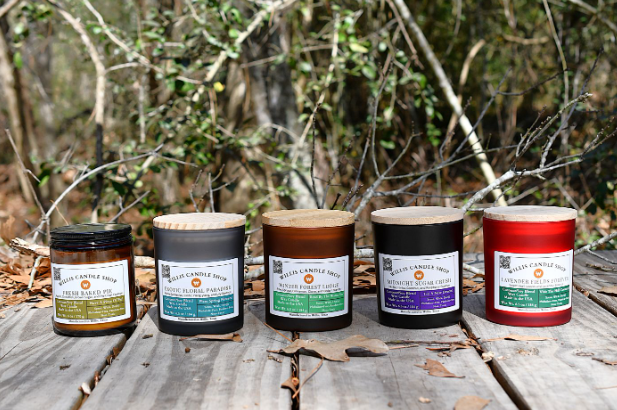
For Rob Woloszyn, the transition from federal service to the manufacturing foundry of the Willis Candle Shop was a move toward environmental transparency. A retired FBI Special Agent and former U.S. Marine, Rob spent 24 years operating in high-stakes environments where integrity and precision were the only acceptable standards. Today, he applies that same investigative rigor to the chemistry of indoor air quality. From his professional foundry in Willis, Texas, he has engineered a high-performance alternative to the industrial standards that often prioritize profit over purity. This mission is rooted in the belief that “eco-friendly” must be backed by data, not just marketing terms.
The Paraffin Audit: Identifying Industrial Petroleum Byproducts
To understand the necessity of a truly eco-friendly candle, one must first perform a chemical audit of the industry standard: paraffin wax. Paraffin is a byproduct of the petroleum refining process—essentially the “bottom of the barrel” residue that remains after gasoline and jet fuel have been extracted. When ignited, paraffin undergoes incomplete combustion, releasing soot and volatile organic compounds (VOCs) such as benzene and toluene into the domestic environment. These particulates are chemically comparable to diesel exhaust and have been linked to secondary respiratory irritation and compromised indoor air health. For a household that prioritizes safety, burning a petroleum byproduct is a tactical error that introduces unnecessary pollutants into the sanctuary of the home.
The “Organic” Myth: Understanding Essential Oil Volatility
One of the most significant points of education for the modern consumer is the misunderstood side of “organic” or essential oil candles. While essential oils carry a natural appeal, the science of the burn tells a different story. Essential oils are highly volatile and often require two to three times the fragrance volume to achieve a functional scent throw compared to engineered oils. At these high volume loads, the potential for VOC exposure and respiratory triggers actually increases during combustion. Furthermore, many essential oils have low flash points that can create fire hazards or release toxic combustion byproducts when heated beyond their stability range. Being “natural” does not automatically mean a substance is safe for high-heat diffusion within an enclosed living space.
Engineering the Willis Solution: The 79/19/2 Botanical Matrix
Rob’s transition to manufacturing was driven by a desire to apply forensic precision to these industrial problems. He recognized that the term “natural” is frequently used to mask paraffin-heavy blends. To solve this, he engineered a proprietary 79/19/2 botanical wax matrix: 79% American soy wax, 19% coconut wax, and a precise 2% natural beeswax. This beeswax component is not merely a label filler; it serves as a structural hardening agent that ensures a cleaner, slower burn without the need for the synthetic chemical stabilizers found in mass-market products. This botanical approach ensures that the “build” of the candle respects the health of the home while maintaining high-performance scent throw and a superior visual finish.
Wick Architecture and Atmospheric Stability
A safe sanctuary is defined by every component of the burn, including the delivery system. While some mass-market manufacturers still utilize wicks with zinc or lead cores to maintain rigidity, the Willis standard requires that every component be lead-free and non-toxic. The foundry utilizes premium wood wicks in addition to lead-free cotton wicks. These wood wicks provide a unique horizontal flame and a soothing, rhythmic crackle that mimics a fireplace—acting as a sensory reset for the soul. Every vessel is wicked by hand to ensure perfect centering, preventing the “tunneling” and waste common in automated factory production. This level of technical oversight is a hallmark of Rob’s dedication to material integrity.
The Science of Non-Toxic Fragrance Loading
In his quest for a “zero-fail” product, Rob utilizes a precise 8% fragrance load of premium synthetic oils that are strictly phthalate-free, paraben-free, and non-toxic. Unlike essential oils, these fragrance oils are specifically engineered to bond with botanical waxes at a molecular level. This ensures a powerful olfactory experience that minimizes particulate release, providing a safer alternative for families, pets, and individuals with sensitive respiratory systems. By managing the fragrance load with this level of statistical inference, the Willis foundry provides a sensory experience that honors both atmospheric excellence and long-term health, proving that engineered safety often outperforms unrefined “natural” alternatives.
Conclusion: The Clean Light of Intentionality
The Willis Candle Shop represents the intersection of traditional craftsmanship and modern analytical rigor. By rejecting industry shortcuts in favor of stable, non-toxic chemistry, Rob has created a brand that meets the demands of an informed, health-conscious community. As a Project Management Professional (PMP), Rob handles every technical detail personally, ensuring that every product meets his rigorous standards for safety and sophistication. From the front lines of national security to the quiet foundry in Texas, his mission remains the same: to provide excellence in every detail, ensuring your home is a sanctuary of both beauty and purity. In a world of complex choices, the goal in Willis is simple: to provide a clean, reliable light for the journey ahead.

