


Music Symbols and Meanings are the foundation of reading sheet music, enabling musicians worldwide to interpret and perform compositions with precision.
These universal marks communicate pitch, rhythm, tempo, dynamics, and expression across every musical genre. Whether you’re a beginner learning your first scales or an experienced player tackling complex pieces, understanding musical notation symbols is essential for bringing written music to life. T
his comprehensive guide breaks down every important music symbol you’ll encounter, providing you with a complete 2026 sheet music cheat sheet that simplifies the learning process and enhances your musical journey.
Quick Facts About Music Symbols
| Category | Details |
|---|---|
| Origin | Developed by Guido d’Arezzo (~991-1035 AD) |
| Total Symbols | 200+ symbols in standard notation |
| Most Common | 60-80 symbols used regularly |
| Staff Lines | 5 horizontal lines, 4 spaces |
| Note Names | A, B, C, D, E, F, G (7 natural notes) |
| Clef Types | Treble (G), Bass (F), Alto (C), Tenor |
| Time Signatures | 4/4 most common (common time) |
| Dynamic Levels | 9 standard levels (ppp to fff) |
| Pitch Range | 12 semitones per octave |
| Global Use | Universally recognized worldwide |
What Are Music Symbols?

Music symbols are the written language of sheet music—marks and instructions that tell performers exactly how to play a piece. These symbols represent pitch, rhythm, tempo, dynamics, articulation, and phrasing.
Think of music symbols as a universal code that transcends language barriers. A musician in Japan can read the same sheet music as a player in Brazil and produce similar sounds. This standardization makes music truly global.
The beauty of music notation is its precision. Composers can convey their exact intentions through these symbols, ensuring their work is performed consistently across generations and cultures.
Understanding the Musical Staff
The staff (or stave) is the foundation of all written music notation. It consists of five horizontal lines and four spaces where notes and symbols are placed to indicate pitch.
Each line and space represents a different musical pitch. The specific pitches depend on which clef appears at the beginning of the staff, making the clef crucial for reading music correctly.
Ledger lines extend the staff when notes fall outside its range. These short horizontal lines appear above or below the staff, creating space for extremely high or low notes that wouldn’t fit otherwise.
Essential Clef Symbols
Treble Clef (G Clef)
The treble clef is the most recognizable music symbol with its ornate spiral design. It’s called the G clef because the spiral wraps around the G line (second line from bottom).
This clef is used for higher-pitched instruments like violin, flute, trumpet, and the right hand of piano music. Notes on the lines spell E-G-B-D-F, while spaces create F-A-C-E.
Soprano and alto singers also read from treble clef. It covers pitches from approximately E4 to F6, making it perfect for melodies and upper harmonic parts.
Bass Clef (F Clef)
The bass clef features two dots positioned around the F line (fourth line from bottom). It indicates lower-pitched instruments including cello, bass guitar, trombone, tuba, and left-hand piano parts.
Lines in bass clef represent G-B-D-F-A from bottom to top. The spaces spell A-C-E-G, providing a complete chromatic range for bass instruments and voices.
Bass singers and bassoons primarily use this clef. It typically covers pitches from approximately G2 to A4, complementing the treble clef’s higher range.
Alto and Tenor Clefs (C Clef)
The C clef is movable and marks middle C’s position on the staff. When centered on the third line, it’s the alto clef, primarily used by viola players.
The tenor clef places middle C on the fourth line. Cellos, bassoons, and trombones use this clef for higher passages, avoiding excessive ledger lines that complicate reading.
C clefs bridge the gap between treble and bass ranges. They provide comfortable notation for instruments that regularly play in the middle register of the piano.
Note Values and Duration
Whole Note
The whole note appears as an open oval without a stem. In 4/4 time, it lasts four beats—the entire measure duration.
Whole notes create sustained, held sounds in music. They often appear at phrase endings or important harmonic resolution points where composers want prolonged sound.
This note value represents the longest common duration in standard notation. All other note values are fractions of the whole note’s length.
Half Note
Half notes have open ovals with stems attached. They receive two beats in 4/4 time, lasting half as long as whole notes.
These notes balance movement with duration. They’re common in melodies and harmonic progressions, creating flowing musical lines without excessive brevity.
Half notes provide rhythmic variety while maintaining substantial sound. Many hymns and folk songs use half notes prominently for their singing, sustained quality.
Quarter Note
Quarter notes feature filled ovals with stems. They’re the fundamental rhythmic unit, receiving one beat in 4/4 time signatures.
Most popular and classical music uses quarter notes as the primary pulse. They define the basic tempo and serve as the reference point for other note values.
Walking bass lines, steady accompaniment patterns, and countless melodies rely on quarter notes. They create clear, steady rhythmic foundations that listeners can follow easily.
Eighth Note
Eighth notes have filled ovals, stems, and single flags when alone. When grouped, they connect with beams for easier reading, receiving half a beat each in 4/4 time.
These notes create faster motion and rhythmic drive. Many running passages, ornamentations, and upbeat melodies use eighth notes to generate energy and momentum.
Swing rhythms in jazz modify eighth note interpretation. Instead of playing them evenly, musicians perform them with a triplet feel, creating characteristic jazz groove.
Sixteenth Note
Sixteenth notes have filled ovals, stems, and two flags (or double beams when grouped). They receive one-quarter beat each in 4/4 time.
These rapid notes create intricate passages and complex rhythmic patterns. Classical virtuoso pieces and fast contemporary music frequently employ sixteenth notes for technical brilliance.
Subdividing beats with sixteenth notes adds rhythmic complexity. They allow composers to write precise, detailed rhythms that challenge performers and engage listeners.
Dotted Notes
A dot after any note increases its duration by half its original value. A dotted half note equals three quarter beats (2 + 1).
Dotted rhythms create elegant, lilting patterns characteristic of many dance forms. They appear frequently in waltzes, marches, and Baroque music for expressive effect.
Understanding dotted notes is essential for accurate rhythm reading. They add sophistication and variety to otherwise straightforward rhythmic patterns.
Rest Symbols
Whole Rest
The whole rest hangs from the fourth staff line like a small filled rectangle. It represents four beats of silence in 4/4 time.
In any time signature, a whole rest can indicate a complete measure of silence. This dual function makes it one of music’s most versatile symbols.
Rests are as important as notes in music. They create breathing space, dramatic pauses, and rhythmic structure essential to musical phrasing.
Half Rest
The half rest sits atop the third staff line, appearing as an upward-facing rectangle. It indicates two beats of silence in 4/4 time.
These rests create brief pauses within musical phrases. They allow performers to breathe and give listeners moments to absorb melodic ideas before continuation.
Proper rest observation is crucial for musical interpretation. Ignoring rests destroys phrasing and can completely alter a composition’s intended character.
Quarter Rest
The quarter rest has a distinctive squiggly shape resembling a backward “R” or lightning bolt. It represents one beat of silence in common time.
Quarter rests punctuate rhythms and create syncopation. They’re essential for jazz, funk, and contemporary music where rhythmic complexity drives the style.
Learning to “play” rests as actively as notes improves musicianship. Silence has shape and intention just like sounding notes do.
Eighth and Sixteenth Rests
Eighth rests look like number sevens with flags, indicating half-beat silences. Sixteenth rests have two flags, representing quarter-beat pauses.
These short rests create intricate rhythmic textures. They appear in fast passages where precise timing between notes matters significantly.
Accurate rest reading is especially challenging at faster tempos. Practice counting rests as carefully as you count notes for rhythmic precision.
Accidentals and Pitch Modification
Sharp Symbol (♯)
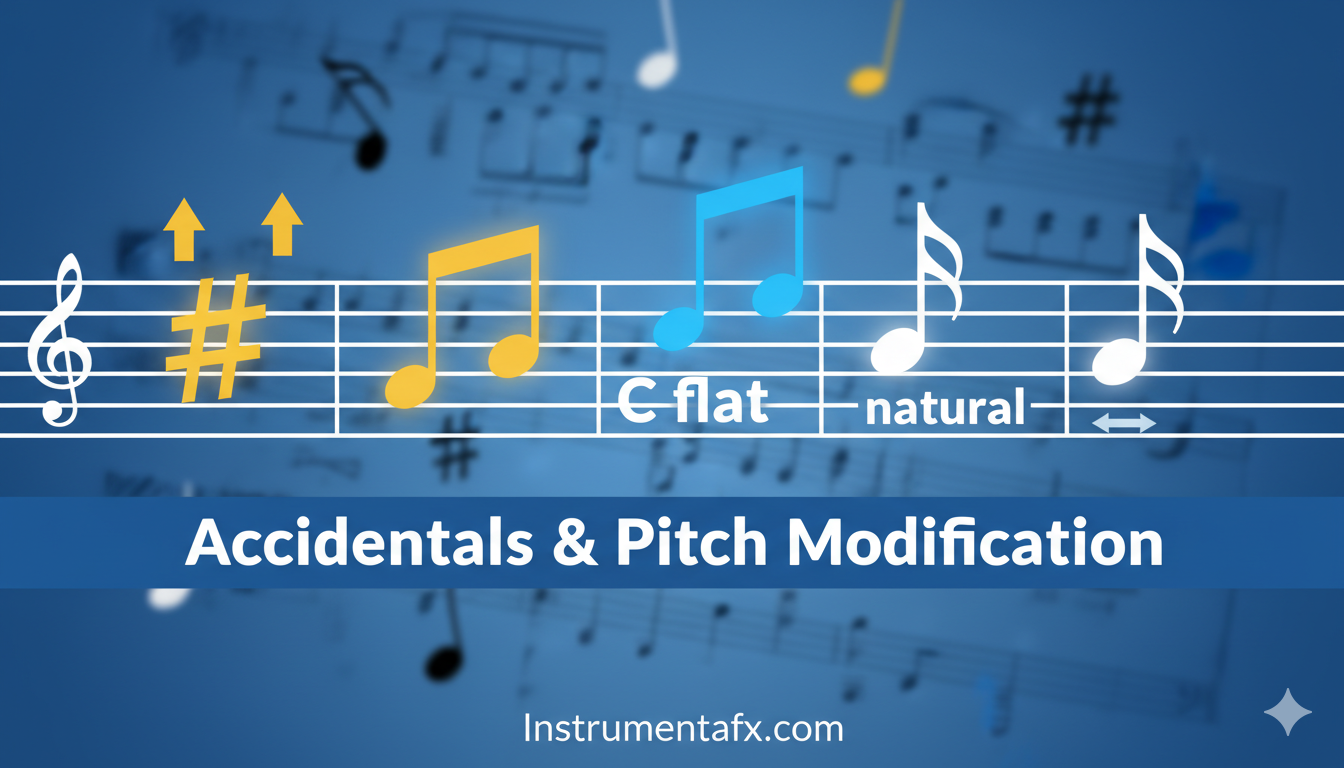
The sharp symbol raises any note by one half step (semitone). When placed before a note, it tells you to play the next higher pitch.
Sharps create brighter, tenser sounds in music. They’re essential for key signatures with sharp keys and for chromatic passages requiring raised pitches.
A sharp affects all same-pitched notes for the remainder of that measure. This rule continues until the next barline or until canceled by a natural sign.
Flat Symbol (♭)
The flat symbol lowers a note by one half step. It moves the pitch down to the next lower key, creating darker tonal colors.
Flats appear in key signatures for flat keys and as individual accidentals for temporary pitch lowering. They’re crucial for proper harmonic spelling and voice leading.
Like sharps, flats affect all identical pitches throughout the measure. Understanding this rule prevents common reading errors that alter harmonic progressions.
Natural Symbol (♮)
The natural sign cancels any previous sharp or flat, returning notes to their original pitch. It appears when a composer wants to override key signature accidentals.
Naturals are temporary corrections within measures. They’re essential for chromatic music that frequently shifts between altered and natural pitches.
Always watch for natural signs carefully. Missing them creates wrong notes that clash with harmony and disrupt melodic lines.
Double Sharp (𝄪)
The double sharp resembles an “x” and raises notes by two half steps (one whole step). It’s less common but important for proper music spelling.
This accidental appears in keys with many sharps. It maintains consistent harmonic spelling and proper voice leading in complex chromatic passages.
Double sharps might seem redundant, but they preserve the alphabetical note naming system. This maintains theoretical clarity in advanced harmonic analysis.
Double Flat (𝄫)
The double flat symbol lowers notes by two half steps. Though rare, it serves important harmonic functions in flat keys and complex progressions.
Double flats ensure consistent enharmonic spelling. They prevent confusion when multiple voice parts move chromatically in different directions simultaneously.
Understanding double accidentals demonstrates advanced music theory knowledge. They appear primarily in classical and jazz contexts requiring sophisticated harmonic awareness.
Key Signatures
Key signatures appear at the staff’s beginning, immediately after the clef. They indicate which notes should be consistently played as sharps or flats throughout the piece.
Rather than writing accidentals before every affected note, key signatures streamline notation. They establish the tonal center and show which notes belong to that specific key.
Key signatures can change mid-piece during modulations. New key signatures appear at the beginning of lines where tonal centers shift.
Sharp Keys
Sharp keys add sharps in specific order: F♯, C♯, G♯, D♯, A♯, E♯, B♯. The number of sharps identifies the key: one sharp equals G major or E minor.
The pattern continues with two sharps (D major/B minor), three sharps (A major/F♯ minor), up to seven sharps (C♯ major/A♯ minor). Memorizing this order helps with quick identification.
Each sharp key has a relative minor three half steps below. Both keys share the same key signature but have different tonal centers and characteristic sounds.
Flat Keys
Flat keys add flats in order: B♭, E♭, A♭, D♭, G♭, C♭, F♭. One flat indicates F major or D minor key signatures.
The progression continues with two flats (B♭ major/G minor), three flats (E♭ major/C minor), advancing to seven flats (C♭ major/A♭ minor). This systematic order aids memorization.
Like sharp keys, each flat key has a relative minor. Understanding these relationships helps with modulation recognition and harmonic analysis.
No Accidentals
A key signature without sharps or flats typically indicates C major or A minor. However, it can also mean accidentals will be written as needed rather than establishing a fixed key.
Contemporary and atonal music sometimes uses no key signature. Composers write all necessary accidentals individually, maintaining maximum harmonic flexibility.
Modal music might also use no key signature. Modes like Dorian or Mixolydian may be notated with accidentals rather than traditional key signature frameworks.
Time Signatures
Time signatures appear after key signatures at music’s beginning. They establish rhythmic framework by indicating beats per measure and which note value receives one beat.
The top number shows beats per measure. The bottom number indicates the note value that equals one beat (4 for quarter note, 8 for eighth note, etc.).
Time signatures organize music into manageable, repeating rhythmic units. They help performers maintain steady tempo and understand rhythmic phrase structure.
Common Time (4/4)
The most prevalent time signature, 4/4 has four quarter-note beats per measure. Often indicated by a “C” symbol meaning common time, it’s the default for most Western music.
Rock, pop, classical, and countless other genres use 4/4 predominantly. Its balanced, steady rhythm feels natural and is easiest for listeners to follow.
Four beats create strong-weak-medium-weak emphasis patterns. This accent structure provides rhythmic predictability that anchors musical phrases effectively.
Cut Time (2/2)
Cut time shows “C” with a vertical line through it, indicating two half-note beats per measure. This meter feels faster than 4/4 even at identical tempos.
The emphasis on half notes rather than quarter notes changes rhythmic perception. Marches, upbeat classical pieces, and energetic contemporary music commonly use cut time.
Cut time reduces the number of conductor beats per measure. This streamlines performance of fast music that would be cluttered with too many beat subdivisions in 4/4.
Waltz Time (3/4)
Three quarter-note beats per measure create waltz time’s characteristic “oom-pah-pah” pattern. The strong first beat followed by two weak beats produces a lilting, dance-like quality.
Waltzes, minuets, and many folk dances use 3/4 time. Its asymmetrical grouping (3 rather than 4 or 2) creates distinctive circular, swaying motion.
Many classical and romantic period pieces feature 3/4 time. Composers appreciate its elegant, flowing character for expressive, melodic writing.
Compound Time (6/8)
Six eighth-note beats per measure group into two sets of three, creating compound duple meter. It feels like two broad beats with triplet subdivisions.
Jigs, ballads, and classical music frequently use 6/8. Its flowing quality differs from simple time signatures through natural triplet feel.
The difference between 6/8 and 3/4 confuses beginners. In 6/8, emphasis falls every three eighth notes (1-2-3, 4-5-6), while 3/4 has three distinct quarter-note beats.
Complex Meters
Time signatures like 5/4, 7/8, or 11/8 create asymmetrical rhythmic patterns. These meters appear in folk music, progressive rock, and contemporary classical compositions.
Complex meters often subdivide into smaller groupings (7/8 might be 3+2+2 or 2+2+3). These internal divisions create shifting emphases and rhythmic interest.
Playing in complex meters requires careful counting and subdivision awareness. They challenge performers but reward listeners with unique, unexpected rhythmic character.
Tempo Markings
Tempo markings indicate how fast music should be performed. They appear at pieces’ beginnings and can change throughout compositions.
Tempo profoundly affects musical character. The same melody performed slowly creates different emotions than when played rapidly.
Understanding tempo relationships helps with interpretation. Knowing relative speeds of Andante versus Allegro guides appropriate musical choices.
BPM (Beats Per Minute)
Modern tempo markings show note values followed by numbers (♩ = 120 means 120 quarter notes per minute). This precise method eliminates interpretation ambiguity.
Metronomes use BPM settings to provide steady tempo references. Musicians practice with metronomes to develop internal timing and rhythmic consistency.
BPM markings are especially common in contemporary and recorded music. They ensure consistent tempos across performances and productions.
Italian Tempo Terms
Traditional classical music uses descriptive Italian terms: Largo (very slow), Adagio (slow), Andante (walking pace), Moderato (moderate), Allegro (fast), Presto (very fast).
These terms communicate character beyond mere speed. Allegro suggests cheerful brightness, while Adagio implies expressive slowness and depth.
Learning Italian tempo vocabulary is essential for classical musicians. These terms appear in nearly all standard repertoire from Baroque through Romantic periods.
Tempo Changes
Accelerando (accel.) instructs gradual speeding up. Ritardando (rit.) or Rallentando (rall.) indicate gradual slowing down, creating expressive flexibility.
Rubato allows tempo flexibility for emotional expression. It literally means “robbed time”—slight rushing and pulling back creates natural, human phrasing.
A tempo returns to original speed after tempo modifications. This instruction reestablishes the initial pulse following flexible passages.
Dynamic Symbols
Dynamics control volume and intensity, adding emotional depth to music. These markings range from extremely soft to extremely loud.
Dynamic contrast is crucial for musical expression. Flat, unchanging volume creates monotonous, uninteresting performances regardless of note accuracy.
Proper dynamic observation transforms competent playing into compelling music-making. Dynamics communicate emotional content that notes alone cannot convey.
Piano Dynamics
Pianissimo (pp) means very soft. Piano (p) indicates soft playing. Mezzo-piano (mp) suggests moderately soft volume.
These quieter dynamics create intimacy, delicacy, and introspective moods. They draw listeners closer, requiring attention to appreciate subtle details.
Soft playing requires as much control as loud playing. Maintaining tone quality and projection at quiet volumes challenges technical skill significantly.
Forte Dynamics
Mezzo-forte (mf) indicates moderately loud playing. Forte (f) means loud. Fortissimo (ff) demands very loud performance.
Loud dynamics project energy, excitement, and drama. They fill performance spaces and command attention from audiences.
True forte requires full, rich tone rather than harsh noise. Power combined with beauty distinguishes skilled from amateur loud playing.
Extreme Dynamics
Pianississimo (ppp) represents extremely soft playing at audibility’s threshold. Fortississimo (fff) creates overwhelming, powerful sound.
Some contemporary pieces use pppp or ffff for even more dramatic effects. These extremes push performance boundaries and create unforgettable moments.
Executing extreme dynamics requires exceptional technical control. The physical and mental challenge separates elite performers from average musicians.
Dynamic Changes
Crescendo (cresc. or <) instructs gradual volume increase. Decrescendo or Diminuendo (decresc., dim., or >) indicates gradual volume decrease.
These gradual changes create tension, release, and emotional contour. They’re essential for shaping musical phrases and maintaining listener engagement.
Controlling gradual dynamic change rate matters greatly. Too fast or slow crescendos/decrescendos lose intended emotional effect.
Articulation Marks
Articulation symbols modify how individual notes are played, affecting attack, duration, and connection. These markings add nuance and character beyond pitch and rhythm.
Different articulations create dramatically different musical effects. The same note sequence sounds completely changed when articulation varies.
Articulation awareness separates musical from mechanical playing. Thoughtful articulation choices bring sheet music to life expressively.
Staccato
A dot above or below notes indicates staccato—short, detached playing. The exact shortness depends on tempo and style.
Staccato creates light, bouncy character. It’s essential for dance music, energetic passages, and crisp, clean rhythmic definition.
Staccato doesn’t mean harsh or accented. Notes should be short but musical, maintaining pleasant tone quality despite brevity.
Legato and Slur
Curved lines connecting different pitches indicate legato playing—smooth and connected without breaks. Slurs instruct seamless note transitions.
Legato creates flowing, singing melodic lines. It’s fundamental for lyrical passages, expressive melodies, and Romantic-era music.
True legato requires careful technique. Wind players coordinate breathing and tonguing; string players manage bow changes; pianists time key releases precisely.
Accent
Accent marks (>) emphasize notes, playing them louder or with more intensity than surroundings. Accents create rhythmic drive and highlight melodic points.
Accents aren’t necessarily harsh. They add emphasis while maintaining musical character appropriate to the piece’s style.
Strategic accent placement transforms rhythmic feel. Unexpected accents create syncopation and surprise, engaging listeners actively.
Tenuto
Horizontal lines above or below notes indicate tenuto—hold notes for full value or slightly longer. Tenuto suggests weight and emphasis without necessarily increasing volume.
Tenuto creates singing, sustained lines. It’s particularly important for legato melodies requiring connected, full-value notes.
The difference between tenuto and regular notes is subtle. Tenuto notes receive slightly more weight and attention without becoming accents.
Staccatissimo
Wedges or inverted teardrops above notes indicate staccatissimo—even shorter than regular staccato. These extremely brief notes create light, bouncing effects.
Staccatissimo appears in fast, playful music. It adds sparkle and energy to already quick passages.
Playing staccatissimo cleanly at speed challenges technical facility. It requires precise control and quick finger/bow/tongue action.
Ornaments and Embellishments
Ornaments add decorative flourishes enriching melodies. These symbols represent rapid note patterns that embellish main melodic tones.
Baroque and Classical periods used ornaments extensively. Understanding historical performance practices helps with stylistic authenticity.
Modern players often have more interpretive freedom with ornaments. Personal taste and style considerations guide execution decisions.
Trill
Trills (tr or wavy lines) indicate rapid alternation between written notes and notes immediately above. Speed and length depend on tempo and style.
Trills create brilliant, shimmering effects. They add excitement and virtuosic flair to melodic passages.
Starting trills on upper or lower notes varies by period and composer. Baroque trills typically start above; Romantic trills often start on the main note.
Mordent
Mordent symbols show quick alternations between main notes and notes directly above (upper mordent) or below (lower mordent) before returning.
These brief ornaments add sparkle without excessive elaboration. They’re quicker and simpler than trills, providing subtle decoration.
Mordents often appear at phrase endings or cadence points. They add conclusive flourish without overwhelming melodic simplicity.
Turn
Turn symbols (sideways S shapes) indicate quick four-note patterns: notes above, main notes, notes below, returning to main notes.
Turns create elegant, flowing melodic decorations. They’re characteristic of Classical-period style and graceful, lyrical writing.
Turn execution speed matches surrounding note values. Faster passages require quicker turns; slower music allows more leisurely, expressive execution.
Grace Notes
Grace notes appear as small notes with slashes through stems. These very quick ornamental notes are performed before beats.
Grace notes add subtle nuance without disrupting rhythm. They’re common in folk, Celtic, and contemporary music for expressive embellishment.
Execution speed varies by style. Scottish pipe music plays grace notes very quickly; jazz might execute them more leisurely for effect.
Glissando
Glissando symbols instruct players to slide smoothly between pitches, passing through all intermediate tones. This swooping effect creates dramatic transitions.
Glissandos are idiomatic for piano, harp, trombone, and voice. Other instruments approximate the effect within their technical limitations.
The speed and emphasis of glissandos affect character. Slow glissandos sound dreamy; rapid ones create excitement and energy.
Repeat Signs and Navigation
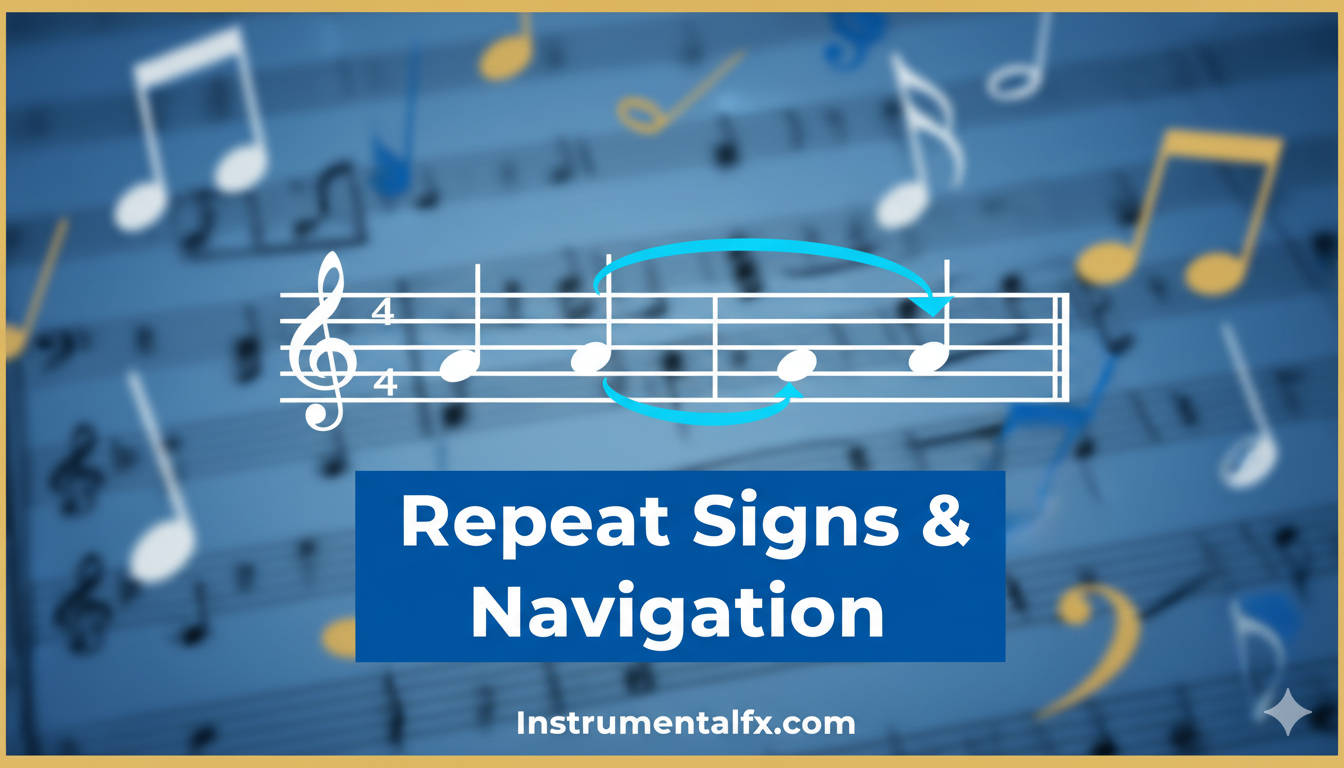
Navigation symbols guide musicians through composition structures, indicating section repetitions and directional jumps within pieces.
Repeat signs conserve notation space. Rather than writing identical passages multiple times, repeats indicate efficiently where to replay sections.
Following navigation symbols correctly is crucial. Mistakes disrupt musical flow and can result in performing wrong structural forms.
Repeat Bars
Repeat signs consist of double bar lines with two dots. When reaching end repeat signs, jump back to start repeat signs (or piece beginnings) and replay sections.
Repeats allow varied endings through first and second ending brackets. This variation prevents exact repetition while maintaining structural efficiency.
Missing repeat signs is common reading error. Always scan ahead for repeats to anticipate structural jumps before encountering them.
Da Capo (D.C.)
Da Capo means “from the head” or beginning. D.C. instructions tell performers to return to pieces’ starts and continue.
D.C. al Fine means return to the beginning and play until Fine markings. This creates ABA forms efficiently without rewriting material.
D.C. appears in many popular song forms. Verse-chorus structures often use D.C. instructions for repeated choruses.
Dal Segno (D.S.)
Dal Segno means “from the sign.” D.S. instructions tell performers to jump back to segno symbols (ornate S with dots) and continue.
D.S. al Coda combines with coda symbols for complex navigation. Players return to segnos, then jump to codas at appropriate markers.
Following D.S. instructions requires attentive reading. Mark scores clearly to avoid confusion during performance.
Coda Symbol
Coda symbols (⊕) mark concluding passages. “To Coda” or “al Coda” instructions tell musicians when to jump to coda sections.
Codas provide final endings after repeated sections. They resolve pieces conclusively without requiring additional repeated material.
Coda jumps create satisfying conclusions. They often feature climactic material that brings pieces to dramatic, memorable closes.
Expression Markings
Expression markings guide emotional interpretation beyond technical notation. They communicate composers’ artistic intentions and desired character.
Expression marks add human quality to mechanical notation. They remind performers that music communicates emotion, not just accurate notes.
Cultural and period understanding informs expression interpretation. Baroque expression differs from Romantic; Classical differs from Contemporary.
Fermata
Fermata symbols (𝄐) placed above notes indicate holding them longer than written values. Exact duration depends on conductor’s gesture or performer’s judgment.
Fermatas create dramatic pauses and emphasis. They allow musical breathing space and highlight structurally important moments.
Fermata length varies by context. Final fermatas typically last longer than internal ones, creating appropriate dramatic weight.
Dolce
Dolce means sweetly and gently. This instruction adds character beyond simple dynamics, conveying emotional quality.
Italian expression terms communicate both technical instruction and emotional intent. Understanding their meanings enriches musical interpretation.
Dolce passages require delicate touch and sensitive phrasing. Harshness or excessive volume contradicts dolce character completely.
Espressivo
Espressivo (express. or espress.) indicates expressive, emotional playing with freedom and feeling. Performers should emphasize music’s emotional content.
Espressivo allows subtle tempo and dynamic nuances. Rigid, mechanical playing contradicts expressivo’s fundamental intention.
Balancing freedom with structure challenges espressivo playing. Too much freedom becomes chaos; too little becomes sterile.
Special Techniques
Different instruments use specialized symbols for unique playing techniques. Understanding these symbols enables authentic, idiomatic performance.
Technique-specific notation reflects instruments’ unique capabilities. What works for strings differs from wind or percussion instruments.
Learning specialized symbols for your instrument improves reading fluency. You’ll recognize and execute techniques instantly during performance.
String Techniques
Up bow (V) and down bow (⌃) symbols indicate bowing direction for string instruments. These markings ensure coordinated orchestra bowing.
Pizzicato (pizz.) instructs string players to pluck strings with fingers rather than bowing. Arco indicates returning to bowed playing.
Harmonics use diamond noteheads or circles above notes. Light finger touches produce ethereal, flute-like overtones.
Piano Pedaling
Ped. indicates pressing sustain pedals; asterisks (*) show releasing them. Continuous pedal passages use lines connecting Ped. to *.
Una corda (U.C.) instructs using soft pedals for muted, intimate sounds. Tre corde (T.C.) indicates releasing soft pedals.
Proper pedal technique distinguishes amateur from professional piano playing. Pedals blur, enhance, or clarify depending on usage.
Wind Techniques
Breath marks (‘) tell wind players when to breathe. Proper breath placement maintains musical lines while ensuring adequate air supply.
Flutter tongue, growl, and multiphonics appear in contemporary music. Special notation indicates these extended techniques.
Mutes change tone quality for brass instruments. Notation specifies when to insert or remove mutes during performance.
Reading Tips for Beginners
Start with simple pieces using basic symbols. Gradually introduce complexity as symbol recognition becomes automatic.
Practice regularly but in short sessions. Fifteen minutes daily proves more effective than occasional marathon sessions.
Keep reference guides handy initially. Over time, symbols become memorized through repeated exposure and application.
Pattern Recognition
Learn to recognize common note patterns, chord shapes, and rhythmic figures as units rather than individual symbols.
Chunking improves reading speed dramatically. Your brain processes patterns faster than individual elements.
Scale and arpeggio knowledge helps pattern recognition. Familiar patterns in different positions become instantly recognizable.
Sight-Reading Practice
Sight-reading skill develops through regular practice with unfamiliar music. Challenge yourself with new pieces frequently.
Read below your performance level initially. Success builds confidence and fluency before tackling technically demanding material.
Don’t stop for mistakes during sight-reading. Maintaining forward momentum matters more than perfection during initial readings.
Slow Practice
Read slowly at first, ensuring accuracy. Speed develops naturally as recognition becomes automatic.
Accuracy always precedes speed. Practicing mistakes at fast tempos trains your brain to play incorrectly.
Use metronomes gradually increasing tempos. This systematic approach builds speed while maintaining accuracy and control.
Common Symbol Combinations
Certain symbol combinations appear frequently, creating specific effects through their interaction.
Understanding combined symbols prevents confusion. Multiple markings work together creating unified musical effects.
Context determines priority when symbols conflict. Musical judgment guides interpretation when notation seems ambiguous.
Staccato with Dynamics
Combining staccato dots with forte dynamics creates sharp, emphatic, detached notes. This combination appears in energetic passages requiring clarity and punch.
Staccato with piano produces light, delicate, separated notes. The combination suits playful, gentle passages.
Dynamic levels modify articulation character. Forte staccato differs dramatically from piano staccato despite identical rhythmic execution.
Crescendo with Accelerando
Simultaneously increasing volume and tempo creates mounting excitement. This powerful combination propels music toward climactic moments.
Gradual intensification through combined changes affects emotional impact. The combination heightens dramatic tension effectively.
Controlling both parameters simultaneously challenges coordination. Practice each element separately before combining them smoothly.
Legato with Rubato
Smooth, connected playing with flexible tempo creates expressive, romantic character. This combination suits lyrical, emotional passages.
Rubato should feel natural, not arbitrary. Slight rushing and pulling back creates human, expressive phrasing.
Excessive rubato destroys musical line. Balance freedom with structural integrity for tasteful, musical results.
Symbol Priorities for Learning
Not all symbols require equal initial attention. Foundational elements should be mastered before advancing to specialized notation.
Focus creates efficient learning. Master essentials thoroughly before attempting advanced or rare symbols.
Your instrument and genre influence which symbols matter most. Prioritize symbols appearing frequently in your repertoire.
Essential Basics
Staff basics, treble and bass clefs, note values, basic rests, simple time signatures form the foundation. Master these first.
Key signatures, accidentals, and basic dynamics (p, mp, mf, f) come next. These appear in virtually all music.
Without solid basics, advanced symbols remain meaningless. Build strong foundations before adding complexity.
Intermediate Symbols
After basics, learn articulations (staccato, accent, legato), repeat signs, and common tempo markings.
Ornaments, octave signs, and expression markings follow. These add nuance and expression to basic technical execution.
Intermediate understanding enables playing most standard repertoire competently. You’ll handle typical sheet music comfortably.
Advanced Notation
Extended techniques, microtonal accidentals, complex meters, and contemporary symbols come last. These appear in specialized repertoire.
Jazz symbols, figured bass, and historical notations serve specific genres. Learn these as relevant to your musical interests.
Advanced notation knowledge demonstrates comprehensive musical literacy. It enables performing challenging, contemporary, and experimental works.
Practice Strategies
Effective practice accelerates symbol learning. Strategic approaches maximize efficiency and retention.
Quality trumps quantity in practice. Focused, intentional sessions produce better results than mindless repetition.
Track progress to maintain motivation. Celebrate small victories as symbol recognition improves steadily.
Flashcard Method
Create flashcards with symbols on one side, meanings on the reverse. Quiz yourself regularly for active recall practice.
Digital flashcard apps enable convenient practice anywhere. Spaced repetition algorithms optimize long-term retention.
Flashcards work well for isolated symbol identification. Combine with real music reading for contextual understanding.
Annotation Strategy
Mark symbols in your sheet music with notes explaining meanings. This active engagement strengthens memory and understanding.
Color-coding different symbol categories helps visual learners. Consistent systems improve pattern recognition and organization.
Annotated scores become personal reference materials. Review them regularly to reinforce learning systematically.
Real Music Application
Apply symbols immediately in actual pieces. Theory becomes meaningful through practical musical application.
Choose music slightly below your technical level initially. Focus can remain on symbol reading without overwhelming technical challenges.
Playing real music maintains motivation better than abstract exercises. Musical context makes symbols memorable and meaningful.
Technology Tools for Learning
Modern apps and software accelerate symbol learning. Interactive tools provide immediate feedback and engaging practice.
Technology supplements traditional methods effectively. Combine digital tools with hands-on instrument practice for best results.
Many free resources exist online. Explore options to find tools matching your learning style and preferences.
Notation Software
Programs like MuseScore, Finale, and Sibelius help visualize symbols and hear how they sound. Input notation and hear playback immediately.
Notation software teaches by doing. Creating scores forces active engagement with every symbol and rule.
Free options like MuseScore make notation software accessible. No financial barrier prevents exploring this valuable learning tool.
Mobile Apps
Dedicated music theory apps offer interactive symbol quizzes, games, and lessons. Practice anywhere with smartphone convenience.
Gamified learning maintains motivation through points, levels, and achievements. Competition or progress tracking encourages consistent practice.
Apps like Tenuto, Music Tutor, and Complete Music Reading Trainer focus specifically on symbol recognition and reading skills.
Online Resources
YouTube tutorials, interactive websites, and digital courses provide comprehensive symbol instruction. Video demonstrations clarify confusing concepts.
Many music universities offer free online theory courses. Quality education is available without enrollment or payment.
Online communities provide support and accountability. Connect with other learners sharing similar goals and challenges.
Genre-Specific Considerations
Different musical genres emphasize particular symbols reflecting their unique aesthetic priorities and performance practices.
Understanding genre conventions improves stylistic authenticity. Notation interpretation varies across classical, jazz, popular, and folk traditions.
Learn symbols relevant to your preferred genres first. Specialization develops expertise in your musical focus area.
Classical Music Notation
Classical notation uses extensive dynamic ranges, detailed articulations, precise tempo changes, and thorough expression markings. Composers specify intentions explicitly.
Strict adherence to notation honors composer intent. Classical tradition values faithfulness to written scores.
Historical performance practice affects interpretation. Baroque ornaments differ from Romantic; Modern differs from Renaissance.
Jazz and Popular Music
Jazz charts use simplified notation with chord symbols, rhythm slashes, and interpretive freedom. Written parts provide frameworks, not strict instructions.
Swing feel, articulation choices, and embellishments come from style knowledge rather than explicit notation. Musicians add personal interpretation.
Lead sheets show melody and chords only. Rhythm sections create accompaniments based on style conventions and personal creativity.
Contemporary and Experimental
Modern classical music employs extended techniques, graphic notation, microtones, and experimental symbols. Composers often create unique notational systems.
Performers frequently work directly with living composers clarifying unconventional markings. Collaboration ensures accurate interpretation.
Contemporary notation pushes traditional boundaries. Open-mindedness and creativity help navigate unfamiliar symbolic systems.
Historical Development
Understanding notation’s evolution provides context for why symbols exist in current forms. History reveals logic behind seemingly arbitrary conventions.
Notation developed gradually over centuries. Each innovation solved specific communication problems between composers and performers.
Historical awareness enriches interpretation. Knowing symbols’ origins and purposes deepens musical understanding significantly.
Medieval Neumes
Early medieval notation (9th-12th centuries) used neumes—symbols above text showing melodic contour without precise pitches.
Neumes preserved liturgical chant traditions. They indicated relative pitch direction and phrase shapes for sacred music transmission.
Precision developed slowly. Staff notation emerged gradually, adding specific pitch indication to contour representation.
Renaissance Mensural Notation
Renaissance mensural notation (1250-1600) introduced rhythmic precision through note shapes. Different shapes indicated duration relationships systematically.
This period established foundations for modern notation. Barlines, time signatures, and note values evolved toward current standards.
Printing technology standardized notation. Movable type enabled consistent symbol reproduction across published scores.
Modern Standardization
By 1800, notation resembled modern forms closely. Subsequent changes added expressive nuances rather than fundamental structural elements.
Twentieth century expanded notation for new techniques and instruments. Electronic music and extended techniques required innovative symbolic systems.
Standardization enables global communication. Despite variations, core symbols remain universally understood across cultures and languages.
Troubleshooting Common Confusion
Certain symbols commonly confuse learners due to similar appearances or context-dependent meanings. Recognizing these trouble spots accelerates learning.
Don’t feel discouraged by initial confusion. Everyone struggles with similar issues when learning musical notation.
Targeted practice on confusing elements resolves difficulties. Focus efforts on specific problem areas rather than general review.
Sharp vs. Natural
Sharp and natural symbols look somewhat similar initially. Sharps have four lines (two horizontal, two diagonal); naturals have geometric box shapes.
Context helps distinguish them. Naturals typically cancel previous accidentals; sharps raise natural pitches.
Practice identifying each in real scores. Contextual recognition builds faster than isolated study.
Slur vs. Tie
Both use curved lines, but slurs connect different pitches (play smoothly) while ties connect identical pitches (hold longer).
Look at noteheads under curved lines. Different pitches mean slurs; same pitches mean ties.
This distinction matters critically for correct playing. Confusion produces either wrong notes or wrong rhythm.
Staccato vs. Staccatissimo vs. Tenuto
Dots indicate staccato (short), wedges show staccatissimo (very short), horizontal lines mean tenuto (full value, possibly slightly longer).
These articulations create vastly different effects. Precise execution requires clear distinction between them.
Listen to examples demonstrating differences. Aural understanding reinforces visual symbol recognition effectively.
Cultural and Regional Variations
While Western notation dominates globally, cultural differences exist in interpretation and application. Understanding variations prevents miscommunication.
International musical exchange requires awareness of different conventions. What seems obvious in one culture may confuse musicians from another.
Flexibility and cultural sensitivity improve collaborative music-making. Open communication resolves notation ambiguities quickly.
International Standards
Most symbols maintain consistent meaning worldwide. Core notation elements transcend language and cultural barriers effectively.
Italian terms dominate classical music globally regardless of composer nationality. This linguistic convention provides universal musical vocabulary.
Modern publications follow standardized engraving guidelines. Organizations like the Music Publishers Association maintain consistent notation practices.
Non-Western Notation Systems
Eastern music traditions use distinct notation: Chinese jianpu (numbered notation), Indian sargam (solfege syllables), Japanese shakuhachi notation (vertical characters).
These systems reflect different musical philosophies and structures. Pitch, rhythm, and expression concepts vary across traditions.
Learning non-Western systems expands musical perspective. Different notational approaches reveal alternative ways of conceiving and organizing sound.
Creating Personal Reference Materials
Building custom reference materials reinforces learning and provides tailored study tools matching your specific needs.
Active creation engages deeper processing than passive reading. Making your own materials strengthens memory and understanding significantly.
Personalized references serve ongoing needs. You’ll consult them repeatedly, making initial time investment worthwhile.
Symbol Chart
Create comprehensive symbol charts organized by category. Include symbols, names, meanings, and examples from your repertoire.
Visual organization aids memory. Grouped categories help understand relationships between related symbols.
Update charts as knowledge expands. Adding new symbols to existing frameworks integrates new learning with established understanding.
Practice Journal
Document symbols encountered in pieces, noting which ones challenge you. Track progress and review difficult symbols regularly.
Journals reveal patterns in your learning. Identifying weak areas guides targeted practice efficiently.
Recording solutions to problems prevents repeating mistakes. Past journal entries become valuable reference resources.
Annotated Repertoire
Mark symbols in personal scores with performance notes. Include fingering, bowing, breathing, or interpretation reminders.
Annotated scores preserve interpretive decisions. Return to pieces later without re-solving technical or musical problems.
Annotations document learning journey. Comparing older and newer annotations reveals skill development over time.
Frequently Asked Questions (FAQs)
What is the most important music symbol to learn first?
The treble clef is the most important music symbol for beginners because it appears in the majority of sheet music and establishes the pitch framework for reading notes. Once you understand the treble clef, learning note names and positions becomes straightforward and intuitive.
How many music symbols do I need to know to read basic sheet music?
You need approximately 40-50 essential music symbols to read basic sheet music comfortably, including note values, rests, clefs, time signatures, basic dynamics, and simple articulations. With these fundamental symbols mastered, you can play most beginner to intermediate level pieces across various genres.
What’s the difference between a sharp and a flat?
A sharp (♯) raises a note by one half step to the next higher pitch, while a flat (♭) lowers a note by one half step to the next lower pitch. Though they often sound the same on piano (enharmonic equivalents like C♯ and D♭), they serve different harmonic functions in music theory and notation.
Why are there different clefs in music notation?
Different clefs exist because musical instruments and voices have widely varying pitch ranges, and using multiple clefs prevents excessive ledger lines that make reading difficult. The treble clef suits high instruments, bass clef accommodates low instruments, and movable C clefs serve mid-range instruments like viola.
How do I remember the notes on the staff lines and spaces?
Use mnemonics like “Every Good Boy Does Fine” for treble clef lines (E-G-B-D-F) and the word “FACE” for treble spaces. For bass clef, remember “Good Boys Do Fine Always” for lines (G-B-D-F-A) and “All Cows Eat Grass” for spaces (A-C-E-G).
What does the dot after a note mean?
A dot placed after any note increases its duration by exactly half of its original value, so a dotted half note equals three quarter beats (2 + 1). Dotted rhythms create elegant, lilting patterns and are essential for reading compound time signatures and dance music correctly.
Can music symbols change meaning in different contexts?
Most music symbols maintain consistent meanings, but some like dynamics (p, f) are relative rather than absolute volume levels that adapt to musical context and ensemble size. Expression markings also allow interpretive flexibility, with performers adjusting execution based on period style, genre conventions, and artistic judgment.
How long does it take to learn all basic music symbols?
Most students can learn basic music symbols within 3-6 months with consistent daily practice and regular application in actual music reading. Complete fluency develops over 1-2 years as symbol recognition becomes automatic and you encounter more advanced notation in progressively challenging repertoire.
What’s the difference between a slur and a tie?
A slur is a curved line connecting two or more different pitches, indicating they should be played smoothly and connected without separation. A tie connects two identical pitches, meaning you hold the note for the combined duration of both notes without re-attacking or re-articulating.
Are music symbols the same worldwide?
Yes, standard Western music notation symbols are universally recognized and used worldwide, making music truly a global language that transcends cultural and linguistic barriers. However, some non-Western musical traditions use different notation systems specific to their instruments and musical structures, like Chinese numbered notation or Indian sargam.
Conclusion
Music symbols and meanings represent the universal language connecting musicians across cultures, generations, and continents.
This comprehensive guide has covered over 100 essential music symbols from basic staff notation and clefs to advanced dynamics, articulations, ornaments, and contemporary techniques.
Whether you’re just beginning your musical journey or refining advanced skills, understanding these symbols transforms written notation into living, breathing music.
Remember that learning music symbols is a gradual process requiring patience, consistent practice, and real-world application in actual pieces.


