



Types of music notes are the fundamental building blocks that create rhythm, melody, and musical expression in every piece of music you hear.
From classical symphonies to modern pop hits, understanding different note types is essential for reading sheet music and playing any instrument accurately.
Each note type has a unique appearance and duration, telling musicians exactly how long to hold each sound. Whether you’re a complete beginner picking up your first instrument or a student learning to read music, mastering these note values will unlock your ability to play songs correctly and develop strong rhythmic skills that last a lifetime.
Quick Facts About Types of Music Notes
| Category | Details |
|---|---|
| Main Note Types | 7 common types (whole, half, quarter, eighth, sixteenth, thirty-second, sixty-fourth) |
| Most Used | Whole, half, quarter, eighth, sixteenth notes |
| Whole Note Duration | 4 beats in 4/4 time |
| Basic Unit | Quarter note (1 beat in common time) |
| Note Names | American vs British (quarter note vs crotchet) |
| Visual Elements | Notehead, stem, flags/beams |
| Time Signature | 4/4 (common time) most popular |
| Relationship | Each note is half the previous value |
| Rest Equivalents | Every note has a matching rest symbol |
| Global Standard | Universally recognized worldwide |
What Are Music Notes?

Music notes are symbols that represent specific sounds in written music. They tell musicians which pitch to play and how long to hold that sound. These visual marks are the foundation of musical communication across all instruments and genres.
Think of music notes as instructions that combine two essential pieces of information: where to play (pitch) and how long to play (duration). Without notes, musicians couldn’t share or preserve their musical ideas.
The types of music notes you’ll encounter depend on the rhythm and tempo of the piece. Faster songs use shorter notes, while slower pieces often feature longer note values.
Understanding Note Duration
Note duration refers to how long a musical sound is held. This concept is crucial because rhythm depends entirely on the relationship between different note lengths. Each type of music note represents a specific fraction of time within a musical measure.
In most Western music, we use a system where each note type is worth exactly half of the next longer note. This mathematical relationship makes learning note values logical and predictable once you understand the pattern.
The duration of notes is measured in beats, with the most common reference being the quarter note receiving one beat in 4/4 time. All other note values are calculated relative to this standard.
The Seven Main Types of Music Notes
Whole Note (Semibreve)
The whole note is the longest commonly used note value in modern music. It appears as a hollow oval without a stem, making it instantly recognizable on sheet music. In 4/4 time, a whole note receives four full beats.
This note type fills an entire measure of music in common time. Musicians hold a whole note for the complete duration of four counts, creating sustained, long sounds that often appear at phrase endings or important harmonic points.
Whole notes are less common in fast-paced music because they require significant time to execute. They appear frequently in slow ballads, hymns, and classical compositions where sustained sounds enhance the emotional impact.
Half Note (Minim)
The half note has a duration of two beats in 4/4 time. It looks like an open oval with a stem attached, making it visually distinct from both whole and quarter notes. The stem can point either up or down depending on the note’s position on the staff.
Two half notes equal one whole note in duration. This mathematical relationship helps musicians quickly understand rhythmic proportions. Half notes create a sense of forward motion while maintaining substantial duration.
This note type appears frequently in melodies and harmonic progressions. It’s particularly common in folk songs, hymns, and music with moderate tempos where sustained tones need to balance with rhythmic movement.
Quarter Note (Crotchet)
The quarter note is the most fundamental rhythmic unit in Western music. It features a filled (solid) oval notehead with a stem, receiving one beat in 4/4 time. This note type defines the basic pulse in most popular and classical music.
Quarter notes serve as the reference point for all other note values. When conductors or metronomes set tempo, they typically count quarter note beats. Four quarter notes fit perfectly into one measure of 4/4 time.
Walking bass lines, steady accompaniments, and countless melodies rely heavily on quarter notes. Their moderate duration creates clear, steady rhythms that listeners can easily follow and musicians can comfortably play.
Eighth Note (Quaver)
Eighth notes last for half a beat each in 4/4 time. They have filled noteheads with stems and single flags when written alone. When multiple eighth notes appear consecutively, they connect with horizontal beams for easier reading.
Two eighth notes equal one quarter note in duration. This subdivision creates faster rhythmic movement and adds energy to musical passages. Eighth notes enable composers to write running melodies and intricate rhythmic patterns.
Most pop, rock, and folk music use eighth notes extensively. They provide the rhythmic drive in upbeat songs and allow for more detailed melodic expression than quarter notes alone permit.
Sixteenth Note (Semiquaver)
Sixteenth notes receive one-quarter of a beat each in common time. They feature filled noteheads, stems, and two flags (or double beams when grouped together). Four sixteenth notes equal one quarter note.
These rapid notes create intricate passages and complex rhythmic textures. Classical virtuoso pieces, jazz improvisation, and fast contemporary music frequently employ sixteenth notes for technical brilliance and rhythmic sophistication.
Reading sixteenth notes accurately requires strong counting skills. Musicians often subdivide beats mentally, counting “1-e-and-a, 2-e-and-a” to maintain precise timing through rapid note sequences.
Thirty-Second Note (Demisemiquaver)
Thirty-second notes are very short, lasting one-eighth of a beat in 4/4 time. They have three flags when alone or three beams when grouped. Eight thirty-second notes equal one quarter note.
These extremely fast notes appear less frequently than longer values. They’re found in advanced classical music, technical études, and passages requiring exceptional speed and precision from performers.
Sight-reading thirty-second notes at tempo challenges even experienced musicians. Many compositions reserve these ultra-fast notes for climactic moments or virtuosic displays of technical mastery.
Sixty-Fourth Note (Hemidemisemiquaver)
Sixty-fourth notes are among the shortest note values in standard notation. They feature four flags or beams and last one-sixteenth of a beat. Sixteen sixty-fourth notes equal one quarter note.
These notes rarely appear in music because they’re extremely difficult to read and execute clearly at normal tempos. When used, they typically occur in very slow pieces where their rapid subdivision creates ornamental flourishes.
Most practical music avoids sixty-fourth notes by adjusting tempo markings instead. Composers can double the tempo and write sixteenth notes, making the same rhythm easier to read and perform.
Note Anatomy: Parts of a Music Note
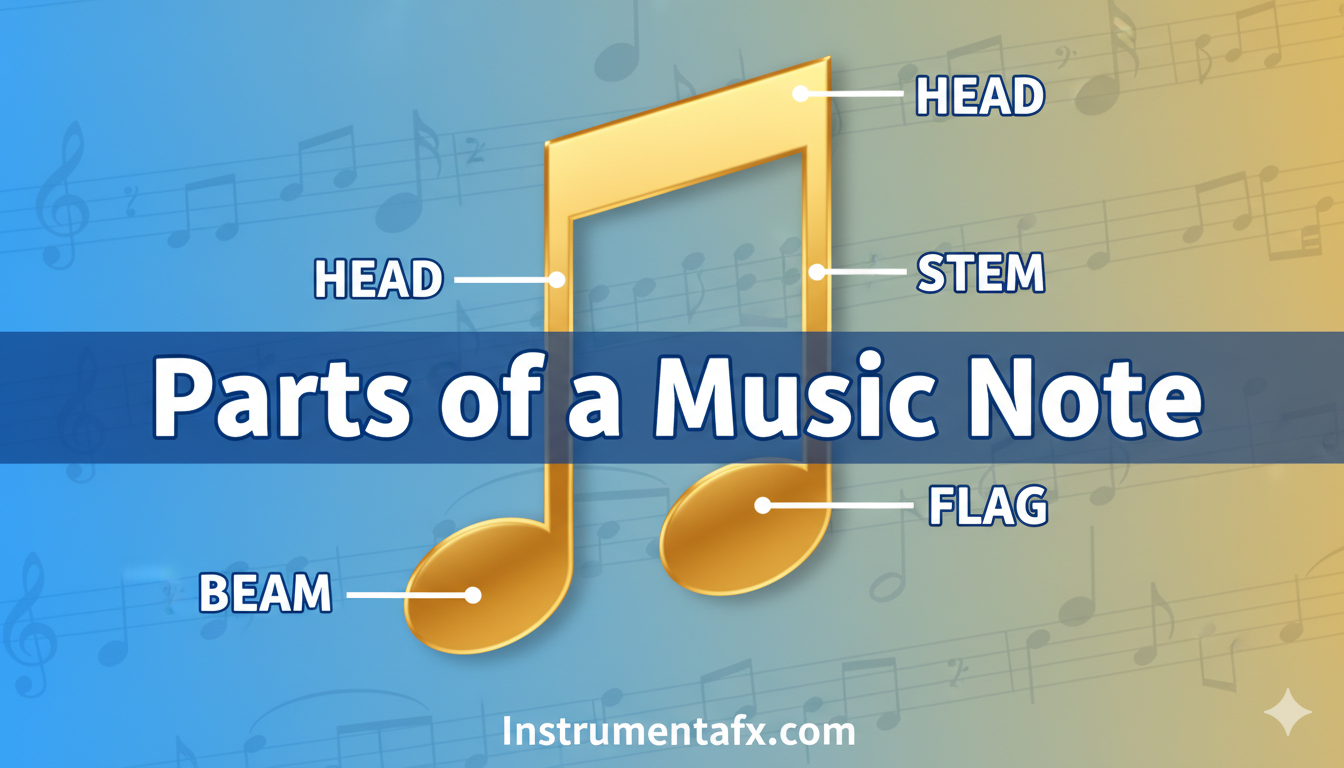
Notehead
The notehead is the oval shape that forms every note’s core. Noteheads can be either open (hollow) or filled (solid), which determines the note’s duration. Open noteheads indicate longer note values like whole and half notes.
Filled noteheads represent shorter durations including quarter notes, eighth notes, and all faster subdivisions. This visual distinction helps musicians instantly recognize note lengths without reading stems or flags.
The notehead’s vertical position on the staff indicates pitch. Notes higher on the staff represent higher pitches, while lower positions indicate lower sounds. This spatial arrangement creates an intuitive visual pitch map.
Stem
The stem is a thin vertical line attached to most noteheads. Stems extend either upward from the right side or downward from the left side of the notehead. Whole notes are the only common note type without stems.
Stem direction follows specific rules: notes below the middle staff line typically have upward stems, while notes on or above the middle line usually have downward stems. This convention keeps notation clean and readable.
Stems don’t affect duration or pitch—they’re purely organizational. However, stem direction can indicate which hand plays the note in piano music or which voice part sings the note in choral arrangements.
Flags and Beams
Flags are curved marks attached to note stems, indicating notes shorter than quarter notes. One flag creates an eighth note, two flags make a sixteenth note, three flags produce a thirty-second note, and so on.
Beams are horizontal lines connecting multiple flagged notes. When several eighth notes appear consecutively, beams replace individual flags, making rhythmic groups easier to read at a glance.
Beaming patterns often reflect beat structure. In 4/4 time, eighth notes typically beam in groups of two or four, visually organizing music into clear beat subdivisions that aid performance and comprehension.
American vs British Note Names
American Terminology
The American music education uses descriptive names indicating proportional relationships. Whole note, half note, quarter note, eighth note, and sixteenth note clearly show how each value relates mathematically to the whole note.
This naming system helps beginners understand duration relationships quickly. The fractions are intuitive: a half note is half a whole note, a quarter note is one-quarter of a whole note, and so on.
Most modern music theory textbooks and online resources worldwide now use American terminology. It’s become the dominant system in international music education due to its logical, mathematical clarity.
British Terminology
British music tradition uses Latin-derived names: semibreve (whole note), minim (half note), crotchet (quarter note), quaver (eighth note), and semiquaver (sixteenth note). These terms have centuries of historical use.
While less mathematically obvious than American names, British terminology connects to music’s historical development. The terms originated in medieval music theory and remained standard in Commonwealth countries for generations.
Understanding both naming systems benefits musicians who study with international teachers or read music from different publishers. The note values themselves remain identical regardless of terminology.
Note Values in 4/4 Time Signature
What is 4/4 Time?
Time signature 4/4, also called “common time,” indicates four quarter-note beats per measure. This is the most prevalent time signature in Western music, appearing in countless songs across all genres.
The top number (4) tells how many beats occur in each measure. The bottom number (4) indicates that a quarter note receives one beat. This combination creates a steady, balanced rhythmic foundation.
Understanding 4/4 time is essential because it’s the reference point for learning all note values. Once you master note durations in common time, adapting to other time signatures becomes much easier.
Counting in 4/4 Time
Musicians count 4/4 measures as “1, 2, 3, 4” with each number representing one quarter note beat. Whole notes are held for all four counts, while half notes receive two counts each.
Eighth notes subdivide beats into “1-and, 2-and, 3-and, 4-and” where each number and “and” represents one eighth note. Sixteenth notes further divide into “1-e-and-a, 2-e-and-a” with four notes per beat.
Consistent, accurate counting develops strong internal rhythm. Beginning musicians benefit enormously from counting aloud while playing until rhythmic patterns become internalized through muscle memory and practice.
Dotted Notes Explained
What Dots Do to Notes
A dot placed after any note increases its duration by exactly half its original value. A dotted half note equals three quarter beats (2 + 1). A dotted quarter note equals three eighth beats (1 + 0.5).
Dotted notes create asymmetrical rhythmic patterns that feel sophisticated and flowing. They’re essential for compound time signatures like 6/8, where dotted quarter notes often receive the primary pulse.
Understanding dotted rhythms expands your rhythmic vocabulary significantly. Many folk dances, classical pieces, and contemporary songs rely on dotted patterns for their characteristic rhythmic feel and forward momentum.
Common Dotted Note Patterns
The dotted quarter note followed by an eighth note is perhaps the most common dotted rhythm pattern. This combination creates the characteristic “long-short” pattern heard in countless melodies and accompaniments.
Dotted half notes appear frequently in 4/4 time, lasting three beats and leaving one beat for another note. This creates elegant, sustained phrases with gentle rhythmic resolution at measure ends.
Dotted eighth notes paired with sixteenth notes produce energetic, snappy rhythms common in march music, jazz swing, and Latin styles. This rhythmic figure adds bounce and excitement to musical phrases.
Tied Notes
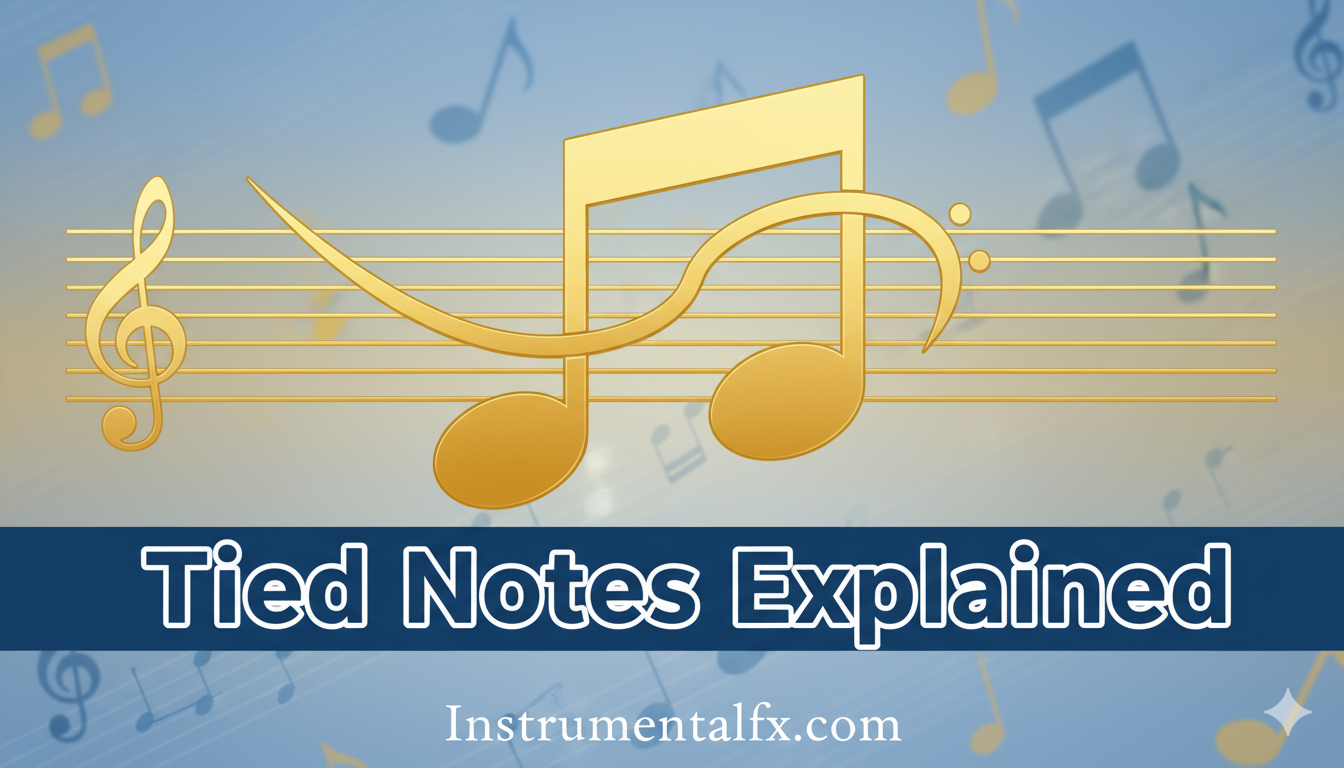
Understanding Note Ties
A tie is a curved line connecting two notes of identical pitch. Tied notes are held continuously for the combined duration of both notes without re-attacking or re-articulating the sound.
Ties allow notes to sustain across barlines or create durations impossible with single note values. For example, tying a half note to a quarter note creates a three-beat duration within a single sound.
This notation device is essential when rhythmic values need to cross measure boundaries. Without ties, composers couldn’t write syncopated rhythms or sustained notes that begin mid-measure and continue into the next.
Ties vs Slurs
Ties connect identical pitches and mean “hold the note longer.” Slurs connect different pitches and mean “play smoothly and connected.” These curved lines look similar but function completely differently.
Looking at the noteheads under curved lines reveals whether you’re seeing a tie or slur. Same pitches indicate a tie requiring sustained sound. Different pitches show a slur requiring smooth articulation.
Confusing ties and slurs is a common reading error that dramatically alters musical interpretation. Careful observation of pitch relationships prevents this mistake and ensures accurate performance.
Rest Symbols
Why Rests Matter
Rests are symbols indicating silence in music. Every note value has a corresponding rest of equal duration. Rests are as musically important as sounding notes, creating breathing space, phrasing, and rhythmic structure.
Silence shapes music just as powerfully as sound. Strategic rest placement creates tension, provides recovery time for performers, and allows musical ideas to resonate before new material begins.
Accurate rest observation distinguishes competent from excellent musicians. Rushing through rests or ignoring them entirely destroys musical phrasing and eliminates the expressive power of well-placed silence.
Whole Rest
The whole rest hangs from the fourth staff line like a small filled rectangle. It indicates four beats of silence in 4/4 time or represents a full measure rest in any time signature.
This dual function makes whole rests versatile. In 3/4 time, a whole rest still means “rest for the entire measure” even though that measure contains only three beats, not four.
Whole rests provide dramatic pauses, mark section endings, and give performers breathing time. They often appear during instrumental breaks where certain players rest while others continue performing.
Half Rest
The half rest sits on top of the third staff line, appearing as an upward-facing rectangle. It indicates two beats of silence, creating brief pauses within musical phrases in common time.
Half rests often appear in breathing spots for wind players or where melodic lines need brief separation. They maintain rhythmic flow while providing essential silence for phrasing and articulation.
Distinguishing half rests from whole rests requires attention to position. Half rests sit ON the line; whole rests hang FROM the line. This positional difference prevents common reading errors.
Quarter Rest
The quarter rest has a distinctive squiggly shape resembling a backward “R” or lightning bolt. It represents one beat of silence, punctuating rhythms and creating syncopation in musical passages.
Quarter rests are extremely common in all music styles. They create rhythmic interest, allow brief pauses between phrases, and establish syncopated patterns that drive musical energy and excitement.
Learning to “play” rests as actively as notes improves musicianship. Silence has shape, duration, and intention just like sounding notes do, requiring equal attention and precision.
Eighth and Sixteenth Rests
Eighth rests look like number sevens with single flags, indicating half-beat silences. Sixteenth rests have two flags, representing quarter-beat pauses. These short rests create intricate rhythmic textures in fast passages.
Multiple short rests in sequence require careful counting to maintain accurate timing. Musicians often count subdivisions aloud during practice to internalize complex rhythmic patterns with frequent brief silences.
These rests appear extensively in syncopated music, jazz, and contemporary styles. They create space between rapid notes, contributing to grooves and rhythmic figures that define musical genres.
Triplets and Tuplets
What Are Triplets?
Triplets divide a beat into three equal parts instead of the usual two. Three triplet eighth notes fit in the space normally occupied by two regular eighth notes, creating a distinctive rolling feel.
Triplets are marked with the number “3” above or below grouped notes, often with a bracket. This notation tells musicians to play three notes in the time normally given to two.
Triplet feel is fundamental to swing jazz, shuffle rhythms, and 12/8 time feels. Many blues and rock songs use triplet subdivisions to create their characteristic groove and rhythmic character.
Other Tuplets
Beyond triplets, other tuplet groupings exist: quintuplets (five notes), sextuplets (six notes), and septuplets (seven notes). These divide beats into unusual subdivisions beyond standard binary divisions.
Tuplets allow composers to write complex polyrhythms and cross-rhythms. They’re common in contemporary classical music, progressive rock, and experimental jazz where rhythmic complexity pushes traditional boundaries.
Reading complex tuplets requires advanced rhythmic skills. Most practical music uses triplets almost exclusively, reserving other tuplets for special effects or moments of heightened rhythmic intensity.
Beaming Rules and Grouping
Purpose of Beaming
Beaming connects multiple flagged notes with horizontal lines instead of individual flags. This makes rhythmic groupings visually obvious, helping musicians read complex passages quickly and accurately.
Proper beaming reflects beat structure. In 4/4 time, notes typically beam within beats, not across them. This visual organization shows where beats begin and end, clarifying rhythmic architecture.
Good engraving software automatically applies standard beaming rules. However, understanding these conventions helps musicians read music more fluently and communicate effectively when handwriting music.
Beaming in Different Time Signatures
Time signature affects beaming patterns. In 4/4 time, eighth notes often beam in groups of two or four. In 6/8 time, they typically beam in groups of three, reflecting the compound meter structure.
Complex meters may have unconventional beaming to clarify beat groupings. In 5/4 time, beaming might show 3+2 or 2+3 beat subdivisions, helping performers understand the asymmetrical rhythmic pattern.
Following standard beaming conventions prevents confusion. When music beams against expected patterns, it often indicates syncopation or cross-rhythms that deserve special attention from performers.
Note Duration Relationships
Fractional Relationships
Each shorter note type equals exactly half the duration of the next longer note. This binary relationship creates a logical, mathematical system that musicians quickly internalize with practice.
Two half notes equal one whole note. Two quarter notes equal one half note. Two eighth notes equal one quarter note. This pattern continues through all note values, maintaining consistent proportional relationships.
Understanding these fractions helps with reading complex rhythms. Musicians can quickly calculate how many sixteenth notes fit into a half note (eight) or how many eighth notes equal two whole notes (sixteen).
Visual Comparison Chart
Creating mental images of note value relationships accelerates learning. Imagine a whole note as a full pizza, half notes as two slices, quarter notes as four slices, and eighth notes as eight slices.
Many teachers use rhythm tree diagrams showing how one whole note branches into two halves, which branch into four quarters, then eight eighths, and so on. These visual aids clarify mathematical relationships.
Practicing with physical manipulatives like fraction bars or rhythm blocks helps kinesthetic learners. Moving pieces representing different note values builds concrete understanding before abstract reading begins.
Reading Note Values on the Staff
Staff Position and Duration
A note’s position on the staff indicates pitch (which key to play), while its appearance indicates duration (how long to hold it). These two pieces of information work together to communicate complete musical instructions.
The same pitch can be written with any note value. A middle C can be a whole note, half note, quarter note, or any shorter duration depending on the musical context and rhythmic requirements.
Beginning musicians sometimes confuse pitch and rhythm, thinking higher notes on the staff should be longer. Position shows pitch; appearance shows duration. These are completely independent aspects of notation.
Ledger Lines
When notes fall outside the five-line staff, short horizontal ledger lines extend the range upward or downward. Note values work identically on ledger lines as on regular staff lines and spaces.
A whole note on a ledger line still lasts four beats. An eighth note on a ledger line still receives half a beat. Ledger lines don’t affect duration—only pitch position changes.
Reading multiple ledger lines requires practice. Musicians often memorize common ledger line notes for their instruments to speed recognition and reduce the need to count lines during performance.
Time Signatures and Note Values
How Time Signatures Work
Time signatures appear at music’s beginning after the clef and key signature. Two numbers stacked vertically indicate beats per measure (top number) and which note value receives one beat (bottom number).
In 3/4 time, three quarter notes fill one measure. In 6/8 time, six eighth notes complete a measure. The bottom number determines which note type equals one beat, affecting how all other values are calculated.
Understanding time signature bottom numbers is crucial. A 4 means quarter notes get one beat. An 8 means eighth notes get one beat. A 2 means half notes get one beat. This affects all duration calculations.
Simple vs Compound Meters
Simple meters (2/4, 3/4, 4/4) divide beats into two equal parts. Compound meters (6/8, 9/8, 12/8) divide beats into three equal parts, creating different rhythmic feels despite similar numbers.
In 3/4 time, three quarter notes create three beats. In 6/8 time, six eighth notes group into two dotted quarter beats, each containing three eighths. This creates a rolling, lilting character.
Recognizing meter type affects how you count and feel rhythm. Simple meters feel “march-like” with strong-weak patterns. Compound meters feel “lilting” with rolling triplet subdivisions underlying the pulse.
Practical Application
Learning Note Values
Start by mastering whole, half, and quarter notes before progressing to faster subdivisions. Build foundation skills with simple rhythms before attempting complex syncopations and rapid note sequences.
Practice clapping or tapping rhythms away from your instrument. This isolates rhythm reading from technical playing challenges, allowing focused attention on duration accuracy and steady pulse maintenance.
Use a metronome from day one. Consistent tempo keeping is essential for accurate rhythm. Start slowly, gradually increasing speed only after achieving solid accuracy at lower tempos.
Rhythm Exercises
Daily rhythm reading exercises build fluency. Practice counting aloud while clapping patterns, ensuring your voice and hands coordinate precisely. This trains both mental processing and physical execution.
Write out rhythm patterns using different note values, then perform them. Creating rhythms reinforces understanding more deeply than only reading them. Composition strengthens analytical understanding.
Practice with rhythm flashcards showing different note combinations. Quick recognition drills train your brain to process note values instantly, eliminating hesitation during actual music reading.
Common Mistakes to Avoid
Rushing Fast Notes
Beginners often rush through sixteenth notes and eighth notes, playing them faster than the tempo requires. Subdividing beats mentally and counting aloud helps maintain proportional accuracy across all note values.
Use metronome subdivisions to check accuracy. Set the metronome to click on eighth notes or sixteenth notes, not just quarter notes. This reveals rushing or dragging immediately.
Remember that fast notes should still fit within the beat structure. Sixteenth notes must distribute evenly across quarter note beats, not cluster at beat beginnings and rush toward endings.
Holding Notes Too Short
Failing to hold long notes for full duration is equally problematic. Whole notes must last four complete beats. Half notes must fill two full beats without shortening or clipping.
Count continuously throughout long notes. Don’t stop counting after attacking the note. Maintain awareness of beat progression while sustaining, ensuring you release only when the duration completes.
Recording yourself reveals duration accuracy issues. Listen back critically, checking whether long notes receive full value and short notes subdivide beats proportionally without rushing.
Ignoring Rests
Treating rests as optional ruins rhythmic integrity. Rests have exact durations that must be observed precisely. Silence is active, requiring attention equal to sounding notes.
Count through rests aloud during practice. This trains your brain to recognize rest durations as concrete values, not vague pauses. Internalizing rest values prevents rushing forward to the next sound.
Think of rests as invisible notes that maintain rhythmic space. They occupy specific time within measures, contributing to musical structure just as importantly as notes themselves.
Genre-Specific Note Usage
Classical Music
Classical compositions use all note values extensively, from long whole notes in slow movements to rapid thirty-second notes in virtuoso passages. Composers notate precisely, expecting faithful duration interpretation.
Baroque music often features steady eighth note and sixteenth note patterns. Romantic era music includes more rhythmic variety with frequent dotted rhythms and triplets. Contemporary classical music pushes boundaries with complex tuplets.
Classical training emphasizes absolute rhythmic accuracy. Players must execute written note values precisely, maintaining ensemble synchronization and honoring composers’ specific rhythmic intentions.
Popular and Rock Music
Rock and pop music primarily uses quarter notes, eighth notes, and sixteenth notes. Whole notes and half notes appear less frequently, reserved for sustained sounds or final phrase endings.
Syncopation is common in popular styles, created through strategic rest placement and off-beat emphasis. Understanding eighth note and sixteenth note subdivisions is essential for authentic popular music performance.
Many pop songs have simple rhythmic foundations beneath seemingly complex sounds. Learning to identify basic note values in recordings helps musicians transcribe and learn songs by ear more effectively.
Jazz Music
Jazz extensively uses triplet eighth notes creating “swing feel.” Written eighth notes are played with triplet interpretation, giving jazz its characteristic laid-back groove and rhythmic sophistication.
Syncopation defines jazz rhythm. Accents on weak beats, abundant rests, and displaced phrase beginnings create the genre’s rhythmic complexity and forward drive that distinguishes it from other styles.
Jazz notation often simplifies rhythms, expecting performers to add stylistic interpretation. Written quarter notes might be played with slight swing, and eighth notes receive uneven, triplet-based execution.
10 Frequently Asked Questions
What is the longest type of music note?
The longest commonly used music note is the whole note (semibreve), which receives four beats in 4/4 time and fills an entire measure. Longer notes like double whole notes exist but are rarely used in modern music notation.
How many beats does a quarter note get?
A quarter note receives one beat in 4/4 time (common time). This makes it the basic unit for counting in most Western music, serving as the reference point for all other note value calculations.
What’s the difference between eighth notes and sixteenth notes?
Eighth notes last for half a beat each (two per beat), while sixteenth notes last for a quarter beat each (four per beat). Visually, eighth notes have one flag and sixteenth notes have two flags on their stems.
Why do some notes have open circles and others filled?
Open (hollow) noteheads indicate longer durations like whole notes and half notes, while filled (solid) noteheads represent shorter values like quarter notes, eighth notes, and faster subdivisions. This visual distinction enables quick duration recognition.
Can you mix different types of notes in one measure?
Yes, absolutely! Measures commonly contain multiple note types as long as the total duration equals the time signature’s required beats. For example, in 4/4 time, you might have one half note (2 beats) plus two quarter notes (2 beats).
What does a dot after a note mean?
A dot after any note increases its duration by exactly half its original value. For example, a dotted half note equals three beats (2 + 1), and a dotted quarter note equals one and a half beats (1 + 0.5).
How do you count sixteenth notes?
Sixteenth notes are counted by subdividing each beat into four parts using syllables like “1-e-and-a, 2-e-and-a, 3-e-and-a, 4-e-and-a” where each syllable represents one sixteenth note. This system helps maintain even timing through fast passages.
Are note names different in other countries?
Yes, British terminology differs from American: whole note (semibreve), half note (minim), quarter note (crotchet), eighth note (quaver), sixteenth note (semiquaver). However, the note values and appearances remain identical regardless of terminology.
What’s a tuplet in music?
A tuplet divides a beat into unusual groupings beyond standard divisions. The most common is a triplet, which fits three notes into the space normally occupied by two notes, creating a rolling rhythmic feel common in jazz and blues.
Do rests have the same durations as notes?
Yes, every note type has a corresponding rest symbol with identical duration. Whole rests equal whole notes (4 beats), quarter rests equal quarter notes (1 beat), and so on, creating precise silence within musical phrases.
Conclusion
Types of music notes form the essential vocabulary of musical rhythm, enabling musicians to communicate precise duration instructions across all instruments and styles.
From the sustained four-beat whole note to the rapid sixteenth note lasting just a quarter beat, each note type serves specific musical functions in creating rhythmic patterns, melodies, and harmonic progressions.
Understanding these note values—their appearances, relationships, and practical applications—is fundamental to reading sheet music accurately and performing with proper timing and expression.
Whether you’re just beginning your musical journey or refining advanced skills, mastering note types provides the rhythmic foundation necessary for musical growth.


