



Moonlight Sonata sheet music represents one of the most sought-after piano compositions in classical music history. Composed by Ludwig van Beethoven in 1801, Piano Sonata No. 14 in C-sharp minor, Op. 27 No. 2, continues to captivate pianists worldwide with its hauntingly beautiful melody and emotional depth.
Whether you’re searching for beginner-friendly arrangements, intermediate versions, or the original advanced score, finding quality Moonlight Sonata sheet music has never been more accessible.
This comprehensive 2026 guide provides everything you need: free downloadable PDF scores, detailed note breakdowns for right and left hands, practice techniques, historical context, and step-by-step tutorials to master this timeless masterpiece.
Understanding Moonlight Sonata
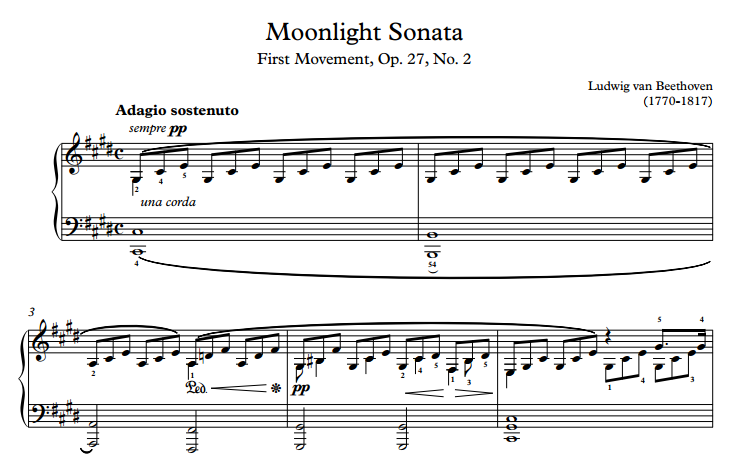
Beethoven’s Piano Sonata No. 14 stands as one of classical music’s most recognizable pieces. Its official name tells only part of the story behind this extraordinary composition.
Official Title and Opus Number
The formal title is “Piano Sonata No. 14 in C-sharp minor, Op. 27, No. 2.” Beethoven subtitled it “Sonata quasi una fantasia,” meaning “Sonata in the manner of a fantasy.” This designation freed him from traditional sonata structure.
The opus number 27, No. 2 indicates this was the second of two fantasy sonatas. These pieces marked Beethoven’s experimental period where he challenged conventional compositional rules. The C-sharp minor key adds to the piece’s melancholic character.
Origin of “Moonlight” Name
Beethoven never called this piece “Moonlight Sonata.” The nickname emerged five years after his death in 1832. German poet and music critic Ludwig Rellstab compared the first movement to moonlight shining on Lake Lucerne.
This poetic description resonated with audiences worldwide. The romantic imagery perfectly captured the piece’s ethereal, contemplative mood. Today, “Moonlight Sonata” remains the universally recognized name despite Beethoven’s original title.
Historical Context and Composition
Beethoven composed this sonata in 1801 during a turbulent personal period. He was beginning to face the reality of progressive hearing loss. This internal crisis profoundly influenced the emotional depth of his compositions.
The piece was dedicated to Countess Giulietta Guicciardi, one of Beethoven’s piano students. Many believe he harbored romantic feelings for the 17-year-old countess. This dedication adds layers of romantic tragedy to the sonata’s interpretation.
Published in 1802, the sonata achieved immediate critical and popular success. It became one of Beethoven’s most performed works during his lifetime. The composition bridges his early classical period and middle romantic period.
Three Movements Overview
Unlike typical sonatas, the Moonlight Sonata reverses traditional tempo structure. Understanding each movement helps pianists approach the complete work strategically.
First Movement: Adagio Sostenuto
The first movement is the most famous and frequently performed section. Marked “Adagio sostenuto,” it translates to “slow and sustained.” The tempo marking indicates a deliberate, meditative pace.
This movement features the iconic triplet arpeggios in the right hand. A hauntingly beautiful melody floats above these flowing patterns. The left hand provides deep bass notes that anchor the harmonic foundation.
The C-sharp minor key signature requires four sharps throughout. This creates a somber, introspective atmosphere perfect for the piece’s emotional character. Most beginner arrangements focus exclusively on this movement.
Second Movement: Allegretto
The second movement provides contrast with a lighter, more cheerful character. Marked “Allegretto,” meaning moderately fast, it moves at a walking pace. This movement is often described as a musical “intermission.”
Written in D-flat major, the relative major of C-sharp minor, it brightens the overall mood. The structure follows a minuet and trio form, common in classical music. It’s considerably shorter than the first and third movements.
Many pianists skip this movement when performing only excerpts. However, it provides crucial emotional balance within the complete sonata. Intermediate players find this movement technically accessible and musically rewarding.
Third Movement: Presto Agitato
The final movement explodes with dramatic intensity and technical difficulty. “Presto agitato” means “very fast and agitated,” accurately describing its character. This movement requires advanced technique and stamina.
The right hand plays rapid arpeggios while the left hand drives powerful bass progressions. The movement builds to several climactic moments demanding exceptional finger strength. Only advanced pianists should attempt this movement.
The tempo and technical demands make it one of Beethoven’s most challenging piano works. It demonstrates his pianistic virtuosity and compositional genius. This movement rarely appears in simplified arrangements.
Finding Quality Moonlight Sonata Sheet Music
Locating reliable, accurate sheet music is essential for learning this piece correctly. Multiple sources offer different quality levels and arrangement types.
Free PDF Downloads
MuseScore provides free user-uploaded arrangements in various difficulty levels. The International Music Score Library Project (IMSLP) offers public domain original scores. These resources allow unlimited downloads and printing without cost.
La Touche Musicale offers simplified versions with accompanying tutorial videos. Many educational websites provide beginner-friendly arrangements with note names included. Always verify the source’s reliability and accuracy.
Free versions sometimes contain transcription errors or unclear notation. Compare multiple sources when possible to ensure accuracy. Read user reviews and ratings before downloading unfamiliar arrangements.
Paid Professional Editions
Henle Verlag publishes authoritative urtext editions based on original manuscripts. G. Schirmer offers performance editions with detailed fingering suggestions and interpretive guidance. These professional publications ensure highest accuracy and quality.
Peters Edition provides scholarly editions with historical performance notes. Alfred Music publishes graded arrangements for different skill levels. Professional editions typically cost $10-20 for physical copies or $5-15 for digital versions.
Investment in quality editions pays dividends through accurate notation and helpful editorial additions. Professional editors provide fingering recommendations that simplify technical passages. Performance notes offer valuable interpretive insights.
Publisher Recommendations
For original scores, Henle Urtext editions represent the gold standard. Their scholarly approach ensures fidelity to Beethoven’s intentions. Bärenreiter also produces exceptional urtext editions with detailed prefaces.
For educational purposes, Alfred’s Premier Piano Course arrangements work excellently. Hal Leonard offers various difficulty levels from late beginner to advanced. Faber Piano Adventures includes the first movement in their Lesson Book series.
Online platforms like Sheet Music Plus and Musicnotes.com offer instant digital downloads. These services allow preview before purchase and provide transposition options. Customer reviews help identify the best editions for specific needs.
Reading the Key Signature
Understanding C-sharp minor’s key signature is crucial for playing Moonlight Sonata correctly. This section demystifies the sharps and key relationships.
C-Sharp Minor Explained
C-sharp minor contains four sharps: F#, C#, G#, and D#. Every occurrence of these notes must be played sharp unless canceled by natural signs. The key signature appears at the beginning of each staff line.
The tonic note C# serves as the home base and resolution point. The minor quality creates the piece’s melancholic, introspective character. Understanding the key center helps with musical phrasing and interpretation.
C-sharp minor is the relative minor of E major. Both keys share the same key signature of four sharps. This relationship appears in various classical compositions and harmonic progressions.
Accidentals and Naturals
Beyond the key signature sharps, additional accidentals frequently appear. Natural signs cancel sharps for specific notes within measures. Double sharps occasionally appear in chromatic passages and modulations.
An accidental applies to all instances of that note within the same measure. Bar lines reset accidentals to the key signature defaults. Many beginners initially struggle tracking these temporary alterations.
Circle or highlight accidentals during initial practice sessions. This visual reminder prevents common mistakes when sight-reading. With practice, recognizing accidental patterns becomes automatic and intuitive.
Beginner-Friendly Arrangements in Easier Keys
Simplified arrangements sometimes transpose the piece to easier keys. D minor versions require only one flat instead of four sharps. This significantly reduces technical reading demands for beginners.
C minor arrangements use three flats, still easier than four sharps. However, transposition changes the piece’s original tonal character. Purists prefer learning in the original C-sharp minor despite increased difficulty.
Eventually, advancing to the original key becomes necessary for authentic performance. Start with simplified keys if needed, then progress to C-sharp minor. This graduated approach builds confidence and technical skill systematically.
First Movement Note Breakdown
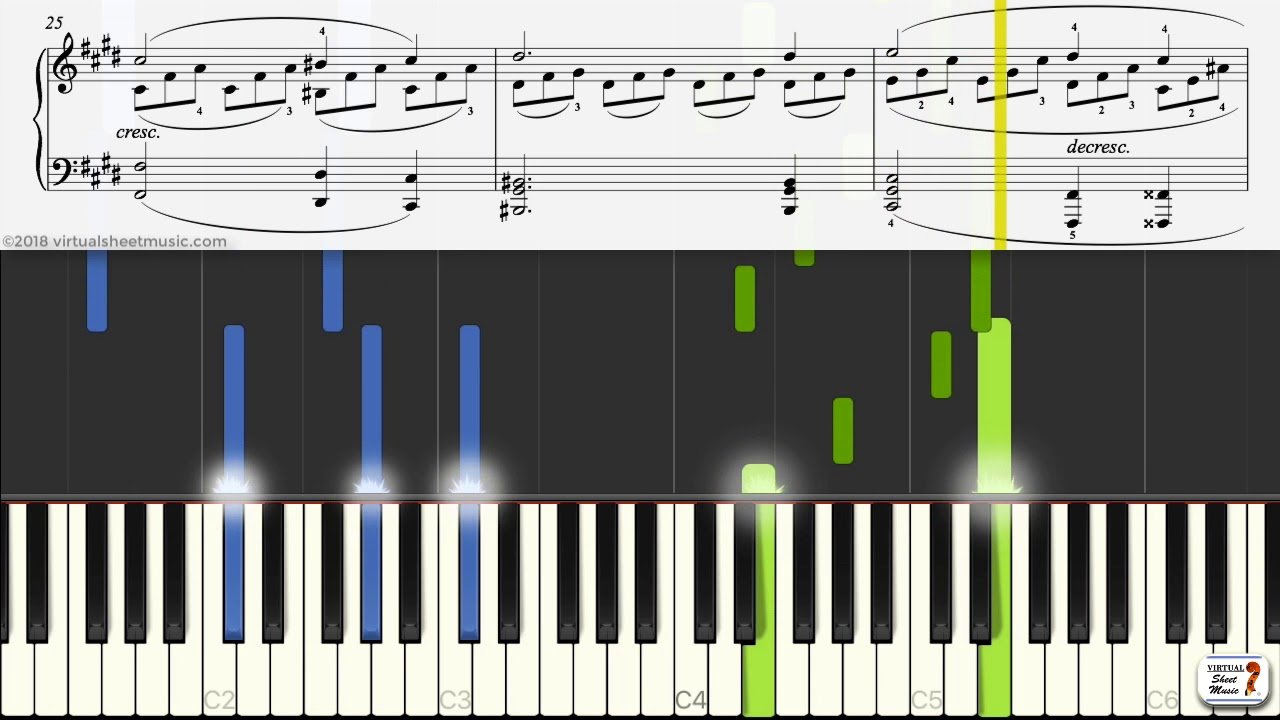
The first movement’s opening measures contain the piece’s most recognizable material. Understanding these notes forms the foundation for successful performance.
Right Hand Notes and Melody
The right hand begins on G#, the dominant note of C-sharp minor. The opening melody follows this pattern: G# – C# – E – G# – C# – E (repeated). These notes form a C-sharp minor triad in first inversion.
The melody note appears as the top voice in triplet arpeggios. Focus on bringing out this highest note louder than accompanying notes. The pattern continues: A – C# – E, then A – D – F#.
The melodic sequence progresses: G# – C – E – G# – C# – E – G# – C# – D# – F# – C – D# – E – G# – C#. Practice these notes slowly, memorizing the pattern before adding left hand. Each three-note grouping creates the flowing triplet texture.
Left Hand Bass Notes
The left hand provides sustained bass foundation in octaves. The opening bass note is C# in the lower register. Hold this note for four beats while the right hand plays triplet arpeggios.
The bass progression moves: C# – B – A – F# – G# – G# – C# – C – C# – F# – B – B – E. Each note sustains for full measure durations. These notes create the harmonic foundation supporting the right hand melody.
Proper pedaling sustains bass notes throughout each measure. The pedal changes with each new bass note, creating legato connections. Practice the left hand separately until the rhythm and notes become automatic.
Combining Both Hands
Start by practicing hands separately until each part is secure. Play right hand triplets evenly and smoothly without rushing. Ensure left hand bass notes sustain their full duration.
When combining hands, focus on steady triplet rhythm in right hand. The left hand bass notes should sound precisely with right hand’s first triplet note. Count “1-2-3, 2-2-3, 3-2-3, 4-2-3” to maintain triplet consistency.
The challenge lies in playing flowing triplets while emphasizing the top melody note. Practice this balance by exaggerating the melody note volume initially. Gradually bring both hands together at slow tempo, increasing speed incrementally.
Step-by-Step Practice Guide
Systematic practice methods accelerate learning while preventing bad habits. This structured approach works for all skill levels.
Practice Routine for Beginners
Begin with five-minute daily practice sessions focusing on measures 1-4 only. Play each hand separately at half tempo before combining. Accuracy takes absolute priority over speed at this stage.
Use a metronome starting at 40 BPM for triplet subdivisions. Increase tempo by only 4 BPM increments when perfectly comfortable. This gradual approach prevents rushing and ensures solid technique.
1st Week : Master measures 1-8 hands separately. 2nd Week : Combine hands for measures 1-8. 3rd Week : Add measures 9-16. This systematic expansion prevents overwhelming complexity.
Intermediate Practice Strategies
Intermediate players should practice difficult passages in isolation. Identify technical trouble spots and create targeted exercises. Practice these challenging sections at various tempos and dynamics.
Block practice helps learn chord progressions and hand positions. Play all notes of each beat simultaneously as chords. This reveals harmonic structure and finger positioning requirements.
Rhythm variation practice strengthens technical control. Play dotted rhythms, then reverse dotting patterns. Practice with different articulations: staccato, legato, and varying accents. These variations build comprehensive technical mastery.
Advanced Performance Preparation
Advanced players focus on musical interpretation beyond note accuracy. Experiment with subtle rubato, tempo flexibility that enhances expression. Study multiple recordings to understand interpretive possibilities.
Practice performing complete run-throughs without stopping for mistakes. This builds performance stamina and error recovery skills. Record practice sessions to identify areas needing improvement.
Memory work becomes essential for polished performance. Memorize in small sections, then gradually connect passages. Understand harmonic structure to support secure memorization. Practice from different starting points throughout the piece.
Pedaling Techniques
Proper pedal technique is absolutely essential for Moonlight Sonata’s characteristic sound. Beethoven specifically marked “si deve suonare tutto questo pezzo delicatissimamente e senza sordini.”
Understanding Sustain Pedal Marking
Beethoven’s instruction translates to “this entire piece must be played very delicately and without dampers.” “Senza sordini” means without dampers, indicating continuous sustain pedal use. This creates the piece’s signature blended, atmospheric sound.
The sustain pedal connects bass notes across measures while right hand plays. Without pedal, the piece sounds disconnected and loses its flowing character. Continuous pedaling requires careful technique to avoid muddy harmonies.
Pedal Changing Technique
Change pedal precisely with each new bass note in left hand. The technique is “lift and press” synchronized with bass note strikes. This maintains legato connection while clearing previous harmonies.
Practice the pedal change motion slowly and deliberately at first. Lift the foot slightly and press again without complete pedal release. Advanced technique involves half-pedaling for subtle harmonic blending.
Listen carefully for harmonic clarity when pedaling. Muddy, unclear harmonies indicate pedal changes occurring too slowly. Crystal-clear but connected sound indicates proper pedal technique execution.
Common Pedaling Mistakes
Over-pedaling creates harmonic mud where individual notes become indistinguishable. This typically results from delayed pedal changes or excessive pedal depth. Always prioritize harmonic clarity over excessive sustain.
Under-pedaling makes the piece sound choppy and disconnected. The flowing arpeggios should blend seamlessly across measures. Insufficient pedal destroys the piece’s essential atmospheric quality.
Asynchronous pedal changes occur when pedal and bass notes don’t align. Practice pedal changes with a metronome to develop precise timing. Record yourself to identify any pedaling timing issues.
Tempo and Dynamics
Musical expression through tempo and dynamics transforms notes into art. Beethoven’s markings provide crucial interpretive guidance.
Adagio Sostenuto Interpretation
“Adagio sostenuto” indicates slow, sustained tempo around 50-60 BPM. Each triplet quarter note receives approximately one second duration. This deliberate pace allows emotional expression and melodic clarity.
“Sostenuto” emphasizes sustained, connected playing throughout. Avoid rushing faster passages or slowing overly in technical sections. Maintain consistent underlying pulse while allowing subtle flexibility.
Different pianists interpret the exact tempo variously. Historical performances often used slower tempos than modern interpretations. Find a tempo allowing complete technical control and musical expression.
Dynamic Markings Throughout
Beethoven marks the opening “pp” (pianissimo), meaning very soft. This whisper-quiet beginning establishes the piece’s intimate, contemplative character. Maintaining this softness requires exceptional finger control.
Dynamic swells to “mf” (mezzo-forte) occur in emotionally intense passages. Return to softer dynamics creates dramatic contrast and emotional impact. These dynamic variations prevent monotonous performance.
The melody line requires slightly more emphasis than accompaniment notes. Create this balance through finger pressure variation, not overall volume changes. The result is a clear melody floating above subtle accompaniment.
Expressive Timing and Rubato
Rubato means “robbed time” – subtle tempo flexibility for expression. Slight slowing at phrase endings feels natural and musical. Compensation through slight acceleration maintains overall tempo stability.
Apply rubato tastefully without exaggeration or predictable patterns. Let musical phrases breathe naturally like spoken language inflections. Over-use creates mannered, affected performance lacking authenticity.
Study Beethoven’s phrase markings to guide rubato placement. Longer note values and phrase conclusions invite subtle tempo relaxation. Inner phrases maintain steadier tempo with minimal flexibility.
Fingering Recommendations
Strategic fingering choices prevent technical difficulties and enable musical phrasing. Professional editions provide expert fingering suggestions.
Right Hand Fingering Patterns
The opening triplet arpeggio uses fingers 5-3-1 (pinky-middle-thumb) repeatedly. This pattern allows smooth position changes and consistent sound. Alternative 5-2-1 fingering works for smaller hands.
Melodic passages require thumb under and finger over techniques. Practice these position changes slowly until completely smooth. Avoid collapsing the hand or twisting the wrist during position shifts.
Weak fourth and fifth fingers need special attention in melody notes. Strengthen these fingers through daily technical exercises. Finger independence exercises significantly improve melody projection ability.
Left Hand Octave Technique
Left hand octaves require fifth finger and thumb spanning eight notes. Smaller hands may roll octaves rather than playing simultaneously. This accommodation maintains musical integrity without technical strain.
Keep the wrist relaxed and slightly elevated above keyboard. Hand tension causes fatigue and limits technical capability. Practice octaves with completely relaxed hand dropping from slightly above keys.
Arm weight provides power for octave bass notes. Let gravity assist rather than forcing keys down with finger pressure. This technique enables powerful bass without excessive hand tension.
Hand Span Challenges
Ninth intervals (one note beyond an octave) appear occasionally. Hands unable to reach ninths can arpeggiate or use pedal tricks. The sustain pedal holds lower notes while hand moves to upper notes.
Practice hand stretching exercises to gradually increase span capability. Never force beyond comfortable limits to avoid injury. Many professional pianists have relatively small hands and successful careers.
Alternative fingerings accommodate various hand sizes and technical preferences. Professional editions often provide multiple fingering options for difficult passages. Experiment to find what works best for your hand.
Common Mistakes and How to Avoid Them
Identifying and correcting common errors accelerates learning progress significantly. These mistakes appear across all skill levels.
Rushing the Triplets
Uneven triplet rhythm is the most common technical error. Players often rush through triplets rather than maintaining steady pulse. Use metronome practice to develop absolutely even triplet subdivision.
Count “1-2-3, 2-2-3, 3-2-3, 4-2-3” throughout practice sessions. This counting method prevents rushing and ensures rhythmic accuracy. Even advanced players benefit from occasional metronome practice.
Record practice sessions to objectively evaluate rhythmic steadiness. Uneven rhythms that feel correct while playing sound obviously wrong on playback. This feedback loop rapidly improves rhythmic control.
Melody Balance Issues
Failing to emphasize the melody note is extremely common. All three triplet notes sounding equally loud destroys musical clarity. Practice exaggerating melody note volume until proper balance becomes habitual.
Isolate the melody line, playing only top notes without arpeggios. This helps internalize the melodic contour and phrasing. Gradually add lower arpeggio notes while maintaining melody emphasis.
The strongest finger (thumb) often plays the quietest note required. Develop independent finger strength so all fingers can produce varied volumes. This control enables sophisticated voicing in complex textures.
Incorrect Pedaling
Changing pedal too late creates harmonic muddiness and blurred sound. Change pedal precisely synchronized with new bass notes. Practice pedal changes separate from note playing initially.
Changing pedal too early creates gaps in sound connection. The legato, flowing character disappears with premature pedal releases. Perfect timing requires focused practice and careful listening.
Forgetting to pedal at all is surprisingly common for beginners. The unpedaled result sounds completely wrong and disconnected. Beethoven specifically instructed continuous pedal use throughout this movement.
Simplified Arrangements for Beginners
Beginners benefit from progressive arrangements that build toward the original version. These adaptations make the piece accessible while maintaining musical integrity.
Easy Piano Versions
Beginner arrangements simplify the right hand to single-note melody. The left hand plays simple whole note bass without octaves. These arrangements preserve the melodic essence in manageable form.
Note letter names often appear inside note heads for reading assistance. This feature helps absolute beginners who haven’t mastered note reading. Gradually transition to standard notation as reading improves.
Some beginner versions transpose to C minor or D minor. These easier keys reduce the sharps from four to three or one. This simplification accelerates initial learning though changes original tonality.
Progressive Difficulty Levels
1st Level : Right hand melody only, no left hand or pedal. 2nd Level : Simple left hand whole notes added, basic pedaling introduced. 3rd Level : Right hand arpeggios simplified to eighth notes.</p>
4th Level : Partial triplet arpeggios with some simplification. 5th Level : Complete original version with all technical demands. This progression builds technique systematically over months or years.
Publishers like Alfred and Faber produce excellent graded arrangements. These editions specify exact difficulty level and prerequisite skills. Choose arrangements matching current ability for optimal learning.
When to Advance to Original
Advance to the original when simplified versions feel completely comfortable. Technical security at slower tempos indicates readiness for increased complexity. Don’t rush progression; solid foundations prevent future problems.
The original version requires secure octave technique in left hand. Right hand must play even triplets with melody emphasis. Pedal coordination must be completely automatic and precise.
Typically, late intermediate to early advanced students tackle the original. This corresponds to approximately 3-5 years of consistent piano study. Individual progress varies based on practice quality and natural aptitude.
Learning with Technology
Modern technology offers unprecedented learning resources for Moonlight Sonata. These tools supplement traditional practice methods effectively.
Interactive Sheet Music Apps
Apps like La Touche Musicale provide note-by-note interactive learning. The app waits for correct notes before progressing automatically. This prevents practicing mistakes and ensures accurate note learning.
Simply Piano offers similar interactive feedback using device microphone. Flowkey and Piano Marvel provide extensive classical repertoire libraries. These apps typically charge monthly subscription fees ($10-20).
Interactive apps work best alongside traditional practice methods. They excel at initial note learning but can’t replace musical understanding. Use technology as a supplement, not a complete replacement.
YouTube Tutorials
Countless YouTube channels offer free Moonlight Sonata tutorials. Pianote, HDpiano, and Synthesia channels provide high-quality instruction. Visual learning complements traditional sheet music reading.
Synthesia-style tutorials show colored blocks on virtual keyboards. These appeal to visual learners and gaming-oriented students. However, they may delay traditional music reading skill development.
Quality varies dramatically across YouTube tutorials. Verify instructor credentials and check viewer comments before following instructions. Incorrect technique advice can create problems requiring months to correct.
MIDI Files and Backing Tracks

MIDI files allow slowing down playback without pitch changes. Analyze exactly how the piece should sound at various tempos. Some software displays MIDI notes on virtual keyboards simultaneously.
Accompaniment tracks for second and third movements enable duet practice. Playing along with recorded orchestrations adds musical context. These resources make solo practice more engaging and musical.
MuseScore’s website offers thousands of user-created MIDI files. Download these files into notation software for study and practice. Transpose, isolate hands, or modify arrangements as needed.
Performance Tips
Transforming practice-room playing into confident performance requires specific preparation. These strategies ensure successful public performances.
Memorization Strategies
Memorize in small sections using multiple memory types simultaneously. Visual memory recalls how the score looks on the page. Kinesthetic memory involves muscle memory and physical sensations.
Analytical memory understands harmonic progressions and structural patterns. Aural memory recalls how the piece sounds in your mind. Combining all memory types creates secure, reliable memorization.
Practice performing from memory starting at various points throughout the piece. This ensures you haven’t merely memorized a continuous sequence. Test yourself by starting at different sections randomly.
Managing Performance Anxiety
Performance anxiety affects even professional musicians regularly. Deep breathing exercises before performing reduces physical anxiety symptoms. Arrive early to familiarize yourself with the performance space.
Mental rehearsal visualizes successful performance in detail. Imagine yourself playing perfectly in the actual performance environment. This mental practice activates similar neural pathways as physical practice.
Accept that some nervousness is normal and even beneficial. Adrenaline enhances focus and energy when properly channeled. Reframe anxiety as excitement about sharing music with others.
Connecting with the Audience
Make eye contact with audience members before beginning. This connection establishes rapport and reduces isolation feelings. Remember that audiences want you to succeed and enjoy the music.
Take your time settling at the piano and finding focus. Rushing the opening from nervousness undermines musical quality. Breathe deeply, feel the tempo internally, and begin deliberately.
After performing, acknowledge applause graciously before leaving the stage. Your presence and confidence affect how audiences perceive the performance. Project calm confidence regardless of any mistakes made.
Historical Recordings to Study
Listening to great pianists illuminates interpretive possibilities. These landmark recordings offer valuable learning insights.
Classic Interpretations
Artur Schnabel’s 1933 recording represents the first complete Beethoven sonata cycle. His intellectual approach emphasizes structural clarity and rhythmic precision. This recording influenced generations of Beethoven interpretation.
Wilhelm Kempff recorded the complete sonatas multiple times (1950s and 1960s). His lyrical, singing tone and subtle rubato showcase romantic sensitivity. These recordings balance classical form with romantic expression beautifully.
Alfred Brendel’s interpretations emphasize Beethoven’s innovative harmonic language. His recordings demonstrate how to voice complex textures clearly. Study his pedaling technique through careful listening to harmonic clarity.
Modern Performances
Mitsuko Uchida’s recordings combine technical perfection with deep musical insight. Her transparent textures reveal inner voices and counterpoint clearly. Modern recording quality captures subtle dynamic nuances.
András Schiff’s complete Beethoven cycle emphasizes historical performance practice. He uses fortepiano for some recordings, revealing Beethoven’s original sound world. These interpretations offer fresh perspectives on familiar music.
Lang Lang’s performances bring romantic passion and technical brilliance. His expressive approach appeals to contemporary audiences particularly. Compare his interpretation with more classical approaches for perspective.
Comparing Different Approaches
Tempo choices vary significantly among professional pianists. Some interpretations use slower, more contemplative tempos around 50 BPM. Others adopt slightly faster 60-70 BPM for increased forward momentum.
Dynamic contrasts range from subtle to dramatic across interpretations. Compare how different pianists balance melody against accompaniment. Notice pedaling differences and their impact on harmonic clarity.
No single “correct” interpretation exists for this masterpiece. Each valid approach reveals different aspects of Beethoven’s genius. Develop your personal interpretation informed by multiple perspectives.
Historical Context and Background
Understanding Beethoven’s life and times enriches musical interpretation. Historical knowledge informs authentic performance practice.
Beethoven’s Life in 1801
Beethoven was 30 years old when composing Moonlight Sonata. He had recently moved to Vienna permanently, establishing his career. By 1801, his hearing problems were becoming increasingly apparent.
His Heiligenstadt Testament (1802) documents the despair over impending deafness. The Moonlight Sonata reflects this emotional turmoil profoundly. The piece’s introspective quality mirrors Beethoven’s inner struggles.
Despite hearing loss, this period was highly productive compositionally. The First and Second Symphonies appeared around this time. Beethoven was transitioning from Classical to Romantic musical style.
Dedication to Giulietta Guicciardi
Countess Giulietta Guicciardi was Beethoven’s 17-year-old piano student. She came from aristocratic Italian family living in Vienna. Beethoven’s dedication suggests romantic attachment beyond teacher-student relationship.
Their relationship lasted only about a year before Giulietta married another. Some scholars believe she was Beethoven’s “Immortal Beloved” from his famous letters. However, this identification remains historically disputed.
The dedication adds romantic tragedy to the sonata’s interpretation. Whether Beethoven’s love was reciprocated remains uncertain. This unrequited or lost love theory influences romantic performance approaches.
Reception and Legacy
The sonata achieved immediate success upon 1802 publication. Critics praised its innovative structure and emotional depth. The public embraced its accessible beauty enthusiastically.
During Beethoven’s lifetime, it was his most frequently performed sonata. Its popularity has never diminished across two centuries. The nickname “Moonlight” cemented its place in popular culture.
The piece influenced countless composers including Chopin and Liszt. Its atmospheric opening inspired many romantic piano works. Today it remains one of the most recorded classical pieces.
Musical Analysis
Deep structural understanding enhances interpretation and memorization. This analysis reveals Beethoven’s compositional genius.
Form and Structure
The first movement follows a modified sonata form. The exposition presents primary theme in C-sharp minor. Development section explores related keys through modulation.
The recapitulation returns to C-sharp minor with elaborated material. A brief coda concludes the movement quietly. This formal structure provides large-scale coherence beneath surface complexity.
Unlike typical sonatas, this movement lacks strong contrast between themes. Instead, variations of a single idea dominate throughout. This unified approach creates the movement’s meditative, introspective character.
Harmonic Progression
The opening establishes C-sharp minor firmly through tonic pedal points. Modulation to the relative major (E major) provides brief respite. These key relationships follow classical harmonic conventions.
Chromatic harmonies appear frequently, adding color and tension. Diminished seventh chords heighten emotional intensity at climactic moments. Beethoven’s harmonic language previews later Romantic innovations.
The bass line moves slowly in whole and half notes. This foundation supports faster harmonic rhythm in upper voices. Understanding harmonic progression aids memorization and musical phrasing.
Melodic Development
The opening melodic gesture generates most subsequent material. Beethoven develops this idea through variation and elaboration. This motivic unity creates organic coherence throughout the movement.
The melody often appears in the soprano voice above accompaniment. Occasionally, melody shifts to inner voices or bass. Tracking melodic movement across voices reveals compositional sophistication.
Sequences and imitation appear frequently in melodic development. These techniques extend musical ideas systematically. Recognizing these patterns aids learning and memory significantly.
Frequently Asked Questions (FAQs)
Where can I download Moonlight Sonata sheet music for free?
MuseScore and IMSLP (International Music Score Library Project) offer free PDF downloads of various arrangements. These sites provide both the original Beethoven score and simplified versions for different skill levels in public domain.
What level pianist can play Moonlight Sonata?
The first movement suits late beginner to intermediate pianists with proper simplified arrangements, while the original requires late intermediate to early advanced skills. The third movement demands advanced to professional-level technique and should only be attempted by experienced pianists.
Is Moonlight Sonata difficult to learn?
The first movement is moderately challenging with its triplet arpeggios, pedaling, and C-sharp minor key signature requiring four sharps. Beginners can start with simplified arrangements and progress gradually to the original version over several months of dedicated practice.
How long does it take to learn Moonlight Sonata?
Intermediate pianists typically need 2-6 months to master the first movement, while beginners may require 6-12 months with simplified versions. The complete three-movement sonata can take advanced pianists 6-12 months to perform at concert level.
What key is Moonlight Sonata in?
Moonlight Sonata is in C-sharp minor, which has four sharps (F#, C#, G#, D#) in the key signature. Beginner arrangements sometimes transpose it to easier keys like D minor or C minor to reduce reading difficulty.
Do I need pedal to play Moonlight Sonata?
Yes, sustain pedal is essential for authentic performance of Moonlight Sonata. Beethoven specifically marked “senza sordini” (without dampers), meaning continuous pedal use throughout the first movement to create its characteristic flowing, atmospheric sound.
What does Adagio Sostenuto mean?
Adagio Sostenuto means “slow and sustained,” indicating the first movement’s tempo should be approximately 50-60 BPM. This deliberate pace allows the piece’s emotional depth and melodic beauty to fully emerge while maintaining connected, legato phrasing.
Can beginners play Moonlight Sonata?
Beginners can play simplified arrangements designed for their level, featuring single-note melodies and easy left-hand patterns. These versions preserve the piece’s essence while removing technical challenges like full triplet arpeggios and octave stretches.
What is the hardest part of Moonlight Sonata?
Maintaining even triplet rhythm while emphasizing the melody note and coordinating precise pedal changes presents the greatest challenge in the first movement. The third movement’s rapid arpeggios and powerful fortissimo passages require advanced technical mastery.
Why is it called Moonlight Sonata?
German poet Ludwig Rellstab compared the first movement to moonlight shining on Lake Lucerne, giving the piece its popular nickname five years after Beethoven’s death. Beethoven himself never used this name, preferring “Sonata quasi una fantasia” (Sonata in the manner of a fantasy).
Conclusion
Moonlight Sonata sheet music remains one of classical piano’s most accessible yet profound masterpieces in 2026. Whether downloading free PDF scores from MuseScore, purchasing professional urtext editions from Henle, or using interactive apps like La Touche Musicale, quality resources abound for every skill level.
The first movement’s iconic triplet arpeggios, hauntingly beautiful melody in C-sharp minor, and essential pedaling techniques require dedicated practice but reward pianists with timeless musical expression.
Understanding Beethoven’s historical context, his relationship with Giulietta Guicciardi, and the piece’s evolution from “Sonata quasi una fantasia” to “Moonlight Sonata” deepens interpretive authenticity.
From beginner arrangements with note letter names to the original advanced score, progressive learning paths make this masterpiece achievable for pianists at every stage.


