


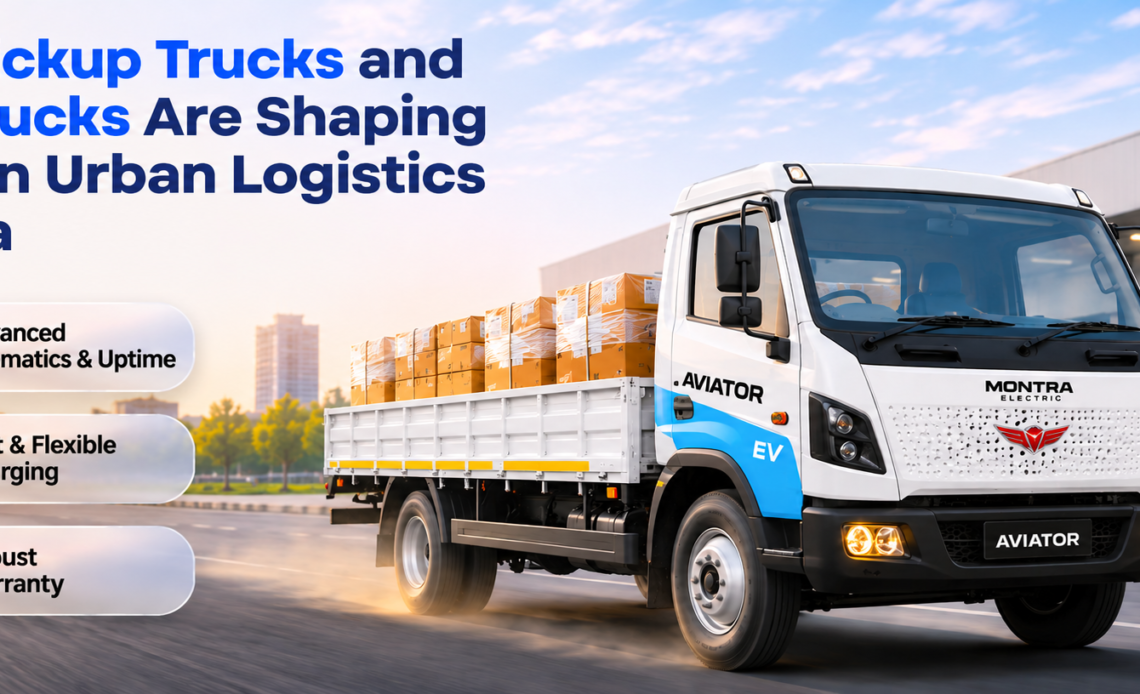
Walk through any Indian city at seven in the morning and the vehicles doing the real work are not the large trucks parked on the ring road. They are the small ones, the pickups and mini trucks threading through lanes that were never designed for freight, dropping off vegetables, packaged goods, building material and parcels before the shops open. Urban logistics in India runs on this class of vehicle, and the way it is changing says a great deal about where the country’s commercial transport is headed.
Urban delivery needs: shorter routes, tighter streets and faster turnaround
The economics of city delivery are different from those of highway haulage. A vehicle on an intra-city duty cycle rarely covers more than 150 kilometres in a day, but it may make thirty or forty stops in that distance. It idles in traffic, waits at loading bays and reverses into spaces with centimetres to spare. What matters is not top-end performance but the ability to turn around quickly, carry a worthwhile load and keep running day after day without expensive downtime.
Streets inside older commercial districts add their own constraints. Narrow approaches, low overhead wires and restricted entry hours mean that larger vehicles are either impractical or simply not permitted. The result is that a significant share of the goods entering a city is transferred to smaller vehicles at the outskirts, and the last leg of the journey depends on how well those smaller vehicles are suited to the job.
Delivery windows have also tightened. E-commerce, quick commerce and organised retail have trained customers to expect same-day or next-day fulfilment, and that expectation flows straight back to the fleet. A vehicle that spends time on refuelling or sits at a workshop for a week eats directly into the number of orders a business can serve.
How pickup trucks and mini trucks support last-mile business operations
The pickup truck has become the default tool for this work because it balances payload, access and cost better than anything larger or smaller. It can carry a tonne or more, it fits where a medium truck cannot and it is light enough to be driven by a wider pool of drivers. For a distributor serving kirana stores, a courier company running a hub-and-spoke network or a contractor moving material between sites, it is the vehicle that gets used every single day.
The mini truck occupies the same space with a slightly different emphasis. It is typically chosen where loads are lighter or where the route is almost entirely inside dense urban areas. Both categories share the same operating logic: short trips, frequent stops, predictable routes and a strong sensitivity to running costs, because the margin on each delivery is small.
That sensitivity is why the running cost per kilometre has become the number fleet owners watch most closely. Fuel, maintenance and the number of days a vehicle is actually on the road determine whether the business makes money, and this is where the newer generation of small commercial vehicles has started to change the calculation.
Where electric light commercial vehicles such as EVIATOR fit into evolving fleets
Electric small commercial vehicles were initially treated as a niche option for operators with sustainability targets. That framing has shifted as the vehicles themselves have matured. Montra Electric’s EVIATOR is a useful example of what the current generation looks like in practice: a 3.5-tonne class electric pickup with a 10.3-foot loading deck and a rated payload capacity of about 1.7 tonnes, which puts it squarely in the range that urban distributors already use.
The specifications that matter for a city duty cycle are the ones Montra Electric has emphasised. The vehicle produces 80 kW of peak power and 300 Nm of peak torque, which is what allows it to pull away from a standstill with a full load without drama. The EVIATOR range is offered with three battery options, with the 32 kWh version rated for a real-world range of 140+ km, the 40 kWh version for 170+ km and the 50 kWh version for 200+ km, so an operator can match battery size to how far the vehicle actually travels rather than paying for capacity that goes unused.
Charging is the practical question every fleet asks, and the answer here is flexible. AC charging takes the battery from 0 to 80 percent over the night, which suits overnight depot charging, while CCS2 DC fast charging covers the same 0 to 80 percent in about an hour for mid-shift top-ups. Montra Electric’s own figures suggest the vehicle eliminates roughly Rs 1,200 to 1,500 in daily diesel costs for an equivalent operation, with a full charge costing around Rs 400 in electricity.
Beyond the drivetrain, features such as over-the-air software updates, a connected app, fleet management tools and a 24/7 uptime centre that Montra Electric says keeps vehicles running around 95 percent of the time reflect how the vehicle is intended to be used: not as a single truck but as part of a managed fleet. A standard warranty of 5 years or 1.75 lakh km on the vehicle, extendable to 7 years or 2.5 lakh km, is also a signal that the manufacturer expects these vehicles to work hard for a long time.
None of this makes diesel pickups obsolete overnight, and operators with long intercity legs or no access to charging will continue to run them. But for the urban delivery pattern described above, with its short routes, predictable mileage and depot-based operations, the electric pickup and mini truck have moved from experiment to serious contender, and the fleets that are growing fastest in Indian cities are increasingly the ones built around them.
Frequently asked questions
What is the difference between a pickup truck and a mini truck for business use?
The terms overlap, but a pickup truck generally refers to a vehicle in the 2 to 3.5-tonne gross vehicle weight class with a larger load deck and higher payload, while a mini truck is usually smaller and lighter, chosen for dense city routes. Both are used for last-mile and intra-city distribution.
How far can an electric pickup truck travel on a single charge?
It depends on battery size and load. The Montra Electric EVIATOR, for example, is rated for a real-world range of 140+ km with its 32 kWh battery, 170+ km with 40 kWh and 200+ km with 50 kWh, which covers most urban delivery duty cycles.
Is charging infrastructure a barrier for electric mini trucks in Indian cities?
Less than it used to be. Most urban fleets charge overnight at a depot using AC charging, and vehicles such as the EVIATOR also support CCS2 DC fast charging that reaches 80 percent in about an hour for mid-day top-ups.

