


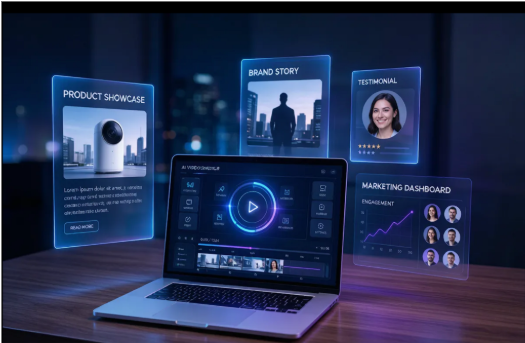
Why Video Is the Engagement Currency of 2026
If you’re running a business in 2026, you already know the numbers. Video content generates more shares, longer session times, and higher conversion rates than any other format. Customers skim text, scroll past images, but they watch video. According to industry research, viewers retain 95% of a message when they watch it in a video, compared to just 10% when reading it in text.
But knowing video works and actually producing enough of it are two very different things. That gap – between the volume of video a business should create and what it can create – is where most companies lose ground every single day.
AI-generated video is closing that gap. And it’s doing so faster than most marketing teams realize.
The Production Bottleneck Businesses Face
Let’s be honest about what traditional video production looks like for a business:
| Traditional Step | Typical Cost | Typical Time |
| Scriptwriting | Copywriter hours or agency fees | 1–3 days |
| Filming (crew, studio, talent) | 2,000–15,000+ per shoot | Half day to multiple days |
| Editing and post-production | Editor hours or outsourced | 3–7 days |
| Localization (dubbing, subtitles) | Per-language agency fees | Additional days per language |
| Revisions | Rework cycles | Days per round |
For a large enterprise, this is expensive but manageable. For a small or mid-sized business – a DTC brand, a local retailer, a SaaS startup, a real estate agency – this cost structure makes consistent video production nearly impossible. The result: marketing teams know they should be creating more video, but they simply can’t produce it fast enough or affordably enough to keep up with demand.
AI changes the economics entirely. What required a crew, a studio, and a week of post-production can now be done by a single marketer with a laptop – often in an afternoon, often for free.
Product Introductions That Actually Convert
The product page is where intent meets decision. Yet most product pages still rely on static images and a bullet list of features. Customers are asked to imagine how the product works, how it fits into their life, what it feels like to use.
AI-generated video eliminates that imagination gap.
Instead of three photos and a spec sheet, a business can now produce:
- Animated product demos – a static product image transforms into a rotating, zooming, context-rich video clip showing the product in use
- Feature highlight videos – short, punchy clips that walk through key benefits with motion graphics and AI voiceover
- Comparison videos – dynamic side-by-side visuals that make abstract differences immediately tangible
The key insight: these videos don’t need a film crew. A marketer uploads product images, writes a short script, and AI handles the animation, voiceover, and assembly. What used to be a week-long production becomes a task that fits between morning meetings.
For businesses with large product catalogs, this is transformative. A furniture retailer with 500 products can’t afford to film 500 videos. But with AI, every product image can become a short showcase clip – automatically, at scale, at a fraction of the cost.
Brand Storytelling at Scale
Customers don’t connect with feature lists. They connect with stories. But brand storytelling through video has always been resource-intensive – the kind of thing reserved for a flagship campaign or a homepage hero video, produced once a year if the budget allows.
AI dissolves that constraint. A brand can now produce story-driven video content continuously:
- Founder narratives – The company’s origin story, told through animated archival photos and AI-narrated voiceover
- Customer testimonials – Real customer stories brought to life with dynamic visuals, even when you only have a written review and a photo
- Behind-the-scenes content – Day-in-the-life clips, culture videos, and process explainers generated from existing imagery and AI motion
- Seasonal campaigns – Holiday, launch, and event-specific videos produced on demand without scheduling a single shoot
The result is a content cadence that keeps audiences engaged across every touchpoint – social media, email, website, ads – without the production bottleneck that forced brands to choose between quality and quantity.
Personalized Customer Communication
This is where AI video creates engagement that traditional formats simply can’t match: personalization at scale.
Imagine a customer receives a video message that opens with their name, references the product they just purchased, and walks them through setup – all delivered in a friendly, human voice with a presenter who appears to be speaking directly to them. That level of personalization, done with traditional video, would require filming a unique video for every customer. Impossible.
With AI, it’s a template and a data feed.
- Onboarding videos – Personalized walkthroughs that address the customer by name and reference their specific use case
- Post-purchase thank-yous – A brief, branded video message that makes a transaction feel like a relationship
- Re-engagement content – Dynamic videos that reference what a customer browsed or abandoned, with a tailored call to action
- Customer support explainers – Instead of a wall of text, send a short video that visually answers the customer’s specific question
The engagement lift from personalized video is substantial. Open rates, click-through rates, and time-on-page all increase meaningfully when a customer sees content that feels made specifically for them – because with AI, it actually is.
Turning Product Images Into Dynamic Marketing Assets
One of the most immediately valuable AI capabilities for businesses is image-to-video generation. Most companies already have extensive libraries of product photography – high-quality images shot for catalogs, websites, and ads. These assets are static. They sit in folders, used once and forgotten.
AI can turn every one of those images into a dynamic video clip.
- A product photo becomes a 5-second showcase with subtle rotation and depth
- A flat lay becomes a cinematic pull-focus shot
- A lifestyle image gains ambient motion – steam rising from a coffee cup, fabric drifting in a breeze, light shifting across a surface
For businesses that need high-volume video content across multiple channels and markets, tools that offer image to video ai free unlimited are especially valuable. The “unlimited” aspect matters because marketing teams don’t just need one video – they need variations for Instagram, TikTok, YouTube Shorts, email headers, ad creatives, and landing pages. Per-clip pricing would make this unsustainable. Removing that cap makes large-scale video production viable for businesses of any size.
The compounding effect: a single product photo, once a static asset, becomes the source material for dozens of video variations – each optimized for a different platform, audience, or campaign objective.
Lip Sync for Multilingual and Spokesperson Content
For businesses operating across regions – or even just targeting multilingual audiences within a single market – video localization has historically been a major friction point. Dubbing is expensive. Subtitles are accessible but don’t deliver the same emotional impact as hearing a message in your own language. And re-shooting a spokesperson video for every market is economically unfeasible.
AI lip-sync technology solves this at the root.
By analyzing an audio track and adjusting the speaker’s facial movements frame by frame, AI creates videos where the presenter appears to genuinely speak the target language – mouth movements, timing, and micro-expressions all aligned. The result is a localized video that feels native, not dubbed.
For marketing teams exploring this capability without upfront investment, there are tools that provide lip sync ai online free no sign up – you can test the technology in-browser on an existing video before committing to a broader localization strategy. This is ideal for pilot projects: localize one product demo into three languages, measure the engagement difference, and scale from there.
Where lip sync delivers the most business value
- Global product launches – One spokesperson video, localized into 15+ languages with natural lip movement
- Regional ad campaigns – The same creative, adapted for each market without re-shooting
- Training and internal comms – Corporate training videos that every employee can watch in their preferred language
- Customer education – Tutorial content that reaches non-English-speaking customers with the same clarity as the original
The business case is straightforward: one production, multiplied across markets, with each version feeling authentic to its audience. That’s not just efficiency – it’s a direct path to higher engagement in every region you operate in.
Measurable Engagement Impact
The value of AI-generated video isn’t theoretical. Businesses adopting these tools are seeing concrete, measurable improvements:
| Metric | Typical Impact |
| Video output volume | 3–5x increase with the same headcount |
| Time-to-publish | From weeks to hours |
| Localization cost | Up to 80% reduction vs. traditional dubbing |
| Engagement rate (social) | 20–40% higher for video vs. static content |
| Email click-through | 2–3x lift when video is included |
| Product page conversion | 10–30% increase with video vs. images only |
But the most significant impact is often the hardest to quantify: agility. When a marketing team can produce a video in hours instead of weeks, they can respond to trends, test messaging, and iterate on creative in real time. That responsiveness compounds into a competitive advantage that static, slow-moving competitors simply can’t match.
A Practical Adoption Framework
If you’re a business leader or marketing manager considering AI-generated video, here’s a framework for adoption that minimizes risk and maximizes learning:
Phase 1: Audit and Identify (Week 1)
Review your existing content. Where are you using static images where video would perform better? Where is localization needed but too expensive? Where are response times too slow because video production can’t keep up? Identify 2–3 high-impact, low-complexity use cases to pilot.
Phase 2: Pilot and Measure (Weeks 2–4)
Select free or low-cost AI tools and produce video for your pilot use cases. Don’t aim for perfection – aim for comparison. Run an A/B test: the existing static content vs. the AI-generated video. Measure engagement, click-through, conversion, or whatever metric matters for that specific touchpoint.
Phase 3: Scale What Works (Months 2–3)
Once you have data proving the impact, scale the winning approach. Build it into your standard workflow. Train your team. Then move to the next use case on your list. The goal is iterative adoption – each cycle proves value and builds internal confidence.
Phase 4: Integrate and Automate (Ongoing)
For mature adoption, integrate AI video generation into your content pipeline. Connect it to your product catalog so new products automatically generate showcase videos. Set up templates for personalized customer communications. Build localization into your launch process by default.
The Competitive Reality
Here’s the uncomfortable truth for businesses still on the sidelines: your competitors are already doing this.
The companies winning attention in 2026 aren’t the ones with the biggest production budgets. They’re the ones with the fastest content cycles. They can launch a product on Monday and have video assets live across every channel by Tuesday. They can localize a campaign into twelve languages without blinking. They can personalize a customer journey at a scale that feels impossible with traditional methods.
AI-generated video isn’t a future technology being evaluated in a strategy deck. It’s a present-day capability that’s actively reshaping who wins and who gets ignored. The cost of adopting is low and falling. The cost of waiting is measured in lost engagement, lost customers, and lost market position – and that cost is rising every quarter.
The businesses that treat AI video as a core part of their engagement strategy – not an experimental side project – will be the ones defining what modern customer communication looks like. The question isn’t whether to adopt. It’s how quickly you can start.
Your customers are already consuming video from the brands that moved fast. The gap is widening every day you wait. The tools are ready. The only question is whether you are.

