


The Multi-Billion Dollar Trap of Dead Air
Let’s be real. The absolute worst thing you can broadcast to your audience is silence. Dead air massacres viewer retention within seconds. You instinctively reach for background music to mask ambient room noise and elevate the energy of your stream. The catch? Unverified audio in 2026 represents an existential threat to your digital livelihood. Let’s look at the modern tech stack. The detection algorithms hunting on Twitch, YouTube Live, and Kick are utterly ruthless today. A stray copyrighted hook will not just demonetize a video anymore. It rips your live feed offline instantly—and usually permanently tanks your account. Survival out here means ditching the old playbook and adopting a paranoid, bulletproof technical setup.
The Brutal Math of Algorithmic Hostility
Section 512 of the Digital Millennium Copyright Act essentially forces platforms to deploy automated content recognition systems just to maintain their safe harbor status. YouTube maintains the most aggressive infrastructure through Content ID. The system scans your live audio fingerprint against a massive database in real-time. If the algorithm catches unauthorized music, it physically overrides your feed with a static, unskippable warning screen. You have mere moments to mute the desktop audio and comply before the platform permanently revokes your live-streaming privileges. Twitch operates slightly differently. Its bots hunt your saved VOD archives in 24-hour intervals to systematically mute unauthorized tracks. Standard legal defenses are functionally obsolete here. Fair use claims cannot protect you because an algorithm cannot adjudicate legal nuance mid-stream.
Kick’s DMCA Absolutism
Kick operates with a slightly different philosophical approach, often emphasizing creator-led expression and contextual moderation for behavioral issues. A responsible reaction to an unexpected event on stream might mitigate a behavioral ban. Copyright law shreds that safety net completely. Kick complies directly with the DMCA. A single valid DMCA notice forces their hand legally, meaning they will yank your stream and hit your channel with a hard strike every single time. A live broadcast featuring unauthorized background music exposes you directly to federal statutory enforcement. You cannot talk your way out of a federal copyright strike.
Auditory Neurohacking and Cognitive Overload
Why risk the ban at all? Pure silence physically drains your chat. Science calls this the Arousal-Mood Hypothesis, but the street translation is simple: bored brains leave. Someone running laps in a slow-paced MMO has to pump fast beats through the mix, otherwise, the audience flatlines and tabs out to watch someone else. Conversely, intense competitive FPS gameplay demands ambient, low-valence audio loops. High-energy rock during an already stressful match pushes viewers into hyper-arousal, which severely fractures their attention. Lyrics also ruin retention metrics. The human brain possesses a strictly limited cognitive load. Vocal tracks directly compete with the verbal working memory required to process your live commentary. Instrumental beats act as a psychological tether—keeping the audience engaged without triggering structural interference in the brain.
The Casino Baseline and Dopamine Carrier Waves
Look closer and you see this sensory staging perfected in the iGaming niche. Casino streamers rely entirely on a meticulously constructed auditory environment to maintain viewer engagement between major events. A broadcast featuring a platform like the Golden Nugget Casino intrinsically relies on the native two-tone accents and spinning wheel noises of online slots to signal potential payouts. Just piping in the raw game audio creates a sterile, agonizing loop that actively drives people away. Smart money fixes this by layering upbeat, cleared synth tracks right over the core gameplay. That steady auditory pulse hides the dead space between hits; it keeps the chat wired and ready to pop off when the big multiplier finally drops. You must engineer this exact type of intentional audio landscape for your own specific niche, because viewers will not tolerate auditory whiplash.
Hardware Routing and the Ghost VOD
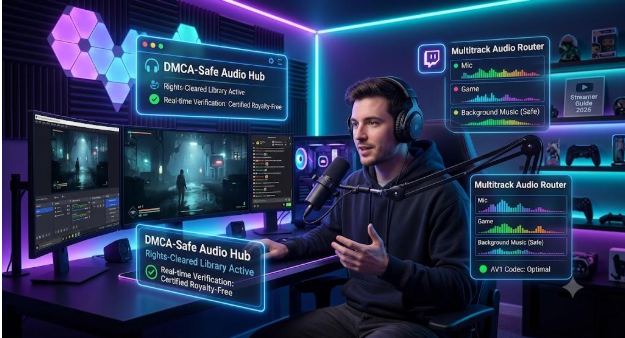
This landscape demands aggressive, zero-tolerance technical configurations. Multitrack audio routing within Open Broadcaster Software (OBS) is your absolute best defense against automated VOD strikes. Twitch natively supports a dedicated VOD Track feature to separate live audio from saved audio. Smart broadcasters route their live microphone and game audio to Track 1, while isolating their royalty-free background music player exclusively to that live feed. Track 2 receives no music data whatsoever. Your live audience gets the energetic vibe, and the copyright bots scan an archive consisting only of your voice. Vocal clarity in that live feed requires sidechain compression—commonly known as audio ducking. An OBS compressor set with a 32:1 ratio, a 100ms attack, and a 600ms release ensures the desktop music volume drops by 36 decibels the precise second you speak. Your voice always dominates the auditory mix.
Next-Gen Codecs and the Bandwidth Tax
Multitrack audio and high-fidelity visuals previously caused brutal network bottlenecks. Twitch Enhanced Broadcasting (TEB) completely altered this mathematical equation in 2026. This pipeline offloads the heavy video transcoding labor directly to your local hardware rather than relying on distant, overwhelmed Twitch servers. Modern graphics cards encode multiple video resolutions simultaneously. TEB utilizes lean HEVC and AV1 codecs, meaning a crisp 1440p feed takes up a fraction of the data it used to. All that leftover bandwidth becomes your secret weapon. Streamers can shove massive, lossless audio channels down the pipe alongside the video, and the stream will not drop a single frame. Your local rig handles the processing strain, preventing the dreaded “Encoding Overloaded” network crash right in the middle of a high-energy stream.
The Unforgiving Reality of the Pre-Clearance Era
Broadcasters today operate as their own ruthless compliance officers. The era of slapping “music credit to the artist” in a chat command and praying for algorithmic leniency is dead. A premium Spotify subscription grants you zero public performance rights for a broadcast. You must rely exclusively on pre-cleared libraries or generative AI audio tools to synthesize royalty-free instrumental tracks tailored to your specific mood. Algorithmic auditing tools—like the Mubert DMCA Copyright Checker—are now mandatory quarantine filters. You upload a track, wait for the acoustic fingerprint to cross-reference global databases, and immediately trash anything that flags a moderate risk. The barrier to entry for modern streaming is no longer just a decent microphone and a charismatic personality; it requires the systematic, cold-blooded elimination of every single digital liability before you ever hit the “Go Live” button.

