


All of Me sheet music has become one of the most sought-after downloads for musicians worldwide since John Legend released this heartfelt ballad in 2013.
Whether you’re searching for piano arrangements, guitar chords, or vocal scores, this comprehensive guide provides everything you need to master this timeless love song.
With over 143 different arrangements available across multiple skill levels—from beginner to advanced—finding the perfect All of Me sheet music for your instrument and ability has never been easier.
This guide explores every available version, teaching tips, and resources to help you perform this beautiful piece.
Understanding “All of Me” – The Song Behind the Sheet Music
Song Background and Composition
“All of Me” was written by John Legend (John Stephens) and Toby Gad. The song appeared on Legend’s 2013 album “Love in the Future.”
The ballad was dedicated to Legend’s wife, Chrissy Teigen. Its deeply personal lyrics express unconditional love and acceptance.
The song became a massive commercial success worldwide. It topped charts in numerous countries and became a wedding favorite.
Musical Structure and Key
The original recording is in the key of Ab Major. This key provides a warm, romantic tone perfect for the song’s message.
Most sheet music arrangements offer transposable versions. Musicians can shift to keys like C Major, G Major, or F Major for easier playing.
The song follows a simple verse-chorus structure. This repetitive format makes it accessible for learners while remaining emotionally powerful.
The tempo is moderate at approximately 120 BPM. This comfortable pace allows singers to deliver lyrics with emotional depth.
Why Musicians Love This Song
The chord progression is relatively simple yet sophisticated. Beginner and intermediate players can learn it without overwhelming difficulty.
The melody is memorable and emotionally resonant. Vocalists appreciate the range that showcases their abilities without being impossible.
The song’s versatility suits multiple instruments. From solo piano to full band arrangements, it adapts beautifully.
Types of All of Me Sheet Music Available
Piano Sheet Music Arrangements
Easy Piano: Simplified arrangements feature basic chords in the left hand. The melody in the right hand uses minimal octave jumps.
These versions typically remove complex rhythms and embellishments. Perfect for beginners who’ve completed 1-2 years of lessons.
Note density is reduced significantly from the original. Fingering suggestions guide proper hand positioning.
Intermediate Piano: These arrangements more closely match the recorded version. Left-hand patterns include arpeggios and broken chords.
Right-hand melody incorporates some of the original runs. Chord voicings become more sophisticated and full.
Advanced/Original Version: Professional-level transcriptions capture every nuance. These include all the decorative notes and subtle variations.
Pedaling instructions ensure proper sustain and dynamics. Hand coordination challenges intermediate players.
Piano Solo: Instrumental-only versions combine melody and accompaniment. These work perfectly for recitals and background music.
Piano/Vocal/Guitar (PVG) Arrangements
These comprehensive scores include three elements simultaneously. Piano part features melody in the right hand.
Vocal line appears on a separate staff with complete lyrics. Guitar chord diagrams sit above the piano staff.
This format allows multiple musicians to perform together. It’s ideal for accompanists supporting singers.
The melody appears in both piano and vocal parts. This redundancy helps when one musician covers both roles.
Guitar Sheet Music and Tabs
Guitar Chords: Simple chord charts show the basic progression. Em, C, G, and D form the foundation in certain keys.
Chord diagrams illustrate finger positions on the fretboard. Strumming patterns are sometimes included.
Guitar Tabs: Tablature shows exact fret numbers and strings. This notation helps guitarists who don’t read standard music.
Fingerpicking patterns are detailed in advanced tabs. These create beautiful solo guitar arrangements.
Capo Positions: Many guitar versions suggest capo placement. Capo on the 1st fret is common for easier chords.
Vocal Sheet Music
Lead Sheets: These minimal scores show melody and chord symbols. Singers use them with accompanists who improvise from chords.
Lyrics align perfectly with melodic notation. This format is popular in jazz and contemporary settings.
Singer Pro Editions: Professional vocal scores include detailed phrasing marks. Breath marks indicate optimal breathing points.
Dynamic markings guide volume and expression changes. These editions help singers deliver emotional performances.
Instrumental Arrangements
Violin: Arrangements for violin capture the song’s lyrical quality. Both solo and violin-with-piano versions exist.
Saxophone: Alto, tenor, and soprano sax arrangements are available. The smooth melody suits the instrument’s timbre.
Flute: Flute versions highlight the song’s delicate nature. These work beautifully for weddings and special events.
Cello: Lower register instruments like cello add depth. The rich tones complement the romantic theme.
Ukulele: Simplified chord arrangements make this accessible. The bright ukulele sound creates a cheerful interpretation.
Ensemble and Choir Arrangements
String Quartet: Four-part arrangements distribute melody and harmony. Violin I carries the main theme while others provide support.
Concert Band: Full band arrangements include parts for all sections. Wind, brass, and percussion create rich textures.
Choir (SATB): Four-part vocal harmonies allow choirs to perform. Soprano, alto, tenor, and bass parts are carefully arranged.
Where to Find All of Me Sheet Music
Official Music Retailers
Musicnotes.com: This platform offers 143+ different arrangements. Prices range from $2.99 to $6.99 depending on complexity.
All purchases include instant PDF download. The Musicnotes app allows playback and transposition features.
Free previews show the first page of each arrangement. Customer reviews help identify the best version for your needs.
Sheet Music Plus: Another major retailer with extensive catalog. Physical printed copies can be ordered and shipped.
Digital downloads arrive instantly via email. The site offers bulk discounts for music teachers.
Hal Leonard: The official publisher of many John Legend sheets. Their arrangements are professionally edited and accurate.
Print books compile multiple John Legend songs together. Individual digital sheets are also available.
Amazon: Physical sheet music books can be purchased. “John Legend – All Of Me – Sheet Music Single” is a popular option.
Prime members receive free shipping on physical copies. Kindle versions offer digital convenience.
Free Sheet Music Resources
MuseScore.com: User-created arrangements are available for free download. Quality varies since anyone can upload content.
Over 100 different versions of “All of Me” exist. Piano solos, duets, and ensemble arrangements are included.
PDF and MIDI files can be downloaded without payment. The site’s playback feature lets you hear before downloading.
Community ratings help identify the best arrangements. Popular versions receive thousands of downloads.
SheetsFree.com: Offers free PDF downloads of basic arrangements. The site includes piano/vocal/guitar versions.
Quality is generally good for personal practice use. Commercial use may require licensing.
IMSLP (Petrunia Music Library): Focuses on public domain works. Since “All of Me” has two versions (1932 and 2013), only the jazz standard qualifies.
The 1932 Seymour Simons composition is fully available. John Legend’s 2013 version remains copyrighted.
YouTube Tutorial Resources
Many music educators post free tutorials with on-screen notation. These visual guides supplement traditional sheet music.
Channels like Piano Tutorial Easy and HDpiano specialize in this. Slow-motion sections help learners master difficult passages.
Synthesia videos display falling notes on a virtual keyboard. This gaming-style approach appeals to visual learners.
Subscription Services
Scribd: A monthly subscription provides unlimited downloads. Thousands of sheet music titles are included.
All of Me arrangements are available in the catalog. The service also includes ebooks and audiobooks.
MuseScore Pro: Premium membership unlocks additional features. Ad-free experience and unlimited downloads are included.
Choosing the Right Arrangement for Your Skill Level
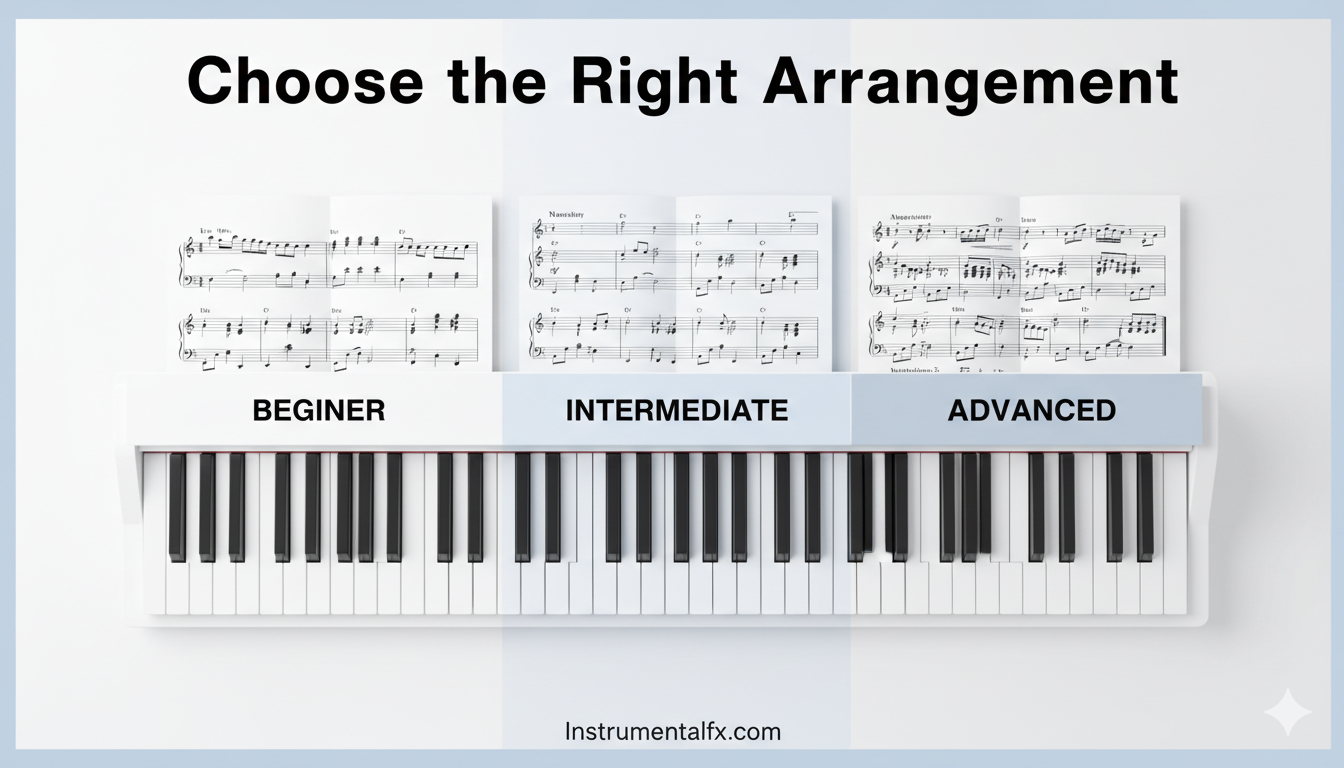
Beginner Level (0-2 Years Experience)
Look for arrangements marked “Easy” or “Beginner.” These typically stay within a 5-finger position per hand.
Left hand plays simple whole notes or basic chords. Right hand carries the melody with minimal jumping.
Note values are mostly quarter and half notes. Few eighth notes keep rhythms manageable.
Key signatures with fewer sharps/flats are preferable. C Major, G Major, or F Major suit beginners best.
Early Intermediate (2-4 Years Experience)
“Intermediate” level arrangements introduce more complexity. Left-hand patterns include broken chords and arpeggios.
Right hand adds occasional runs and embellishments. Octave spans and hand position changes increase.
Eighth note rhythms become more prevalent. Some syncopation challenges timing skills.
Original key (Ab Major) becomes accessible at this level. Four flats require comfort with black keys.
Late Intermediate to Advanced (5+ Years Experience)
Advanced arrangements faithfully reproduce the recording. Every decorative note and variation is transcribed.
Complex left-hand patterns require independence from the right. Pedaling technique becomes crucial for proper sound.
Dynamic range from soft pianissimo to strong fortissimo. Expressive playing separates good from great performances.
Tempo flexibility and rubato add professional polish. These arrangements prepare for performance or recording.
Learning All of Me Sheet Music – Step by Step Guide
Step 1: Choose Your Arrangement
Assess your current skill level honestly. Attempting too-difficult arrangements leads to frustration.
Preview the first page before purchasing. This reveals the arrangement’s complexity immediately.
Read customer reviews if available. Other musicians’ experiences provide valuable insights.
Step 2: Initial Familiarization
Listen to John Legend’s original recording repeatedly. Internalize the melody, rhythm, and feeling.
Study the sheet music without your instrument first. Identify challenging sections that need extra attention.
Mark breath points if you’re singing. Circle difficult passages for focused practice.
Step 3: Hands-Separate Practice (Piano)
Begin by learning the right-hand melody alone. Play slowly, ensuring every note is accurate.
Add the left-hand accompaniment separately. Master the chord patterns and rhythms independently.
This method builds muscle memory without overwhelming coordination. Each hand learns its part thoroughly.
Step 4: Hands-Together Integration
Combine hands at a very slow tempo. Accuracy matters more than speed initially.
Use a metronome starting at 60-80 BPM. Gradually increase speed as comfort grows.
Practice difficult transitions repeatedly. Isolate problematic measures until they flow smoothly.
Step 5: Adding Expression and Dynamics
Once notes and rhythms are secure, focus on musicality. Dynamic markings indicate volume changes.
Crescendos (getting louder) and decrescendos (getting softer) add emotion. These reflect the song’s dramatic arc.
Rubato (slight tempo flexibility) makes performances personal. Don’t rush through the meaningful lyrics.
Step 6: Performance Preparation
Play through the entire piece without stopping. Simulate performance conditions during practice.
Record yourself and listen critically. This reveals areas needing improvement.
Perform for friends or family before a formal event. Building confidence reduces performance anxiety.
All of Me Guitar Chords and Tabs
Basic Chord Progression
The song primarily uses four chords in many keys. In the key of G: Em, C, G, and D.
In the original key of Ab: Fm, Db, Ab, and Eb. These barre chords challenge beginners more.
Capo on the 1st fret allows easier open chords. This transposition helps guitarists avoid barre chords.
Strumming Patterns
A simple down-down-up-up-down-up pattern works well. This creates a flowing, rhythmic accompaniment.
Fingerpicking patterns create a gentler sound. Thumb plucks bass notes while fingers pick higher strings.
The pattern follows: Thumb (bass), index, middle, ring, middle, index. This arpeggiated approach suits the ballad perfectly.
Chord Variations and Substitutions
Adding 7th chords enhances harmonic richness. Cmaj7 instead of C adds sophistication.
Suspended chords (like Dsus4 to D) create tension and release. These variations prevent monotony.
Guitar Tab Resources
Ultimate-Guitar.com hosts multiple tab versions. User ratings help identify accurate transcriptions.
The website includes chord diagrams and strumming guides. Pro versions offer official, verified tabs.
JustinGuitar.com provides free lessons for the song. Video tutorials supplement written tabs.
Digital vs. Physical Sheet Music
Advantages of Digital Downloads
Instant Access: Purchase and download within seconds. No shipping wait times or delivery concerns.
Portability: Store thousands of sheets on a tablet. Entire music library fits in your bag.
Transposition: Many platforms allow key changes with one click. Find the perfect range for your voice.
Environmental: No paper waste or physical storage needed. Eco-friendly option for modern musicians.
Cost-Effective: Digital sheets typically cost less than physical. No printing or shipping fees.
Advantages of Physical Sheet Music
No Screen Required: Some musicians prefer paper for reduced eye strain. Screen glare can bother sensitive eyes.
Page Turns: Physical books lie flat better. No worry about tablets sleeping or losing your place.
Annotations: Pencil markings feel more natural to many. Highlighting and notes personalize your copy.
No Battery Concerns: Paper works without power. Performance venues without outlets aren’t problematic.
Collection Display: Physical music libraries have aesthetic appeal. Organized shelves showcase your repertoire.
Copyright and Legal Considerations
Understanding Music Copyright
John Legend’s “All of Me” remains under copyright protection. The composition is owned by publishers Sony/ATV Music and EMI April Music.
Unauthorized sharing of copyrighted sheet music is illegal. Downloading from unauthorized sites violates copyright law.
Respect composers’ and arrangers’ intellectual property rights. Legitimate purchases support artists and the music industry.
Legal vs. Illegal Downloads
Legal Sources: Musicnotes, Sheet Music Plus, Hal Leonard, and Amazon. These sites have licensing agreements.
Questionable Sites: Many free PDF sites operate illegally. They distribute copyrighted material without permission.
MuseScore Considerations: User uploads may or may not be authorized. Original user arrangements of copyrighted songs exist in legal gray areas.
Personal Use vs. Commercial Use
Purchased sheet music is typically for personal practice. Public performances often require additional licensing.
ASCAP and BMI handle performance rights licensing. Venues and performers pay fees for public performances.
Recording cover versions requires mechanical licenses. Services like Harry Fox Agency facilitate this process.
Teaching students with purchased music is generally acceptable. Making copies for an entire class may not be.
Tips for Different Instruments
Piano Performance Tips
Pedaling: Use sustain pedal to connect phrases smoothly. Release during chord changes to avoid muddiness.
Balance: Keep melody louder than accompaniment. Left hand should support, not overpower the melody.
Chord Voicing: In the left hand, experiment with inversions. Root position bass notes ground the harmony.
Dynamics: Start verses softer, build to the chorus. The emotional arc follows the song’s narrative.
Guitar Performance Tips
Finger Placement: Proper thumb position behind the neck is crucial. This enables clean chord changes.
Strumming Control: Lighter strums during verses create intimacy. Stronger strums emphasize the chorus.
Muting Technique: Palm muting creates texture variation. Lift the palm for ringing, full chords.
Transitions: Practice chord changes until seamless. Smooth transitions maintain musical flow.
Vocal Performance Tips
Breath Support: Take breaths at marked points or natural phrase breaks. Proper breathing prevents running out of air.
Range Considerations: The song spans approximately an octave and a fourth. Ensure the key suits your comfortable range.
Emotional Connection: Connect with the lyrics’ meaning personally. Authentic emotion resonates with audiences.
Microphone Technique: For amplified performances, maintain consistent distance. This ensures even volume.
All of Me Sheet Music for Special Occasions’

Wedding Performances
“All of Me” tops wedding song charts consistently. Its message of unconditional love perfectly suits ceremonies.
Many couples choose it for their first dance. The moderate tempo works well for dancing.
Ceremony musicians often play instrumental versions during processionals. Piano solo arrangements are particularly popular.
Reception performances can include vocals and accompaniment. Professional musicians and talented friends both perform it.
Recitals and Competitions
The song’s popularity makes it a recital favorite. Audiences recognize and appreciate the familiar melody.
For competitions, it demonstrates emotional expression and technical skill. The combination impresses judges.
Choose appropriate difficulty levels for your current abilities. An advanced arrangement poorly executed hurts more than helps.
Busking and Street Performance
Contemporary songs like this attract passersby effectively. Familiar tunes encourage people to stop and listen.
The song’s emotional impact often inspires generous tips. Street musicians report strong audience response.
Acoustic guitar or portable keyboard works well for busking. The song doesn’t require elaborate instrumentation.
Recording Projects
Cover versions of “All of Me” perform well on YouTube. Countless musicians have recorded their interpretations.
Home recording setups can capture quality performances. USB microphones and audio interfaces are affordable.
Adding personal arrangements distinguishes your version. Unique instrumentations attract viewer attention.
Advanced Techniques and Variations
Jazz Interpretation
“All of Me” exists in two versions—1932 jazz standard and 2013 ballad. Jazz musicians have reharmonized both versions countless times.
Substitute ii-V-I progressions for enhanced sophistication. These chord changes add harmonic interest.
Improvisation over the chord changes showcases creativity. Solo sections allow personal expression.
Walking bass lines in the left hand (piano) or bass add movement. This drives the rhythm forward.
Contemporary Arrangements
Modern producers create electronic versions with beats. Sheet music adaptations include drum notation.
String sections can be added to the basic arrangement. This orchestral approach elevates the production.
Gospel-style chord voicings add richness to piano parts. Suspended and added-note chords enhance harmony.
Simplified Arrangements for Beginners
Reduce the song to its most essential elements. Melody in the right hand, single bass notes in the left.
Use only root position chords to minimize complexity. This helps absolute beginners experience success.
Eliminate octave jumps and keep hand positions static. Confidence builds when the music feels manageable.
Teaching All of Me to Students
Pedagogical Considerations
Age Appropriateness: The song suits students aged 10 and up. Younger children may lack the hand span.
Emotional Maturity: Understanding the love song’s message helps interpretation. Teenagers often connect deeply.
Technical Requirements: Students should have basic chord knowledge. Comfort with hand independence is essential.
Lesson Plan Suggestions
Week 1: Listen to the recording and introduce the melody. Right-hand practice begins.
Week 2: Add left-hand chord accompaniment separately. Hands-separate practice continues.
Week 3: Begin hands-together practice at slow tempo. Focus on accuracy over speed.
Week 4: Address challenging transitions and dynamics. Musical expression gets attention.
Week 5-6: Polish the performance and add personal touches. Prepare for recital or sharing.
Motivation and Engagement
Students often request popular contemporary songs like this. Their enthusiasm drives practice commitment.
Allow students to find YouTube performances for inspiration. Seeing peers play motivates them.
Incorporate recording technology to track progress. Hearing improvement builds confidence.
Technology Tools for Learning
Sheet Music Apps
Musicnotes App: Digital library in your pocket. Transpose, annotate, and playback features included.
forScore: Professional iPad app for musicians. Powerful organization and annotation tools.
MuseScore: Create, play, and share sheet music. Built-in playback helps learning.
Practice Tools
Metronome Apps: Tempo, Soundbrenner, and Pro Metronome help timing. Essential for steady rhythm development.
Slowdowner Apps: Amazing Slow Downer and Anytune reduce tempo. Learn fast passages at comfortable speeds.
Recording Apps: GarageBand, Voice Memos, and specialized apps document practice. Progress tracking becomes easy.
YouTube Channels for Learning
HDpiano: Offers free piano tutorials with on-screen notation. Multiple camera angles show hand positions.
Piano Tutorial Easy: Simplified arrangements for beginners. Slow-motion sections aid learning.
GuitarLessons365: Comprehensive guitar tutorials with tabs. Clear explanations suit visual learners.
Common Mistakes and How to Avoid Them
Rushing Through the Song
The emotional ballad requires patience and space. Rushing destroys the song’s romantic quality.
Solution: Practice with a metronome at a slow tempo. Gradually increase speed only when ready.
Ignoring Dynamics
Playing every note at the same volume sounds mechanical. Dynamics create emotional impact.
Solution: Mark dynamics in your sheet music clearly. Exaggerate them in practice.
Poor Chord Transitions (Guitar)
Jerky chord changes disrupt the musical flow. Gaps between chords sound unprofessional.
Solution: Isolate difficult transitions and practice them repeatedly. Slow motion practice builds muscle memory.
Neglecting the Left Hand (Piano)
Focusing only on melody leaves accompaniment weak. Both hands require equal attention.
Solution: Practice left hand alone until confident. This strengthens the harmonic foundation.
Incorrect Pedaling (Piano)
Over-pedaling creates muddy sound quality. Under-pedaling sounds choppy and disconnected.
Solution: Listen critically to pedaling effects. Change pedal with chord changes.
The Two “All of Me” Songs
The 1932 Jazz Standard
Composed by Seymour Simons and Gerald Marks. This earlier version predates John Legend’s by 81 years.
The jazz standard features different lyrics and melody. “All of me, why not take all of me” begins the song.
It’s been recorded by countless jazz legends. Billie Holiday, Frank Sinatra, and Louis Armstrong all performed it.
The chord progression is classic jazz harmony. ii-V-I progressions and circle-of-fifths movements abound.
John Legend’s 2013 Ballad
Completely different from the 1932 version musically. Only the title connects the two songs.
Legend co-wrote it with Toby Gad during a creative session. The personal lyrics reference his relationship.
The contemporary production features piano, strings, and subtle drums. Acoustic and electronic elements blend beautifully.
This version achieved mainstream pop success globally. It won numerous awards and certifications.
Frequently Asked Questions
Where can I download All of Me sheet music for free?
MuseScore.com offers free user-created arrangements for personal use. However, purchasing from legitimate retailers like Musicnotes supports the artists and ensures high-quality, accurate transcriptions.
What is the difficulty level of All of Me on piano?
Difficulty varies by arrangement. Easy versions suit beginners with 1-2 years experience, while advanced arrangements challenge experienced players with complex voicings and rhythms.
What key is All of Me sheet music written in?
The original John Legend version is in Ab Major. However, most sheet music retailers offer transposable versions in multiple keys including C, G, and F Major.
How much does All of Me sheet music cost?
Digital sheet music typically costs $2.99 to $6.99 per arrangement. Physical books range from $4.99 to $12.99, depending on the publisher and complexity.
Can I use All of Me sheet music for my wedding?
Yes, purchasing legitimate sheet music grants you rights for personal performances including weddings. Public venue performances may require additional licensing depending on local regulations.
What instruments are All of Me arrangements available for?
Sheet music exists for piano, guitar, voice, violin, flute, saxophone, cello, ukulele, choir, and many other instruments. Over 143 different arrangements cover virtually every instrument.
Is there a simplified version of All of Me for beginners?
Yes, many publishers offer “Easy Piano” or “Beginner” arrangements. These feature simplified rhythms, reduced hand movements, and easier keys designed for novice musicians.
What chords are used in All of Me guitar version?
Common keys use Em, C, G, and D. With capo on the 1st fret, the progression becomes even easier for beginners learning open chord positions.
Can I transpose All of Me sheet music to a different key?
Most digital platforms like Musicnotes allow instant transposition. This feature helps singers find their optimal vocal range or instrumentalists play in comfortable keys.
How long does it take to learn All of Me on piano?
Learning time varies by skill level. Beginners might need 4-8 weeks practicing 20-30 minutes daily. Intermediate players could learn it in 1-2 weeks of focused practice.
Conclusion
All of Me sheet music provides musicians at every skill level the opportunity to perform one of the 21st century’s most beloved love songs.
Whether you’re a beginner pianist working through a simplified arrangement, an intermediate guitarist mastering chord transitions, or an advanced vocalist adding this piece to your repertoire, the perfect version exists for your needs.
With over 143 arrangements spanning piano, guitar, voice, and numerous other instruments, finding your ideal All of Me sheet music has never been easier.
Legitimate retailers like Musicnotes, Sheet Music Plus, and Hal Leonard offer professionally edited scores that respect copyright while providing exceptional quality. Free resources like MuseScore supplement commercial options for practice purposes.
The song’s enduring popularity stems from its universal message of unconditional love and acceptance. John Legend’s masterful composition, combined with Toby Gad’s collaborative genius, created a modern classic that resonates across generations.


