


Most teams do not fail AI detection because they skipped a rewrite. They fail because they treated a homepage badge as a lab result. One tool claims a perfect scoreboard; another lists a stack of detectors; neither tells you which model, which sample size, or what “pass” even means. Before I trust any Ai humanizer claim, I force a protocol: same draft, one detector at a time, a fixed definition of pass, and a written failure signal.
That is the buyer problem, not a feature tour. Marketing can say “optimized for Turnitin” and still leave you guessing whether the rewrite that worked on a blog post will hold for a methods section. In my testing, the useful question is narrower: can you reproduce a result under rules you would put on an internal wiki?
Why Detector Badges Are Not a Pass Certificate
Detectors disagree with each other. A draft that looks calm in one scanner can spike in another because each tool weights rhythm, burstiness, and predictability differently. If your acceptance test is “looks green somewhere,” you are not measuring writing quality. You are shopping for a friendly screenshot.
The sharper failure mode is silent drift. A synonym pass can lower one score while leaving the same sentence openings, the same evenly spaced claims, and the same citation cadence that another system still flags. Surface calm is not structural change. That gap is where people waste a week rerunning tools instead of fixing the draft.
The Protocol I Use Before Trusting Any Score
I run a four-part protocol on every candidate rewrite stack. It is boring on purpose. Boring is what makes the numbers comparable.
- Freeze one source draft of at least 200 words. Shorter scraps reward lucky edits.
- Pick one detector for the round. Do not rotate mid-test.
- Lock the rewrite settings before you click. Change one variable per run.
- Write a pass rule in advance. Mine is usually “under 5% AI” or an equivalent band the team already uses.
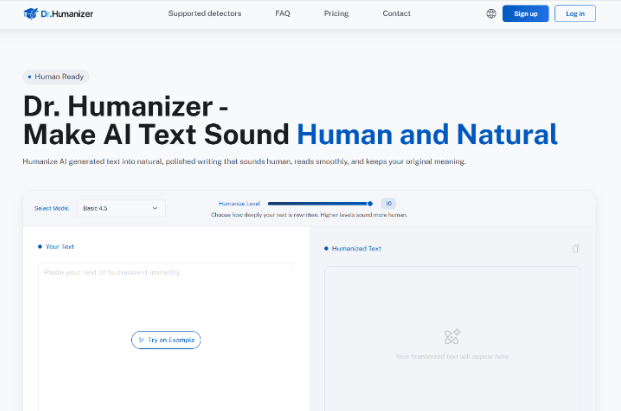
Only after that do I open drhumanizer as the rewrite engine under test. The site positions itself around deep structural rewriting rather than thesaurus swaps, and it surfaces Select Model plus a Humanize Level control so you can change depth without inventing a second workflow. Those controls matter only if your protocol already says what you are measuring.
What Counts as a Real Pass Signal
A screenshot of “Human 100%” on a marketing strip is not a pass signal. A pass signal is a number you can recheck tomorrow with the same draft hash, the same model choice, and the same detector version. If you cannot name those three, you do not have a result. You have a mood.
Where Most DIY Tests Quietly Cheat
People cheat the test without meaning to. They paste a cleaner paragraph after a bad first run. They switch detectors when the first one stays red. They raise Humanize Level until the prose sounds “different enough,” then forget to re-verify citations. The protocol exists to stop that drift. If the draft changes, the trial resets.
Standard Model Numbers Worth Putting on a Wiki
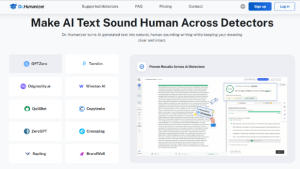
Dr. Humanizer publishes tested Standard Model pass rates across 20,000+ samples, with “pass” defined as rewrites detected as less than 5% AI-generated content. That definition is the useful part. It turns a slogan into something you can argue with.
| Detector context | Published Standard Model pass rate |
| Scribbr / QuillBot | 79% |
| ZeroGPT | 78% |
| Turnitin | 70% |
| Originality.ai | 60% |
| Winston AI | 40% |
Read the table as a ranking of difficulty under one lab definition, not as a promise for your next essay. Winston AI at 40% under that rule is a warning label: if your workplace leans on that scanner, a single casual rewrite is not a plan. Turnitin at 70% is stronger on paper and still leaves a real miss rate. Originality.ai at 60% sits in the uncomfortable middle where teams often over-celebrate a lucky green bar.
How I Turn Those Rates Into a Decision
I map the table to the detectors my team actually uses, then set a retest budget. If the published rate for our primary scanner sits near 60–70%, I assume I need a second refinement plus a light human pass, not a victory lap. The site itself notes that many users see strong results after one rewrite and that another one or two refinements can push real-world outcomes higher, while still refusing a universal guarantee. That matches what a protocol expects: improve the odds, then verify.
What I Refuse to Infer From the Table
I do not infer that every model on the Select Model menu matches Standard’s numbers. Basic, Pro, and Standard are described as different rewriting approaches with different detection performance. If I need the stricter lane, I pick Standard on purpose. If I need fewer grammar slips and closer meaning, the Standard 2.0 framing on the help side is a separate choice, not a silent upgrade. Mixing those lanes mid-test invalidates the row.
Old Fix Paths and Why They Burn Time
The old path is familiar. Paste into a paraphraser. Swap adjectives. Resubmit. When the score barely moves, blame the detector. When it finally drops, ship without reading for meaning. The cost is not only credits. It is lost judgment: you stop noticing whether a methods claim still says what the data said.
A structural rewrite path is slower at the decision layer and faster at the cleanup layer. You still paste text, still choose depth, still compare outputs. The difference is that you score against a prewritten rule instead of chasing whichever badge looks friendliest today. Dr. Humanizer fits that path when you treat it as the rewrite step inside the protocol, not as the protocol itself.
- Manual synonym loops: cheap, weak on cadence, easy to overfit one scanner.
- Blind “humanize” clicks: fast, no audit trail, hard to explain to a reviewer.
- Protocol-first rewriting: slower setup, clearer failures, easier to repeat next week.
A One-Week Pilot That Survives Scrutiny
I run the same three drafts for five workdays: one academic paragraph with citations, one business memo, and one marketing blurb. Each day I change only one variable—Humanize Level, model lane, or detector—and I log the pass band in a shared sheet. By Friday I know which combination is stable enough to recommend, and which one only looked good once. That log is also how I brief a manager who asks why we are not “just trusting the badge.”
If the pilot shows that Standard clears our primary scanner most days but fails Winston-style checks often, I do not hide the gap. I write the gap into the playbook and require an extra human pass for that lane. Tools do not get to negotiate the definition of pass after the fact.
Keep the Scoreboard Honest Before You Buy
If your team needs a rewrite tool, buy the one you can test under named rules. The Standard Model table is useful because it admits uneven difficulty across detectors instead of pretending every badge is equal. Use that honesty. Lock a detector, lock a pass band, lock a model, then judge the draft. Dr. Humanizer is easiest to evaluate when you already know which scanner your reader will open next.
This approach fits editors and coursework teams who already know which scanner their institution or client prefers. It is a poor fit if you only want a one-click miracle and refuse to reread for meaning. In my testing, the win is not a perfect homepage guarantee. The win is a scoreboard you can defend when someone asks how you got there.

