


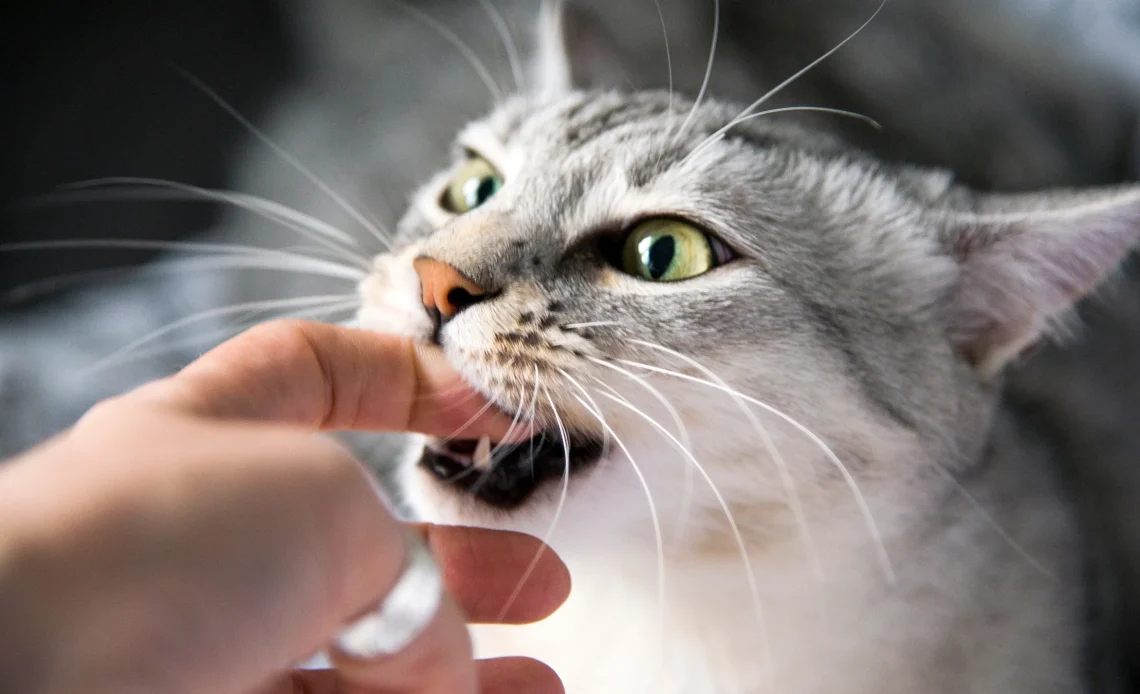
Why does my cat keep biting me is a question every cat owner asks at some point, often right after a peaceful petting session suddenly ends with teeth in their hand.
Cat biting is one of the most misunderstood feline behaviors, but it almost always has a clear reason behind it.
Cats bite out of playfulness, overstimulation, fear, pain, affection, or a need to communicate something their meow cannot express.
Is Cat Biting Normal Behavior?
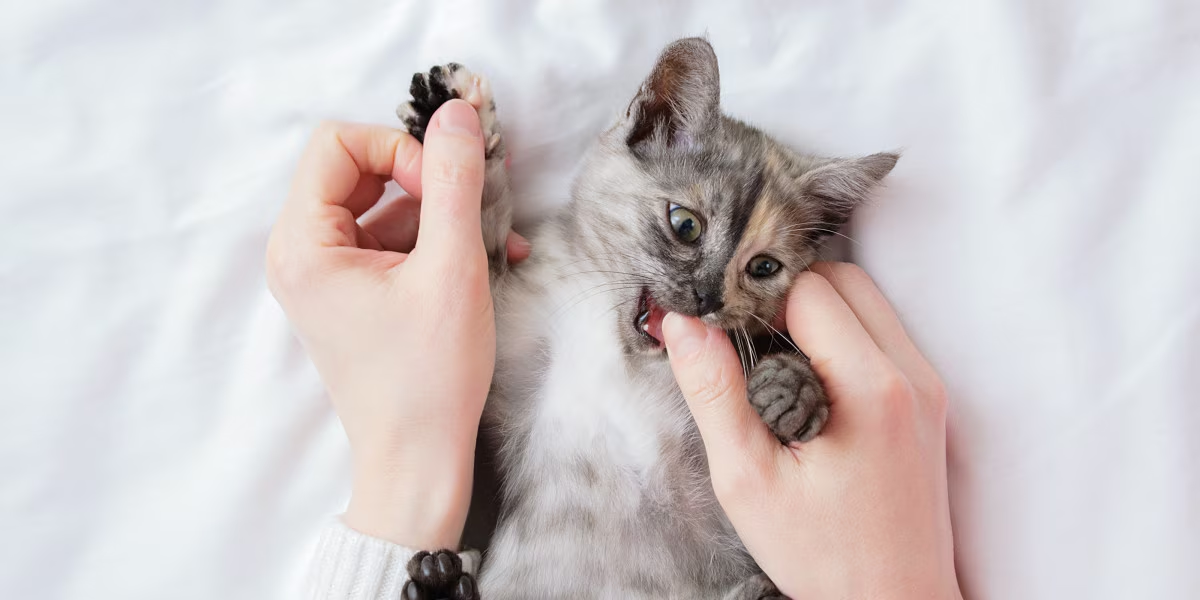
Cat biting is extremely common and, in most cases, completely normal. Cats are natural predators with deeply hardwired hunting instincts, and their teeth are one of their primary tools for interacting with the world.
That said, normal does not mean acceptable. Frequent, painful, or unprovoked biting is a problem that needs addressing, both for your safety and for your cat’s wellbeing.
The key is understanding what type of biting is happening and why, because the solution depends entirely on the cause.
Love Bites vs Aggressive Bites: What Is the Difference?
What a Love Bite Looks Like
A love bite is a gentle, controlled nip that does not break the skin. It is often paired with relaxed body language, purring, slow blinking, or being preceded by grooming like licking.
Love bites are your cat’s way of bonding with you, showing affection, or mimicking the grooming behavior their mother used on them as kittens. They are not meant to cause pain. They are the feline equivalent of a hug.
What an Aggressive Bite Looks Like
An aggressive bite is forceful, sudden, and often accompanied by clear warning signals. These include flattened ears, a puffed tail, dilated pupils, growling, hissing, or a stiff body posture.
Aggressive bites can break the skin and cause real injury. They signal that your cat is frightened, in pain, overwhelmed, or has reached a point where they feel they have no other way to communicate their distress.
Quick Comparison Table
| Feature | Love Bite | Aggressive Bite |
|---|---|---|
| Pressure | Gentle, no skin break | Forceful, may break skin |
| Body language | Relaxed, purring, slow blink | Stiff, ears flat, tail puffed |
| Timing | During calm petting or grooming | During stress, fear, or overstimulation |
| Intent | Affection, bonding, communication | Defense, pain response, fear |
| What to do | Observe and enjoy or gently redirect | Stop interaction, give space |
Reason 1: Play Aggression and Hunting Instincts
Why Your Cat Treats You Like Prey
Play aggression is the most common reason cats bite their owners, especially kittens and young cats. Cats are hardwired predators. Every fiber of their instinct drives them to stalk, pounce, and bite.
When they do not have appropriate targets for that energy, such as toys or wand teasers, they redirect it at the nearest moving object. That is often your hand, foot, or ankle.
Why Kittens Bite More
Kittens learn bite inhibition from their littermates. When a kitten bites a sibling too hard during play, the sibling yelps and stops playing, teaching the biter that hard bites end the fun.
Kittens separated from their litter before eight weeks of age miss this critical lesson. They grow up not understanding how much pressure is too much, which is why early socialization is so important to long-term biting behavior.
The Hands-As-Toys Problem
One of the most common mistakes cat owners make is using their hands and fingers as toys during kitten play. It seems harmless when they are tiny, but it teaches the cat that human hands are prey items.
As they grow, their jaw strength increases, but the lesson stays the same: hands are for biting. This is why you should always use a wand toy, feather teaser, or laser pointer rather than your bare hands during play sessions.
Reason 2: Overstimulation and Petting-Induced Aggression
What Overstimulation Actually Means
Petting-induced aggression, also called overstimulation, is one of the most frustrating types of cat biting because it seems to come out of nowhere. Your cat was purring and enjoying themselves, and then suddenly bit your hand.
What actually happened is that your cat reached their personal petting threshold. Every cat has a limit for how much physical contact feels pleasant before it becomes overwhelming. When that limit is crossed, biting is their way of saying “enough.”
Why Cats Have a Lower Tolerance Than Dogs
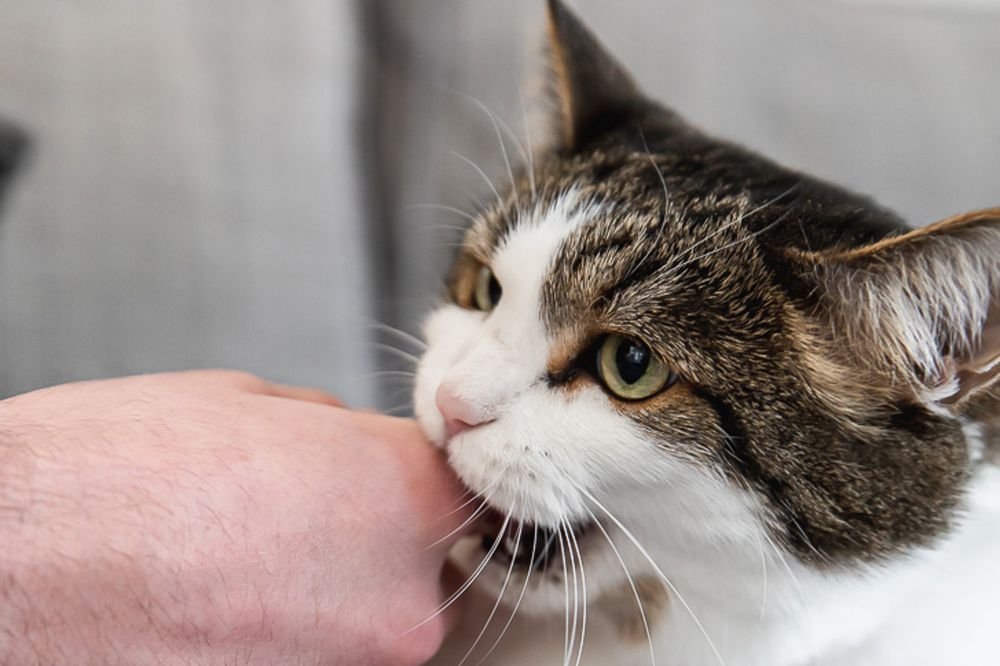
Unlike dogs, most cats are not naturally wired for extended full-body petting from humans. Their social grooming in the wild is brief and targeted, focused on the head and neck area.
Long, repetitive strokes along the body can build up static-like irritation in their nervous system. Sensitive skin, especially along the spine, can make prolonged petting feel genuinely uncomfortable even if it starts out pleasant.
Warning Signs Before the Bite
Your cat almost always gives multiple warnings before biting during overstimulation. Most people miss them because they are subtle.
| Warning Sign | What It Means |
|---|---|
| Tail begins to flick or thump | Irritation is building |
| Skin rippling along the back | Highly overstimulated |
| Ears rotate back or flatten slightly | Discomfort is increasing |
| Pupils dilate | Arousal or stress rising |
| Body becomes tense or stiff | About to act |
| Stops purring suddenly | Tolerance threshold reached |
| Turns head to watch your hand | Tracking it as a target |
Stopping the petting session the moment you see any of these signals will prevent the bite entirely. The bite is not random. It is always step five of a five-step escalation you had the chance to interrupt at steps one through four.
Reason 3: Fear and Defensive Biting
When Your Cat Feels Trapped
Fear biting happens when a cat feels they cannot escape a situation they find threatening. Loud noises, unfamiliar people, being picked up against their will, or being cornered can all trigger a defensive bite.
The bite is not personal. Your cat is not attacking you because they dislike you. They are trying to create enough space between themselves and what feels threatening. If escape is not possible, biting becomes the next option.
Cats With Difficult Histories
Cats that were handled roughly, abused, or poorly socialized during their critical development window (two to seven weeks of age) are more likely to develop fear-based biting as adults.
These cats often have a lower threshold for feeling threatened and may bite in situations that a well-socialized cat would simply walk away from. Patience, predictable routines, and allowing the cat to control interactions are essential for rebuilding trust.
What Never to Do
Never corner, chase, or physically restrain a fearful cat. Never yell at or hit a cat after a fear bite. Both responses escalate the fear and reinforce the idea that humans are dangerous, making future biting more likely.
Give the cat space, move slowly, speak softly, and let them approach on their own terms. Forcing interaction is counterproductive every single time.
Reason 4: Pain and Medical Causes
When Biting Signals Something Is Wrong
Sudden biting in a cat that was previously calm is one of the most important behavioral red flags. Pain is a leading cause of sudden aggression in cats, and they are exceptionally good at hiding discomfort until it becomes unbearable.
Conditions that commonly cause pain-related biting include dental disease, arthritis, abscesses, hyperthyroidism, skin infections, trauma, and internal organ pain. When you accidentally touch a sore spot, biting is their only way to tell you to stop.
Medical Conditions Linked to Cat Biting
| Condition | How It Triggers Biting |
|---|---|
| Dental disease | Pain when face or muzzle area is touched |
| Arthritis | Pain when joints are touched or cat is picked up |
| Hyperthyroidism | Increased irritability and anxiety overall |
| Skin infection or allergy | Pain or intense itch when skin is touched |
| Neurological issues | Unpredictable sensory responses |
| Cognitive dysfunction (older cats) | Confusion and disorientation causing aggression |
When to See a Vet
If your cat has suddenly started biting when they never did before, a vet appointment should be your first step, not a behavioral intervention. Trying to train out pain-related biting without treating the underlying condition is both ineffective and unkind.
A vet will perform a physical examination, may take blood work or X-rays, and can identify whether a medical issue is driving the behavior change.
Reason 5: Redirected Aggression
Why Your Cat Bites You for Something That Has Nothing to Do With You
Redirected aggression is one of the least understood causes of cat biting. It happens when your cat is highly aroused or agitated by something they cannot access or attack, and then redirects that energy onto the nearest person or animal.
Common triggers include seeing another cat outside the window, hearing a loud noise, smelling an unfamiliar animal, or watching birds. Your cat becomes intensely aroused and cannot reach the source of that arousal. You walk past at the wrong moment and become the outlet.
How to Handle a Redirected Aggression Episode
Do not approach a cat who is in a redirected aggression state. They are flooded with arousal hormones and cannot process social cues normally. Even a cat who normally loves you may bite severely in this state.
Give them 20 to 30 minutes in a quiet room to fully calm down before attempting any interaction. Remove or block access to the window or stimulus that triggered the episode if possible.
Reason 6: Attention-Seeking and Communication Biting
When Biting Gets Your Attention
Some cats learn quickly that biting is the most effective way to get what they want. If your cat bites and you immediately respond by feeding them, playing with them, or even just looking at them and saying “ow,” you have rewarded the biting.
Cats are smart. If biting produces a consistent response from you, even a negative one, they will continue doing it. In their mind, biting = result, and results are good.
How to Break the Attention-Biting Habit
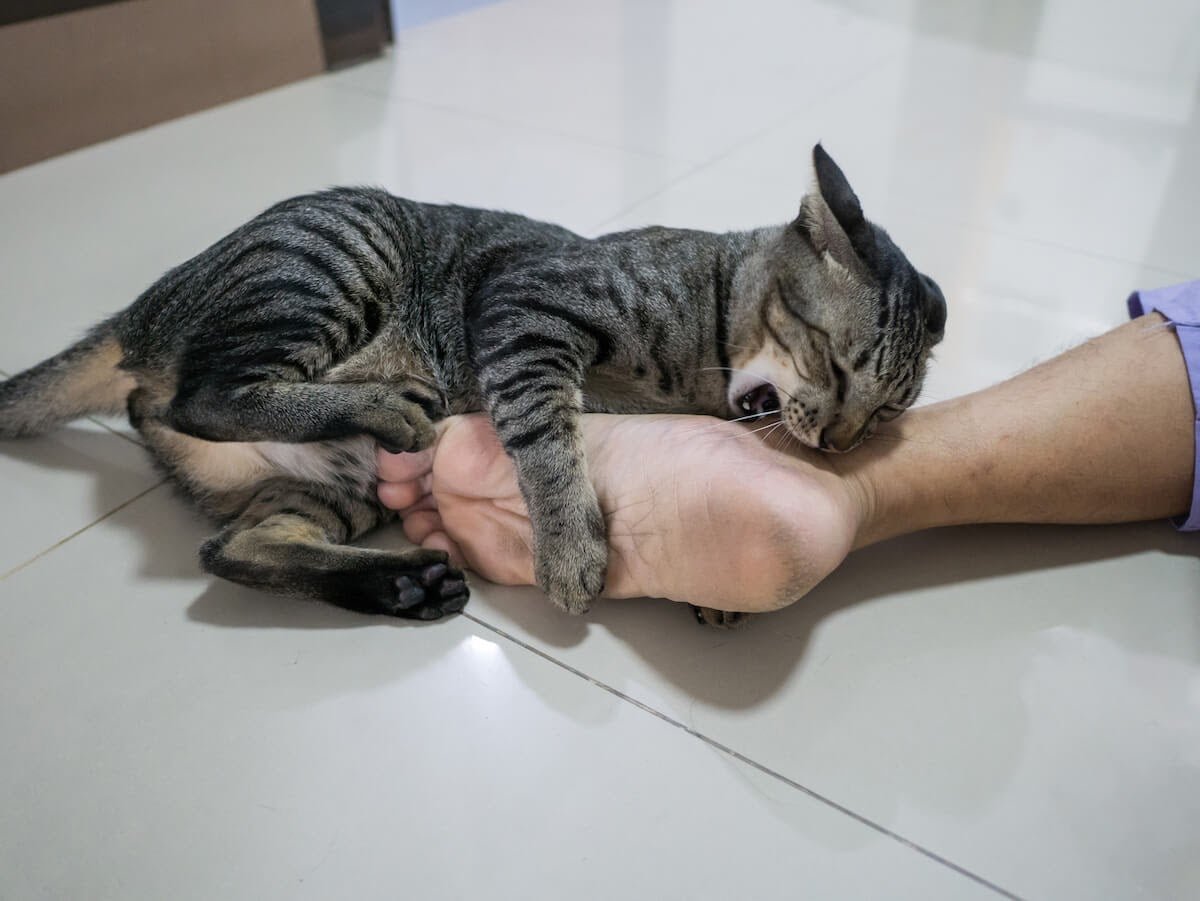
The key is to make biting completely unrewarding. When your cat bites for attention, stand up immediately, turn your back, and leave the room without saying anything. No eye contact, no scolding, no reaction.
Consistently come back only when your cat is calm and not biting. Reward calm behavior with attention and treats. Over time, your cat learns that biting ends the interaction while calm behavior starts it.
Reason 7: Territorial Aggression
Cats Are Territorial Animals
While cats are not pack animals, they are intensely territorial. They map out their living space and can become aggressive when that space feels invaded.
A new pet entering the home, a new person moving in, furniture being rearranged, or even the smell of another animal on your clothing can trigger territorial biting. It is rarely personal, but it can be intense.
Managing Territorial Biting
Introduce new pets slowly using scent swapping before any face-to-face meetings. Give your cat plenty of vertical space, hiding spots, and areas they can claim as exclusively theirs.
If the territorial behavior is severe or getting worse, a certified cat behavior consultant can design a structured introduction or desensitization protocol that dramatically reduces aggression.
Reason 8: Poor Socialization as a Kitten
The Critical Window You Cannot Get Back
The critical socialization period for cats is between two and seven weeks of age. What a kitten is exposed to during this window shapes their behavior for life.
Kittens who were feral, poorly handled, or isolated during this period often grow into adults who bite more readily because they never learned that humans are safe and predictable. They lack the early experiences that build trust and bite inhibition.
What You Can Do for a Poorly Socialized Cat
Progress with an undersocialized cat requires patience measured in months, not days. Work at their pace entirely. Let them set the terms for every interaction. Use high-value treats to build positive associations with human presence and touch.
Never push the pace. Each small, positive interaction is a deposit in the trust bank. Forcing contact is a large withdrawal that can set you back weeks.
Reason 9: Boredom and Under-Stimulation
The Bored Cat Problem
A bored cat is a biting cat. Indoor cats who do not receive enough mental stimulation, physical exercise, or environmental enrichment are more likely to redirect their unused energy into aggressive play biting.
Cats need on average 20 to 30 minutes of active, interactive play per day. Many indoor cats receive far less than this. The result is a cat with pent-up predatory energy and limited appropriate outlets.
Enrichment Ideas That Reduce Biting
Puzzle feeders engage a cat’s foraging instincts and reduce boredom during the long hours they spend alone. Window perches let them watch birds and outdoor activity, providing passive stimulation.
Rotating the toys available keeps novelty high, since cats habituate quickly to familiar objects. A second cat can also provide a social outlet for predatory play energy, though introductions must be managed carefully.
How to Stop Your Cat From Biting: What Actually Works
Never Use Your Hands as Toys
This is the single most impactful rule for preventing play biting. Always use a wand toy, feather teaser, or other object that creates distance between your hand and your cat’s teeth.
When your cat bites during play, let your hand go completely limp, wait for them to release, then immediately redirect to a toy. Limp prey is not interesting prey. This response removes the reward from the bite without a dramatic reaction.
Use Consistent Positive Reinforcement
Reward all calm, gentle interaction with treats, praise, and continued attention. When your cat stops biting and looks at you, that is the exact moment to reinforce with something they love.
Positive reinforcement creates a clear communication loop: gentle behavior earns good things, biting ends good things. Cats learn this quickly because it mirrors the logic they already use in social play with each other.
What to Avoid When Stopping Cat Biting
| What Not to Do | Why It Makes Things Worse |
|---|---|
| Yelling or scolding | Increases anxiety and fear-based biting |
| Hitting or flicking the nose | Causes fear and damages trust permanently |
| Spraying with water | Creates fear and unpredictability |
| Pulling your hand away fast | Mimics prey movement, escalates biting |
| Rough play or wrestling | Reinforces that hands are prey targets |
| Inconsistent responses | Confuses the cat, slows learning |
The Freeze-Then-Redirect Method
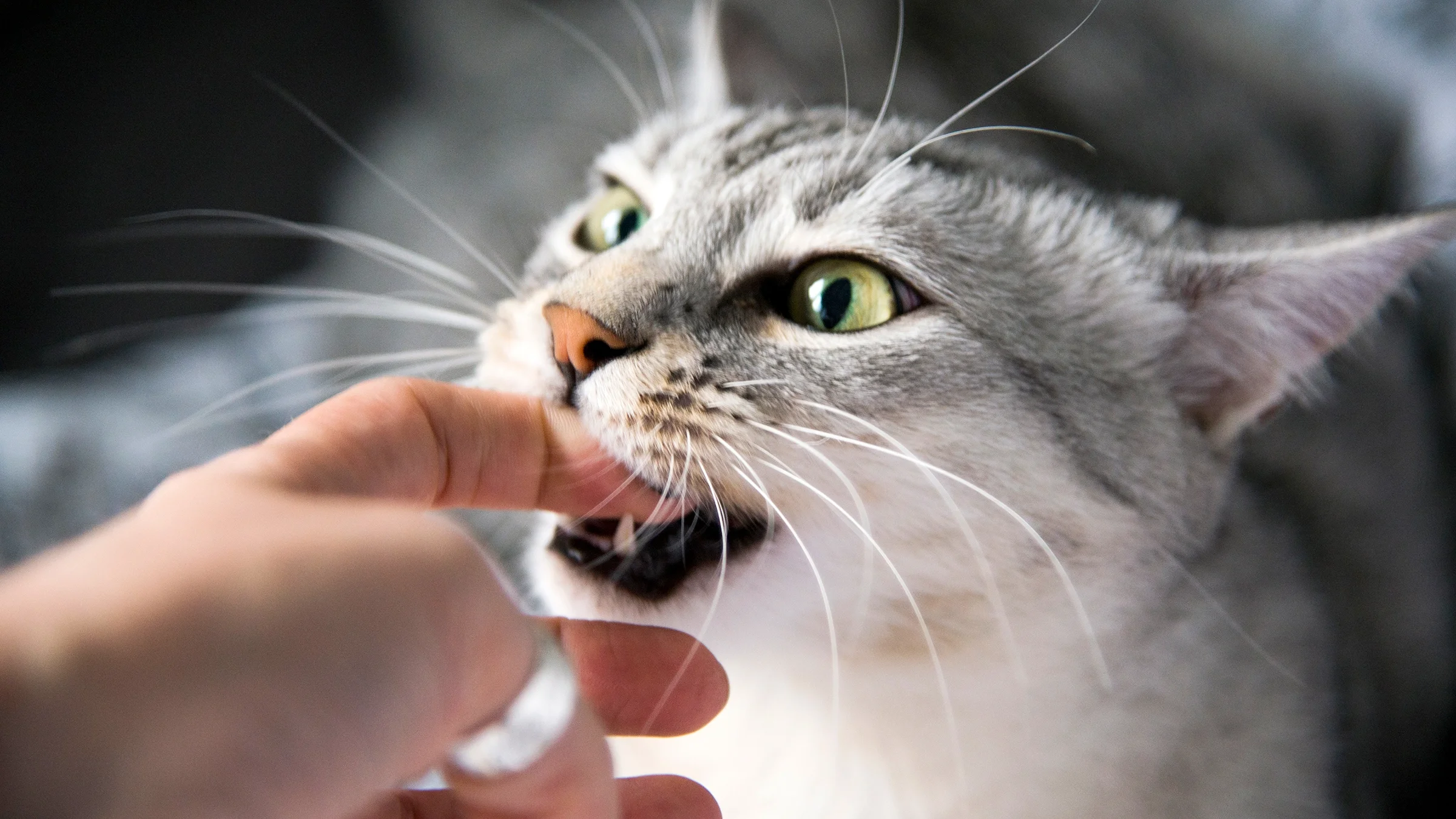
When your cat bites during play, freeze your hand completely instead of pulling it away. A cat’s predatory instinct is triggered by movement. Stillness removes the fun instantly.
After two to three seconds of stillness, calmly withdraw your hand and offer a toy instead. Repeat this every single time without exception. Consistency is what makes the method work. One person allowing hand play while another discourages it trains the cat to bite when they want to.
Interactive Play Sessions
Schedule two dedicated play sessions per day of ten to fifteen minutes each, ideally once in the morning and once in the evening when cats are naturally most active.
Use a wand toy that mimics prey movement, moving it in irregular bursts, pauses, and retreats rather than waving it in circles. Always end the session by letting your cat catch and hold the toy, which completes the hunt sequence and prevents lingering frustration.
When to Consult a Professional
If biting is severe, involves multiple unprovoked attacks, does not improve after four to six weeks of consistent behavioral management, or involves a sudden personality change, seek professional help.
A veterinarian should rule out medical causes first. A certified cat behavior consultant (IAABC or CCBC certified) can then assess the specific behavioral pattern and create an individualized management plan. Medication may be appropriate in cases where anxiety or an underlying neurological issue is contributing to aggression.
Understanding Cat Body Language to Prevent Bites
Read the Signs Before the Bite Happens
The most effective bite prevention is not a training technique. It is learning to read your cat fluently enough to respond before a bite occurs.
Cats communicate escalating discomfort through very precise body language signals. Learning these signals gives you a consistent early warning system.
Full Body Language Guide
| Body Part | Relaxed Signal | Warning Signal |
|---|---|---|
| Ears | Forward or slightly to sides | Rotating back, flattening |
| Eyes | Soft, slow blink | Dilated pupils, hard stare |
| Tail | Still or gently curling | Flicking, thumping, puffed |
| Body | Loose, relaxed posture | Stiff, low, crouched |
| Whiskers | Fanned naturally | Pulled back flat |
| Skin | Still | Rippling along the spine |
| Vocalizations | Purring, chirping | Growling, hissing, chattering |
When you see warning signals appear, stop the interaction immediately. Do not wait to see if they escalate. Stopping at the first warning prevents the bite and teaches your cat that warning signals work, which actually reduces overall biting over time.
Cat Bite Safety: What to Do If You Get Bitten
Cat Bites Are Medically Significant
Cat bites should never be dismissed as minor. Cat teeth are sharp and narrow, creating small puncture wounds that seal quickly on the surface while trapping bacteria deep in the tissue.
The most common bacterium in cat mouths is Pasteurella multocida, present in 70 to 90% of cats. Cat bite infections can develop rapidly, sometimes within hours, and can become serious if untreated.
What to Do Immediately After a Cat Bite
Press the wound gently to encourage mild bleeding and flush out bacteria. Wash thoroughly with soap and running water for at least five minutes. Apply an antiseptic and cover with a clean bandage.
Monitor the wound closely over the next 24 to 48 hours for signs of infection: increasing redness, swelling, warmth, pus, or red streaks extending from the wound. Any of these signs requires medical attention promptly. A doctor may prescribe antibiotics as a precaution even without obvious infection signs, particularly for bites on the hands or fingers.
Frequently Asked Questions (FAQs)
Why does my cat keep biting me for no reason?
There is always a reason, even if it is not obvious. The most common hidden causes are overstimulation during petting, redirected aggression from an external trigger, boredom, or an underlying medical issue causing pain or discomfort.
Why does my cat bite me gently while I pet them?
A gentle bite during calm petting is most likely a love bite, your cat’s way of bonding with you and showing affection. However, if the bite occurs when your cat’s body becomes tense or their tail starts flicking, it is a sign of overstimulation rather than affection.
Why does my cat bite me when I stop petting them?
Your cat wants the petting to continue and is using a bite to ask for more. This is attention-seeking biting. Ignore the behavior entirely, wait for calm, and resume petting briefly on your terms rather than theirs to break the pattern.
Why does my kitten bite me so much?
Kittens bite as part of natural play and development. They are practicing their hunting instincts and learning social limits. Always redirect kitten biting to toys immediately and never use your hands as toys to prevent the behavior from carrying into adulthood.
Does my cat bite me because they love me?
Gentle, brief nibbles during calm, relaxed moments can absolutely be affectionate. True love bites are soft, do not break skin, and are accompanied by relaxed body language. If the bite is hard, sudden, or leaves marks, it is not affection.
How do I get my cat to stop biting me?
Use wand toys instead of your hands during play, freeze your hand when bitten rather than pulling away, end all interactions immediately when biting occurs, and schedule daily active play sessions to drain predatory energy appropriately.
Why does my cat bite me then lick me?
Licking followed by a bite, or a bite followed by licking, is typically allogrooming behavior, the same social bonding cats perform with each other. Your cat is treating you as a family member they trust enough to groom. It is a compliment.
Why does my cat bite my ankles?
Ankle biting is classic predatory play behavior. Your moving feet trigger the stalk-and-pounce hunting sequence. Keep a wand toy nearby and drag it away from your feet when your cat starts stalking so they chase the toy instead of you.
Can a cat bite be dangerous?
Yes. Cat bites carry a high risk of infection because of the bacteria in cat mouths and the deep puncture nature of the wound. Any cat bite that breaks the skin should be washed thoroughly and monitored for signs of infection. See a doctor if redness, swelling, or pus develops.
When should I see a vet about my cat biting?
See a vet if biting began suddenly without a clear behavioral trigger, if the biting has become more frequent or severe over time, or if your cat shows other signs of illness such as changes in appetite, lethargy, or hiding. Pain is a leading cause of sudden aggression and needs to be ruled out before any behavioral work begins.
Conclusion
Why does my cat keep biting me almost always has a specific, identifiable answer.
It might be playful energy with no appropriate outlet, overstimulation during a petting session that went one stroke too long, fear of a situation they could not escape, or pain from a condition they cannot otherwise communicate.
Rarely is it random, and it is never spite. Cats do not bite out of malice.
They bite because it is the clearest signal in their communication toolkit that something needs to change.
Once you understand why your cat bites, the fix becomes clear: use toys instead of hands, learn to read their body language, respect their petting threshold, schedule daily play, and see a vet if the biting is sudden or unexplained.
With patience and consistency, even cats with a long history of biting can learn that gentle interaction is more rewarding than using their teeth.
Building that trust is one of the most satisfying parts of sharing your life with a cat.


