


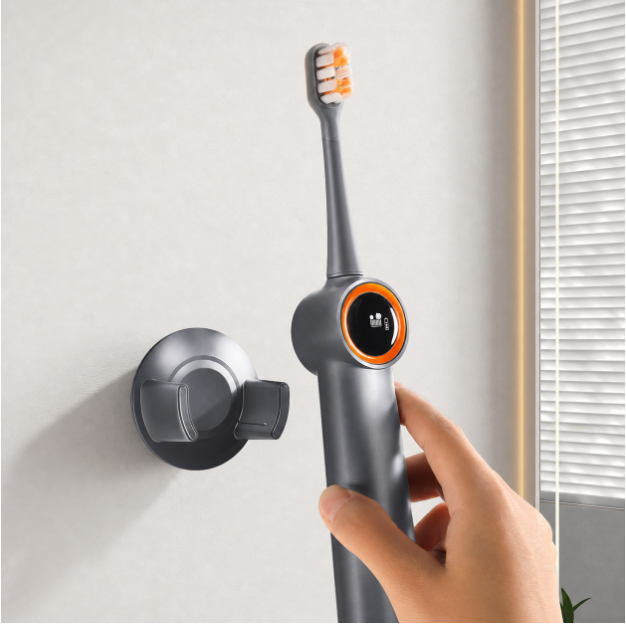
Here’s a sentence you don’t hear very often in consumer tech: the most interesting engineering of the year might be hiding in a toothbrush.
We’re used to innovation showing up in phones, chips, and cameras — the obvious places. But every once in a while, a company takes a category everyone assumes is solved and quietly rebuilds it from first principles. RANVOO has done exactly that with AirJet, and the flagship AirJet X5 is the payoff.
The pitch, in one line: instead of cleaning your teeth with brute-force bristle friction — the mechanism every electric toothbrush has used for decades — AirJet cleans with pressurized airflow and collapsing microbubbles. That requires shrinking an industrial-grade pneumatic system into a 152-gram handheld device. The engineering behind that is worth a closer look.
The Problem Nobody Solved
Let’s be honest about the state of the electric toothbrush. The category has been iterating for half a century on a single, unchanging principle: a motor spins or oscillates bristles, and the bristles physically scrape plaque off tooth surfaces.
It works. It also has a fundamental cost. There’s a well-documented relationship between brush frequency and gum damage:
- Below 25,000 movements per minute — gum damage rises slowly.
- 25,000 to 38,000 — damage climbs noticeably with intensity.
- Above 38,000 — cleaning gains plateau while gum trauma spikes.
Mainstream high-end brushes operate in that red zone — by design. The industry’s answer to “how do we clean better” has consistently been “more mechanical energy.” Faster motors, higher frequencies, stronger vibration. RANVOO’s engineering team looked at that arms race and asked a genuinely different question: what if the bristles aren’t the right cleaning mechanism at all?
The AirJet Architecture: Five Stages of Physics
What emerged is a miniaturized pneumatic cleaning platform. The full system breaks down into five distinct stages:
Stage 1 — Filtered Intake. Ambient air enters through a filtered port at the base of the handle, keeping contaminants out of both the pump and your mouth.
Stage 2 — Variable-Frequency Compression. A direct-current, three-cylinder air pump pressurizes the incoming air. The variable-frequency design is the key detail here: it lets the system modulate airflow pressure dynamically across brushing modes, rather than operating at a single fixed output like a simple compressor. This is genuine engineering nuance, not a spec-sheet number.
Stage 3 — Hollow-Shaft Conduction. The pressurized air travels through a hollow output shaft running through the brush head. The mechanical challenge is subtle: that shaft has to simultaneously transmit the brush head’s 12-degree micro-sweep motion while remaining an unobstructed air conduit. Dual-purpose, high-tolerance mechanical integration.
Stage 4 — Cavitation Boost Chamber. A secondary pressure chamber near the brush head amplifies compression to the point of cavitation — generating microscopic bubbles in the oral fluid and toothpaste foam. These microbubbles are the actual cleaning workforce.
Stage 5 — Coanda-Effect Flow Guidance. The brush head’s internal geometry exploits the Coanda effect, the fluid-dynamics principle where a fast-moving jet follows a curved surface. As the stream races along this contour, it creates a low-pressure zone that entrains surrounding fluid and foam, thickening the outgoing plume and directing it precisely at tooth surfaces and interdental spaces.
The cleaning action itself happens at the microscale: those bubbles travel into the narrow gaps between teeth and along the gumline, then collapse. Each implosion releases a micro-pulse of energy that dislodges plaque — without a bristle ever scraping the gum tissue.
RANVOO also invokes the reverse Kármán vortex street — the same wake dynamics a great white shark’s tail uses for forward propulsion — as the conceptual model for generating forward-moving oral fluid that carries bubbles into interdental crevices. It’s a striking analogy, and one you’d normally expect to see in an aerospace or marine-engineering paper, not a bathroom product.
The Miniaturization Story
The reason this didn’t exist before isn’t lack of imagination — it’s lack of miniaturization. Pneumatic systems capable of generating cavitation-grade airflow have historically been desktop-scale laboratory equipment. Getting that functionality into a handheld form factor means re-engineering every component:
- A pump compact enough to fit alongside a battery, a motor, a display, and a waterproof housing — in a 250.8 × 34.4 × 30.4 mm body.
- Power efficiency good enough for a 1,600 mAh / 5.92 Wh cell to deliver 30 days of strong-mode or 50 days of gentle-mode use.
- IPX7-rated sealing, because the whole point is that it lives in a wet environment.
That’s the kind of engineering constraint stack that kills most product ideas — and the fact that it shipped is the story.
What the Lab Data Says
RANVOO’s internal testing reports the following comparative results against conventional electric toothbrushes:
| Metric | Reported Result |
| Plaque removal | 97% |
| Working frequency | 39% lower |
| Physical force applied | 56% lower |
| Composite gum-damage rate | 90% lower — under one-tenth of conventional brushes |
The pattern is worth noting: a dramatic reduction in the destructive variables (frequency, force, gum damage) alongside a high plaque-removal number. That’s exactly the profile you’d expect from a mechanism that does more of its work through fluid dynamics and less through abrasion.
A third-party CVC Cleaning Effect Classification Level 1 certificate (No. CVC24300012089, valid through February 2029) independently confirms cleaning efficiency for the PH5 (X5) and PH3 (X3) models — a meaningful data point beyond manufacturer claims.
The X5, From a Tech Perspective
Judged purely as a piece of consumer hardware, the AirJet X5 holds up:
- Full-screen dynamic display. Mode, status, and battery at a glance — an interface decision that moves the category forward from single-LED indicators.
- Five operational states: AirJet (maximum cavitation), Gentle (reduced intensity), Clean (balanced daily), Whiten (sustained jet-assisted surface treatment), and Travel Lock. Mode-switching is genuinely functional here — it changes airflow pressure, not just motor speed.
- Precision bristle system. DuPont Pro-grade diamond filaments, 0.01 mm tapered tips, 99.9% taper rate — with the bristles re-positioned as guides for airflow rather than primary scrapers.
- Three interchangeable heads (Soft Gum-Care, Balanced Multi-Effect, Diamond Whitening) for different cleaning profiles.
- Magnetic wall-mounted charging dock that doubles as storage — a small but thoughtful piece of product design.
- 152 g, 4 W, IPX7 — a compact, shower-safe, travel-friendly package.
Why This Matters Beyond the Bathroom
There’s a broader lesson in the AirJet story. The electric toothbrush is a perfect example of a category where incumbents optimized the wrong variable for decades — competing on motor speed because that was the easy knob to turn, while the actual constraint (mechanical trauma) went unaddressed.
RANVOO’s approach — questioning the core mechanism rather than iterating on the parameter — is the kind of first-principles engineering that’s easy to talk about and hard to do. It requires admitting that the fundamental assumption of a 50-year-old category might be worth revisiting, then doing the genuinely hard work of miniaturizing an entirely different technology to prove it.
The AirJet X5 is that proof. It’s a toothbrush, sure. But it’s also a reminder that the biggest opportunities in tech are often hiding in the products we stopped thinking about — because we stopped believing they could be better.
Performance data from RANVOO internal laboratory testing; results may vary by individual usage. CVC Cleaning Effect Classification Level 1, Certificate No. CVC24300012089, valid through February 2029. This article does not constitute medical or dental advice.

