


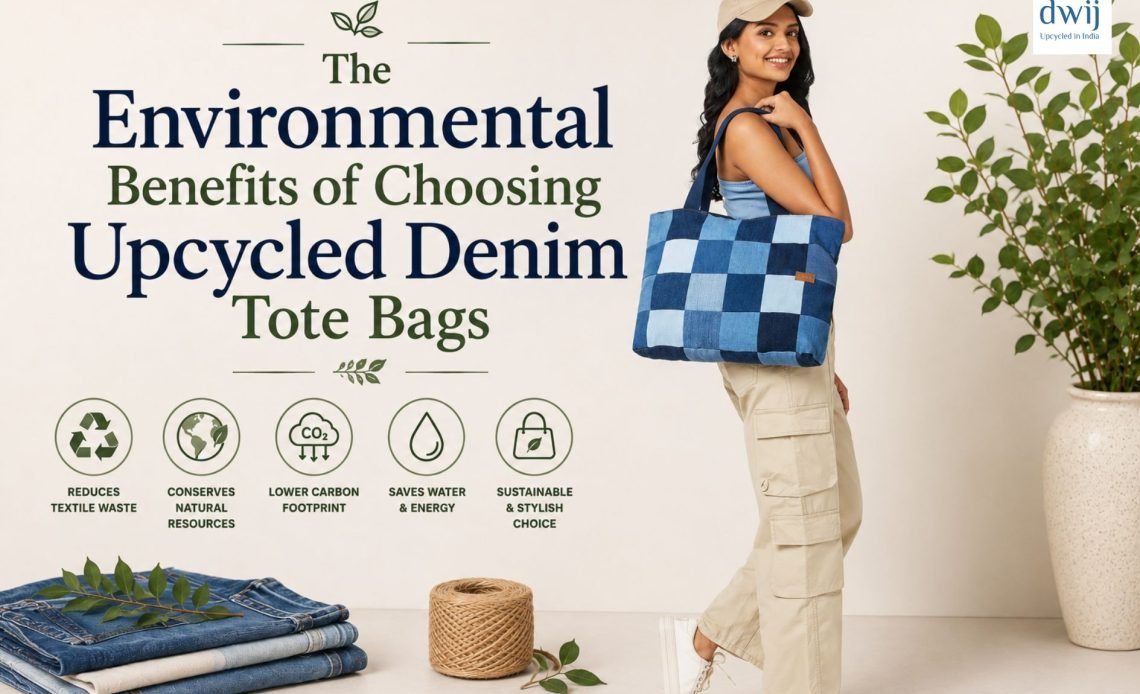
As the fashion industry continues to generate millions of tonnes of textile waste every year, consumers have an opportunity to make more conscious purchasing decisions. At Dwij, we believe that every product should have a purpose beyond its first life. That’s why we transform discarded denim into durable, handcrafted accessories that combine functionality with sustainability.
Our denim tote bags are more than everyday carry bags—they are a practical solution to reducing textile waste, conserving natural resources, and supporting a circular economy. By giving post-consumer jeans and post-industrial denim a second life, we prove that waste isn’t the end of a product’s journey—it’s the beginning of something meaningful.
Why Upcycled Denim Matters
Every year, India generates nearly 7,800 kilotonnes of textile waste, much of which ends up in landfills or is incinerated. Traditional denim manufacturing is also one of the most resource-intensive processes in the fashion industry, requiring enormous quantities of water, energy, and chemicals.
At Dwij, our philosophy is simple: instead of producing new denim, we rescue existing materials and transform them into handcrafted products that are built to last. Every jeans tote bag we create represents one less piece of textile waste entering a landfill and one more step toward a circular future.
1. Significant Water Conservation
One of the greatest environmental advantages of choosing upcycled denim tote bags is water conservation.
Producing new denim starts with growing cotton, a crop that requires substantial irrigation. The fabric is then dyed, washed, and finished using additional water-intensive processes. It is estimated that manufacturing a single new pair of jeans can consume around 1,800 gallons of water throughout its production cycle.
By using post-consumer jeans and post-industrial denim, Dwij eliminates the need for producing new fabric. Since the denim already exists, we only focus on carefully cleaning, designing, and stitching it into functional products. This dramatically reduces the overall water footprint while extending the useful life of valuable textiles.
2. Preventing Textile Waste from Reaching Landfills
Textile waste has become one of the biggest environmental challenges facing the fashion industry.
Discarded denim takes years to decompose and may release greenhouse gases such as methane and carbon dioxide when left in landfills. Instead of allowing perfectly durable materials to become waste, Dwij gives them a meaningful second life.
Every jeans tote bag we produce rescues denim that would otherwise be discarded. Through collection drives, second-hand markets, and post-industrial textile sourcing, we transform waste into practical everyday accessories that continue serving a purpose for years.
3. Lower Carbon Emissions
Creating new fabrics requires energy at every stage—from cotton farming and spinning to weaving, dyeing, finishing, and transportation.
Upcycling skips many of these energy-intensive processes.
Because Dwij works with existing denim, our production focuses primarily on cleaning, cutting, designing, and stitching. This significantly lowers the carbon footprint compared to manufacturing products from virgin materials.
Our commitment to circular design is delivering measurable environmental impact. In FY2024–25, Dwij’s upcycling initiatives sequestered carbon equivalent to growing 502 tree seedlings for 10 years. This achievement has been independently audited by J-PAL South Asia under TechnoServe’s Greenr Sustainability Accelerator Program, demonstrating that every upcycled product, thoughtful design decision, and responsible sourcing choice contributes to a more sustainable future.
4. Reduced Chemical Pollution
Conventional denim production often involves synthetic dyes, bleaching agents, and finishing chemicals that can contribute to water pollution if not managed responsibly.
At Dwij, we embrace the authentic beauty of naturally faded denim. Rather than using chemicals to recreate worn textures, we preserve the unique character that time has already given the fabric.
By avoiding unnecessary dyeing and chemical treatments, our upcycling process minimizes environmental pollution while celebrating the individuality of every piece.
5. Built for Long-Term Use
Sustainability is not only about using recycled materials—it is also about creating products that last.
Denim was originally designed as a strong workwear fabric, making it naturally durable for everyday use. Combined with premium YKK zippers, rust-resistant hardware, reinforced stitching, and careful craftsmanship, Dwij’s denim tote bags for women are designed to withstand years of regular use.
A long-lasting product reduces the need for frequent replacements, helping consumers lower both waste and consumption over time.
6. Replacing Single-Use Plastic Bags
Reusable bags have become an essential part of sustainable living.
Whether you’re carrying groceries, books, office essentials, or travel accessories, a sturdy designer denim tote bag offers a practical alternative to disposable plastic bags.
At Dwij, we believe that sustainability should fit naturally into everyday life. Our tote bags are designed to be versatile enough for work, shopping, travel, and daily errands while reducing dependence on single-use plastics.
7. Every Bag Is One of a Kind
Mass-produced fashion often prioritizes uniformity, but nature rarely creates identical stories.
Because our materials come from real jeans with their own fading patterns, stitching details, and textures, no two Dwij bags are ever exactly alike.
Every designer denim tote bag carries the authentic character of the original garment, making each piece unique while preserving the history woven into the fabric.
Dwij’s Commitment to Circular Design
At Dwij, sustainability goes beyond simply reusing materials. Every stage of our production process reflects our commitment to responsible design.
Our rescued textiles are industrially pre-washed to maintain high hygiene standards before being handcrafted into fresh-looking, long-lasting products. We maximize material utilization by incorporating smaller denim scraps into patchwork and design elements, helping us move closer to our zero-waste goals.
We also support skilled artisans through handcrafted embroidery and detailed finishing, ensuring every product reflects both environmental responsibility and exceptional craftsmanship.
Choose Products That Give Materials a Second Life
Every purchasing decision has an environmental impact. Choosing upcycled denim tote bags means supporting a system that values resource conservation, reduces landfill waste, lowers carbon emissions, and extends the life of existing materials.
At Dwij, our name means “Twice Born,” and that philosophy is reflected in every product we create. Each bag tells a story of transformation—where discarded denim becomes a durable everyday companion with a renewed purpose.
When you choose an upcycled jeans tote bag or one of our thoughtfully crafted denim tote bags for women, you’re not simply buying an accessory. You’re becoming part of a movement that proves sustainable design can be practical, beautiful, and built to last.

