


Look at almost any photograph of Ozzy Osbourne from the past five decades. The hair changes. The makeup comes and goes. The black trench coats give way to robes, then back to leather. The bats arrive in 1982 and never quite leave the conversation.
The cross stays.
The Ozzy Osbourne cross necklace is one of the few constants in his entire visible career — a small Latin cross on a chain, sitting just below the collarbone in album art, music videos, MTV reality shows, and the final, seated performance at Villa Park in July 2025. It outlasted three or four reinventions of his image. It outlasted the band that made him. It outlasted, in the end, the man wearing it.
This is the story of why that cross stayed.
Where the Cross Came From
Ozzy was born John Michael Osbourne in 1948 in Aston, a working-class district of Birmingham, England. His mother was Catholic — non-practicing by the time he was a teenager, but Catholic enough that crosses were furniture in the family home, not statements. The first crosses he wore were ordinary. The kind sold at small jewelry counters in post-war Birmingham. Sterling silver, plain Latin form, no stones, nothing distinctive.
By 1968, the same Aston streets that produced his Catholic upbringing produced Black Sabbath. The four founding members — Osbourne, Tony Iommi, Geezer Butler, Bill Ward — were factory-town kids who’d seen too much industrial accident, too much religious anxiety, too much horror cinema, and not enough money. Their music traded in occult atmosphere precisely because that atmosphere was familiar. The cross around the singer’s neck, in that context, was both a personal artifact and a visual contradiction.
The contradiction was deliberate. In multiple interviews across the 1980s and 1990s, Osbourne described the cross as protective — a hedge against the imagery the band was trafficking in. He’d talk about being terrified of the occult while singing about it. The cross was insurance.
A Cross on the Frontman of Black Sabbath
The band’s name came from a 1963 Mario Bava horror film. The artwork for their 1970 debut showed a cloaked figure in a forest by an old mill. The lyrics on that record asked literal questions about Satan. And the man on the microphone — black-haired, pale, already wearing the cross by the second album — sang those songs while wearing the symbol they were supposedly mocking.
The contradiction is the point. Heavy metal as a genre is built on tension between transgression and tradition: pagan imagery played by men raised on Christmas hymns, cathedral-scale chord progressions used to sing about hell. The cross around Ozzy’s neck was the first and most visible signal of that tension. It told fans the band was inside the imagery, not outside it.
By the time of Paranoid (1970) and Master of Reality (1971), the cross had become part of the visual signature. Press shots, gatefold sleeves, German TV broadcasts — there it was, sometimes catching stage lights, sometimes lost against the black shirt. Fans noticed. Within five years, plain sterling crosses became standard issue at metal shows from Birmingham to Detroit. Ozzy didn’t invent the rock cross pendant. He made it the default.
How the Cross Survived Every Era of His Career
Every era of Ozzy Osbourne’s performing life had its own visual identity, and the cross outlived all of them.
The early 1970s Sabbath years were grimy and earnest — long hair, denim, the cross often hidden under a shirt. The 1980 solo debut Blizzard of Ozz repackaged him in glossier, more theatrical metal aesthetics; the cross became more visible, often layered over a leather strap or a heavy chain. The mid-1980s tabloid era — bat, dove, biting incidents — kept the cross prominent in every photograph the press ran. By the 2000s, when MTV’s The Osbournes turned him into a sitcom dad, the cross was still there at breakfast.
The point isn’t that he was sentimental about one specific cross. He wore variations — slightly different chains, different lengths, occasionally different cross styles. The point is that the category of object stayed. A simple sterling cross pendant was always somewhere on him, the way a wedding ring is always on a married man’s hand. Bikerringshop’s guide to gothic cross meanings traces this same pattern across heavy metal more broadly — the cross became, by the late 1980s, a permanent visual marker of rock musicianship rather than a religious statement.

The Cross at Villa Park, July 2025
The final concert was called Back to the Beginning. It was held at Villa Park stadium in Aston, the same Birmingham district where Black Sabbath had formed 57 years earlier. The original lineup reunited for the first time since 2005. Fourteen supporting acts performed: Metallica, Guns N’ Roses, Tool, Slayer, Alice in Chains, Pantera, and others — the bands Sabbath had spawned, all in attendance to send the founders off.
According to the sold-out farewell at Villa Park drew 45,000 spectators, with another 150,000 in the virtual queue trying to buy tickets. Ozzy performed seated on a black throne — Parkinson’s disease had taken his ability to stand for long stretches. He sang while gripping the throne’s armrest with one hand. The other hand stayed near his chest.
The cross was there. Visible in the close-ups, partially obscured by the microphone in the wide shots. Same general shape as it had been in 1970. Sterling silver Latin cross. Plain chain.
Seventeen days later, on July 22, 2025, he died. He was seventy-six years old.
Why a Simple Latin Cross Outlasts Trendy Variations
If you trace the history of jewelry that survives in popular culture for fifty years, the pieces that endure are almost never the elaborate ones. They’re the plain ones — the styles simple enough to read at a distance, made in materials that age gracefully rather than degrading.
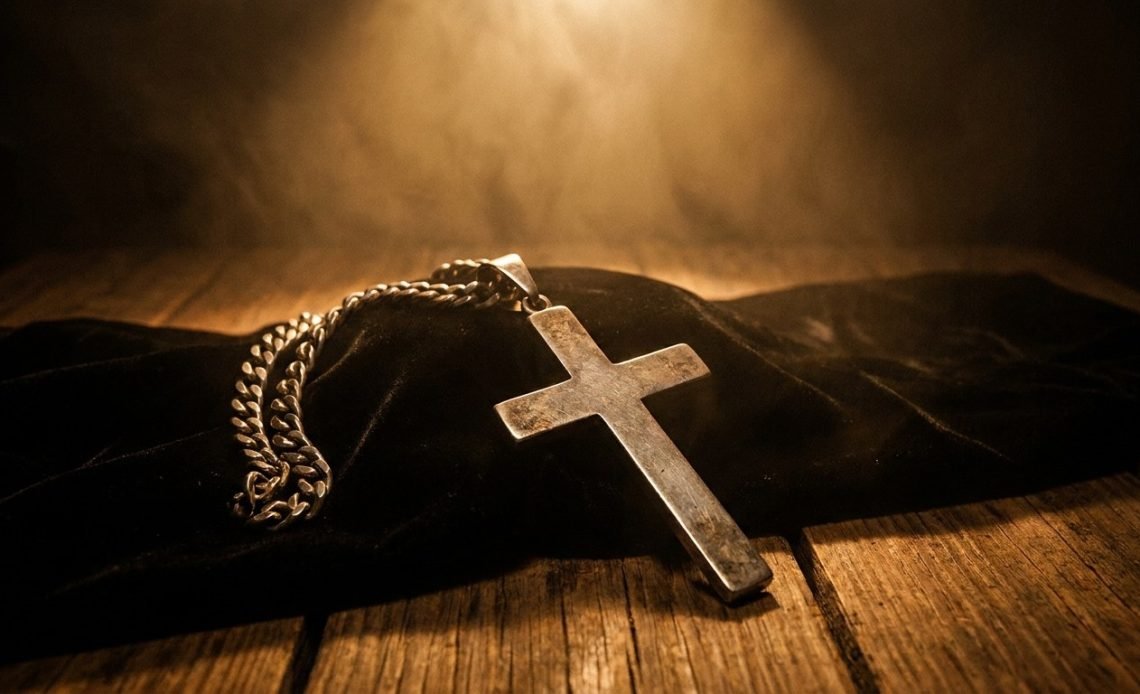
The Ozzy Osbourne cross style is a textbook example. It’s a Latin cross — vertical bar slightly longer than the horizontal, with no embellishment, no inlay, no stones. The width is moderate, neither delicate nor chunky. The metal is sterling silver, .925 standard, which develops a soft patina with skin contact but doesn’t corrode. The chain is a basic curb or rope link, heavy enough to hold the pendant straight under stage movement, fine enough to disappear against skin.
This is why handcrafted sterling silver cross pendants for men in this same general format have stayed in continuous demand among rock and biker subcultures since the early 1970s. The pieces that get worn for decades aren’t the ones with the most ornament. They’re the ones with enough mass to survive daily contact and a shape simple enough that it never goes out of style.
Plated pieces wear through. Trendy designs date themselves. Solid sterling Latin crosses look identical at year one and year forty, except for the patina the wearer added themselves.

Frequently Asked Questions
Why did Ozzy Osbourne wear a cross?
Osbourne grew up in a Catholic household in Birmingham, England, and described the cross in interviews as protective — a counterweight to the occult imagery in Black Sabbath’s music. He’d talk about being genuinely afraid of what the band was singing about, and the cross was, in his words, insurance. Over time it became signature visual identity rather than active religious statement.
What kind of cross does Ozzy Osbourne wear?
A simple Latin cross — vertical bar slightly longer than horizontal, no inlay or stones — usually in sterling silver on a basic chain. He wore variations on this same form across his career. The style is sometimes called the “rock cross” or “metal cross” because of how thoroughly his version came to define what musicians wore on stage.
Is Ozzy Osbourne’s cross pendant available for sale?
The specific personal pieces he wore are not publicly sold. The general design — a plain sterling silver Latin cross on a heavy chain — is one of the most reproduced styles in men’s jewelry. Specialty retailers focused on rock and biker aesthetics typically carry close equivalents in solid sterling silver.
Where was Ozzy Osbourne’s final concert?
Villa Park stadium in Aston, Birmingham, on July 5, 2025. The show was billed as Back to the Beginning. It was the first reunion of Black Sabbath’s original lineup since 2005, drew 45,000 attendees, and ended with both the band’s and Osbourne’s final live performances. He died seventeen days later.
What Stays When the Person Goes
Most of what made Ozzy Osbourne famous was performance — sound, gesture, image, decades of public spectacle. None of that survives in physical form once the performer is gone. What does survive is the small set of objects that traveled with him through all of it. The cross is one of those objects. Somewhere right now, it’s sitting on a shelf or in a drawer or around someone else’s neck, doing the quiet work of outlasting its first owner.
About the author: The team at Bikerringshop has spent over fifteen years working with sterling silver pieces for rock, biker, and gothic clientele. The workshop specializes in hand-finished men’s silver jewelry and exotic leather goods.

