


Easy Happy Birthday Piano Sheet Music & Notes 2026
Happy Birthday piano sheet music is the perfect starting point for beginner pianists looking to learn their first recognizable song.
This timeless melody, originally composed by Mildred J. Hill and Patty S. Hill in 1893, remains the most celebrated tune worldwide.
Whether you’re preparing for a family celebration, teaching young students, or simply want to surprise someone special, learning Happy Birthday on piano opens doors to musical expression.
With simplified arrangements, letter notes, free PDF downloads, and step-by-step tutorials available online, mastering this classic song has never been easier for pianists of all skill levels in 2026.
Quick Facts: Happy Birthday Piano Sheet Music
| Category | Details |
|---|---|
| Composers | Mildred J. Hill & Patty S. Hill (1893) |
| Original Title | “Good Morning to All” |
| Popular Keys | C Major, F Major, G Major |
| Difficulty Level | Beginner to Advanced |
| Time Signature | 3/4 (Waltz rhythm) |
| Note Range | 1 octave (C to C) |
| Chord Progression | I-V-IV-I (C-G-F-C in C Major) |
| Average Learning Time | 1-3 days for beginners |
Understanding Happy Birthday Sheet Music Basics (Happy Birthday Piano Sheet Music)

Happy Birthday piano sheet music comes in various difficulty levels suitable for every player. The song’s simple structure makes it ideal for absolute beginners starting their musical journey.
The melody spans just one octave, requiring minimal hand movement across the keyboard. This compact range allows young children and adult beginners to focus on rhythm and note reading without complex finger stretches.
Most arrangements use the key of C Major, which contains no sharps or flats. This key signature simplifies reading music and helps beginners build confidence before tackling more challenging pieces.
History of Happy Birthday Song
The Happy Birthday song originated in 1893 when sisters Mildred and Patty Hill composed “Good Morning to All” for kindergarten students in Louisville, Kentucky. The original melody was designed to be easy for young children to sing.
Around 1912, the lyrics transformed into the familiar “Happy Birthday to You” we know today. The exact origin of this lyrical change remains unknown, though the melody remained identical to the original composition.
The song became the most recognized tune in the English language according to Guinness World Records in 1998. Its universal appeal transcends cultural and linguistic barriers, making it truly global.
Free PDF Downloads Available Online
Numerous websites offer free Happy Birthday piano sheet music in downloadable PDF format. These resources save money while providing high-quality arrangements for immediate use.
MuseScore hosts user-uploaded arrangements ranging from simple to complex versions. The platform allows you to transpose sheet music into different keys, print directly from your browser, and access MIDI playback features.
Music-for-Music-Teachers provides multiple arrangements including beginner versions with letter notes inside note heads. These specialized arrangements help children and visual learners identify notes more quickly during practice.
Hoffman Academy offers super easy versions specifically designed for early elementary students. Their simplified notation removes unnecessary complexity while maintaining the song’s recognizable melody.
Different Difficulty Levels Explained
Beginner Level Arrangements
Beginner Happy Birthday sheet music features melody-only right hand parts with single bass notes in the left hand. These simplified arrangements eliminate chord complexity, allowing new pianists to focus on melody accuracy.
Large-print notation helps young students and those with vision difficulties read music more comfortably. Letter names printed inside note heads provide instant recognition without requiring fluency in traditional music reading.
Single-line left hand accompaniment keeps coordination challenges minimal. Students can master each hand separately before attempting to play both together, reducing frustration during learning.
Easy Level Arrangements
Easy arrangements introduce simple chord accompaniment in the left hand while maintaining straightforward melody lines. The “oom-pah-pah” bass pattern (root note followed by chord, chord) creates waltz-like rhythm.
These versions typically stay within one hand position throughout the piece. Minimal hand movement allows students to concentrate on timing and dynamics rather than navigation across the keyboard.
Fingering suggestions appear above or below notes, guiding proper technique from the start. Following these markings develops good habits preventing tension and awkwardness in hand positioning.
Intermediate Level Music
Intermediate Happy Birthday arrangements add harmony notes to the right hand melody. These additional notes create fuller sound and introduce concepts of musical texture and voice leading.
Left hand features full chords including inversions for smoother transitions between harmonies. Understanding chord inversions represents a significant milestone in piano development, opening doors to more sophisticated repertoire.
Some intermediate versions incorporate variations or embellishments to the basic melody. Grace notes, trills, and rhythmic alterations add personal style while maintaining recognizable core tune.
Advanced Level Variations
Advanced arrangements transform Happy Birthday into showcase pieces featuring complex harmonies and technical passages. Jazz versions incorporate seventh chords, altered harmonies, and syncopated rhythms.
Classical-style variations might include running passages, arpeggios, and dramatic dynamic contrasts. These concert arrangements demonstrate how simple melodies can become sophisticated musical statements through creative development.
Some virtuoso arrangements on platforms like MuseScore push technical boundaries with rapid scales and intricate voicings. These “insane” versions challenge even experienced pianists while entertaining audiences with their complexity.
Popular Keys for Happy Birthday
C Major: Best for Beginners
C Major uses only white keys, eliminating the confusion of black key sharps and flats. This accessibility makes it the universal starting key for piano students learning their first songs.
The key’s central position on the keyboard allows both hands to rest comfortably in natural positions. No awkward reaches or uncomfortable stretches distract from learning the melody and rhythm.
Most free sheet music downloads feature C Major arrangements as the default option. This standardization means beginners can easily find compatible resources across different websites and music books.
F Major: Ideal Singing Range
F Major places the melody in a comfortable vocal range for most people regardless of gender. The moderate pitch accommodates both male and female voices without straining high or low extremes.
This key contains one flat (B-flat), introducing beginners to accidentals in a manageable way. Learning to watch for and play the B-flat develops attention to key signatures early in musical education.
Many intermediate arrangements choose F Major to balance playability with vocal accommodation. Party pianists often prefer this key when leading group singing at birthday celebrations.
G Major: Bright and Cheerful
G Major creates a brighter, more celebratory sound due to its higher pitch. The key’s cheerful quality matches the festive nature of birthday celebrations perfectly.
This key requires one sharp (F-sharp) in the right hand only for basic arrangements. The limited black key usage keeps the piece accessible while introducing the concept of sharps naturally.
Some musicians argue G Major offers easier bass clef reading because it uses fewer ledger lines. This technical advantage benefits students still building bass clef fluency.
Reading Piano Sheet Music Components
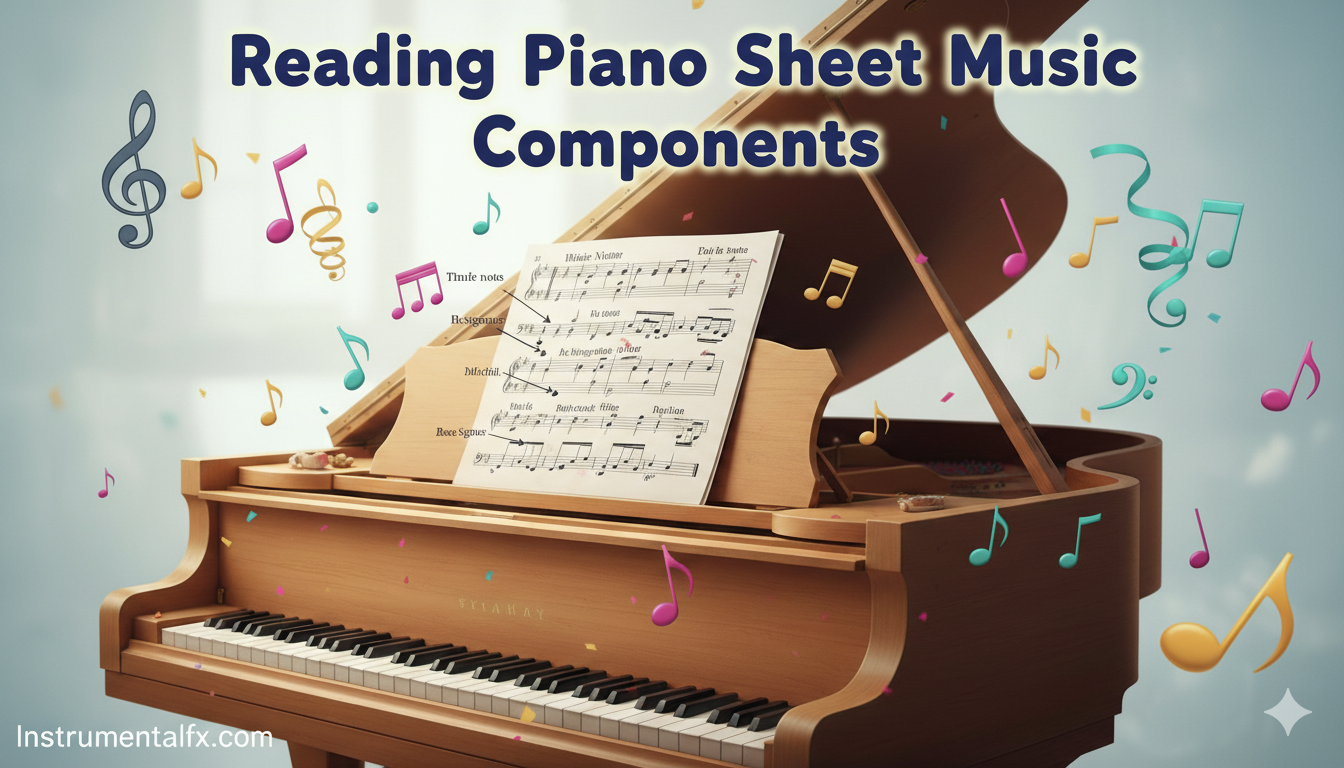
Understanding the Treble Clef
The treble clef (G clef) indicates right hand notes in piano music. Its spiral centers on the G above middle C, establishing the reference point for all other notes on this staff.
Notes progress upward alphabetically through the musical alphabet: C-D-E-F-G-A-B. Each line and space represents a specific pitch, creating a visual map of the keyboard on paper.
Mnemonic devices like “Every Good Boy Does Fine” (EGBDF for lines) and “FACE” (for spaces) help beginners memorize treble clef note positions. These memory aids accelerate the note-reading learning curve.
Reading the Bass Clef
The bass clef (F clef) shows left hand notes, typically handling harmony and accompaniment. Its two dots surround the F below middle C, serving as the orientation landmark.
Bass clef lines use the mnemonic “Good Boys Do Fine Always” (GBDFA), while spaces spell “All Cows Eat Grass” (ACEG). These phrases provide quick recall during early reading stages.
Beginning arrangements often use simpler bass parts to ease coordination challenges. As skill develops, bass lines grow more complex with fuller chords and countermelodies.
Time Signature Meaning
Happy Birthday uses 3/4 time signature, indicating three quarter-note beats per measure. This creates the characteristic waltz rhythm that gives the song its gentle, swaying quality.
The top number (3) tells how many beats each measure contains. The bottom number (4) indicates that a quarter note receives one beat, establishing the basic rhythmic unit.
Counting “1-2-3, 1-2-3” while playing helps maintain steady tempo and proper rhythm. This waltz feel distinguishes Happy Birthday from songs in common 4/4 time.
Letter Notes for Absolute Beginners
Letter note systems replace traditional notation with alphabetic note names. These simplified methods allow instant playing without requiring months of note-reading training.
C-C-D-C-F-E forms the opening phrase “Happy Birthday to you.” This sequence uses only five different notes within a six-note span, keeping hand position stationary.
The second phrase (C-C-D-C-G-F) mirrors the first with one variation. This repetitive structure aids memorization and builds confidence through pattern recognition.
Color-coded systems assign specific colors to each note, matching colored stickers placed on piano keys. This visual association helps very young children and special needs students connect notation to keyboard action.
Step-by-Step Learning Guide
Practice Right Hand First
Isolating the right hand melody allows focus on correct notes and rhythm without coordination distractions. Play through slowly, saying note names aloud while pressing keys.
Break the piece into small sections of 2-4 measures. Master each section completely before moving to the next, ensuring solid foundation before adding complexity.
Use a metronome or steady counting to maintain consistent tempo. Speed matters less than accuracy and steadiness during initial learning phases.
Master Left Hand Separately
Learn left hand accompaniment independently before combining hands. This separate practice allows each hand to develop muscle memory for its specific patterns.
Simple arrangements may use only single bass notes on beat one of each measure. More advanced versions incorporate full chords or alternating bass patterns.
Practice left hand while singing or humming the melody. This mental connection prepares your brain for the coordination required when playing both hands together.
Combine Hands Slowly
Start at half-speed or slower when first attempting hands together. Rushing this crucial step leads to mistakes becoming ingrained habits difficult to correct later.
Work through the piece phrase by phrase, ensuring clean execution before moving forward. Build your hands-together version from solid components rather than hoping it comes together eventually.
If one section proves particularly challenging, isolate those few measures for extra repetition. Most pieces contain one or two trouble spots requiring focused attention.
Add Dynamics and Expression
Once notes and rhythm flow comfortably, incorporate dynamics (volume changes) for musical interest. The traditional pause before the final phrase builds anticipation effectively.
Experiment with slight tempo variations, perhaps slowing at phrase endings or rushing slightly through exciting sections. These subtle manipulations make performances sound more natural and engaging.
Consider pedal usage if playing on acoustic piano. Light pedaling can blend harmonies beautifully, though overpedaling muddies the sound unpleasantly.
Fingering Tips and Techniques
Proper fingering creates efficient movement patterns preventing awkward reaches and tension. Standard fingering for Happy Birthday keeps the right hand in five-finger position starting on C.
Thumb (finger 1) plays C notes, index finger (2) handles D, middle finger (3) takes E, ring finger (4) covers F, and pinky (5) plays G. This position remains stable throughout most arrangements.
Left hand fingering varies based on whether playing single notes or chords. For simple single-note versions, use finger 5 (pinky) for lower bass notes and 1 (thumb) for higher ones.
When playing chords, use fingers 5-3-1 for three-note chords in root position. This spacing creates comfortable hand shape and allows smooth transitions between different chords.
Common Mistakes to Avoid
Rushing Through the Piece
Beginners often accelerate tempo unconsciously when nervous or excited. This rushing destroys the waltz feel and makes the song sound hurried and unmusical.
Practice with metronome set slower than your eventual performance tempo. Gradually increase speed only after achieving consistency at lower tempos over multiple practice sessions.
Record yourself playing to identify tempo inconsistencies. Listening back reveals rushing or dragging that you might not notice while focusing on playing.
Ignoring the Rhythm
The 3/4 time signature requires emphasis on beat one of each measure. Missing this downbeat emphasis makes the song lose its characteristic waltz swing.
Count out loud during practice: “ONE-two-three, ONE-two-three.” This verbal reinforcement ingrains proper rhythmic feel before it becomes automatic.
The fermata (pause symbol) in most arrangements marks an important dramatic moment. Hold this note longer than its written value to build tension before the finale.
Poor Hand Position
Collapsed knuckles and flat fingers create tension and limit technical development. Maintain rounded hand shape as if gently holding a small ball or orange.
Wrist height matters significantly for comfort and control. Keep wrists level with or slightly higher than knuckles, never dropping below key level.
Tension in shoulders, arms, or hands indicates improper technique. Shake out tension regularly during practice, and never play through pain or discomfort.
Forgetting Key Signature
In keys with sharps or flats, students commonly revert to white keys when memory fails. Stay alert for accidentals throughout the piece, not just at the beginning.
Practice scales in your chosen key before learning the song. This familiarity with the key signature’s altered notes prevents forgetfulness during performance.
Mark accidentals with pencil or highlighter in your sheet music. Visual reminders help until key awareness becomes second nature through repetition.
Teaching Happy Birthday to Children
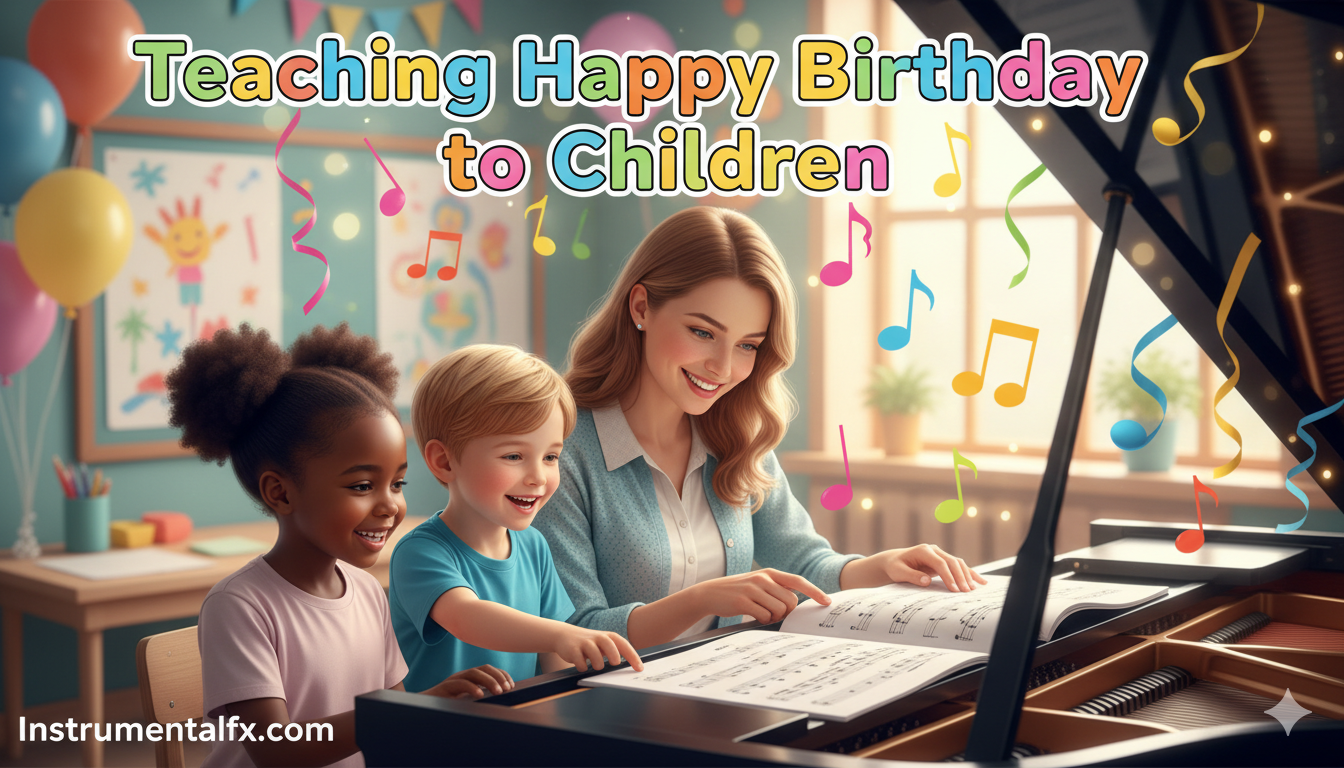
Children respond well to Happy Birthday because they recognize and love the song. This familiarity provides motivation that abstract exercises cannot match.
Use large-print sheet music with colorful notation for young students. Visual appeal maintains attention spans and makes practice time more enjoyable.
Incorporate games and challenges into practice sessions. Can they play it with eyes closed? Can they transpose it to a different starting note? Playful approaches keep engagement high.
Allow students to perform for family members as soon as possible. Real-world application through performing at actual birthday parties validates their learning and boosts confidence.
Digital Resources and Apps
Piano learning apps like Simply Piano, Flowkey, and Skoove offer interactive Happy Birthday lessons. These platforms use real-time feedback to correct mistakes immediately during practice.
YouTube tutorials provide free visual demonstrations showing proper hand position and technique. Slow-motion videos help beginners observe finger movements they should replicate.
MIDI files allow playback at adjustable speeds, letting students hear exactly how the piece should sound. These audio references prevent developing incorrect rhythms or note interpretations.
Virtual piano keyboards on tablets enable practice without access to physical instruments. While not ideal for developing proper touch, they provide convenient additional practice opportunities.
Chord Progressions Explained
Happy Birthday uses the basic I-V-IV-I progression found in countless popular songs. Understanding these chord relationships unlocks ability to play many songs by ear.
In C Major, this progression translates to C-G-F-C chords. The Roman numeral system allows musicians to discuss progressions independent of specific keys.
The I chord (tonic) provides home base, creating stability and resolution. Songs typically begin and end on this chord, establishing tonal center clearly.
The V chord (dominant) creates tension wanting to resolve back to I. This pull toward resolution drives harmonic momentum throughout Western music.
The IV chord (subdominant) provides contrast without the strong tension of V. Its sound bridges between tonic stability and dominant tension effectively.
Transposing to Different Keys
Transposition means playing the same melody starting on different notes. This essential skill allows accommodation of different vocal ranges or instrumental limitations.
To transpose up or down, maintain the same pattern of intervals between notes. If the original melody goes up a whole step then down a half step, keep those relationships in the new key.
Most sheet music websites offer automatic transposition tools. Select your desired key from a dropdown menu, and the notation instantly adjusts to the new key signature.
Understanding scale degrees facilitates transposition without relying on written music. If you know the melody uses scale degrees 1-1-2-1-4-3, you can play it in any key.
Adding Jazzy Variations
Jazz harmonizations replace simple triads with richer seventh chords. A basic C chord becomes Cmaj7 (C-E-G-B), adding sophisticated color to familiar harmonies.
Walking bass lines in the left hand create movement and swing feel. Instead of holding whole notes, play quarter note patterns connecting chord roots smoothly.
Syncopation places emphasis on unexpected beats, creating rhythmic interest. Anticipate melody notes slightly ahead of the beat for authentic jazz phrasing.
Improvisation allows personal expression within the song’s structure. Add melodic fills between phrases or embellish held notes with grace note ornaments.
Performance Tips for Parties
Announce your intention to play clearly before sitting at the piano. This cues party guests to gather around and prepare to sing along with your accompaniment.
Start with a clear introduction pattern, such as a rolled chord or short melodic pickup. This musical cue tells everyone exactly when to begin singing.
Make eye contact with the birthday celebrant during the performance. This personal connection adds emotional warmth to the musical tribute.
Play slightly slower than you might practice alone. Groups need extra time to coordinate their singing, and rushing creates chaotic, unsatisfying results.
End with a flourish like a final chord arpeggio or brief improvised cadenza. A strong finish earns more enthusiastic applause than simply stopping abruptly.
Practice Schedules for Quick Learning
Beginners can learn Happy Birthday in 3-5 practice sessions of 15-20 minutes each. Short, focused sessions prove more effective than marathon practice periods.
Day one should focus entirely on right hand melody until completely secure. Aim for playing without looking at music or hands by end of session.
Day two introduces left hand accompaniment separately. Ensure comfort and accuracy with bass line before attempting any hand coordination.
Day three combines hands at very slow tempo. Work through piece phrase by phrase, stopping to fix any coordination problems immediately.
Days four and five refine tempo, dynamics, and polish. Gradually increase speed while maintaining accuracy and musical expression throughout.
Online Sheet Music Libraries
MuseScore Community hosts thousands of user-created arrangements in every difficulty level. Free accounts allow downloading unlimited sheet music in PDF, MIDI, and MusicXML formats.
IMSLP (International Music Score Library Project) provides public domain music including various Happy Birthday editions. All content is legally downloadable without registration requirements.
8notes.com offers arrangements for multiple instruments with transposition options. Their clean interface and quality engravings make for easy printing and reading.
MakingMusicFun.net specializes in educational arrangements for young students. Their beginner versions include helpful practice tips and theory explanations integrated with sheet music.
Understanding Musical Notation Symbols
Quarter notes receive one beat in 3/4 time, appearing as filled noteheads with stems. These form the basic pulse of Happy Birthday’s waltz rhythm.
Half notes last two beats, shown as open noteheads with stems. The song contains several half notes creating phrase endings and breathing points.
Dotted half notes extend three full beats, filling entire measures in 3/4 time. The final notes of phrases typically use this duration for satisfying resolution.
Rests indicate silence measured in beats just like notes. Quarter rests (one beat of silence) occasionally appear in more advanced arrangements creating rhythmic interest.
Piano vs Keyboard Considerations
Acoustic pianos offer superior touch sensitivity and dynamic range compared to electronic keyboards. Weighted keys develop proper finger strength and technique from the beginning.
Digital pianos and keyboards provide portability and volume control advantages. Headphone jacks allow silent practice without disturbing household members or neighbors.
Full 88-key instruments give access to the piano’s complete range, though Happy Birthday requires only a small central portion. Even 61-key keyboards contain sufficient range for this piece.
Touch-sensitive keyboards respond to playing force with volume changes. This feature remains essential for developing musical expression, making it a priority when selecting instruments.
Music Theory Concepts in Happy Birthday
The song demonstrates tonic-dominant-subdominant relationships fundamental to Western harmony. These three chord functions form the foundation of thousands of compositions.
Stepwise motion dominates the melody, meaning most notes connect to adjacent scale degrees. This creates smooth, singable lines easy to remember and perform.
The melody’s range (one octave) keeps it accessible to untrained voices. Composers writing for groups consider vocal comfort to encourage participation.
Phrase structure follows regular 4-bar patterns creating predictable, satisfying form. This symmetry contributes to the song’s memorability and widespread appeal.
Troubleshooting Learning Difficulties
When Progress Stalls
Plateaus occur naturally during learning processes. Take a day off from the piece, then return with fresh perspective and renewed focus.
Break challenging sections into smaller segments of just 2-3 notes. Master micro-sections before expanding to larger phrases gradually.
Change practice approach by using different learning methods. Try playing by ear, using letter notes, or watching video tutorials for alternative perspectives.
Coordination Problems
Hand coordination develops gradually through patient, methodical practice. Expecting immediate hands-together success creates frustration and discouragement.
Practice one hand while tapping the rhythm of the other hand. This intermediate step bridges the gap between separate hands and full coordination.
Use extremely slow practice tempos initially, even if it feels uncomfortable. Speed emerges naturally from accuracy, but rushing prevents proper neural pathway development.
Memory Slips
Secure memory requires understanding, not just repetition. Analyze chord progressions, phrase structures, and melodic patterns to create multiple mental anchors.
Practice starting from different points within the piece rather than always beginning at the start. This prevents dependence on momentum for memory retrieval.
Mental practice away from the piano strengthens memory remarkably. Visualize playing while sitting on a bus or lying in bed before sleep.
Advanced Arrangement Techniques

Countermelody additions create interest in the left hand beyond simple accompaniment. These secondary melodic lines interweave with the main tune harmonically.
Reharmonization substitutes different chords while maintaining the original melody. Jazz players particularly enjoy exploring alternative harmonic interpretations.
Modulation (key changes) can occur mid-piece for dramatic effect. Moving up a half-step for the final phrase creates excitement and energy.
Rhythmic variations alter the basic waltz feel into different styles. Try swing eighths, Latin rhythms, or straight rock feels for creative arrangements.
Recording Your Performance
Smartphone recording apps capture practice sessions for self-assessment. Listening back reveals mistakes and areas needing attention that you miss while playing.
Video recordings show posture and hand position issues requiring correction. Visual feedback proves invaluable for developing proper technique.
Share recordings with teachers or online communities for feedback. Constructive criticism from experienced players accelerates improvement significantly.
Keep recordings dated in a folder to document progress over time. Comparing early and later versions provides encouraging evidence of improvement.
Building Performance Confidence
Start by playing for one trusted family member or friend. Small, supportive audiences help overcome initial performance anxiety before larger groups.
Practice performing through mistakes without stopping. Real performances continue despite errors, and stopping draws more attention to problems than smoothly continuing.
Visualize successful performances during practice sessions. Mental rehearsal primes your brain for actual performance situations effectively.
Remember that people want to enjoy your playing, not judge it harshly. Birthday party audiences feel grateful for musical contributions to their celebrations.
Maintenance Practice After Learning
Continue playing Happy Birthday regularly even after mastering it. Skills deteriorate without maintenance practice sessions.
Incorporate it into warmup routines before practicing other pieces. This keeps the song fresh while serving as technical preparation for more complex works.
Try new variations or improvisations to keep the piece interesting. Creative exploration prevents boredom while deepening musical understanding.
Volunteer to play at actual birthday celebrations whenever possible. Real-world applications reinforce learning and provide motivation for continued development.
Frequently Asked Questions
What is the easiest key for Happy Birthday piano?
C Major is the easiest key for beginners because it uses only white keys with no sharps or flats. This simplifies reading and playing for students just starting their musical journey with basic piano skills.
How long does it take to learn Happy Birthday on piano?
Most beginners can learn Happy Birthday in 3-5 days with 15-20 minute daily practice sessions. Complete novices might need one week, while those with some experience can master it in a single afternoon of focused practice.
Can I learn Happy Birthday without reading music?
Yes, letter note systems and color-coded methods allow learning without traditional notation. These alternatives use alphabetic note names (C-D-E-F-G) or colored keys matching colored notes on simplified sheet music for quick learning.
What chords do I need for Happy Birthday?
In C Major, you need three basic chords: C Major (I), G Major (V), and F Major (IV). These simple triads form the complete harmonic foundation, and you can add G7 instead of G for richer sound.
Where can I download free Happy Birthday sheet music?
MuseScore, IMSLP, 8notes, Music-for-Music-Teachers, and Hoffman Academy offer free PDF downloads in multiple difficulty levels. These legitimate sites provide legal arrangements without copyright concerns or payment requirements.
Is Happy Birthday hard to play on piano?
Happy Birthday is considered one of the easiest piano songs for beginners. The melody spans just one octave with simple rhythm, basic chords, and repetitive patterns that make it accessible to players with minimal experience.
What is the best fingering for Happy Birthday?
Use standard five-finger position: right hand fingers 1-2-3-4-5 on C-D-E-F-G. This position remains stable throughout, avoiding complicated shifts or stretches. Left hand fingering depends on whether playing single notes or full chords.
Can children learn Happy Birthday on piano?
Yes, children as young as 5-6 years old can learn simplified versions using large-print sheet music with letter notes. Color-coded systems make it even easier for preschoolers to participate in basic piano playing.
Should I use pedal when playing Happy Birthday?
Pedal is optional and depends on skill level and piano type. Beginners should focus on accurate notes and rhythm first. Intermediate players can add light pedaling to blend chords smoothly without muddying the melody.
How do I play Happy Birthday by ear?
Start by singing and identifying the first note, then find it on the piano. Continue matching each melodic note to keyboard keys using your ear to verify correctness. The melody’s stepwise motion makes this process accessible for development.
Conclusion
Happy Birthday piano sheet music provides the perfect entry point for aspiring pianists at every skill level. From simplified letter note versions for absolute beginners to complex jazz arrangements for advanced players, this beloved song offers something for everyone.
The availability of free PDF downloads, interactive apps, video tutorials, and comprehensive learning resources in 2026 makes mastering this classic tune more accessible than ever before.
By following proper practice techniques, understanding basic music theory, and gradually building coordination skills, you’ll soon play confidently at birthday celebrations.
Whether you’re a parent teaching your child, an adult learner pursuing a new hobby, or a teacher guiding students, Happy Birthday remains the ideal first song for developing fundamental piano skills.
Start your musical journey today by downloading free sheet music and bringing joy to every birthday celebration with your newfound piano abilities.


