


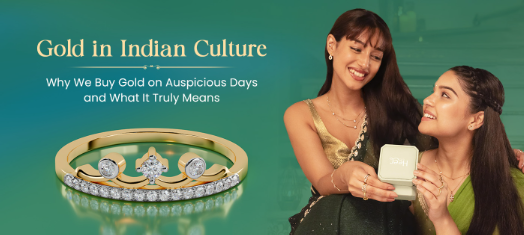
Walk into any Indian home during Dhanteras, Diwali, Akshaya Tritiya, or Navratri and you will notice that at some point in the day a family member went and bought gold. Maybe it was a coin or a pair of earrings. When Gold jewellery comes home and for a moment everyone stops and looks at it together.
Gold in Indian homes carries something heavier than a price tag. It has been the grandmother’s bangles for decades. The mother who pressed a chain into her daughter’s hand before a wedding, just a quiet look that said everything. Heer by GIVA understands that weight. Their pieces feel like they were made for moments that actually matter, not just occasions on a calendar. To understand what gold means in India, you have to go back much further.
Why Is Gold Considered Auspicious in Indian Culture
Nobody grows up in an Indian household being told gold is just a metal. You grow up watching it get locked away carefully, brought out for special occasions, discussed in hushed tones when something important is being decided.
Lakshmi never appears without it. Every image, idol, painting of the goddess of wealth shows her draped in gold. So when a family brings gold home on an auspicious day, they are not completing a purchase. They are extending an invitation. Come in. We are ready.
The connection to Surya runs just as deep. Gold and the sun have been linked in Vedic belief forever. The metal is considered clean in a way almost nothing else is, which is why it turns up at every threshold moment in Indian life. The first time a baby’s ears are pierced. A boy’s thread ceremony. The morning of a wedding. The last rites. Gold is present at every celebration not for tradition’s sake but because it genuinely held meaning for the people who began it.
Why Do Indians Buy Gold on Dhanteras and Diwali
Dhanteras falls on the thirteenth lunar day of Krishna Paksha in the month of Kartik. Dhan literally means wealth. On this day buying gold is not a lifestyle choice. It is closer to an obligation that nobody minds fulfilling.
Jewellers prepare for it months in advance. Families save up. People who have been going back and forth on a decision for weeks finally walk in and do it. Gold brought home on Dhanteras is believed to multiply. Lakshmi follows it through the door. The household will be looked after in the year ahead. Diwali then stretches that feeling across five full days. A purchase made anywhere inside that window carries an intention behind it that a regular Tuesday simply cannot match.
What Is Akshaya Tritiya and Why Do People Buy Gold on This Day
Most auspicious occasions come with a window. A specific hour when the stars align and the timing is right. Akshaya Tritiya does not work that way. The entire day from sunrise to sunset is considered inherently good. Akshaya means that which never runs dry and the day lives up to its name. Businesses open on Akshaya Tritiya. Weddings get scheduled around it. Gold gets bought with a specific kind of faith, that whatever you put in on this day will only grow from here.
Akshaya Tritiya has a calmer mood than Dhanteras. No queues forming before shops open, no festive noise outside. People come in having already decided. Less crowd energy, more deliberate intention. Even those who never track lunar calendars will make a point of buying on this day because the belief has stopped being religious and started being simply cultural.
Why Is Gold Jewellery Important in Indian Weddings
An Indian wedding without gold is hard to picture because gold at a wedding is not about looking good. It is about saying things that words cannot quite cover.
The streedhan is thousands of years old. Gold given to a bride was her security at a time when she had almost no financial independence. It was the one thing that was completely and legally hers. Families understood this. They still do even if they cannot always articulate why they feel so strongly about it.
The specific pieces differ everywhere. In Tamil Nadu and Kerala the thali is the moment, the knot of the marriage tied literally around the bride’s neck. In Punjab and UP the chooda and the gold bangles carry that weight. In West Bengal the loha and shakha worn with gold mark a woman’s married life in a way everyone around her can read instantly.
The vocabulary changes by region. The feeling behind it does not.
Best Auspicious Days to Buy Gold in India Beyond Dhanteras
Beyond the big occasions there are dates that regular buyers quietly plan around.
Pushya Nakshatra landing on a Sunday is one of them. Pushya is already considered auspicious. Add Sunday, which carries solar energy in Vedic tradition, and the combination is treated as powerful. Gold bought on such a day is believed to bring compounded benefit.
Navratri works differently. Nine nights of Durga, each one carrying a different form of her energy. Buying gold during Navratri is less about timing and more about devotion, a way of placing yourself inside the goddess’s protection rather than waiting to see if it arrives.
Regional new years add another layer. Ugadi in Andhra and Karnataka. Gudi Padwa in Maharashtra. Baisakhi in Punjab. Pongal in Tamil Nadu. Each one treats gold as the right way to open a new chapter. Different festivals, same instinct underneath.
Is Buying Gold in India a Financial Decision or an Emotional One
The financial case for gold is solid and well documented. It holds value when currencies wobble. It sits outside the volatility of stock markets. Indian households collectively hold more gold than most central banks. That is not sentiment. That is strategy.
But look at what happens when a new baby arrives in a family. The grandmother does not reach for a mutual fund. She reaches for a gold bangle to put on the child’s wrist and she insists on doing it herself. And a family that is short on money will still find a way to bring a gold piece home on Dhanteras because skipping it feels unthinkable.
What to Know Before Buying Gold Jewellery in 2026
The reasons people buy gold have not changed. The questions they ask before buying have. Young buyers want to know where it came from, who made it, and what the process looked like. The values that always made gold worth keeping, purity, integrity, something you can trust without checking twice, are now being applied to the supply chain behind it and not just the shine on top.
Recycled gold and ethically certified options are moving from niche to normal. A piece made cleanly from start to finish is worth passing down, not just wearing.
Gold has always been how Indian families mark what matters. A birth, a wedding, a moment they wanted to hold onto. That is not changing. What is shifting is the thought behind the choice. And a tradition that grows more considered with each generation is not losing itself. It is finding a better version of itself.

