


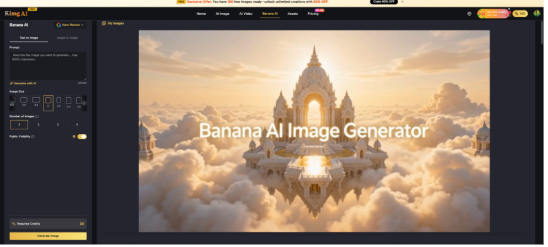
Midjourney has long been the go-to for mood-driven, aesthetically stunning imagery — but for anyone who’s tried getting clean text on a product label or a print-ready 4K output, the frustration is real. That’s where Kimg AI‘s Banana AI suite steps in, and specifically its Nano Banana Pro model, which was built precisely for the kind of precision work Midjourney wasn’t designed to handle.
I. The Midjourney Problem Nobody Talks About
Midjourney is exceptional at composition, lighting, and visual atmosphere. But two specific tasks consistently break its workflow:
- Text rendering: Signs, packaging, logos — Midjourney garbles them. Users routinely get creative, beautiful images with unreadable or nonsensical text baked in.
- Upscaling: Native resolution outputs often need a boost for print or display use, and simply stretching pixels produces muddy, artifact-heavy results.
- Prompt rigidity: Midjourney’s aesthetic engine thrives on mood but struggles with multi-element precision — the kind of control needed for commercial product visuals.
These aren’t minor inconveniences. For marketers, product photographers, and brand designers, they’re genuine production blockers.
II. What the Banana AI Model Family Actually Is
The Banana AI lineup on Kimg AI isn’t a single tool — it’s a tiered model family, each built for a different level of creative demand.
- Nano Banana: The entry-level model, solid for general text-to-image and image-to-image tasks, with support for up to 4 reference images per session.
- Nano Banana 2: A significant step up, designed for complex multi-image work — it accepts up to 13 reference images simultaneously, making it the strongest option for style consistency across large asset libraries.
- Nano Banana Pro: The flagship model, engineered for professional-grade output, precision text rendering, and intelligent upscaling up to 4K — built for work that needs to be print-ready or ad-ready on the first pass.
Each model in the family has a distinct role. Understanding which one fits the task prevents wasted iterations.
III. Nano Banana Pro and Text Rendering — What’s Different
The text rendering gap between Midjourney and Nano Banana Pro is one of the clearest capability differences visible in direct comparisons.
- Legible in-image text: Nano Banana Pro generates sharp, readable text directly within images — on packaging, signage, posters, and product mockups — without requiring post-production overlays in Photoshop or Figma.
- Prompt-following precision: Where Midjourney interprets prompts aesthetically, Nano Banana Pro treats text instructions more literally, producing outputs that match specifications rather than approximate them.
- Commercial application ready: Product photography with branded text, promotional banners with slogans, and retail display mockups all benefit from this capability without additional manual correction.
This is the single biggest reason creative professionals are integrating Nano Banana Pro as a finishing layer on top of Midjourney-generated base images.
IV. The Upscaling Approach — Intelligence Over Interpolation
Most upscalers simply stretch and smooth. Nano Banana Pro’s upscaling on Kimg AI works differently.
- Context-aware reconstruction: Rather than enlarging pixels, the model analyzes the structure, materials, and lighting in the image, then repaints detail at a higher resolution that looks authentically sharp.
- Semantic understanding: The model distinguishes between different surface types — skin, metal, fabric, wood — and renders appropriate texture detail for each material at scale.
- 4K-ready output: Outputs reach up to 4K resolution, suitable for large-format print, high-resolution display, and professional publishing. The quality ceiling is 4K, and it’s reached without the artificial sharpening artifacts common in standard upscalers.
The result is a high-resolution image that looks like it was captured at that resolution — not one that was stretched to fill it.
V. Practical Workflows: Where Nano Banana Pro Fits
The most effective creative workflows don’t treat Nano Banana Pro as a replacement for Midjourney — they use both tools for what each does best.
- Midjourney for macro: Composition, mood, lighting, and atmosphere — areas where Midjourney’s aesthetic intelligence genuinely excels.
- Nano Banana Pro for micro: Text accuracy, detail precision, iterative refinement, and upscaling — tasks that require control over specific elements rather than overall style.
- Final output via Kimg AI: Once the base image is established, the Banana AI Image Maker on Kimg AI handles the refinement pass — bringing the image up to production quality with sharp text and clean 4K output in a single step.
This hybrid approach eliminates the traditional trade-off between beautiful images and usable ones.
VI. Who Should Be Using Nano Banana Pro
Nano Banana Pro on Kimg AI isn’t positioned as a general-purpose generator for casual exploration. It’s built for specific professional use cases:
- Brand and product designers who need text-on-image accuracy for packaging, labels, and promotional materials without manual post-editing.
- E-commerce teams producing high-volume product visuals that need consistent quality at 4K output for large-format display and print.
- Content creators and agencies working at scale who use Midjourney for creative ideation but need a reliable finishing tool for commercial delivery.
The Banana AI model family as a whole covers a wide range of production needs. But when the requirement is precision, legibility, and output quality that holds up under professional scrutiny, Nano Banana Pro is where that expectation gets met.
VII. Conclusion
Midjourney remains a powerful creative tool — but it was never built to be a production finishing engine. For anyone hitting walls with garbled text or soft, artifact-heavy upscales, the answer isn’t to abandon Midjourney entirely. It’s to pair it with a model that handles what it can’t.
Kimg AI‘s Nano Banana Pro fills that gap cleanly. Sharp in-image text, intelligent 4K upscaling, and a multi-reference image workflow that scales with project complexity — these aren’t incremental improvements. They’re the difference between a concept image and a file that ships.
The Banana AI model family gives creators a genuine choice based on what the project actually demands, not a one-size-fits-all generator that forces compromises. That’s a more honest way to build creative tools, and a more useful one.

