



Happy Birthday sheet music remains one of the most searched-for musical arrangements worldwide. Whether you’re a beginner pianist, experienced guitarist, or music teacher, finding the perfect arrangement transforms any celebration into a memorable musical moment.
This comprehensive guide covers everything from free downloads to advanced variations across multiple instruments.
Quick Facts About Happy Birthday Sheet Music
| Fact | Details |
|---|---|
| Original Composers | Mildred J. Hill and Patty Smith Hill (1893) |
| Copyright Status | Public domain (as of 2016) |
| Most Popular Keys | C Major, F Major, G Major |
| Difficulty Levels | Beginner, Easy, Intermediate, Advanced |
| Common Instruments | Piano, Guitar, Violin, Flute, Voice |
| Typical Duration | 30-45 seconds |
| Original Title | “Good Morning to All” |
| First Verse Length | 8 measures standard |
| Recommended Age to Learn | 5 years and up |
| Best Keys for Singing | F Major, G Major (vocal range friendly) |
Understanding Happy Birthday Sheet Music
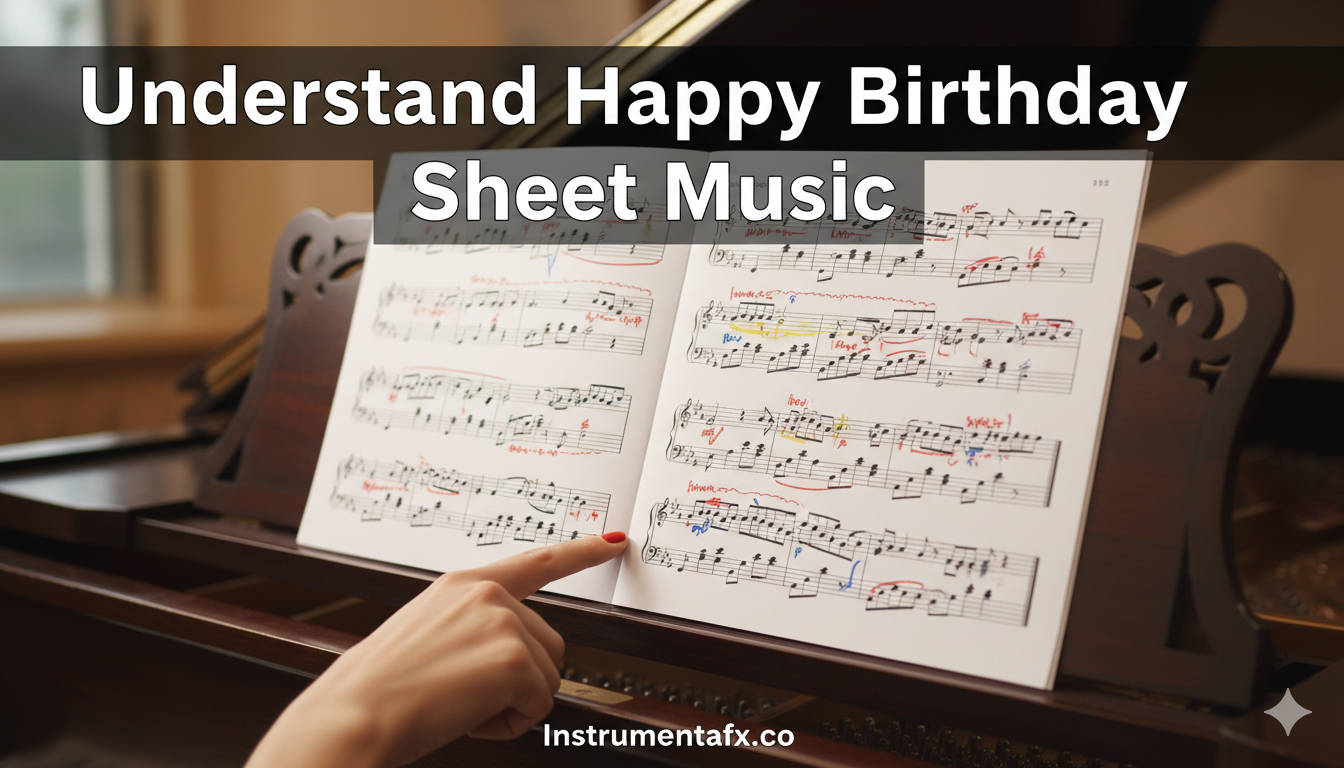
Happy Birthday sheet music comes in numerous arrangements designed for different skill levels and instruments. The traditional melody follows a simple pattern that makes it accessible for beginners while offering room for creative interpretation by advanced musicians.
The History Behind the Song
The melody was originally composed in 1893 by Mildred J. Hill with lyrics by her sister Patty Smith Hill. Initially titled “Good Morning to All,” the song was meant for classroom use. Over time, the familiar birthday lyrics replaced the original words, creating the world’s most recognized celebratory song.
The song entered public domain in 2016, making it freely available for all uses. This change wishregards revolutionized access to official arrangements and encouraged musicians worldwide to create and share their versions.
Happy Birthday Piano Sheet Music
Piano arrangements dominate the sheet music landscape for this classic tune. From simple five-finger positions to complex jazz interpretations, pianists of all levels find suitable versions.
Beginner Piano Arrangements
Beginner arrangements typically use the C Major or F Major key signature. These versions feature simple right-hand melodies with basic left-hand chords or single bass notes. Many beginner sheets include finger numbers and lettered note names inside note heads.
The Middle C position works wonderfully for absolute beginners. This arrangement keeps both hands close to middle C, minimizing hand position changes. Students can master the melody within their first few months of piano study.
Five-finger arrangements represent another excellent starting point. These versions require only basic hand positions without stretches or complicated fingerings. Teachers often introduce this song early because students already know the tune by ear.
Intermediate Piano Versions
Intermediate arrangements introduce chord inversions and more sophisticated accompaniment patterns. The classic “oom-pah-pah” style uses root position chords with alternating bass notes and chord patterns. This approach teaches fundamental chord theory while creating a fuller, more professional sound.
Key signatures expand to include D Major, Eb Major, and A Major. These variations help students practice different key signatures and develop transposition skills. Many teachers use Happy Birthday as a transposition exercise, having students play the same arrangement in multiple keys.
Seventh chords appear frequently in intermediate versions. The G7 chord in the key of C or C7 in F Major adds harmonic richness. Learning these chords through familiar melodies helps students grasp chord construction naturally.
Advanced Piano Arrangements
Advanced versions feature complex harmonies, jazz interpretations, and classical variations. Blues-style arrangements incorporate swing rhythms, blue notes, and syncopation. Jazz versions might include extended chords like 9ths, 11ths, and 13ths.
Classical variations imitate famous composers’ styles. You’ll find arrangements in the style of Mozart, Beethoven, or Chopin. These creative interpretations maintain the recognizable melody while showcasing different musical periods and techniques.
Concert arrangements for advanced players include dramatic introductions, modulations, and virtuosic passages. These versions transform the simple birthday song into impressive performance pieces suitable for recitals or special celebrations.
Happy Birthday Guitar Sheet Music
Guitar arrangements include both standard notation and tablature formats. The song’s simple chord progression makes it perfect for beginning guitarists learning their first accompaniment patterns.
Basic Guitar Chords
The most common guitar keys are G Major and D Major. In G Major, the basic chords are G, C, and D7. These open position chords allow beginners to play comfortable, full-sounding accompaniment.
D Major arrangements use D, G, and A7 chords. This key sits slightly higher, often better for male voices. The fingerings remain straightforward, with all chords using standard open positions.
Strumming patterns range from simple downstrokes to more complex rhythmic patterns. A basic down-down-up pattern works well for casual singalongs. More experienced players might add fingerpicking patterns or Travis picking styles.
Guitar Tablature Versions
Tab versions show exactly which frets to press on which strings. This format helps guitarists who haven’t learned standard notation yet. Many tabs include chord diagrams above the staff for reference.
Fingerstyle arrangements present the melody on the higher strings while bass notes or chords fill in harmony on lower strings. These solo guitar versions let guitarists perform the complete arrangement without accompaniment.
Lead guitar versions focus on the melody line itself. These arrangements work well for guitarists playing along with piano or other instruments. The melody typically sits on the first and second strings for clarity.
Sheet Music for Other Instruments
Beyond piano and guitar, Happy Birthday arrangements exist for virtually every instrument. String, woodwind, and brass players all find suitable versions.
Violin Sheet Music
Violin arrangements typically use first position for beginners. The melody lies comfortably within the first five notes on each string. Key signatures of G Major or D Major work naturally with violin’s open strings.
Intermediate violin versions add double stops and harmonics. These embellishments create a richer texture while maintaining the recognizable melody. Advanced arrangements might include pizzicato sections or variations in different positions.
Flute and Clarinet Arrangements
Wind instrument arrangements consider breath marks and phrasing. The song’s short phrases work perfectly for wind players developing breath control. Beginning arrangements stay in comfortable registers without extreme high or low notes.
Clarinet versions often use Bb or F Major to accommodate the instrument’s transposition. Flute arrangements use C, G, or F Major, keeping the melody in the instrument’s sweet spot. Both instruments handle the song’s range easily at any skill level.
Trumpet and Brass Music
Brass arrangements account for lip stamina and range limitations. Beginning trumpet versions stay within the staff, typically using C, Bb, or F Major. The melody’s limited range makes it ideal for developing brass players.
Advanced brass arrangements might include fanfare-style introductions or jazz-influenced improvisations. These versions showcase the instrument’s bright, celebratory tone quality. Brass ensembles often arrange the song with harmonized parts for multiple players.
Vocal Sheet Music and Lead Sheets
Singers need sheet music that accommodates different vocal ranges. Lead sheets provide melody and chords, letting accompanists create their own arrangements.
Choosing the Right Key for Singers
Female voices typically sing comfortably in F Major or G Major. These keys place the melody in a moderate range accessible to most women. The highest note (typically a fifth above the starting pitch) remains manageable without strain.
Male voices often prefer D Major or Eb Major. These lower keys suit baritone and bass ranges while remaining singable for tenors. Accompanists should be prepared to transpose as needed for different voices.
Mixed groups usually use F Major as a compromise. This middle-ground key allows both men and women to participate comfortably. The melody sits in a range where most people can sing confidently.
Lead Sheet Format
Lead sheets show the melody line with chord symbols above. This streamlined format gives musicians freedom to interpret the accompaniment. Jazz musicians particularly appreciate this flexibility for improvisation.
Chord symbols indicate harmony without dictating specific voicings. A pianist might play block chords, broken chords, or complex jazz voicings. Guitarists strum or fingerpick based on the performance context.
Two-verse lead sheets often include traditional birthday lyrics for the first verse and alternative words for the second. Some religious versions include “Born again” references, while secular versions stick with the familiar “Happy Birthday” text throughout.
Free vs. Paid Sheet Music Options
Musicians can access Happy Birthday sheet music through various channels, both free and commercial. Understanding the differences helps you choose the best resources.
Free Sheet Music Sources
Since Happy Birthday entered public domain, many websites offer free arrangements. MuseScore, IMSLP, and music education sites provide downloadable PDFs at no cost. Quality varies significantly across free sources.
Music teacher blogs often share beginner arrangements with helpful teaching notes. These resources include fingering suggestions, practice tips, and performance advice. Many creators offer multiple difficulty levels and key signatures.
YouTube channels sometimes provide free printable sheet music in video descriptions. These resources often include play-along demonstrations. The visual element helps learners who prefer watching performances before attempting the music themselves.
Premium Sheet Music Collections
Paid sources like Musicnotes and Sheet Music Plus offer professionally engraved, high-quality arrangements. These versions include careful editing, clear notation, and often audio or video demonstrations. Prices typically range from $3 to $8 per arrangement.
Subscription services provide unlimited downloads for a monthly fee. Musicnotes Pro and similar services offer good value for teachers or active musicians needing regular access to sheet music. The professional quality and reliability justify the cost for many users.
Individual arranger collections showcase unique interpretations. Platforms like Gumroad or Etsy host independent musicians selling their creative arrangements. These specialized versions might include unusual instrumentations or innovative harmonies not found elsewhere.
Easy Piano Arrangements for Beginners

Simplified piano arrangements use various techniques to make learning accessible. These beginner-friendly versions maintain musical integrity while reducing technical demands.
Note Reading Helpers
Alphanote arrangements place letter names inside note heads. This feature helps absolute beginners connect note positions with letter names. As students progress, they transition to standard notation without letters.
Large-note arrangements increase note head size for easier reading. Young students or those with visual challenges benefit from this accommodation. The enlarged staff spacing reduces crowding and confusion.
Color-coded notes assign different colors to different pitches or hand positions. This visual system helps some learners organize information spatially. Teachers often use these temporarily while students develop standard note-reading skills.
Simplified Accompaniments
Single-note bass lines create simple left-hand parts for beginners. Rather than full chords, students play one bass note per measure or per chord change. This approach builds left-hand independence without overwhelming coordination skills.
Blocked chords on beat one provide harmonic support without complex rhythm. Students play a chord at each measure’s beginning, then rest while the right hand continues the melody. This pattern teaches chord shapes while maintaining musical flow.
Dyad accompaniments use two-note “pinch” chords instead of full triads. These mini-chords sound rich enough to support the melody while requiring less finger span. Students learn chord relationships without struggling to reach wide intervals.
Intermediate Arrangements and Variations
Intermediate versions add musical interest through enhanced harmony, rhythm, and texture. These arrangements challenge developing musicians without exceeding their technical abilities.
Chord Progression Enhancements
Secondary dominants add chromatic color to the basic harmony. A D7 chord approaching the G chord in C Major creates forward motion. These momentary tonicizations make the harmony more sophisticated and interesting.
Chord substitutions replace standard chords with jazz alternatives. The ii-V-I progression might substitute for a simple V-I cadence. Diminished chords create smooth voice leading between main harmonies.
Modulations to related keys expand the harmonic palette. A brief shift to the dominant key or relative minor adds variety. Students learn to navigate key changes while maintaining the melody’s familiarity.
Rhythmic Variations
Syncopation creates rhythmic interest by emphasizing off-beats. Jazz and Latin arrangements frequently use syncopated rhythms. These patterns add energy and sophistication to the familiar tune.
Swing feel transforms the straight eighth notes into triplet-based rhythms. This jazz interpretation gives the song a completely different character. Students develop important stylistic awareness through this rhythmic transformation.
Rubato playing allows expressive tempo flexibility. Advanced performers might slow down at phrase endings or accelerate through transitions. This interpretive freedom elevates the performance beyond mechanical note-playing.
Advanced Variations and Styles
Experienced musicians enjoy creative arrangements that showcase technical prowess and musical interpretation. These versions transform the simple tune into concert-worthy pieces.
Jazz Interpretations
Bebop variations use rapid scalar passages and chromatic approaches. These arrangements require advanced technique and theoretical understanding. The melody becomes a framework for improvisation and ornamentation.
Stride piano style features alternating bass notes and mid-range chords. This energetic left-hand technique creates a self-contained arrangement. The style evokes early 20th-century jazz piano traditions.
Modal arrangements explore different scale systems beyond major and minor. Dorian, Mixolydian, or Phrygian modes create unexpected harmonic colors. These interpretations demonstrate how mode choice dramatically affects a melody’s character.
Classical Style Variations
Mozart-style arrangements use Classical period characteristics. Alberti bass patterns, clear phrasing, and elegant ornamentation typify this approach. The arrangement maintains Mozart’s characteristic clarity and grace.
Romantic interpretations add lush harmonies and expressive dynamics. Thick chords, arpeggiated accompaniments, and dramatic tempo fluctuations characterize this style. The simple melody gains emotional depth through Romantic era techniques.
Impressionistic versions use whole-tone scales, parallel chords, and ambiguous tonality. These arrangements create dreamlike atmospheres far removed from the original’s simplicity. Advanced players appreciate the technical and interpretive challenges.
Teaching Happy Birthday to Students
Music educators use Happy Birthday as a valuable teaching tool across multiple skill levels. The familiar melody provides a comfortable starting point for introducing new concepts.
Lesson Planning Strategies
Introduce the song by ear before presenting sheet music. Students already know the melody, making rhythm and note reading easier to learn. This aural foundation supports literacy development effectively.
Use the song for teaching specific concepts like intervals, chords, or key signatures. The fourth leap on “to you” introduces the interval of a fourth. The chord progression demonstrates I-IV-V-I relationships clearly.
Create practice assignments that include the song at various difficulty levels. Students progress from simple to complex arrangements as skills develop. Multiple versions maintain interest while reinforcing learning.
Group Teaching Applications
Ensemble arrangements let students of different levels participate together. Advanced students play melody or complex harmonies while beginners handle simple accompaniment. Everyone contributes meaningfully to the performance.
Transposition exercises help students understand key signatures and interval relationships. Playing the same arrangement in multiple keys develops technical facility and theoretical understanding. This practical application makes abstract concepts concrete.
Improvisation opportunities encourage creative expression. Students might add their own variations or embellishments to the basic melody. This creative work builds confidence and musical independence.
Popular Keys and Their Characteristics
Different key signatures suit different purposes and skill levels. Understanding each key’s advantages helps musicians choose appropriate arrangements.
C Major Arrangements
C Major uses all white keys on the piano, making it visually simple for beginners. The absence of sharps or flats reduces reading complexity. This key works well for initial learning and basic arrangements.
For singers, C Major sits moderately high. Many female voices find it comfortable, while some males might strain at the upper notes. Transposing down to Bb or A Major often helps male singers.
Guitar arrangements in C Major use relatively easy open chords. The C, F, and G7 progression requires some finger stretching for beginners. More experienced players navigate these shapes comfortably.
F Major Versions
F Major introduces one flat (Bb) to the key signature. This key signature is simple enough for early intermediate players to manage. The Bb appears frequently enough to require attention but isn’t overwhelming.
Vocally, F Major suits a wide range of voices. Both men and women typically find this key comfortable for group singing. The moderate range prevents strain while maintaining the melody’s recognizable shape.
Piano arrangements in F Major feel natural under the hands. The key’s layout encourages proper hand position and finger technique. Many teachers prefer this key for teaching purposes.
G Major Music
G Major uses one sharp (F#) in the key signature. This key sits slightly higher than F Major, suiting soprano voices particularly well. Male singers might find it challenging without falsetto.
Guitar players love G Major for its resonant open chord voicings. The G, C, and D7 chords ring clearly with open strings. This key produces the instrument’s richest, fullest sound.
For string instruments like violin, G Major aligns with natural open strings. This makes the key technically easier and tonally brighter. Beginning string players often start with G Major pieces.
Digital Sheet Music vs. Printed Copies
Modern musicians choose between traditional printed music and digital alternatives. Each format offers distinct advantages depending on context and preference.
Benefits of Digital Music
PDF files provide instant access without shipping delays. Musicians download arrangements immediately after purchase. This convenience particularly helps when preparing for last-minute performances or lessons.
Tablet apps like forScore or Musicnotes allow annotation without damaging original copies. Digital highlighting, notation, and fingering marks appear and disappear easily. Multiple students can use the same file with personalized markings.
Transposition features automatically shift music to different keys. Some apps transpose sheet music in seconds, helping singers find their optimal range. This technological advantage surpasses manual transposition convenience dramatically.
Advantages of Printed Music
Physical copies don’t require batteries or device maintenance. Page-turning remains simple without touching screens or pedals. Many musicians prefer the tactile experience of paper music.
Large printed music provides better visibility at distance. Ensemble members reading from stands benefit from full-sized pages. Screen glare and small text can hinder digital reading in some lighting conditions.
Annotation permanence varies between formats. Pencil marks on paper music stay until erased, while digital annotations might disappear with software updates. Archivists and serious students often prefer tangible marked copies.
Special Arrangements and Medleys
Creative arrangements combine Happy Birthday with other songs or styles. These special versions transform familiar material into unique performances.
Birthday Song Medleys
Combining Happy Birthday with “For He’s a Jolly Good Fellow” creates extended celebration music. These medleys provide more substantial performance material than the brief birthday song alone. Transitions between songs offer compositional opportunities.
Holiday mashups blend birthday music with seasonal songs. A Christmas birthday might combine Happy Birthday with “Jingle Bells.” These creative combinations personalize celebrations meaningfully.
Multiple birthday songs from different cultures create international medleys. “Las Mañanitas” (Mexican), “Zum Geburtstag viel Glück” (German), and other versions celebrate diversity. Multicultural arrangements educate while entertaining.
Themed Variations
Movie soundtrack styles transform the song into cinematic experiences. Arrangements might imitate Star Wars, Harry Potter, or Disney film scores. These creative interpretations delight audiences familiar with the referenced material.
Holiday-specific arrangements add seasonal elements. A Halloween version might use minor keys and spooky harmonies. Christmas arrangements incorporate jingle bells or carol-like accompaniment patterns.
Genre transformations showcase stylistic versatility. Country, reggae, heavy metal, or electronic dance versions demonstrate the melody’s adaptability. Students enjoy these creative departures from traditional arrangements.
Transposition Guide for Different Instruments
Transposing instruments require adjusted sheet music. Understanding transposition helps musicians share arrangements across different instruments.
Concert Pitch Instruments
Piano, guitar, flute, trombone, and strings read concert pitch music. Arrangements written in C Major sound in C Major on these instruments. No transposition calculation is necessary.
Bb Instruments
Clarinet, trumpet, tenor saxophone, and soprano saxophone are Bb instruments. Music written in C Major sounds in Bb Major. To sound in concert C Major, these instruments read D Major music.
For Happy Birthday in concert F Major, Bb instruments read G Major. This transposition relationship remains consistent regardless of the concert key. Understanding this pattern simplifies arrangement sharing.
Eb Instruments
Alto saxophone and baritone saxophone are Eb instruments. Concert C Major sounds as Eb Major. To play in concert key, these instruments read A Major (or Ab Major).
French horn traditionally uses various transpositions, though modern players often read concert pitch. Older arrangements might require transposition depending on the horn’s specific key. Modern horn players typically handle transposition mentally.
Performance Tips for Special Occasions
Performing Happy Birthday successfully requires more than correct notes. Context, presentation, and musical sensitivity enhance the celebratory moment.
Tempo and Expression
Choose tempos based on group singing ability. Too fast, and singers struggle to articulate words. Too slow sounds labored and loses energy. A moderate pace allows comfortable participation.
Add expressive elements like ritardando at phrase endings. Slowing slightly before “to you” and “dear [name]” adds sophistication. The final phrase particularly benefits from slight broadening.
Dynamic contrast creates interest in this short piece. Starting softly and building to the climax on “[name]” makes the moment more special. The return to comfortable volume for the final phrase provides satisfying closure.
Accompaniment Considerations
Support singers without overpowering them. Instrumental accompaniment should enhance rather than dominate the singing. Balance depends on group size and acoustical environment.
Provide clear introductions that establish tempo and tonality. A few chords or a brief melodic fragment cues singers to enter confidently. This professional touch prevents uncertain starts.
Allow flexibility for personal touches during the name insertion. Some singers hold this moment longer. Accommodating this natural expressiveness requires attentive accompanying.
Handling Difficult Situations
Adapt key choice for unexpected voice ranges. If the original key proves too high or low, skilled accompanists transpose on the spot. This flexibility ensures everyone participates comfortably.
Maintain steady tempo despite enthusiastic but rhythmically imprecise singing. The accompanist serves as the rhythmic anchor. Gentle guidance through clear playing helps the group stay together.
Recovery from mistakes should be graceful and unobtrusive. If someone loses place or sings wrong notes, continue smoothly. The celebratory moment matters more than perfect execution.
Copyright and Usage Information
Understanding current copyright status prevents legal issues while ensuring proper attribution. The song’s history includes complex copyright developments worth knowing.
Public Domain Status
Happy Birthday entered United States public domain on February 8, 2016. A federal court ruling invalidated Warner/Chappell Music’s copyright claims. Musicians worldwide can now use the song freely without licensing fees.
International copyright varies by country. European Union copyright might extend beyond U.S. public domain dates. Musicians performing or recording internationally should verify local copyright status.
Arrangement Copyrights
While the original song is public domain, specific arrangements remain copyrighted. An arranger’s unique harmonization, instrumentation, or variation receives copyright protection. Free use applies only to public domain arrangements or those with explicit permissions.
Commercial arrangements from publishers maintain their copyrights. Purchasing sheet music grants performance rights but not reproduction rights. Photocopying copyrighted arrangements without permission violates copyright law.
Proper Attribution
Credit original composers Mildred J. Hill and Patty Smith Hill when appropriate. This acknowledgment honors the song’s creators even though legal requirement has lapsed. Professional courtesy maintains music community standards.
Arranger credits matter when using someone’s specific version. Acknowledge the arranger’s creative contribution separately from the original composition. This practice respects intellectual property while sharing musical resources.
Resources for Finding Sheet Music
Numerous platforms provide access to Happy Birthday arrangements. Knowing where to look saves time and ensures quality resources.
Online Sheet Music Platforms
Musicnotes offers the largest commercial selection with professional quality arrangements. Their catalog includes versions for virtually every instrument and skill level. Prices remain reasonable, and frequent sales provide additional value.
Sheet Music Plus provides extensive inventory with detailed searching capabilities. Filter by instrument, difficulty, arranger, or specific features. Preview pages help ensure arrangements meet your needs before purchasing.
IMSLP (International Music Score Library Project) hosts public domain scores. While Happy Birthday selections remain limited, the platform provides free access to countless other pieces. The community-driven model supports musicians worldwide.
Music Education Websites
Music teacher blogs share free arrangements with pedagogical notes. These resources often include teaching strategies and practice suggestions. The educational context adds value beyond the notation itself.
YouTube channels combine free sheet music with demonstration videos. Visual learning supports help students understand interpretive choices. The combination of audio, video, and notation accelerates learning.
Educational publisher websites offer curriculum-aligned arrangements. Method book companions and series supplements provide grade-appropriate versions. These resources integrate with existing teaching materials seamlessly.
Creating Your Own Arrangement
Musicians with theory knowledge can create personalized arrangements. This creative process deepens musical understanding while producing unique versions.
Harmonic Choices
Decide whether to use traditional or creative harmony. Basic I-IV-V-I progression works beautifully in its simplicity. Jazz arrangements might substitute secondary dominants or extended chords.
Voice leading creates smooth connections between chords. Keeping common tones while moving other voices minimally produces professional results. This technique applies across all musical styles.
Chromatic embellishments add color without changing fundamental harmony. Passing tones, neighbor tones, and appoggiaturas enrich the texture. These ornamental pitches create interest while maintaining harmonic clarity.
Texture Development
Choose between homophonic and polyphonic textures. Block chords create homophonic texture suitable for group singing. Contrapuntal lines develop polyphonic interest for instrumental arrangements.
Accompaniment patterns affect musical character significantly. Alberti bass suggests Classical style, while stride piano evokes jazz. Arpeggiated accompaniment creates flowing, romantic atmospheres.
Register distribution determines sonic balance. Widely spaced voicings sound open and transparent. Closely voiced chords create density and warmth. Effective arrangements vary register strategically.
Notation and Publishing
Engrave arrangements using notation software for professional appearance. Finale, Sibelius, or MuseScore produce publication-quality scores. Clear notation communicates musical ideas effectively.
Include performance directions like tempo markings and dynamics. These interpretive guides help performers realize your musical vision. Articulation marks clarify desired phrasing and style.
Consider sharing arrangements through appropriate platforms. Personal websites, Sheet Music Plus marketplace, or educational sites reach interested musicians. Proper licensing ensures legal compliance while sharing creativity.
Frequently Asked Questions (FAQs)
What is the easiest key for Happy Birthday on piano?
C Major represents the easiest key for piano because it uses only white keys. This eliminates the need to navigate black keys, making it visually simpler for beginners. The straightforward fingering patterns in C Major help students focus on rhythm and coordination without worrying about complex hand positions.
Can I download Happy Birthday sheet music for free legally?
Yes, Happy Birthday is in the public domain as of 2016, allowing free legal downloads. Many websites offer public domain arrangements at no cost. However, specific copyrighted arrangements by individual arrangers still require payment, even though the original song is free to use.
What’s the best key for singing Happy Birthday in a group?
F Major works best for mixed-voice groups because it accommodates both male and female vocal ranges comfortably. This key places the melody in a moderate range where most people can sing without strain. G Major works well for predominantly female groups, while D or Eb Major suits male voices better.
How long does it take to learn Happy Birthday on piano?
Beginners can typically learn a basic version within 1-2 weeks of consistent practice. More complex arrangements with chord accompaniment might require 2-4 weeks for intermediate players. Advanced variations demand longer preparation time depending on the arrangement’s technical and musical complexity.
Are there Happy Birthday sheet music books with multiple arrangements?
Yes, many publishers offer collections featuring multiple Happy Birthday arrangements at different difficulty levels. These books typically include versions for various instruments, different musical styles, and skill progressions. Collections provide excellent value for teachers working with students at multiple levels.
What tempo should Happy Birthday be played at?
The traditional tempo ranges from 100-120 beats per minute, creating a comfortable singing pace. Slower tempos around 90 BPM work better for young children or large groups. Faster tempos up to 132 BPM suit energetic celebrations but may challenge singers’ articulation.
Can I transpose Happy Birthday sheet music to a different key?
Absolutely—transposition is common and often necessary for different voices or instruments. Digital sheet music apps can transpose instantly, while musicians can manually transpose using interval relationships. Understanding key signatures and scale degrees makes transposition straightforward for musicians with basic theory knowledge.
Is Happy Birthday suitable for beginner music students?
Yes, Happy Birthday is excellent for beginners because the melody is already familiar. This familiarity allows students to focus on reading notes, developing technique, and coordinating hands. Many music teachers use this song as an early piece in curriculum specifically because students already know how it should sound.
Where can I find jazz arrangements of Happy Birthday?
Musicnotes, Sheet Music Plus, and jazz-specific publishers offer jazz arrangements featuring swing rhythms and complex harmonies. YouTube also hosts numerous jazz interpretations with accompanying sheet music. Some jazz method books include Happy Birthday arrangements as teaching examples for style and improvisation.
What instruments can play Happy Birthday besides piano and guitar?
Virtually every instrument has Happy Birthday arrangements available. Violin, flute, clarinet, trumpet, saxophone, cello, ukulele, recorder, and harmonica all have suitable versions. Percussion instruments can play rhythm parts, and vocalists perform it across all voice types. The song’s simplicity allows universal instrumental adaptation.
Conclusion
Happy Birthday sheet music continues serving as a cornerstone of musical celebrations worldwide.
From simple beginner arrangements to sophisticated concert variations, this timeless melody adapts to every skill level and musical context.
The song’s entry into public domain has democratized access, encouraging musicians to explore, create, and share their interpretations freely.
Whether you’re a student learning your first piano piece, a guitarist accompanying a birthday singalong, or an advanced musician crafting an innovative arrangement, Happy Birthday offers endless possibilities.
The combination of familiar melody, accessible harmony, and universal recognition makes it an invaluable teaching tool and performance favorite. Musicians can choose from thousands of arrangements across all instruments, styles, and difficulty levels.
Understanding key signatures, transposition, and arrangement styles empowers musicians to select or create the perfect version for any celebration.
Digital resources provide unprecedented access to quality sheet music, while traditional printed copies maintain their value for many performers. The wealth of free and commercial options ensures everyone can find suitable arrangements regardless of budget or skill level.


