


Enterprise LLM projects often begin with an impressive demo. A team uploads a few documents, connects a large language model, asks several prepared questions, and receives fluent answers. The room becomes optimistic. Executives see a future where employees search less, customers get faster responses, and internal knowledge becomes easier to use. For a first conversation, that excitement is useful. It proves that natural-language interaction can change how people work with information. But a demo is not a deployment, and treating it as one is one of the most common reasons enterprise AI projects lose momentum.
The demo stage is designed to show possibility. The production stage is designed to create reliable value. These are different goals. A demo can rely on a small set of clean documents, friendly questions, and a technical owner who knows exactly what to test. A production system must survive real users, messy files, unclear questions, outdated policies, permission boundaries, model variation, operational incidents, and changing business needs. The distance between those two worlds is where most of the real work lives.
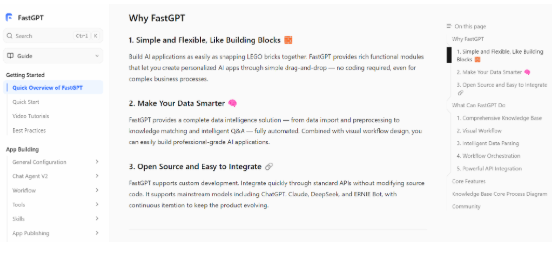
This is especially true for AI knowledge base projects. An enterprise knowledge assistant is not only a chat interface. It is a system for ingesting documents, retrieving relevant evidence, generating grounded answers, citing sources, respecting access rules, recording usage, collecting feedback, and improving over time. A platform such as FastGPT can help teams move beyond raw experimentation, but the organization still needs a production mindset. The question should not be “can the model answer this sample question?” The question should be “can this knowledge application become a trusted part of daily work?”
Demo Documents Are Usually Too Clean
The first reason not to stop at the demo stage is that demo documents are usually too clean. During a prototype, teams often choose the best manuals, the clearest policies, or the most complete product documents. They avoid duplicates, old versions, scanned files, messy tables, and contradictory sources. That makes sense for early testing, but it hides the actual difficulty of enterprise knowledge. In real use, employees will upload policy documents from different years, customer support notes written in different styles, spreadsheets that mix instructions and numbers, and presentations that were never designed for machine reading.
If the project stops after the demo, the team never builds the knowledge governance needed for scale. Production requires decisions about which sources are authoritative, who can upload documents, how outdated files are removed, how document structure is preserved, and how quality is checked after ingestion. Without these decisions, the assistant may answer from the wrong document or combine conflicting information into a fluent but unreliable response. Users do not care that the model is advanced if the answer is based on stale knowledge.
Real Users Ask Messier Questions
The second reason is that demo questions are too friendly. In a demo, users often ask exactly the kind of question the system was prepared to answer. Real users ask incomplete, vague, emotional, multilingual, or context-heavy questions. A customer may describe a symptom without naming the product feature. An employee may ask about a policy using an informal phrase that does not appear in the handbook. A manager may ask a question that depends on department, region, role, or contract type. A production assistant must handle these variations with discipline.
This does not mean the assistant must answer every question. In fact, one of the most important production behaviors is knowing when not to answer. If the retrieved evidence is weak, the assistant should ask a clarifying question, show the relevant source without overinterpreting it, or route the issue to a human. A demo rarely tests refusal quality because refusal is not visually impressive. But in enterprise environments, a controlled “I cannot confirm this from the available knowledge” can be more valuable than a confident answer built on thin evidence.
Retrieval Quality Needs Measurement
The third reason is that retrieval quality needs measurement. A demo answer may sound correct, but the team needs to know whether the system retrieved the right source, used the right passage, and avoided unrelated material. Retrieval is the foundation of an AI knowledge base. If the wrong chunks are retrieved, even a strong model may generate a plausible answer from irrelevant context. If the right chunks are retrieved but mixed with noisy content, the answer may become vague. If the system retrieves only partial evidence, it may miss important exceptions.
Production teams should build a test set before launch. The test set should include real questions from customer service tickets, HR messages, sales conversations, internal helpdesk requests, and search logs. Each question should have an expected answer source. Some questions should be intentionally unanswerable from the available knowledge. The team should measure whether the system retrieves the right evidence, whether the answer is complete, whether citations are useful, and whether the assistant handles uncertainty correctly. This evaluation process is rarely part of a quick demo, but it is essential for trust.
Permissions and Traceability Become Real After Rollout
The fourth reason is that permissions become real only after more users join. A demo may use a single administrator account or a small private document set. Production introduces departments, roles, regions, customers, partners, and different levels of confidentiality. HR policies may be visible to all employees, but compensation details may not be. Product documents may be public, but implementation notes may be internal. Customer-specific knowledge may need strict separation. If a knowledge base is not designed around access control, it can become risky very quickly.
Permission design should happen before broad rollout, not after the first incident. The team must decide how knowledge bases are segmented, who owns each collection, who can edit documents, who can view answers, and how usage is audited. If the assistant connects to workflows or tools, permission questions become even more important because the system may not only answer but also initiate actions. A production-grade AI project must treat permission boundaries as part of the core design, not as a later compliance feature.
Enterprise Users Need Traceability
The fifth reason is that enterprise users need traceability. In a demo, a smooth answer can be enough to impress. In daily work, people need to verify. A support agent wants to see the product note behind the answer. An HR specialist wants to confirm the policy paragraph. A sales engineer wants to know whether a technical claim is current. A manager wants to understand why the assistant gave a wrong recommendation. Traceability turns a black-box response into a reviewable workflow.
Traceability requires more than adding citations in the interface. Source metadata must be preserved during document ingestion. Chunks must remain connected to documents and sections. Logs must show what was retrieved and how the answer was formed. Administrators need a way to inspect failures and improve the knowledge base. If the system cannot show its work, users may stop trusting it after the first few mistakes. A production assistant should make verification easy enough that users can rely on it without blindly obeying it.
Workflow Integration and Adoption Change the Value Equation
The sixth reason is that workflow integration changes the value equation. A demo often focuses on Q&A. The assistant answers a question, and the conversation ends. But real enterprise work usually continues after the answer. A customer service agent may need to draft a reply, classify the ticket, or escalate to a specialist. An employee asking about reimbursement may need the right form or approval process. A sales team may need to turn product knowledge into a proposal draft. An operations team may need to summarize an issue and trigger a standard procedure.
When AI knowledge is connected to workflow, the assistant becomes more than a search tool. It becomes a guided work interface. But workflow integration also adds complexity: authentication, APIs, error handling, approval steps, permissions, and audit trails. A demo can ignore these details. Production cannot. The right approach is to start with low-risk workflow support, such as drafting, summarizing, routing, or preparing structured information, before allowing the assistant to trigger high-impact actions.
Operations Continue After Launch
The seventh reason is that operations continue after launch. Enterprise AI is not a one-time implementation. Documents change, models change, user expectations change, and business processes change. A good answer today may become wrong after a policy update. A model upgrade may alter response style. A new product release may create questions that the knowledge base cannot yet answer. If nobody owns the ongoing maintenance loop, the assistant slowly becomes less useful.
Production operations should include content review, usage monitoring, bad-answer feedback, evaluation updates, cost tracking, and release management. There should be a clear owner for each knowledge domain. Customer service may own support knowledge. HR may own policy knowledge. IT may own system access documentation. The AI team may own platform configuration and quality monitoring. Without this ownership model, the project depends on enthusiasm rather than process, and enthusiasm fades when the next initiative begins.
Adoption Depends on Workflow Fit
The eighth reason is that adoption depends on workflow fit, not only answer quality. Employees will not use an AI assistant simply because it exists. They will use it if it fits naturally into a task they already perform. Customer service agents need answers where they handle tickets. HR teams need policy support that matches employee request patterns. Sales teams need knowledge that helps them prepare calls and proposals. Managers need summaries they can trust without reading ten documents. If the assistant is hidden in a separate tool with unclear purpose, adoption may remain low even if the demo was strong.
A production rollout should therefore define the audience and use case clearly. “Internal AI assistant” is too broad. “HR policy assistant for onboarding and leave questions” is clearer. “Customer service troubleshooting assistant for the top 80 product questions” is clearer. “OA process assistant for reimbursement and procurement requests” is clearer. Narrow use cases make it easier to prepare documents, test questions, configure answer style, measure impact, and train users. After one area works, the company can expand.
Success Metrics and Expectations Need to Be Designed Before Scale
The ninth reason is that success metrics need to be designed before scale. A demo usually measures excitement. Production needs measurable outcomes. Depending on the use case, metrics may include reduced first-response time, lower ticket escalation rate, fewer repeated questions to experts, faster onboarding, higher self-service resolution, better answer consistency, shorter document search time, or improved completion of internal processes. These metrics should be connected to business goals, not only model behavior.
It is also useful to track quality metrics. How often does the assistant cite the correct source? How often does it refuse correctly? How often do users mark an answer as helpful? Which questions fail repeatedly? Which documents are retrieved too often or not enough? These signals help administrators improve the system. Without metrics, the team may rely on anecdotes: one impressive success story and one embarrassing failure. Production decisions need a broader view.
Stakeholder Expectations Must Be Managed
The tenth reason is that stakeholder expectations must be managed. A demo can accidentally create the belief that the assistant will replace entire systems or roles immediately. That expectation is dangerous. An AI knowledge base is strongest when it helps people retrieve, understand, summarize, and act on knowledge. It should not be positioned as a full replacement for OA, ERP, CRM, HRIS, finance, or legal review systems. Those systems own transactions, approvals, and records. The AI layer should improve access and workflow guidance while respecting these boundaries.
This positioning matters for adoption. If leaders oversell the assistant, users will test it on tasks it was not designed to perform and lose confidence. If leaders undersell it, users may ignore it. The right message is practical: this system helps with approved knowledge and repeatable workflows; it cites sources where possible; it escalates when the knowledge is insufficient; and it will improve as usage reveals gaps. That message creates realistic trust.
A Practical Path Beyond the Demo
Moving beyond the demo does not require a massive rollout. A strong path is to run a focused 30-day production pilot. Choose one use case with frequent questions and a clear owner. Prepare the knowledge base carefully. Create a question set from real user behavior. Define answer rules, citation expectations, and escalation boundaries. Let a small group use the assistant in real work. Review logs weekly. Fix document gaps. Track time saved and answer quality. At the end of the pilot, decide whether the use case is ready to expand.
This process is more demanding than a demo, but it prevents the common failure pattern: impressive prototype, unclear owner, weak knowledge maintenance, no metrics, low adoption, and eventual abandonment. The purpose of a pilot is not to prove that AI is exciting. That has already been proven. The purpose is to prove that a specific business workflow can be improved reliably.
Teams evaluating FastGPT can use the FastGPT official documentation to understand how a knowledge-based application can be configured and expanded. But the tool selection should be paired with an operating plan. Who maintains the documents? Who reviews failed answers? What questions should the assistant refuse? Which users can access which knowledge base? What metric proves business value? These questions are the bridge from demo to production.
Final Takeaway
Enterprise LLM projects should not stop at the demo stage because the demo only proves that the technology can speak. Production proves that it can work. It must work with real documents, real users, real permissions, real uncertainty, real operational limits, and real business metrics. The companies that succeed will be the ones that treat AI knowledge bases as living systems rather than one-time experiments. They will start narrow, measure honestly, improve continuously, and expand only when trust is earned.
The most important shift is mental. Do not ask whether the demo was impressive. Ask whether the system can become dependable. Can it retrieve the right source when the question is messy? Can it show evidence? Can it respect boundaries? Can it be maintained by the people who own the knowledge? Can it fit into daily work? Can it improve after failure? If the answer is yes, the project is ready to move beyond the demo. That is where enterprise AI begins to create durable value.

