


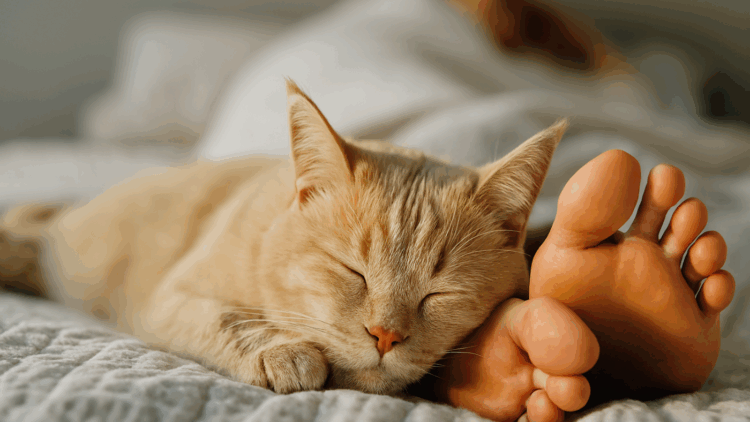
Why do cats sleep at your feet is one of the most searched feline behavior questions of 2026 — and it deserves a real answer.
If you have ever woken up to find your cat curled at the end of the bed, right by your ankles, you already know the feeling.
It looks simple, maybe even random. But cat behavior experts and veterinarians agree: nothing a cat does during sleep is accidental.
Every spot your cat chooses carries meaning rooted in instinct, trust, temperature regulation, and territorial communication.
Understanding How Cats Choose Where to Sleep
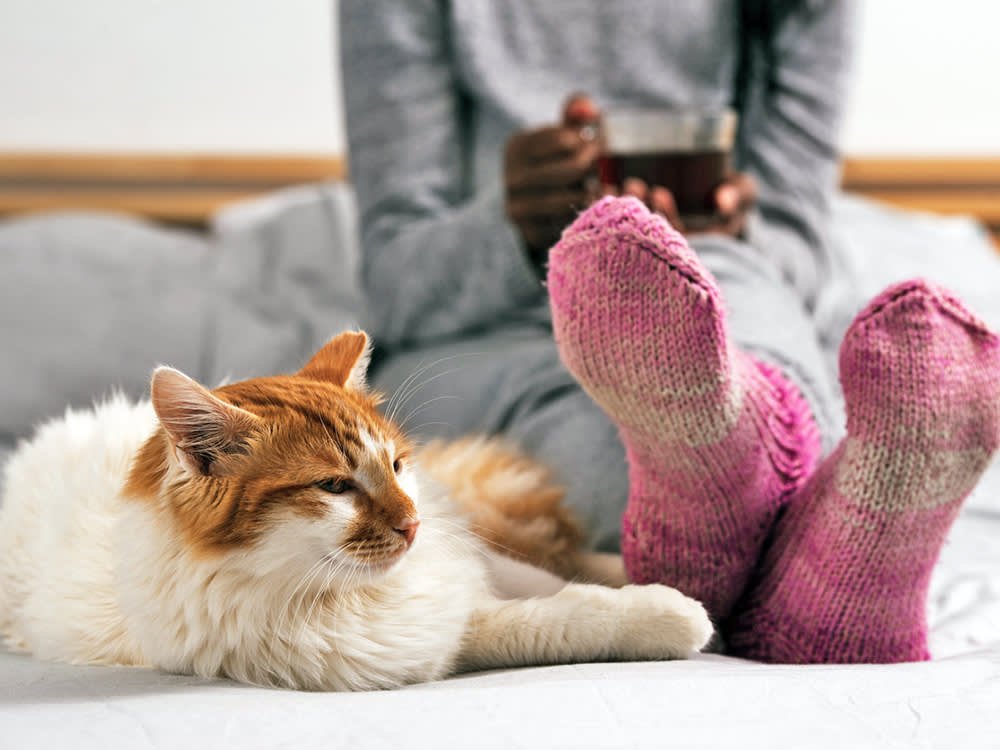
Cats sleep between 12 and 16 hours per day on average. Where they choose to sleep matters enormously to them.
Unlike dogs, who will often press themselves against their owners for maximum contact, cats balance closeness with independence. Their sleeping spot is a careful calculation — warmth, safety, personal space, escape access, and social bond all factor in.
Feet vs. Head: Why the Difference Matters
Cats that sleep at your head tend to be drawn to your scent, want maximum closeness, or are highly bonded and slightly demanding.
Cats that sleep at your feet have found a position that satisfies their need for proximity without compromising their independence or comfort. It is arguably the more self-aware choice — affection on their own terms.
Reason 1: Warmth and Body Heat
One of the clearest and most immediate reasons cats sleep at your feet is simple physical warmth.
Your feet generate steady, consistent heat throughout the night. Even while you sleep, the end of the bed remains a reliable warm zone. For cats — whose ideal resting temperature is higher than humans — this warmth is deeply appealing.
Why Feet Specifically
The feet and head are where most human body heat escapes during sleep. Vicki Jo Harrison, president of The International Cat Association (TICA), confirms that cats are especially drawn to warm spots near the head and feet for exactly this reason.
Your feet also sit within layers of blanket and bedding that trap and retain heat, creating an insulated pocket of warmth that cats find irresistible.
It Goes Back to Kittenhood
This preference for warmth is wired in from birth. Kittens huddle together in tight piles for warmth and comfort in their first weeks of life — a pile where tiny feet stick out in every direction.
That early association between warmth, safety, and closeness to others stays with cats for life. Sleeping near your feet reactivates that same deep sense of comfort.
Reason 2: Trust and Emotional Safety
When a cat chooses to sleep near you — in any position — they are expressing trust. Cats are most vulnerable when they sleep, and they choose sleeping spots based on perceived safety.
If your cat did not trust you, they would not sleep anywhere near you.
Feet Offer Trust Without Full Vulnerability
Sleeping at your feet represents a particular kind of trust: deep enough to be physically close, but calibrated enough to avoid total vulnerability.
Your feet move less than your chest, arms, and head during sleep. The lower body is the calmest, most predictable part of you at night. Choosing this spot means your cat has studied your sleep patterns and picked the zone that minimizes being accidentally disturbed.
Cats Don’t Sleep Near People They Fear
According to feline behavior researchers, cats display relaxed body posture and lower stress markers during sleep when they are close to a trusted person.
A cat that sleeps at your feet is not just tolerating you — it is actively choosing you. This is a significant compliment from an animal that values autonomy as much as cats do.
Reason 3: Territorial Marking and Scent Communication
Cats are territorial creatures. Everything they do with their body positions involves some element of scent communication.
Your feet carry some of the strongest, most distinctive human scent — from walking, wearing shoes, and general daily activity. To a cat with a nose tens of thousands of times more sensitive than yours, your feet are an incredibly scent-rich location.
Scent Glands in the Paws
Cats have scent glands in their paw pads (interdigital glands). When they knead, tread, or settle against a surface — including your feet — they deposit pheromones.
By sleeping at your feet, your cat is simultaneously absorbing your scent for comfort and depositing their own scent to mark you as part of their territory.
“You Belong to Me”
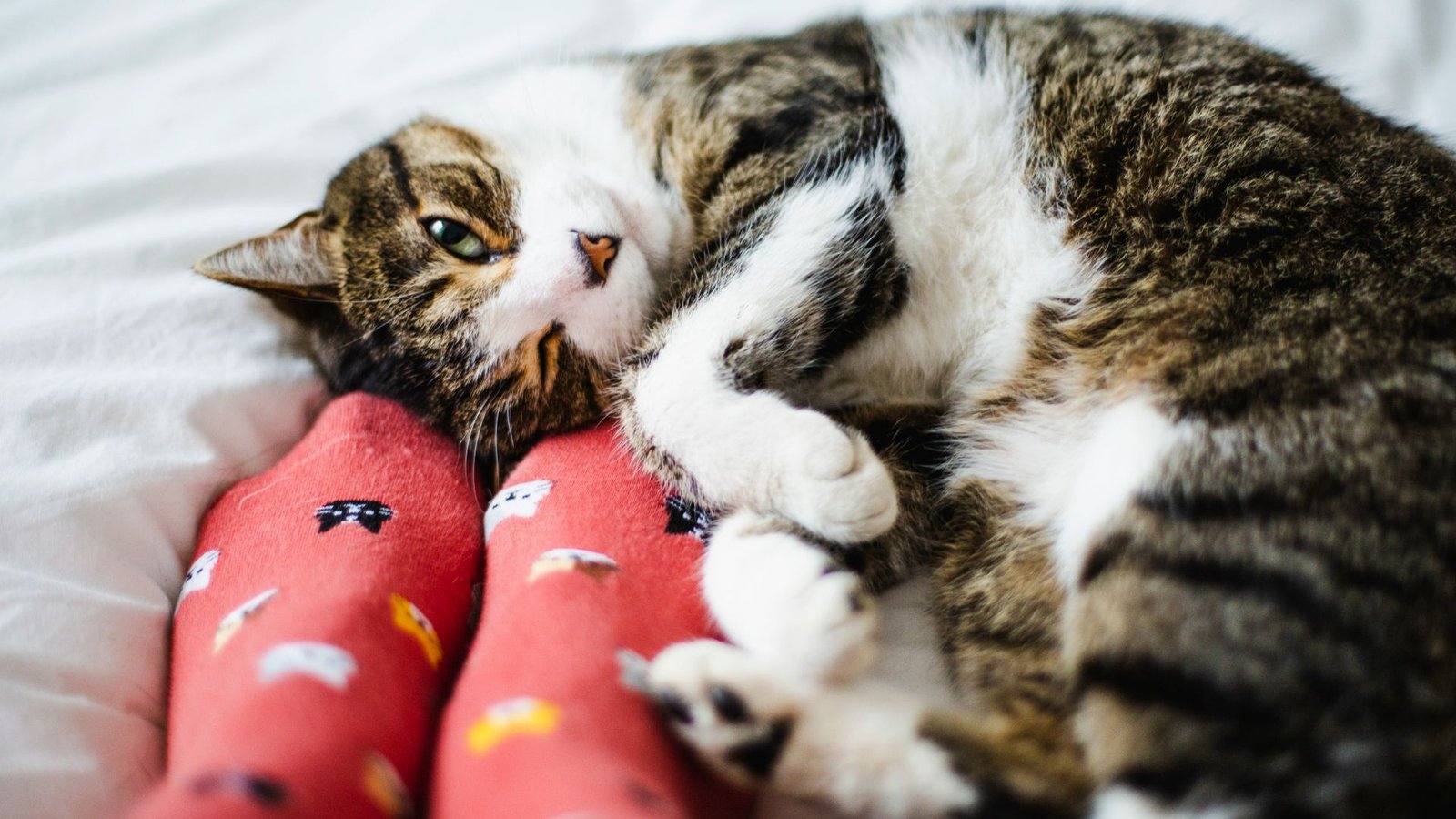
This is not possessiveness in a negative sense. In feline social communication, scent exchange is how cats signal belonging, familiarity, and emotional inclusion.
When your cat marks your feet with their scent, they are saying to other animals in the home: “This human is in my territory. This person is mine.” It is one of the purest expressions of feline affection.
Signaling to Other Pets
In multi-pet households, a cat that sleeps at your feet is also communicating with other animals. By sleeping at the foot of the bed, they mark their special bond with you and communicate their relationship status to other cats or dogs in the home.
Reason 4: The Strategic Vantage Point and Escape Route
Cats are simultaneously predators and prey animals. Even the most pampered indoor cat retains survival instincts evolved over millions of years.
The foot of the bed offers something uniquely valuable from a survival perspective: a clear view of the room combined with quick access to an exit.
Clear Sightlines to the Doorway
From your feet, a cat can typically see the bedroom door and much of the surrounding room. This gives them early warning of anything entering the space.
As Dr. Nicole Savageau, VMD, explains: “The edge of the bed ensures that the cat can survey the room for predators.” Even in a perfectly safe home, this instinct runs continuously.
Fast Exit Route
Sleeping at the foot of the bed means a cat can move off the mattress and out of the room in one fluid motion if needed.
Contrast this with sleeping on your chest or curled against your side — positions that require navigating past a human body before reaching safety. Feet sleeping is simply more operationally efficient for an animal that is always at least partially alert.
Prey Animal Awareness During Sleep
Research confirms that cats maintain environmental awareness even during REM sleep. Their ears continue tracking sounds. Their nervous system remains ready to respond.
Choosing a vantage point for sleep is not paranoia — it is normal, healthy feline cognition at work.
Reason 5: Independence and Personal Space
Cats are not dogs. They do not crave constant physical merging with their owners. They love on their own terms — and those terms include personal space even during sleep.
Sleeping at your feet is the perfect expression of this balance: close enough to feel your presence, far enough to breathe and stretch freely.
Less Disruption from Your Movements
Your upper body — shoulders, arms, chest, and head — moves significantly more during sleep than your lower legs and feet.
Cats are sensitive to movement during sleep. By positioning themselves at your feet, they choose the calmest, most stable zone on your body. They can stay close without being jostled awake every time you shift.
Affection Without Intrusion
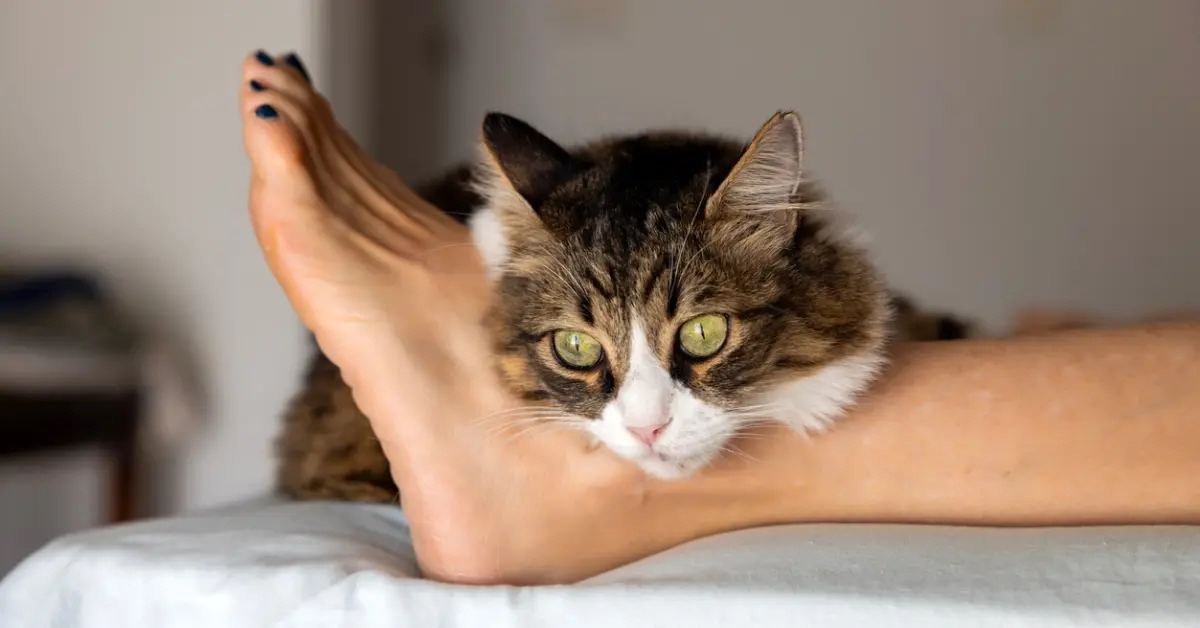
For cats that are affectionate but still value their autonomy, feet sleeping threads a needle perfectly. They are present. They are connected. But they are not trapped or pressed.
As feline behavior researcher John Bradshaw notes, not all cats seek direct body-to-body contact to express social bonding. Sleeping at the feet or nearby serves the same social function for cats who prefer a bit more space.
Considerate Behavior
Some behaviorists suggest that cats sleeping at the feet rather than on the face or chest may actually be displaying consideration for their owner.
Dr. Nicole Savageau notes that cats can gauge their owner’s comfort and adjust accordingly: “By choosing to sleep at the end of the bed, they may be trying to avoid disrupting their owner’s sleep.” A cat at your feet is sharing your space thoughtfully.
Reason 6: Habit, Routine, and Security
Cats are deeply creatures of habit. Once your cat finds a sleeping spot that works — safe, warm, appropriately close, with a good exit — they will return to it night after night.
This habitual behavior is itself a sign of emotional security. A cat that feels anxious or unsettled changes sleeping spots frequently. A cat that returns to the same spot at your feet is a cat at peace with its environment.
Bedtime Routine as Bonding
Cats adapt to their owner’s sleep schedule over time. Many cat owners notice their cat appearing at the foot of the bed reliably as the owner begins the nighttime routine.
This synchronization of routines is a social behavior. It is your cat choosing to align their day with yours — a meaningful act for an animal that is technically quite self-sufficient.
Familiarity Reinforces the Choice
Each time your cat sleeps at your feet and wakes up safe and comfortable, that location becomes more associated with positive experience.
Over weeks and months, the foot of the bed becomes deeply embedded in the cat’s mental map as a primary security zone. The behavior becomes self-reinforcing through positive repetition.
Reason 7: Protection and Guarding Behavior
Some cats sleep at their owner’s feet not just to feel protected but to actively serve as a protector.
From the end of the bed, a cat is positioned to notice anything entering the room before you do. They become an early warning system — positioned to alert you to threats before those threats reach you.
The Sentinel Position
This is particularly common in bonded, confident cats who have taken on a guardian role within the household. A cat in this position monitors the room, tracks sounds, and orients toward the door throughout the night.
If your cat raises its head and stares at the door when it hears a noise at night — then looks back at you — this is classic sentinel behavior.
Social Sleep from Wild Ancestors
In wild cat colonies, bonded cats sleep in proximity precisely to provide mutual protection. Domestic cats retain this instinct fully.
Studies of feral cat colonies show that socially bonded cats sleep touching or in very close proximity, with at least one cat typically positioned facing potential threats. Your cat at your feet is replicating this ancient protective sleeping arrangement.
Reason 8: Health Intuition and Emotional Attunement
Many cat owners report that their cats begin sleeping closer to them — including at their feet — during periods of illness, stress, or emotional difficulty.
Cats are highly attuned to changes in their owner’s physiology. They detect shifts in body temperature, heart rate, scent changes associated with stress hormones, and altered breathing patterns.
Cats Notice When Something Is Different
When you are sick, stressed, grieving, or anxious, your body chemistry changes in ways a cat can detect.
Moving closer to your feet — or pressing against your legs more than usual — may be your cat’s response to these detected changes. They are not diagnosing you. They are responding to a signal that something is different, and staying close.
The Comfort Goes Both Ways
Research shows that petting or being in close proximity to a cat lowers human blood pressure, reduces cortisol levels, and triggers the release of oxytocin — the bonding hormone.
For the cat, your presence, heartbeat, and familiar scent create the same calming biological effect. The sleeping arrangement at your feet is genuinely therapeutic for both parties.
What Different Cat Sleeping Positions Near You Actually Mean
| Where Your Cat Sleeps | What It Signals |
|---|---|
| At your feet | Affection with independence, trust, vantage point, warmth |
| Between your legs | Nesting for warmth, strong sense of safety, high trust |
| On your chest | Deep attachment, drawn to your heartbeat and breathing |
| Near your head / on pillow | Maximum scent-seeking, very strong bond, slightly demanding |
| Next to you without touching | Trust and proximity without contact — still a meaningful signal |
| On your lap while sitting | Active desire for contact and warmth, comfortable with closeness |
| On your feet specifically | Warmth + scent marking, often in colder weather |
Why Does My Cat Sleep at My Feet Instead of by My Head
This is one of the most common follow-up questions, and it has a clear answer.
The head and pillow area carries the most intense version of your scent. Cats drawn to scent and maximum closeness sleep there. But this position also involves being right next to your face, which moves, breathes heavily, and sometimes makes unpredictable sounds.
Your feet are the quieter, calmer end. Less movement. Less sensory noise. Better sightlines. Better exit access.
A cat choosing feet over head is not less bonded — they are often better calibrated. They have found the sweet spot between companionship and comfort.
Why Does My Cat Suddenly Start Sleeping at My Feet
If your cat has changed their sleeping position and has started sleeping at your feet after previously sleeping elsewhere, several explanations are possible.
Change in Household Dynamics
A new pet, a new person in the home, or a change in routine can shift a cat’s need for security. Moving closer to you at night is a self-soothing response to perceived change.
Seasonal Temperature Changes
As temperatures drop, cats seek warmer sleeping spots. Your feet become more appealing in winter months as an additional heat source.
Change in Your Own Behavior or Health
If you have been stressed, unwell, or sleeping differently, your cat may have detected these changes and repositioned to stay closer. This is attunement, not coincidence.
Deepening of the Bond
Sometimes cats simply grow into a closer bond over time. A cat that once slept in another room may graduate to the foot of the bed as trust deepens over months or years.
Is It Healthy for Cats to Sleep at Your Feet
In the vast majority of cases, yes. Cats sleeping at the foot of the bed is a healthy, normal behavior that benefits both the cat and the owner.
The exceptions worth noting are rare:
- If your cat is completely unable to sleep away from you and shows extreme anxiety when separated, this can indicate over-attachment or separation anxiety
- If sleeping at your feet is disrupting your sleep significantly, a designated cat bed placed at the foot of the bed can redirect the behavior without disrupting the bond
Otherwise, the behavior is a positive sign of a secure, well-adjusted cat with a healthy attachment to their owner.
Should You Let Your Cat Sleep at Your Feet
This is entirely a personal choice. There are genuine benefits to consider.
| Benefits for the Owner | Benefits for the Cat |
|---|---|
| Reduced stress and anxiety | Warmth and thermal comfort |
| Lower blood pressure (oxytocin release) | Emotional security and reduced anxiety |
| Sense of companionship | Scent marking and territory reinforcement |
| Feeling of warmth and comfort | Maintains social bond with owner |
| Strengthened bond with the cat | Fulfills instinctive protective behavior |
The main reasons owners sometimes choose not to allow co-sleeping include sleep disruption, allergies, or hygiene preferences — all completely valid. Setting up a cat bed nearby is a good middle ground.
How to Encourage or Redirect Foot Sleeping
If you want your cat to sleep at your feet but in a specific, less disruptive spot:
Use a Designated Cat Bed
Place a small, soft cat bed at the foot of the bed. Add a worn item of your clothing to it so it carries your scent. Most cats will adopt it quickly as their designated spot.
Use Positive Reinforcement
When your cat settles in the right spot, offer quiet verbal praise or a gentle pat. Consistency builds the association. Avoid picking them up and moving them repeatedly — this breaks trust.
Maintain a Consistent Bedtime Routine
Cats follow patterns. If you go to bed at roughly the same time each night, your cat will begin anticipating it and positioning themselves early.
Never Punish the Behavior
Foot sleeping is a healthy, trust-based behavior. Punishing it damages the bond without solving any real problem. Redirect, do not reprimand.
Comparison: Why Cats vs. Dogs Sleep Near Owners
| Factor | Cats at Your Feet | Dogs Near Their Owners |
|---|---|---|
| Primary motivation | Balance of closeness and independence | Maximum physical contact and closeness |
| Scent marking | Yes — through paw glands | Yes — through body contact |
| Vantage point priority | High — important for survival instinct | Lower — less instinctual concern |
| Escape route need | Yes — prey animal instinct | Less relevant |
| Independence maintained | Yes — cats keep personal space | Less so — dogs merge more fully |
| Bond expression | Subtle, chosen proximity | Overt, contact-based |
Both behaviors express deep bond and trust — through very different species-specific lenses.
Frequently Asked Questions (FAQs)
Why do cats sleep at your feet?
Cats sleep at your feet for a combination of warmth, trust, territorial scent marking, and survival instinct — it is an ideal spot that balances closeness, independence, warmth, and a clear escape route.
Does it mean my cat loves me if they sleep at my feet?
Yes. Cats only sleep near people they feel completely safe with — choosing to rest at your feet is a genuine expression of trust, affection, and a strong bond with you.
Why does my cat sleep at my feet instead of by my head?
Your feet offer more personal space, less movement during sleep, a better vantage point of the room, and a quicker escape route — all appealing qualities to a cat that values independence alongside closeness.
Is it good or bad to let your cat sleep at your feet?
It is generally healthy for both you and your cat — it reduces stress, strengthens the bond, and gives the cat security. Only consider redirecting it if it significantly disrupts your sleep.
Why does my cat suddenly sleep at my feet when they never used to?
A change in household routine, seasonal temperature drops, a shift in your health or stress levels, or simply a deepening bond over time can cause cats to reposition closer to you at night.
Do cats sleep at your feet to protect you?
Yes, partly. From your feet, cats can monitor the entire room and alert you to disturbances — a behavior rooted in social sleeping instincts inherited from wild cat ancestors who slept in protective groups.
Why does my cat knead at my feet before sleeping?
Kneading activates the scent glands in the paw pads, depositing pheromones and marking the area as safe and familiar. It is also a self-soothing behavior linked to the comfort of nursing as a kitten.
What does it mean when a cat sleeps between your legs instead of at your feet?
Between-leg sleeping signals a very high degree of trust and warmth-seeking — your legs create a nest-like enclosed space that feels safe and insulating, with a slightly easier escape than sleeping on your chest.
Does it mean my cat is cold if they sleep at my feet?
Warmth is always a factor, but it is rarely the only reason. Cats seek the combination of warmth, safety, and your scent. In colder months, the thermal motivation increases, but the emotional and territorial reasons remain year-round.
Can cats sense when you are stressed or sick and sleep closer as a result?
Yes. Cats are highly attuned to changes in your body chemistry, heart rate, and scent. When owners are unwell or stressed, many cats reposition closer — including moving to sleep at their feet — as a form of attunement and comfort.
Conclusion
Why do cats sleep at your feet is a question with a beautifully layered answer. It is not one thing — it is warmth, trust, territorial communication, survival instinct, emotional attunement, and deeply ingrained social bonding all expressed in a single quiet act.
Your cat has surveyed the entire sleeping environment, assessed every factor their ancient instincts demand, and concluded that the foot of your bed is exactly the right place to be.
They are close enough to feel safe.
Independent enough to feel free. Positioned to protect. Warm and comfortable.
And marking their territory in the gentlest possible way.
If your cat sleeps at your feet tonight, take a moment to appreciate what that simple position actually says: you are trusted, you are chosen, and in their world — you are home.


