


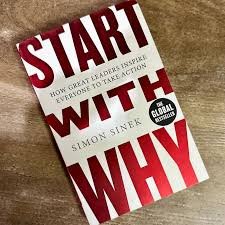
Start with Why Simon Sinek is one of the most influential ideas in modern leadership, and in 2026 it is more relevant than ever.
Published in 2009, the book asks a deceptively simple question — why do some leaders, organizations, and movements inspire action while others do not? Simon Sinek’s answer, built around a framework called the Golden Circle, has reshaped how millions of people think about leadership, purpose, and communication.
His TED Talk based on the book has surpassed 60 million views, making it one of the most-watched presentations in TED history.
Who Is Simon Sinek?
The Man Behind the WHY Movement
Simon Sinek is a British-American author, motivational speaker, and organizational consultant. He is best known for his work on purpose-driven leadership and the idea that great leaders communicate differently from everyone else.
His full-length book is titled “Start With Why: How Great Leaders Inspire Everyone to Take Action,” published in October 2009. He has since written several follow-up books including “Find Your Why,” “Leaders Eat Last,” and “The Infinite Game.”
Why His Ideas Went Viral
Sinek’s 2009 TED Talk titled “How Great Leaders Inspire Action” became the third most watched TED Talk of all time. The talk’s central message — that people don’t buy what you do, they buy why you do it — resonated with leaders, marketers, and entrepreneurs worldwide.
The simplicity of the Golden Circle model combined with powerful real-world examples gave it instant accessibility and enduring authority.
What Is Start with Why About?
The Central Question of the Book
The book begins with a fundamental observation. Most organizations and leaders can clearly explain what they do. Many can explain how they do it. But very few can clearly articulate why they do what they do.
That gap — between WHAT and WHY — is the difference between transactional business and inspiring leadership.
The Core Argument
Sinek argues that the most inspiring leaders and organizations in history — Apple, Martin Luther King Jr., the Wright Brothers — all think, act, and communicate in the same way. They start with WHY.
Everyone else starts from the outside in. Inspiring leaders and organizations start from the inside out. That single reversal changes everything about how people respond to them.
The Golden Circle — The Heart of Start with Why
What the Golden Circle Is
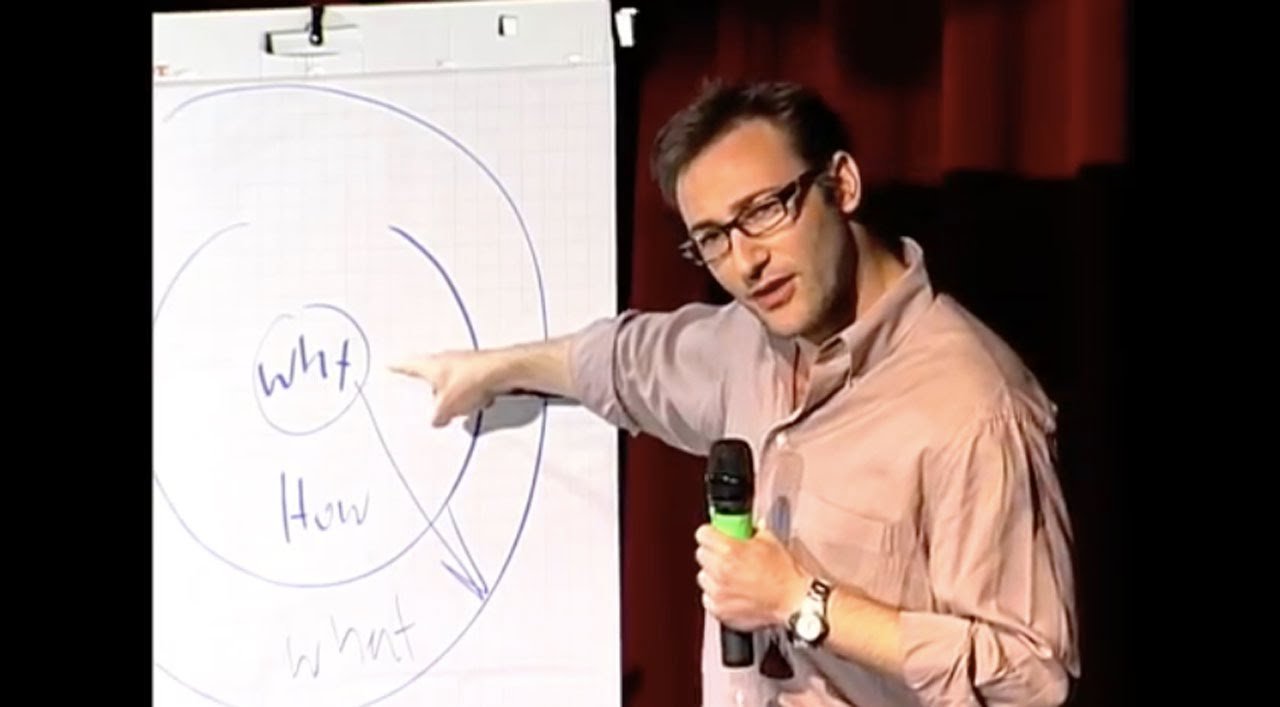
The Golden Circle is Simon Sinek’s central framework. It visualizes the structure of an organization and its communication as three concentric circles — like a bullseye target.
The innermost circle is WHY. The next ring out is HOW. The outermost ring is WHAT.
| Layer | What It Represents | Example (Apple) |
|---|---|---|
| WHY | Purpose, cause, or belief — the reason the organization exists | To challenge the status quo and empower the individual |
| HOW | The processes, values, and principles that bring the WHY to life | Through beautiful design and intuitive user experience |
| WHAT | The tangible products or services that result from WHY and HOW | Computers, iPhones, iPads, software |
Inside-Out vs. Outside-In Communication
Most organizations communicate from outside in. They lead with WHAT, then sometimes explain HOW, and rarely mention WHY at all.
Inspiring organizations communicate from inside out. They lead with WHY, support it with HOW, and let WHAT become the proof of the belief they started with.
This is not a small stylistic difference. It is a fundamental shift in how people emotionally experience and respond to your message.
The Three Layers of the Golden Circle Explained
WHY — The Most Powerful Layer
What WHY Actually Means
The WHY is not about making money. That is a result. The WHY is about your purpose, cause, or belief — the fundamental reason your organization exists beyond generating profit.
According to Sinek, very few companies can clearly articulate their WHY. Most default to describing their products or processes instead. But without a clear WHY, everything an organization does feels interchangeable with competitors.
WHY Creates Emotional Connection
When you communicate your WHY, you speak directly to the part of the human brain responsible for decision-making, trust, and loyalty. That part of the brain — the limbic system — does not process language or logic. It processes feelings.
This is why a compelling WHY creates conviction that facts and features never can.
HOW — The Disciplined Middle Layer
HOW Brings WHY to Life
The HOW level represents the specific actions, values, and principles that distinguish how an organization fulfills its WHY. This is where discipline lives.
Not everyone has the same HOW. Two organizations can share a similar WHY but execute it very differently through their culture, processes, and standards.
The Role of Discipline in HOW
Starting with WHY turns people who say “I think this is the right decision” into people who say “I know this is the right decision.” HOW is the discipline that makes sure every action stays true to the original belief.
Without discipline in the HOW layer, even a powerful WHY gradually drifts away from its original meaning as organizations scale.
WHAT — The Tangible Outer Layer
WHAT Is the Proof, Not the Point
The WHAT layer represents the products, services, or tangible outputs of an organization. Every company on earth knows their WHAT. It is the easiest thing to describe and the easiest thing for competitors to replicate.
WHAT matters enormously — but only as proof of the belief expressed in WHY. A WHAT without a WHY is a product without a story.
When WHAT Leads, Loyalty Disappears
Organizations that lead with WHAT attract customers based on features, price, and convenience. These are transactional relationships. When a competitor offers a better feature or a lower price, those customers leave.
Organizations that lead with WHY attract customers who share their beliefs. These people become loyal not just to the product but to the purpose — and they are far less price-sensitive and far more forgiving of imperfection.
The Neuroscience Behind Start with Why
Why Biology Validates the Golden Circle
One of the most compelling aspects of Sinek’s argument is that the Golden Circle is not just a management concept — it mirrors the physical structure of the human brain.
The neocortex is the outer brain layer responsible for rational thought, analytical processing, and language. It corresponds to the WHAT layer. It handles facts, features, and specifications.
The Limbic Brain Controls the Real Decisions
The limbic brain is the inner brain region responsible for emotions, trust, loyalty, behavior, and gut decisions. It corresponds to the WHY and HOW layers of the Golden Circle.
The limbic brain has no capacity for language. This is why people often feel strongly about a choice but cannot fully explain it in words — they are “going with their gut.” That gut reaction is the limbic brain overriding the neocortex.
| Brain Region | Golden Circle Layer | What It Controls |
|---|---|---|
| Neocortex | WHAT | Rational thought, analysis, language |
| Limbic Brain | WHY and HOW | Emotions, trust, loyalty, gut decisions, behavior |
People Don’t Buy What You Do — They Buy Why You Do It
This is the most famous line from Start with Why Simon Sinek, and the neuroscience backs it completely. When you lead with WHAT, you engage only the neocortex — the rational brain that processes information but does not drive behavior.
When you lead with WHY, you engage the limbic brain — the emotional center that actually decides, commits, and acts. This is why purpose-driven messaging creates loyalty that product-focused messaging never can.
The Apple Example — The Most Famous Case Study
How Apple Communicates
Sinek uses Apple as the clearest real-world example of a company that starts with WHY. He contrasts how Apple communicates versus how a typical company communicates.
A typical technology company might say: “We make great computers. They are beautifully designed and easy to use. Want to buy one?” This is WHAT first, then HOW, and never WHY.
Apple Starts With WHY
Apple communicates entirely differently. Everything they say and do starts from WHY. Their implicit message is: “We believe in challenging the status quo and empowering the individual. The way we do that is through beautiful design and intuitive experience. And we happen to make great computers. Want to buy one?”
The product is exactly the same. The order of communication is completely different. The emotional impact is enormous.
Why Apple’s Customers Are Devoted, Not Just Satisfied
Apple’s WHY — challenging the status quo, championing creativity — is a belief that millions of people share personally. When customers buy Apple products, they are not just purchasing hardware. They are signaling to themselves and the world who they are and what they believe.
This is why the Apple logo faces outward on MacBooks rather than toward the user. It is not just a product. It is a symbol of shared belief.
The Wright Brothers vs. Samuel Langley
Two Attempts at the Same Goal — Wildly Different Outcomes
In the early 1900s, Samuel Langley was the most funded and most credentialed person attempting to build a powered airplane. He had financial backing from the US War Department, a team of elite engineers, and extensive public profile.
Orville and Wilbur Wright were bicycle mechanics from Ohio with no funding, no government support, and no formal engineering degrees.
Why the Wright Brothers Won
Sinek uses this contrast to illustrate the power of WHY. The Wright Brothers were driven by a belief — that human flight would change the world — not by the prospect of financial reward or fame.
Their team shared that belief entirely. Their motivation was intrinsic and passion-driven. When they failed, they kept going. When they succeeded, their achievement was the natural result of belief in action.
Langley’s team, by contrast, was assembled around credentials and compensation. When Langley lost funding, the entire project collapsed. He had WHAT and HOW. He never had a WHY.
Martin Luther King Jr. and the I Have a Dream Speech
Leading With Belief, Not a Plan
Martin Luther King Jr. did not give the “I Have a Plan” speech. He gave the “I Have a Dream” speech. The difference is everything.
King communicated from WHY first. He spoke about belief — about what kind of world he believed was possible, about values of justice, dignity, and equality. He never led with policy proposals or implementation strategies.
250,000 People Who Showed Up for Themselves
An estimated 250,000 people gathered at the March on Washington in 1963. They did not show up because King sent them invitations. They showed up because they shared his belief.
They came for themselves — because his WHY was also their WHY. This is the power of purpose-driven leadership that Sinek describes. The leader does not need to convince people. The WHY attracts people who already believe.
The Law of Diffusion of Innovation
How Ideas and Products Spread Through Society
Sinek connects the Golden Circle to Everett Rogers’ Law of Diffusion of Innovation to explain how purpose-driven messages achieve mass adoption.
The Innovation Adoption Curve divides any market into five segments based on willingness to adopt new ideas.
| Segment | Percentage of Market | Behavior |
|---|---|---|
| Innovators | 2.5% | First to adopt — drawn by novelty |
| Early Adopters | 13.5% | Buy based on belief and vision |
| Early Majority | 34% | Buy once others have validated it |
| Late Majority | 34% | Buy when it becomes the norm |
| Laggards | 16% | Adopt only when forced to |
The Tipping Point Lies at 15 to 18 Percent
For an idea or product to achieve mass market adoption, it needs to reach the tipping point — roughly the first 15 to 18 percent of the market.
Organizations that lead with WHY naturally attract Innovators and Early Adopters because those people make decisions based on belief and gut feeling — the limbic brain. Once that 15 to 18 percent threshold is crossed, the Early Majority follows.
Organizations that lead with WHAT struggle to get past Early Adopters because they are trying to convince people with logic — and the limbic brain does not respond to logic alone.
WHY-Types vs. HOW-Types in Leadership
Two Kinds of Leaders, Both Essential
Sinek identifies two distinct leadership types within the Golden Circle framework. Both are necessary for an organization to succeed.
WHY-types are visionary leaders driven by belief, purpose, and passion. They inspire people with a compelling sense of direction. Steve Jobs and Martin Luther King Jr. are the archetypal examples.
HOW-types are operational builders. They take the vision of the WHY-type and translate it into functioning systems, processes, and disciplines. Without them, the WHY remains an inspiring idea that never becomes reality.
The Most Successful Leadership Pairings in History
| WHY-Type Leader | HOW-Type Partner | Organization |
|---|---|---|
| Steve Jobs | Steve Wozniak | Apple |
| Bill Gates | Paul Allen | Microsoft |
| Martin Luther King Jr. | Ralph Abernathy | Civil Rights Movement |
| Walt Disney | Roy Disney | The Walt Disney Company |
The most enduring, successful organizations in history have featured both a powerful WHY-type and a disciplined HOW-type working in close alignment.
Clarity, Discipline, and Consistency — The Three Principles
Starting with WHY Is Just the Beginning
Sinek emphasizes that finding your WHY is necessary but not sufficient. Three principles must be sustained for the Golden Circle to function properly.
Clarity of WHY means being able to articulate your purpose with precision and conviction. If you cannot clearly state your WHY in a single sentence, it is not yet clear enough to communicate.
Discipline of HOW means every action, policy, and decision must be evaluated against the WHY. If it does not align with the purpose, it should not happen regardless of short-term gain.
Consistency of WHAT means every product, service, message, and behavior must be tangible proof of the WHY. Inconsistency between stated WHY and actual WHAT destroys trust faster than any competitor can.
How to Find Your Personal WHY
The WHY Is Not Just for Businesses
While Start with Why Simon Sinek focuses primarily on organizations, the concept applies equally to individuals. Your personal WHY is the belief that drives your choices — your career decisions, your relationships, your approach to work and life.
People with a clear personal WHY make faster decisions, experience more meaning in their work, and build more authentic relationships because their actions consistently reflect their core beliefs.
A Simple Framework for Finding Your WHY
Ask yourself: what contribution do I want to make to others, and what belief drives that contribution? The answer is your WHY.
There is not about what you do for money. It is not about your job title or industry. It is the reason you do what you do when no one is watching and no external reward is guaranteed.
Start with Why in 2026 — Why It Matters More Than Ever
The Purpose Economy Is Real
In 2026, consumers and employees are more demanding of authentic purpose than any previous generation. Lippincott’s 2026 trend report identifies accountability as the defining brand requirement of this decade.
Consumers no longer accept vision statements and mission slides at face value. They want measurable alignment between what a company says it believes and how it actually behaves — in its supply chain, its compensation structures, and its environmental impact.
AI Makes WHAT and HOW Commodities
Artificial intelligence in 2026 is making WHAT and HOW faster to replicate than ever before. Any competitor can match your product features, your pricing strategy, and your operational processes within months using AI tools.
The only thing AI cannot replicate is authentic belief. The only competitive advantage that cannot be commoditized is a genuine, consistently demonstrated WHY. This makes the core argument of Start with Why more strategically important in 2026 than it was in 2009.
Purpose Washing Is the New Risk
The 2026 landscape also carries a sharp new warning. A beautifully crafted WHY that is contradicted by actual behavior does more damage than having no stated purpose at all.
A 2019 study analyzing the value propositions of 100 organizations using the Golden Circle framework found that only 24% explicitly articulated their WHY. The majority still defaulted to WHAT and HOW. The opportunity is wide open — but only for organizations willing to be genuinely consistent.
Practical Applications of Start with Why
For Business Leaders
Leaders who internalize Start with Why Simon Sinek shift the way they hire, communicate, and make strategic decisions. Purpose-driven hiring attracts candidates who share the belief — not just candidates who want the paycheck.
Every communication from purpose-driven leaders begins with WHY. Team meetings, product launches, customer communications, and strategic pivots all start from the belief at the center of the Golden Circle.
For Marketing and Brand Strategy
| Marketing Approach | Leads With | Customer Response |
|---|---|---|
| Traditional marketing | Features and price (WHAT) | Transactional, price-sensitive |
| Purpose-driven marketing | Belief and mission (WHY) | Loyal, emotionally connected |
| WHY-first brand storytelling | Vision of what could be | Advocacy and word-of-mouth growth |
Purpose-driven brands build customer communities, not just customer databases. The difference is loyalty that survives price increases, product failures, and competitive pressure.
For Personal Career Development
Understanding your personal WHY changes how you evaluate career opportunities. Instead of asking “does this pay enough?” you begin asking “does this align with what I believe?”
People who act from a clear personal WHY report higher job satisfaction, stronger sense of meaning, and more resilient motivation during difficult periods.
Criticisms and Limitations of Start with Why
What Critics Have Said
No widely read framework exists without intelligent criticism. Start with Why has received several legitimate challenges worth acknowledging.
Some critics argue that the Wright Brothers example is historically oversimplified. Others note that the book’s case studies rely heavily on survivorship bias — the companies with strong WHYs that still failed are not discussed.
What the Critics Get Right and Wrong
| Criticism | Validity | Response |
|---|---|---|
| Survivorship bias in examples | Partially valid | Framework is still a useful communication tool |
| WHY alone is not enough for success | Correct | Sinek acknowledges WHY must pair with HOW and WHAT |
| Not all successful companies are purpose-driven | True | Some succeed on execution but rarely sustain loyalty |
| Purpose washing risk | Increasingly valid in 2026 | Stated WHY must be backed by verifiable behavior |
The most accurate reading of Start with Why Simon Sinek is not that WHY guarantees success. It is that WHY is necessary for inspiring loyalty, trust, and sustainable engagement — and without it, success is possible but unlikely to last.
Books to Read After Start with Why
The Simon Sinek Reading Path
| Book | Author | What It Adds |
|---|---|---|
| Find Your Why | Simon Sinek | Practical exercises for discovering personal and team WHY |
| Leaders Eat Last | Simon Sinek | How trust and safety create high-performance cultures |
| The Infinite Game | Simon Sinek | How purpose sustains organizations beyond short-term wins |
| Drive | Daniel Pink | The science of intrinsic motivation — complements WHY deeply |
| Good to Great | Jim Collins | Structural factors behind enduring organizational success |
Frequently Asked Questions (FAQs)
What is the main idea of Start with Why by Simon Sinek?
The main idea is that inspiring leaders and organizations lead with purpose — their WHY — rather than their products or processes, creating emotional loyalty that features and price never can.
What is the Golden Circle in Start with Why?
The Golden Circle is Sinek’s framework of three concentric circles — WHY at the center, HOW in the middle, and WHAT on the outside — representing how inspiring organizations think, act, and communicate.
What does “people don’t buy what you do, they buy why you do it” mean?
It means customers and followers are ultimately motivated by shared belief, not product specifications. When your WHY resonates with their values, loyalty becomes personal and deeply durable.
How does the limbic brain relate to Simon Sinek’s Golden Circle?
The limbic brain controls emotions, gut decisions, and loyalty — it corresponds to the WHY layer. Leading with WHY engages this deeper decision-making system, while WHAT only reaches the rational neocortex.
What is the Wright Brothers example in Start with Why?
Sinek contrasts the belief-driven Wright Brothers with the better-funded Samuel Langley to show that purpose and conviction — not resources — are the primary drivers of extraordinary achievement.
How do I find my personal WHY according to Simon Sinek?
Ask what contribution you want to make to others and what core belief drives that contribution. Your WHY is the purpose behind your actions when no external reward is guaranteed.
Is Start with Why still relevant in 2026?
More than ever. As AI commoditizes products and processes, authentic purpose becomes the only truly defensible competitive advantage — and consumers demand verifiable proof that WHY and behavior are aligned.
What is the difference between a WHY-type and a HOW-type leader?
WHY-types are visionaries who inspire with purpose and belief. HOW-types are operational builders who translate that vision into functioning systems. The most successful organizations pair both types.
What are the criticisms of Simon Sinek’s Start with Why?
The most common criticisms are survivorship bias in examples, oversimplification of complex business success, and the growing risk of purpose washing when stated WHY is not backed by consistent behavior.
What books should I read after Start with Why?
Read Find Your Why for personal application, Leaders Eat Last for team culture, The Infinite Game for long-term strategy, and Drive by Daniel Pink for the science of intrinsic motivation.
Conclusion
Start with Why Simon Sinek presents a deceptively simple idea that holds profound implications for how leaders communicate, how organizations build loyalty, and how individuals find meaning in their work.
The Golden Circle — WHY, HOW, WHAT — is not a marketing trick or a motivational poster concept.
It is a framework rooted in neuroscience, demonstrated across history’s most inspiring leaders, and increasingly validated by the demands of a 2026 marketplace that rewards authentic purpose and punishes its absence.
In an era where artificial intelligence replicates WHAT and HOW faster than ever, the only sustainable competitive advantage is a genuine, consistently demonstrated WHY.
Whether you are building a company, leading a team, advancing a career, or searching for personal direction, the question Sinek poses in 2009 is the right question in 2026: not what do you do, and not how do you do it — but why do you do it at all? The answer to that question, clearly articulated and honestly lived, is where inspiration begins.


