


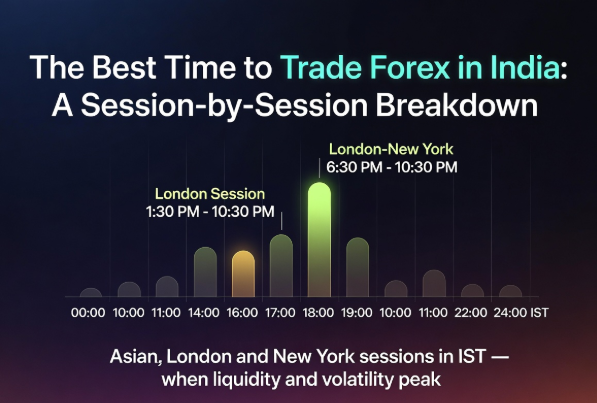
Open a position on EUR/USD at 9:00 AM IST and the spread might be 2 pips. Open the same position at 7:00 PM IST and it runs 0.8 pips. The setup is identical. The pair is identical. The difference is the session behind it – and that difference compresses directly into your P&L on every single trade. For traders in India, understanding which hours carry real liquidity and which are structural dead zones is not optional background knowledge. It is the baseline.
The Structure Behind the 24-Hour Market
The forex market operates continuously because banks and institutional desks in different cities open in sequence. Four financial centres define the rhythm: Sydney, Tokyo, London, and New York. Each city’s business day creates a concentration of activity, and when two centres overlap, volume peaks sharply.
India Standard Time is UTC+5:30 – a position that places Indian traders in an advantageous spot. The Asian session covers the morning working hours. The London session arrives in the early afternoon. The highest-volume window of the day, the London-New York overlap, lands between 6:30 PM and 10:30 PM IST – after a standard work day ends. No other major trading country has the peak liquidity window arrive quite so conveniently in the evening.
The full session schedule in IST looks like this. Sydney opens at 10:30 PM and closes at 7:30 AM. Tokyo runs from 5:30 AM to 2:30 PM. London opens at 1:30 PM and closes at 10:30 PM. New York runs from 6:30 PM to 3:30 AM. Two sessions overlap with genuine significance: the Asian-London crossover from 1:30 PM to 2:30 PM, and the London-New York overlap from 6:30 PM to 10:30 PM IST.
One variable worth tracking: the US and Europe observe daylight saving time on different dates. During US DST (roughly March through November), New York opens at 5:30 PM IST rather than 6:30 PM IST. The London open shifts to 12:30 PM IST when UK clocks change. These one-hour shifts alter the entire evening trading window and catch unprepared traders at exactly the wrong moment.
How Spreads Move Through the Day
Spread is the first cost on every trade. Understanding how it changes by session – not just by broker – prevents the mistake of applying Asian session position sizing to a London open entry.
During the Sydney session (10:30 PM to 5:30 AM IST), spreads on most major pairs are at their widest. EUR/USD, which London tightens to under 1 pip, can run 2-3 pips in the dead Sydney hours. AUD/USD and NZD/USD are the exceptions – these are Sydney’s native pairs and spread tightly throughout the session.
The Tokyo session (5:30 AM to 2:30 PM IST) improves conditions on yen crosses. USD/JPY tightens as Japanese institutional players enter. EUR/USD remains moderately wide. The 5:30 AM to 7:30 AM Sydney-Tokyo overlap is the most liquid sub-window of the Asian morning – AUD/USD and AUD/JPY see the cleanest conditions here.
| Hours (IST) | Active session | EUR/USD spread | Recommended pairs |
| 10:30 PM – 5:30 AM | Sydney only | Wide (2-3 pips) | AUD/USD, NZD/USD |
| 5:30 AM – 1:30 PM | Tokyo | Moderate (1.5-2 pips) | USD/JPY, AUD/JPY |
| 1:30 PM – 6:30 PM | London only | Tight (0.8-1 pip) | EUR/USD, GBP/USD |
| 6:30 PM – 10:30 PM | London + New York | Tightest (0.5-0.8 pip) | EUR/USD, GBP/USD, USD/CAD |
| 10:30 PM – 3:30 AM | New York only | Moderate (1-1.5 pips) | USD/CAD, USD/CHF |
London’s opening at 1:30 PM IST produces an immediate compression in spreads across all major pairs. According to the Bank for International Settlements’ 2022 Triennial Central Bank Survey, London accounts for approximately 38% of average daily global forex turnover. When that volume enters the market, liquidity providers tighten pricing across the board.
The London Open: One Moment Worth Knowing
The 90 minutes after the London open – 1:30 PM to 3:00 PM IST – deserve specific attention. The Asian session typically produces a narrow range on EUR/USD and GBP/USD during the Indian morning. That range often breaks at exactly 1:30 PM as London institutional orders hit the market.
Traders who monitor the overnight range during the Asian session and set breakout orders in advance often find their entries triggered in this precise window. The move tends to be directional and sustained because it carries real institutional volume behind it – not a retail breakout into thin air.
European economic data also concentrates in the first half of the London session. CPI releases from Germany and the Eurozone, UK employment and PMI figures, and ECB communications all land between 1:30 PM and 5:00 PM IST. These create specific volatility windows around known times – plannable, not reactive.
The London-New York Overlap: Four Hours of Peak Conditions
New York opens at 6:30 PM IST. The four-hour window until London closes at 10:30 PM IST is the most liquid period of the entire trading day. Spreads hit their floor. Volume peaks. Moves that begin in this window have the deepest institutional backing of any session.
US macroeconomic releases land in the first 90 minutes: Non-Farm Payrolls, CPI, and FOMC decisions all typically arrive between 6:30 PM and 8:30 PM IST. A major data surprise can drive 80-150 pips on EUR/USD within minutes. That creates genuine opportunity – and genuine risk. Position sizing calibrated for the quieter Asian morning is not appropriate for a live FOMC release. The traders who navigate news events consistently are those who size specifically for the expected volatility, not those who leave Asian session lots open through a Fed announcement.
This guide covers the complete session structure for Indian traders, including DST transitions and the distinction between exchange-traded INR pairs – which trade on NSE and BSE with fixed hours of 9:00 AM to 5:00 PM IST – and global OTC forex CFDs, which follow the 24-hour schedule described here. The two instruments operate on entirely separate clocks, and confusing them creates avoidable errors in position management.
Building a Routine Around the Sessions
Strategy type determines the right session. Range approaches on yen pairs belong in the Asian morning, when daily bands compress and price oscillates between identifiable levels. Breakout and momentum strategies belong at the London open. News-driven trades belong in the 6:30 PM to 8:30 PM IST block, with volatility-adjusted sizing.
The traders who improve fastest are those who stop trading opportunistically across all hours and start treating session selection as part of the setup itself. A breakout at 3:00 AM IST in the thin late New York session holds different structural weight than the same pattern confirmed at 2:00 PM IST with London volume behind it. Same chart, same signal – different market.
Conclusion
Spreads, volume, and volatility are not fixed properties of a currency pair. They shift by the hour, driven by which centres are active and how much institutional capital is flowing. For traders in India, that means the Asian morning, the London afternoon, and the evening overlap are three distinct trading environments, each suited to different approaches. Treating them as interchangeable is where most timing errors originate. Knowing the difference is where consistent execution begins.

