


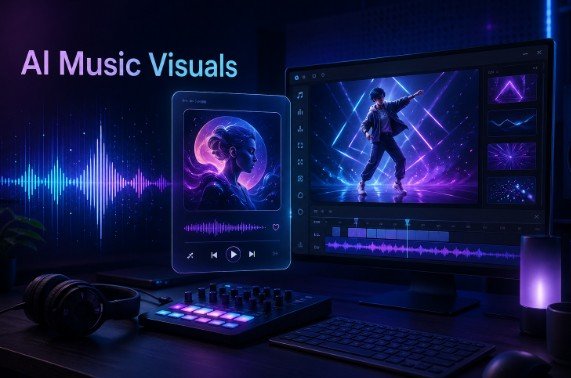
I used to believe that music promotion was mainly about sound. If the track was good, I thought people would naturally pay attention. After working on more music-related content, I slowly realized that this idea was only half true. A good sound still matters, of course, but on today’s platforms, the first thing people usually notice is not the melody. It is the visual.
That change has completely reshaped the way I look at music content. When I prepare a track preview, a remix teaser, or even a short background loop for social media, I no longer ask only, “Does this sound good?” I also ask, “Will someone stop scrolling when they see this?”
This is why tools like an AI dance generator have become useful in my workflow. They give music creators a way to turn a simple idea, character image, or visual concept into motion without setting up a full video shoot.
GoEnhance also provides an effective AI video generator for creating clean, polished motion content from simple visual inputs, which is helpful when I need something fast but still presentable.
Music Promotion Is Becoming More Visual
The biggest shift I have noticed is that music is no longer consumed only as audio. Even when people discover a song, they often discover it through a video.
That video might be:
- a short dance clip,
- an animated cover image,
- a lyric-style visual,
- a character loop,
- or a simple mood-based background.
For independent musicians and small creative teams, this creates both pressure and opportunity. The pressure is obvious: people expect more content. The opportunity is that good visual content can help a track travel much further than audio alone.
I have seen this clearly when testing different versions of the same music idea. A plain audio post usually feels passive. A short animated version feels more alive. Even when the music is exactly the same, the moving visual gives people a reason to pause.
Why Static Cover Art Is No Longer Enough
Album covers and single artwork still matter, but they are often just the starting point now.
A static cover can work well on streaming platforms or a website, but on social platforms, it often needs motion to compete. People scroll quickly. A still image has to work very hard to grab attention. A moving image has a better chance.
This does not mean every musician needs a cinematic music video. In fact, many of the best-performing visuals I have seen are simple:
| Visual Type | Best Use Case |
| Animated cover art | Spotify Canvas, YouTube background |
| AI dance clip | TikTok, Reels, Shorts |
| Looping character motion | Electronic music, remixes, concept tracks |
| Subtle camera movement | Ambient, instrumental, lo-fi music |
The point is not to overproduce. The point is to give the music a visual rhythm.
How AI Dance Clips Fit Into Music Content
Dance has always been connected to music discovery. What changed is the speed at which dance-based content can now be created.
In the past, making a dance promo required a dancer, a camera setup, editing time, and usually several rounds of revisions. That still has value, especially for professional campaigns. But for quick music testing, it can be too much.
With AI dance tools, I can start from a still image or visual concept and generate a short clip that matches the energy of the track. This works especially well for:
- pop song teasers,
- dance track promotion,
- remix announcements,
- character-based music branding,
- and quick social media experiments.
The first time I tested this, I did not expect much. I assumed the movement would feel too artificial. Some results did. But after adjusting the input and choosing better source visuals, the clips became much more usable. The key lesson was simple: AI tools respond better when the original visual already has a clear pose, strong lighting, and a clean subject.
Image Animation Gives Old Assets New Value
Another thing I like about AI animation is that it helps reuse existing assets.
Many music creators already have a folder full of cover art, concept images, promotional graphics, and character designs. Most of those assets get used once and then disappear. That feels wasteful.
With image animation online, those same visuals can be turned into short motion clips.
For example, a single cover image can become:
- a moving background for a lyric video,
- a short promotional reel,
- a looping visual for a live stream,
- or a mood clip for a music announcement.
This is where the workflow becomes practical. Instead of designing something from zero every time, I can build on what already exists.
My Practical Workflow for Music Visuals
When I create AI-assisted visuals for music, I usually keep the process simple.
I start with the strongest available image. If the image is messy, the output usually becomes messy too. A clean subject, good contrast, and a clear mood make a big difference.
After that, I generate a few motion versions rather than relying on the first result. In my experience, AI video generation works best when treated like a creative draft process. One version may have better movement. Another may have better composition. A third may match the song’s mood more closely.
The final step is matching the motion to the music. A fast dance clip does not fit every track. A slow ambient song may need only subtle motion. A high-energy remix may need stronger movement and sharper edits.
What Music Creators Should Watch Out For
AI tools are useful, but they do not remove the need for taste.
I have seen creators overuse motion just because they can. Too much movement can distract from the song. A visual should support the music, not fight it.
There are also basic quality checks I always recommend:
- Does the motion match the beat or mood?
- Is the subject still recognizable?
- Does the video look clean on mobile?
- Would the clip make sense without explanation?
If the answer is no, I would rather generate again than publish something that feels rushed.
Final Thought
AI dance and image animation are not replacing musicians, video editors, or visual artists. From my experience, they are better understood as creative shortcuts.
They help creators test ideas faster, reuse existing visuals, and make music feel more shareable. For independent artists, that can make a real difference.
A song still needs emotion. It still needs identity. But in a crowded feed, motion can give that song a better chance to be noticed.

