


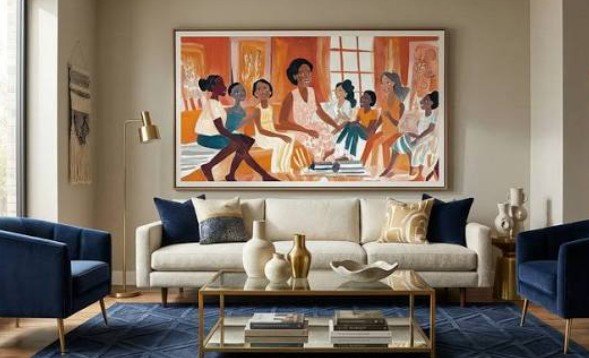
Contemporary interiors often speak in a restrained language. They rely on clean lines, open space, edited palettes, and a preference for objects that feel intentional rather than excessive. Yet rooms built entirely around restraint can drift toward anonymity, especially when they borrow from the same catalog of neutral furnishings and familiar design cues. What gives a modern interior its real force is not only proportion or finish, but also the meaning carried by the objects inside it.
That is where African American wall art brings unusual depth. It can introduce color, memory, narrative, and cultural specificity without disturbing the architectural clarity that contemporary design values. In many homes, the right artwork becomes the element that transforms a room from stylish to resonant. It tells visitors something about the people who live there, what histories matter to them, and what visual traditions they want to elevate in daily life.
The significance of this art extends beyond decoration. African American wall art often carries themes of family, migration, music, struggle, spiritual endurance, fashion, joy, and self-possession. When placed in a contemporary interior, those themes interact with modern materials and layouts in revealing ways. The result is not simply a prettier room, but a more articulate one, where design and identity are in active conversation.
African American Wall Art Gives Contemporary Rooms a Human Narrative
Modern interiors are often praised for their discipline, but discipline alone rarely makes a room memorable. Many contemporary spaces succeed at being calm, organized, and efficient, yet fall short of feeling lived in. African American wall art helps correct that imbalance by introducing narrative into environments that might otherwise seem purely formal. Portraiture, figurative work, abstraction rooted in cultural symbolism, and scenes of everyday Black life all give a room a story line. That story can be subtle or direct, but either way it adds emotional intelligence to the space. Instead of treating walls as empty surfaces to be filled, this approach treats them as places where values and memory can be made visible.
The narrative power of this work is especially potent in homes that aim for visual simplicity. A room with pale plaster walls, oak flooring, and carefully chosen furniture can provide the ideal setting for art that carries depth and complexity. The contrast works because the architecture does not compete with the message. A single image of a poised sitter, a family gathering, or a musician in motion can change the emotional weather of the entire room. It invites the eye to pause and the mind to interpret. Art becomes the point where aesthetics and biography intersect.
This narrative quality matters because people increasingly want their interiors to reflect more than taste. They want them to express lineage, conviction, and curiosity. African American wall art allows contemporary interiors to participate in a broader cultural conversation while remaining deeply personal. It can honor heritage in one home and signal solidarity or admiration in another, provided the choice is made thoughtfully. In both cases, the room becomes less generic and more grounded. That sense of grounding is what gives many contemporary spaces their missing layer of meaning.
It Brings Cultural Depth Without Sacrificing Modern Clarity
One of the most useful misconceptions to discard is the idea that culturally rich interiors must be visually crowded. In fact, African American wall art often works best in contemporary settings precisely because modern design leaves room for it to breathe. Clean-lined interiors offer visual silence, and strong artwork benefits from silence. The cultural dimension of the art comes forward with greater clarity when it is not surrounded by clutter or too many competing references. A sparse room can be a powerful frame for a work filled with historical, emotional, or symbolic density. In that sense, minimalism and meaning do not oppose each other. They can sharpen one another.
The relationship is especially effective when the art introduces references that the architecture does not. Contemporary interiors often lean on concrete, steel, linen, glass, walnut, and matte finishes. These materials communicate order and refinement, but they do not inherently communicate cultural context. African American wall art supplies that missing context by bringing in visual traditions shaped by Black history, community life, spirituality, music, and political experience. The room gains not only beauty but also dimension. It begins to suggest that sophistication is not merely a matter of expense or polish, but of cultural awareness. That shift changes how the whole interior is read.
As interest in African American wall art continues to grow, more homeowners are seeking sources that present the category with both breadth and curatorial clarity. That search often extends beyond traditional galleries to design-focused platforms that make it easier to find work suited to contemporary interiors. Among the more established names is iCanvas, a wall art company and online marketplace, offering ready-to-hang pieces from a global community of independent artists, licensed estates, and cultural institutions. Its collection of African American wall art prints shows how culturally resonant work shaped by Black expression can add depth, character, and sophistication to contemporary interiors without feeling forced or overly staged.
Color, Texture, and Composition Gain Greater Purpose
African American wall art often contributes more than subject matter. It also brings a distinct command of color, rhythm, and composition that can energize contemporary interiors in ways furniture alone rarely can. A room built around subdued upholstery and architectural neutrals may benefit from a work that introduces saturated blues, ochres, crimson, or deep earth tones. Those colors do not merely enliven a scheme. They change its cadence. They can pull a space away from sterility and toward vitality while preserving a sense of control.
Texture matters just as much. Even when reproduced as a print, artwork can suggest layered brushwork, collage, textile influence, photographic grain, or graphic line. These visual textures create a counterpoint to the smoothness that dominates many modern rooms. In a setting filled with polished stone, flat-front cabinetry, and crisp upholstery, the tactile suggestion of art becomes important. It gives the eye a more varied experience. That variety is often what makes a room feel complete rather than overly managed.
Composition also plays a strategic role in how meaning is communicated. Many works in this tradition use posture, silhouette, pattern, and negative space in ways that command attention without shouting. A dignified frontal portrait can anchor a dining room. A layered abstract piece can bring movement to a quiet hallway. A multi-figure composition can make a sitting room feel more social, even when no one is there. When art contributes at the level of color, texture, and structure, it does more than fill a wall. It helps organize the room’s visual intelligence.
Representation Changes the Emotional Temperature of a Home
Representation in art has a direct effect on how a room feels. Seeing Black subjects portrayed with complexity, beauty, dignity, and imagination alters the emotional atmosphere of an interior. It introduces presence, not just image. In homes where family members or guests recognize themselves, their histories, or their communities in the work on the wall, the space can feel more affirming and more alive. That is a design outcome with emotional weight. It cannot be measured like square footage or resale value, but it is often what people remember most.
This matters across generations. For children growing up in a home with thoughtful representation, the art around them can quietly shape ideas about identity, aspiration, and belonging. For adults, it can be equally powerful, particularly in rooms meant for gathering, reflection, or celebration. A hallway portrait can become part of a daily ritual of seeing and being seen. A striking piece in the living room can set the tone for conversation. Over time, the artwork moves from object to companion. It helps establish what the home chooses to honor.
Even for homeowners who are not decorating from within that identity, representation remains significant when approached with sincerity and respect. Collecting African American wall art should not be reduced to trend adoption or social signaling. It works best when informed by genuine engagement with artists, themes, and histories. In that context, the art deepens the room because it deepens the owner’s relationship to what is being displayed. The home becomes a place where aesthetic pleasure and cultural literacy meet. That combination gives contemporary interiors a seriousness they often lack.
The Art Creates a Bridge Between History and the Present
Contemporary interiors are, by definition, of the present. They tend to privilege current living patterns, new materials, and a forward-looking sensibility. Yet interiors become more compelling when they acknowledge time rather than erase it. African American wall art often serves as a bridge between historical experience and modern life. It can reference the civil rights movement, the Harlem Renaissance, jazz traditions, Southern roots, urban migration, or the ordinary rituals of family life. These references do not make a room nostalgic. They make it historically aware.
That historical awareness is important because design can easily become detached from social reality. A beautifully composed room may communicate taste, but taste without context can feel thin. Artwork that carries traces of Black history gives the space a broader frame of reference. It reminds viewers that beauty does not emerge outside of struggle, resilience, invention, and memory. In a contemporary home, this reminder can be quietly radical. It insists that comfort and consciousness belong in the same room.
The bridge between past and present is also what keeps the art from feeling merely illustrative. The best pieces do not sit on the wall like historical footnotes. They continue speaking to current questions about identity, visibility, style, belonging, and power. They show how the past remains active in the present tense. That is why such work often feels especially right in contemporary interiors. It balances modern design’s appetite for freshness with a deeper respect for continuity and inheritance.
Placement and Scale Determine How Strongly the Message Lands
Meaning in interiors is not created by selection alone. It is also shaped by placement, scale, and context. African American wall art can lose force if it is hung timidly, surrounded by distractions, or chosen at the wrong size for the room. A work with emotional authority often deserves equally confident placement. Over a fireplace, at the end of a corridor, behind a sofa, or opposite an entry, it can establish immediate presence. In those positions, the art is not supplemental. It becomes part of the room’s structure.
Scale is especially important in contemporary spaces, which often have generous walls and open sight lines. A small work can be intimate and effective, but it needs proper framing by space. Large-scale pieces, meanwhile, can transform a room by making the emotional content unavoidable. A monumental portrait or expansive abstract work introduces both drama and clarity. It tells the viewer where to look and how to read the room. In homes with lofty ceilings or wide-plan living areas, the right scale is often the difference between decoration and statement.
Grouping also requires discipline. A gallery wall composed of African American art can be powerful, but only if it has internal coherence. The works should speak to one another through palette, subject, medium, or rhythm. Otherwise, the wall risks becoming an accumulation instead of an argument. In contemporary interiors, fewer strong pieces often outperform many middling ones. The message lands best when the art has room, proportion, and intentional company.
Thoughtful Collecting Turns Decoration Into Living Culture
The most meaningful interiors are rarely assembled in a rush. They evolve through looking, learning, editing, and living with objects over time. African American wall art rewards this slower approach because it invites collectors to think beyond matching colors or filling blank walls. It encourages questions about artist background, subject matter, medium, mood, and context. Those questions make the collecting process richer. They also produce interiors with more staying power.
Thoughtful collecting begins with curiosity. A buyer might start with a single portrait that resonates emotionally, then gradually expand toward photography, abstraction, mixed media, or works that connect with music, place, or literature. This process tends to create a home that feels layered rather than staged. Each acquisition adds not only visual interest but also intellectual and emotional substance. The walls begin to reflect a pattern of attention. That pattern is often what gives a home its distinct identity.
In the end, African American wall art adds meaning to contemporary interiors because it asks more of them. It asks a room to do more than look polished. It asks it to remember, to represent, to provoke, and to delight. When those demands are met, the result is not a themed interior or a passing design statement. It is a home with cultural texture, personal conviction, and a visual life that feels fully inhabited.


