


Open any crypto subreddit in 2026 and you will see the same argument on repeat: which exchange is actually worth using? Most replies are a mix of affiliate bias, old screenshots, and users speaking from different regions with different rules.
That is the real issue. Traders do not lack options. They lack clear information before funding an account: whether KYC is mandatory at entry, how leverage works in their jurisdiction, and what withdrawal limits apply before verification.
This review looks at BYDFi through five practical friction points: onboarding, fees, strategy testing, fund protection signals, and unresolved risks. The goal is not to sell you a platform. It is to help you decide whether the product fits your actual trading behavior.
1) Onboarding Speed vs Withdrawal Freedom
As of April 2026, BYDFi allows email registration and access without mandatory KYC at sign-up. That lower-friction start matters for users who want to evaluate the interface and product range before uploading sensitive documents.
The trade-off is predictable: easier entry usually comes with tighter unverified limits. BYDFi’s optional KYC tiers unlock higher withdrawal allowances and additional features such as P2P services. So while “no mandatory KYC” improves first access, it does not mean unlimited account flexibility.
Relative to the market, this places BYDFi closer to no-KYC-friendly exchanges and farther from platforms that require full identity checks before any trading activity.
2) Fees: Competitive Baseline, Real Impact Depends on Volume
A 0.1% fee looks minor on one order. Over hundreds of monthly trades, it becomes a measurable drag.
BYDFi’s published baseline sits near industry norms: spot around 0.1% maker/taker and futures around 0.02% maker / 0.06% taker at entry level, with VIP discounts tied to 30-day volume.
A notable differentiator is the platform’s 2026 TradFi perpetual offering, marketed with zero trading fees on selected synthetic contracts linked to equities, metals, and forex references.
That sounds attractive, but users should separate low fee from low risk. These are synthetic derivatives, not ownership of underlying assets. Product legality and protections can vary sharply by jurisdiction.
Bottom line on costs: the fee sheet is competitive, but your real cost profile depends on how often you trade, whether you qualify for higher tiers, and what products are legally available in your region.
3) Strategy Testing Before Real Capital
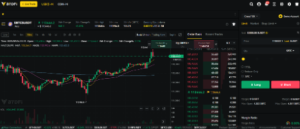
A useful exchange should let you practice before you pay tuition to the market.
BYDFi offers demo trading with virtual funds and support for multiple perpetual setups. For most users, the interface is close enough to live trading to rehearse order types, margin settings, and execution flow.
As always, simulation has limits. Live liquidity, slippage, and spread behavior will differ when real size enters the book.
The platform also includes automation features such as grid bots, DCA-style tools, and copy trading with a relatively low minimum. These can reduce manual workload, but they do not remove downside risk. Automation changes process, not market uncertainty.
4) Security and Compliance: Positive Signals, but Know the Limits
After multiple exchange failures in recent years, trust claims need evidence.
BYDFi has publicly highlighted proof-of-reserves reporting, an 800 BTC protection fund announced in September 2025, and operational controls such as cold-storage emphasis and withdrawal safeguards. Those disclosures are better than pure marketing language and give users something concrete to evaluate.
On compliance, the platform references U.S. FinCEN MSB registrations and membership in South Korea’s CODE VASP Alliance. These are meaningful baseline indicators for AML and registration, but they are not equivalent to full licensing frameworks across all jurisdictions.
That distinction matters. If your priority is the broadest regulatory coverage, you may prefer exchanges with deeper local licensing footprints. If your priority is product access and onboarding speed, your weighting may be different.
5) What This Review Still Cannot Fully Confirm
Some risks remain difficult to verify externally and should be treated as live variables.
Liquidity quality is pair-specific. Large listing counts do not guarantee deep books on lower-cap tokens.
Promotional programs can change quickly. Reward structures and campaign terms are often revised without long lead time.
Leverage availability is not the same as suitability. Even where high leverage appears accessible, local rules may restrict it, and liquidation risk is severe.
New product lines, including synthetic TradFi perpetuals launched in 2026, also lack long-cycle performance history.
Final View
As of April 24, 2026, BYDFi looks like a credible mid-tier option for traders who value faster onboarding, broad derivatives coverage, and flexible entry before full verification.
It is a less obvious fit for users who place comprehensive regulatory licensing above all other criteria.
The practical next step is simple: test before funding. Run strategies in demo mode, compare execution and fee impact against at least one alternative venue, and then decide whether BYDFi deserves a long-term place in your exchange rotation.
That decision will be more reliable than any headline, including this one.


