


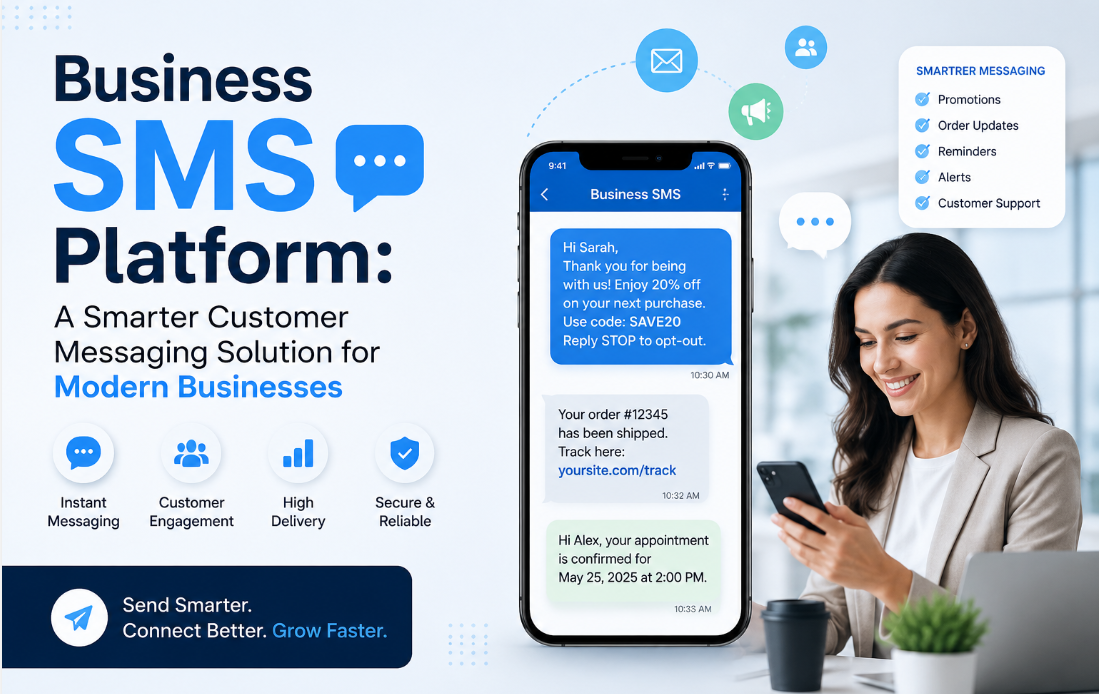
In today’s fast-moving digital environment, businesses need communication channels that are quick, simple, and capable of reaching customers wherever they are. Email, social media, and mobile applications all have important roles, but messages can easily become buried among countless notifications. SMS provides businesses with a more direct way to communicate important information, promotions, reminders, and updates straight to a customer’s mobile phone.
For organizations looking to improve the way they communicate with customers, a professional SMS service can bring marketing and operational messaging together in one convenient system. Businesses can use SMS not only for promotional campaigns but also for customer service notifications, appointment reminders, order updates, membership communication, and automated messages.
Why SMS Communication Still Matters for Businesses
Mobile phones have become an essential part of everyday life. Customers carry them throughout the day, making mobile messaging one of the most immediate ways for a company to communicate with its audience. Unlike communication channels that require customers to open a particular application or regularly check an inbox, SMS messages arrive directly on the recipient’s phone.
This direct approach makes SMS particularly useful when timing matters. A retailer may want to announce a limited-time promotion, while a service company may need to remind customers about upcoming appointments. An online business might use SMS to communicate important order information, and an organization may need to send updates to a large group of members.
The flexibility of SMS means businesses can adapt it to different communication goals rather than relying on it exclusively as an advertising channel.
Choosing the Right Business SMS Platform
As a company’s customer base grows, manually sending individual messages quickly becomes impractical. A dedicated Business SMS platform allows companies to organize and manage SMS communication more efficiently from a centralized environment.
HelloSMS provides several options for business SMS communication, including SMS campaigns, an SMS API/gateway, SMS through email, personalized SMS, incoming SMS capabilities, and customizable senders. Its customer portal also allows businesses to manage campaigns and access statistics related to their messaging activity.
The advantage of using a dedicated platform is that businesses can develop a more structured communication process. Instead of managing messages through personal phones or disconnected systems, teams can coordinate messaging from a solution designed specifically for business communication.
Making Customer Communication More Efficient
Efficiency becomes increasingly important when a company communicates with hundreds or thousands of customers. Sending the same update individually would require significant time and administrative effort.
A professional SMS service makes it possible to prepare a message once and distribute it to the intended audience. Businesses can therefore communicate announcements, offers, reminders, or other important information without repeating the same manual process.
This approach can be especially valuable for businesses running regular campaigns. Marketing teams can prepare promotional messages while operational teams can use the same communication channel for practical customer notifications.
A centralized system also makes communication easier to manage because businesses can maintain a clearer overview of their SMS activity.
Building Better Customer Experiences Through Messaging
Modern customers expect businesses to provide information quickly and conveniently. Waiting too long for an important update can create unnecessary uncertainty and negatively affect the overall customer experience.
A well-planned Customer messaging solution can help companies deliver relevant information directly to customers at important stages of their journey.
For example, an appointment-based business can remind customers before scheduled visits. Retailers can inform subscribers about new products or special promotions. Membership organizations can distribute announcements, while service companies can communicate changes or important notices.
The objective should not simply be to send more messages. Businesses should focus on sending useful information at appropriate times. Relevant and timely communication is more likely to provide value to customers and support a positive relationship with the company.
SMS Marketing for Promotions and Customer Engagement
Marketing is one of the most common applications of business SMS. Companies can use SMS campaigns to promote seasonal offers, announce new products, distribute discount information, or encourage customers to visit a website or physical location.
The short format of SMS also encourages businesses to communicate clearly. A successful promotional message normally focuses on one primary idea and gives customers an obvious next step.
Personalization can further improve the experience. Instead of treating every recipient exactly the same, companies can adapt messages according to their communication strategy and available customer information.
However, businesses should always follow applicable marketing, privacy, and consent requirements when sending promotional SMS messages. Customers should receive communications they have appropriately agreed to receive, and companies should maintain responsible messaging practices.
Connecting SMS With Existing Business Systems
For businesses with more advanced requirements, API-based messaging can make SMS part of existing software and workflows.
HelloSMS offers an SMS API/gateway designed to support automated messaging. This type of integration can be useful when messages need to be triggered automatically by actions inside another business system.
For example, an e-commerce platform might trigger a message after a particular customer action. A booking system could generate appointment notifications automatically, while another business application could send status updates when specific conditions are met.
Automation reduces repetitive manual work and helps companies create more consistent communication processes. As message volumes increase, API integration can become particularly useful because SMS functionality can operate as part of the company’s existing digital infrastructure.
Sending SMS From Familiar Business Tools
Not every organization requires a complex technical integration. Some teams simply want an easier way to send SMS while continuing to work with familiar tools.
HelloSMS supports SMS through email as well as sending messages through its web-based customer portal. According to the company, the service operates through a browser and email software without requiring a separate installation.
This flexibility can make adoption easier for different types of organizations. A small company may prefer a straightforward portal, while a larger organization may eventually integrate SMS through an API.
The ability to choose an appropriate method allows businesses to introduce SMS communication according to their current requirements and expand their use as those requirements change.
Using Messaging Data to Improve Campaigns
Business communication should continuously improve. Sending messages without understanding campaign performance makes it difficult to determine what is working.
HelloSMS states that its customer portal provides statistics and information about SMS campaigns. Access to messaging data can help businesses evaluate their communication activities and refine future campaigns.
Companies can experiment with different message formats, calls to action, campaign timing, and audience strategies. Over time, these insights can contribute to more focused and relevant communication.
The goal is to move from simply sending SMS messages to developing a measurable communication strategy.
Supporting Different Types of Business Communication
One of the strongest advantages of SMS is its versatility. It can support marketing communication as well as practical customer interactions.
A restaurant might send reservation-related updates, a retailer may announce a sale, an association could communicate with members, and a service provider might send appointment reminders. Online companies can also use automated messaging for various customer notifications.
HelloSMS provides services for business SMS campaigns, customer clubs, associations, SMS API integration, email-to-SMS communication, incoming SMS, personalized messages, and other messaging functions.
This range of capabilities means businesses can potentially manage multiple SMS use cases within one communication environment rather than adopting separate solutions for every requirement.
Creating an Effective SMS Communication Strategy
Technology alone does not guarantee effective customer communication. Businesses also need a clear strategy for determining what to send, when to send it, and who should receive each message.
Messages should be concise and immediately understandable. Customers should not have to interpret complicated language to understand an offer or important notification. When an action is required, the message should provide a clear direction.
Frequency is equally important. Sending too many promotional messages can reduce engagement, while communicating too rarely may cause businesses to miss valuable opportunities. Companies should find an appropriate balance based on customer expectations and the nature of their services.
Segmentation and personalization can also make communication more relevant. Different groups of customers may have different interests, purchasing behaviors, or communication needs. Creating messages around those differences can provide a better experience than sending every campaign to an entire database.
The Growing Role of Business Messaging
Customer communication continues to evolve as businesses adopt more digital systems and automation. Companies increasingly want communication tools that can connect marketing, customer service, and operational processes.
SMS fits naturally into this environment because it can function independently or integrate with other business systems. A company can start with straightforward SMS campaigns and later introduce automated notifications through an API as its requirements become more sophisticated.
The most effective approach is often to view SMS as part of a broader customer communication strategy. Email, social media, web notifications, and SMS can complement one another when each channel is used for the situations where it performs best.
Conclusion
Effective communication is essential for building strong customer relationships. Businesses need reliable methods for distributing important information quickly while keeping the communication process manageable for internal teams.
A professional business SMS service can help companies centralize campaigns, automate notifications, communicate through familiar tools, and monitor messaging activity. Platforms such as HelloSMS combine multiple SMS capabilities, including business campaigns, SMS API functionality, email-to-SMS communication, personalization, and customer portal management.
By combining appropriate technology with relevant content, responsible messaging practices, and thoughtful timing, businesses can transform SMS from a simple notification channel into an important part of their overall customer communication strategy.

