


Why Home & Living Content Is Uniquely Painful to Produce
Home and living is probably the hardest e-commerce category to create content for. Every product needs context—a sofa doesn’t sell on a white background, a lamp means nothing without a room around it, and bedding needs to look like it belongs in someone’s actual bedroom.
The traditional production pipeline for this category is brutal:
- Every shoot needs a set. You’re not just photographing a product—you’re staging an entire room. A single furniture video might require renting a location, hiring an interior stylist, bringing in complementary pieces, and spending a full day getting the lighting right. One product, one setting, thousands of dollars.
- Customers need to see products in their world. The number one question shoppers have is “will this work in my space?” A modern apartment buyer and a suburban homeowner need completely different visual contexts. Traditional production means separate shoots for each.
- The SKU problem is massive. A mid-size furniture brand might carry 200+ products across multiple colorways and collections. Creating unique video content for each variant? At traditional production costs, that’s financially impossible.
- Seasonal refreshes never stop. Holiday staging in November, spring refresh in March, back-to-school in August. Each cycle demands fresh content, and production timelines of 2-6 weeks per shoot can’t keep up.
- Lifestyle content ages fast. Interior design trends move quickly. That farmhouse-chic shoot from 18 months ago now looks dated, but reshooting everything costs as much as the original production.
The gap between what shoppers expect and what brands can afford to produce keeps widening. Something had to give.
What AI Video Actually Means for Home & Living in 2026
Here’s what shifted: AI video tools got good enough to generate lifestyle content that looks like it came from a professional interior shoot. Not “obviously AI” or “pretty good for a computer”—genuinely convincing room scenes with accurate lighting, realistic materials, and proper spatial relationships.
For home and living brands specifically, this changes the game in a few key ways:
One product photo, unlimited rooms. Upload a single transparent-background image of your armchair, and generate it placed in a Scandinavian living room, a mid-century modern den, a cozy reading nook, and a bright coastal sunroom. Same product, four completely different stories, produced in minutes.
Short-form video at the volume social demands. TikTok and Instagram Reels are where home decor discovery happens now. The algorithm rewards brands that post frequently with varied content. Using models like HappyHorse 1.0 for image-to-video generation, brands can turn those AI-generated room scenes into smooth, cinematic video clips—camera panning across the room, zooming into texture details, transitioning between day and night lighting—all from a single product photo.
Personalization that was previously impossible. Different shoppers have different tastes. With AI, you can show the same dining table in a minimalist apartment for urban buyers, in a spacious farmhouse for suburban families, and in a compact setting for studio-dwellers. That level of contextual personalization used to require three separate production budgets.
Global without the logistics nightmare. Want to sell that sofa in Japan, Germany, and Brazil? Each market has different interior design preferences, room sizes, and aesthetic expectations. AI-generated content adapts to each without booking studios in three countries.

How This Works in Practice
Let’s get specific about what the actual workflow looks like when a home and living brand uses an AI content platform like Topview AI.
From Product Shot to Lifestyle Content Library
You start with what you already have: product images from your existing catalog. The platform takes that single image and generates:
- Room scene placements: Your coffee table appears in a styled living room with complementary furniture, decor, and natural lighting. Not floating in space—properly grounded with realistic shadows and scale.
- Multiple design aesthetics: The same table in Modern Luxe, Japandi, Industrial Loft, and Coastal Grandma settings. Each version tells a different story to a different customer segment.
- Dynamic presentations: Slow camera movements through the room, focusing on your product. Zoom-ins that show material quality and finish details. Day-to-night transitions that demonstrate how a lamp changes the ambiance of a space.
- Seasonal variations: The same bedroom setup with summer linens and natural light, then winter textures and warm candlelight. Refresh your product pages without refreshing your production budget.
AI Presenters for Tutorials and Storytelling
Home products often need explanation. Assembly instructions, styling tips, feature walkthroughs—this kind of content traditionally requires hiring on-camera talent for every video.
AI avatar presenters now handle this at a fraction of the cost:
- Assembly and setup guides for furniture, with step-by-step visual instructions delivered by a natural-looking presenter.
- Styling tutorials where an AI host walks through “3 ways to style this bookshelf” or “how to layer bedding like a designer.”
- Product feature demos for smart home devices—showing how a robot vacuum navigates different floor plans, or how smart lighting adapts throughout the day.
- Multilingual versions of the same tutorial, generated without reshooting. Same script, different languages, ready for every market you sell in.
Social Content at Scale
The real unlock for home and living brands is volume. With Seedance 2.0 powering video generation, a brand can produce a month’s worth of social content from a handful of product images:
- Platform-optimized formats: Vertical for TikTok and Reels, square for feed posts, horizontal for YouTube and product pages.
- Trend-aligned content: “Small space hacks” compilations, “room makeover” before-and-afters, “ASMR unboxing” of home decor items—all generated at the speed trends emerge.
- UGC-style reviews: Authentic-feeling product showcases that don’t scream “corporate ad.” The kind of content that actually performs on social.
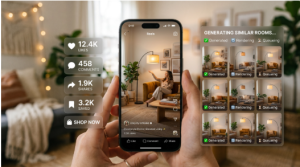
- Shoppable sequences: Quick cuts between different products in a styled room, perfect for collection launches and seasonal campaigns.
Campaign-Ready Visuals from Text
Beyond video, home brands burn through static imagery for ads, emails, and social posts. OpenAI’s GPT Image 2 model—accessible through integrated platforms—lets you generate photorealistic lifestyle images from descriptions alone. Need a hero shot of your new throw pillow collection arranged on a velvet sofa in a sun-drenched apartment? Describe it and have it in 60 seconds, no photographer needed.
What the Numbers Actually Look Like
Marketing leaders care about ROI, not technology for technology’s sake. Here’s what home and living brands are seeing:
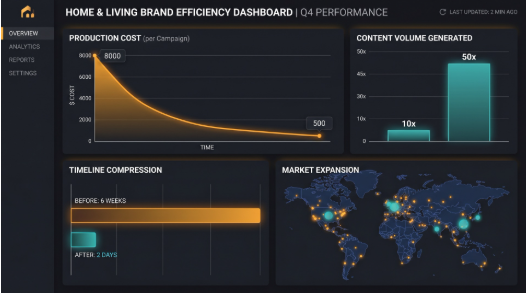
Production cost reduction: 80-90%. A furniture brand that previously spent USD 5,000-8,000 per product video (location, styling, crew, editing) now produces equivalent content for under USD 500. When you’re covering 200+ SKUs, the savings are transformative.
Time to market: hours instead of weeks. A seasonal campaign that used to require 4-6 weeks of planning and production now launches in 2-3 days. Some brands are producing same-day content for flash sales and trend responses.
Content volume: 10-50x increase. Instead of 2-3 hero videos per product, brands generate 20-30 variations across different room styles, formats, and platforms. More content means more testing, more discovery surface, and more conversion opportunities.
Return rate impact. Products shown in contextual room settings see measurably lower return rates—customers have a clearer picture of what they’re buying. One home decor brand reported a 19% drop in returns after switching to AI-generated lifestyle imagery.

Global expansion cost: near-zero incremental. Entering a new market used to mean budgeting for localized content production. Now it means generating regionally appropriate room settings and translating scripts—all from existing assets.
How Home & Living Brands Are Using This Right Now
This isn’t hypothetical. Here’s what’s happening across the category in 2026:
Furniture brands are generating room-scene videos for every sofa, bed, and dining set in their catalog—each shown in 5-10 different interior styles, lighting conditions, and room sizes. One brand went from 50 product videos to over 2,000 in a single quarter.
Decor and soft furnishings companies create ambient content at scale: candles flickering in styled rooms, throw pillows arranged across seasonal settings, curtains billowing in different window configurations. The kind of mood-driven content that performs incredibly well on Pinterest and Instagram.
Kitchen and appliance brands produce AI-hosted recipe tutorials, feature comparison videos, and “day in the life” content showing products in realistic kitchen environments. No chef, no kitchen rental, no food stylist—just the AI platform and your product images.
Smart home companies demonstrate product functionality through generated walkthroughs: robot vacuums navigating furniture layouts, smart lighting transitioning through the day, connected appliances working together in a cohesive kitchen setup.
Bedding and textile brands showcase the hardest-to-convey qualities—drape, texture, softness—through dynamic video that does what static images never could. Close-up fabric shots, bedroom ambiance sequences, and side-by-side material comparisons all generated from product swatches.
Getting Ahead of the Curve
The home and living brands that figure this out first have a compounding advantage. More content means more algorithm surface. More algorithm surface means more discovery. More discovery means more data on what converts. And more data means smarter content decisions—all feeding back into the AI production loop.
The brands still waiting to see how this plays out are watching their competitors build content libraries that would take years to replicate through traditional production. The technology gap is real, and it’s widening every quarter.
This isn’t about replacing creative vision. Your designers still decide the aesthetic direction, your brand team still sets the narrative, and your merchandisers still choose which products to feature. AI just removes the production bottleneck that prevented those decisions from scaling.
Start with your best-selling SKUs. Generate a few room scenes. See how they perform against your existing content. That’s usually all it takes to understand why every major home brand is moving in this direction

