

Why Is My Car Shaking When I Stop? A car that runs fine on the highway but shudders the moment you stop at a light is one of the most common complaints mechanics hear. It’s unsettling because nothing seems wrong until the car goes still.
At idle, your engine spins at its lowest speed, usually 600 to 1,000 RPM. There’s no road motion left to smooth out small mechanical or combustion problems, so anything slightly off gets amplified right through the seat and steering wheel.
Why Is My Car Shaking When I Stop?


Car shaking when stopped is most often caused by worn spark plugs, a vacuum leak, a failing motor or transmission mount, a dirty air or fuel filter, or a struggling AC compressor adding load at idle. Mild shaking that fades with speed usually points to the engine; shaking that only happens under braking usually points to the brakes or tires instead.
Worn or Fouled Spark Plugs
Spark plugs ignite the fuel-air mixture in each cylinder. When one plug is worn, dirty, or misfiring, combustion becomes uneven and the engine shudders.
This is one of the most common causes of rough idle, and often the cheapest to fix. A check engine light doesn’t always come on, so shaking alone can be the only symptom.
Vacuum Leaks
Vacuum hoses regulate airflow into the engine. A cracked or loose hose lets in extra unmetered air, throwing off the air-fuel ratio the engine needs to idle smoothly.
This usually causes a hissing sound along with the shake, and sometimes a higher-than-normal idle speed. It’s a common but often overlooked cause.
Worn Motor or Transmission Mounts
Motor mounts hold the engine in place and absorb its natural vibration. When a mount cracks or wears out, that movement transfers straight into the cabin.
A telltale sign is shaking that changes noticeably when you shift from Park into Drive or Reverse. If it eases in Neutral, mounts are a strong suspect.
Dirty Air or Fuel Filters
A clogged air or fuel filter restricts what the engine needs to keep a steady idle. The engine compensates by working harder, which shows up as a rough, shaky idle.
This is routine wear-and-tear, usually resolved with a filter swap during a normal service visit.
Failing Oxygen Sensor
The oxygen sensor tells the engine’s computer how much fuel to mix with incoming air. A failing sensor sends bad data, which can push the engine to run too rich or too lean.
Either extreme creates a rough idle. This often triggers a check engine light, unlike some of the other causes on this list.
AC Compressor Load

Turning on the air conditioning adds extra load to an engine that’s already working at its lowest output. If other components are already marginal, that extra draw can be the tipping point that makes shaking noticeable.
If your car only shakes at idle with the AC on, and smooths out with it off, this is worth checking first since it’s often the simplest explanation.
Worn Serpentine or Timing Belt
A loose or worn belt can throw off how accessories like the alternator, water pump, and AC compressor spin. That imbalance shows up as vibration and sometimes a squealing noise.
Belts are a routine inspection item and generally straightforward to replace before they fail completely.
Shaking Specifically When Braking
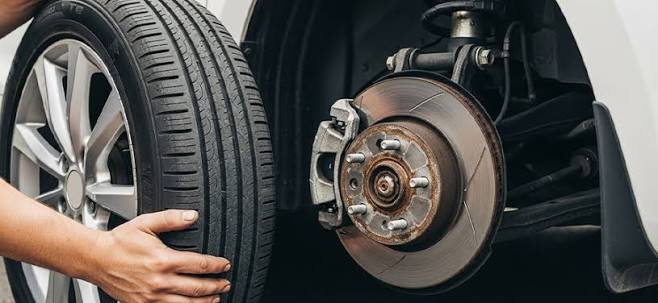
If the shake only appears when you press the brake pedal to stop, the cause is usually different from idle shaking. Warped brake rotors are the most common culprit, creating a pulsing feeling through the pedal.
Uneven tire wear or a steering system knocked out of alignment — often from hitting a pothole or curb — can also cause this. These are suspension and braking issues, not engine issues.
Comparison: Idle Shake vs. Braking Shake
| Symptom | Likely Cause | Typical Fix |
|---|---|---|
| Shakes at idle, smooths out driving | Spark plugs, vacuum leak, filters | Tune-up, filter replacement |
| Shakes at idle, changes in Drive vs. Neutral | Motor or transmission mounts | Mount replacement |
| Shakes only when braking | Warped rotors | Rotor resurfacing or replacement |
| Shakes at idle, worse with AC on | Marginal components under extra load | Diagnostic check |
| Vibration after hitting a pothole | Tire damage or alignment | Tire inspection, alignment |
When to See a Mechanic Right Away


- Shaking is sudden, severe, or getting worse quickly
- A check engine light or other warning light is on
- You notice a burning smell, fuel smell, or smoke
- The car hesitates, stalls, or loses power along with the shaking
- Shaking is accompanied by grinding or squealing noises
When It Can Wait for a Routine Visit
- Mild shaking that’s been consistent and not worsening
- No warning lights and no unusual smells or sounds
- The car drives normally at speed and only shakes at idle
- You’re already due for a scheduled service or inspection


Frequently Asked Questions (FAQs)
Why does my car shake only when I’m stopped?
At idle there’s no road motion to smooth out small mechanical or combustion issues, so problems like worn spark plugs or a vacuum leak become noticeable the moment you stop.
Is it safe to keep driving if my car shakes at idle?
Mild, steady shaking with no warning lights is usually safe short-term, but it’s worth getting diagnosed soon since untreated issues tend to worsen and get costlier.
Why does my car shake more with the AC on?
The AC compressor adds extra load to the engine, which is already running at its lowest output at idle. That added strain can expose marginal spark plugs, mounts, or other components.
What does it mean if the shaking changes between Park and Drive?
Shaking that shifts noticeably between Park, Drive, and Neutral usually points to worn engine or transmission mounts rather than a combustion issue.
Can bad spark plugs really cause this much shaking?
Yes. Worn or fouled spark plugs cause uneven combustion, which is one of the most common and least expensive causes of rough idle shaking.
Why does my car only shake when I brake?
Shaking that appears specifically during braking usually points to warped brake rotors, not the engine. Uneven tire wear or alignment issues can also cause it.
Will a vacuum leak trigger my check engine light?
Sometimes, but not always. A vacuum leak often causes a hissing sound and a higher idle speed even without triggering a warning light.
How much does it cost to fix worn motor mounts?
Costs vary by vehicle, but motor mount replacement is a well-understood repair most shops can quote after a quick inspection.
Should I use an OBD-II scanner before going to a mechanic?
It can help. A scanner can reveal stored trouble codes even if the check engine light isn’t on, which narrows down the cause before your appointment.
Can dirty air or fuel filters really cause a shaking car?
Yes. Clogged filters restrict airflow or fuel delivery, forcing the engine to work harder to maintain idle, which often shows up as a rough shake.
Conclusion
A shaking car at a stoplight almost always has a specific, findable cause — spark plugs, a vacuum leak, worn mounts, or a filter overdue for replacement are the usual suspects. None of these are exotic problems, and most are inexpensive to fix once identified.
The one thing worth not ignoring is how the shaking changes over time. A mild, steady shake at idle can usually wait for a normal service appointment, but sudden, worsening, or warning-light-accompanied shaking is worth getting looked at right away before a small issue turns into a bigger repair.