


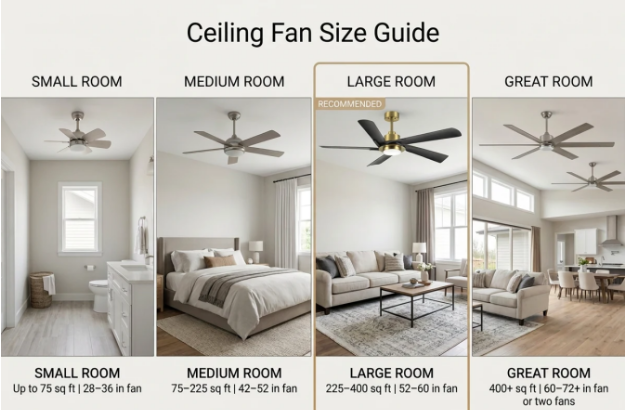
For most large residential rooms, a ceiling fan in roughly the 52- to 60-inch range is a practical starting point. Rooms around 225 to 400 square feet often fall into this range, while very large great rooms, open-plan spaces or rooms above about 400 square feet may need a 60-, 72-inch or larger fan, or more than one fan. Blade span is only the first filter. Room shape, ceiling height, mounting position and the fan’s published airflow all affect whether a particular model will work well in the space.
What Size Ceiling Fan Is Best for a Large Room?
A room-size chart is useful because it gives you a sensible place to begin, but it should not be treated as a universal rule. Manufacturers use different sizing ranges, and two fans with the same diameter can deliver very different airflow. Use the table below as a starting point, then confirm the specific fan’s airflow and installation requirements.
| Room size | Approx. area | Practical starting fan size |
| Small room | Up to about 75 sq. ft. | 28–36 in. |
| Medium room | About 75–225 sq. ft. | 42–52 in. |
| Large room | About 225–400 sq. ft. | 52–60 in. |
| Great room / open-plan space | 400+ sq. ft. | 60–72+ in. or multiple fans |
These ranges are starting points rather than hard limits. A long room, an open kitchen-living area, a high ceiling or an off-center mounting position can change the choice even when the square footage is the same.
How to Calculate the Right Ceiling Fan Size for Your Room
The simplest way to estimate fan size is to start with the room’s floor area, then adjust for layout and installation conditions.
Step 1: Measure the Room
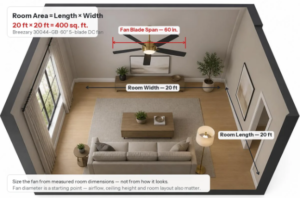
Measure the length and width of the usable room area in feet, then multiply the two numbers:
Room area = length × width
For example, a 20 × 20-foot room has 400 square feet of floor area. A 15 × 20-foot room has 300 square feet.
Step 2: Match the Area to a Blade-Span Range
Once you know the square footage, use it to narrow the fan diameter. The fan size refers to the full blade span from one side of the rotating circle to the other, not the length of a single blade.
Step 3: Look at the Shape of the Room
A nearly square 300-square-foot room and a long 300-square-foot room do not distribute air in exactly the same way. In a long, L-shaped or divided open-plan space, one oversized fan may not reach every occupied zone evenly. In those layouts, fan placement—or using two fans—can matter more than simply choosing the largest diameter available.
Ceiling Fan Size by Room Dimensions
If you already know your room dimensions, the examples below make the sizing process easier. The ranges are intentionally flexible because airflow, ceiling height and room layout still need to be checked.
| Room dimensions | Area | Typical starting range |
| 10 × 10 ft | 100 sq. ft. | 42–48 in. |
| 10 × 12 ft | 120 sq. ft. | 42–48 in.; 52 in. may work in some layouts |
| 11 × 11 ft | 121 sq. ft. | 42–52 in. |
| 12 × 12 ft | 144 sq. ft. | 44–52 in. |
| 12 × 14 ft | 168 sq. ft. | 48–52 in. |
| 15 × 20 ft | 300 sq. ft. | 52–60 in. |
| 20 × 20 ft | 400 sq. ft. | 60 in. or larger, depending on airflow and layout |
If a room sits near the upper end of a size range, do not assume that the larger diameter is automatically better. Compare published CFM, available clearance and where the fan will be mounted.
Is a 60-Inch Ceiling Fan Good for a Large Room?
A 60-inch fan is often a strong option for a large living room, primary bedroom, open family room or similar space when the room is near the upper end of the large-room range. It can also make sense in rooms that are wide, have a broad seating area or need airflow distributed across more than one activity zone.
The important point is that 60 inches describes only the diameter. Before choosing a model, check its published airflow, mounting height, included downrods, ceiling-slope limits and the available distance between blade tips and nearby walls, beams or cabinets.
A Real 60-Inch Ceiling Fan Example
A real product helps show why diameter should be considered together with performance data. One example is a 60-inch ceiling fan with LED light from Breezary. The model uses a 60-inch five-blade design with a DC motor and publishes a maximum airflow of 5,783 CFM. It also includes 6-inch and 12-inch downrods, which gives the installer two standard mounting-height options.
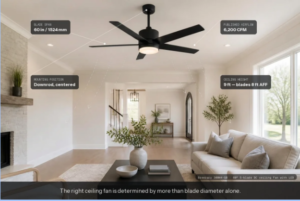
The same product includes an 18W integrated LED light, six fan speeds, forward and reverse operation, and a remote control. Those features do not make it the right choice for every large room, but they illustrate the kind of information that should be checked after the room-size estimate. A shopper can compare diameter, airflow and mounting details rather than choosing by blade span alone.
Why CFM Matters as Much as Fan Size
CFM, or cubic feet per minute, describes how much air a fan moves. It is one of the most useful performance figures to compare once you have narrowed the diameter range. Two 60-inch ceiling fans can have noticeably different airflow because motor output, blade pitch, blade shape, speed and overall design are different.
A larger diameter can help a fan cover a broader area, but longer blades do not automatically guarantee more airflow. If one model publishes substantially higher airflow than another, that difference may matter more than a small change in diameter. For a large room, the best fit is usually the model that balances adequate coverage with airflow that suits the way the room is used.
Can a Ceiling Fan Be Too Large for a Room?
Yes. A ceiling fan can be too large even if it physically fits within the room. The most obvious problem is clearance: blade tips need enough space from walls, cabinets, beams, tall furniture and other fixtures. An oversized fan can also dominate a small room visually or create stronger air movement than occupants want at normal operating speeds.
Before moving up to the next fan size, ask four questions:
- Will the blades have comfortable clearance from walls, beams and built-ins?
- Will the fan be centered over the area where people actually sit or sleep?
- Does the model provide enough low-speed control for everyday comfort?
- Does its installed height work with the ceiling and the room below?
If the answer to any of these is no, a slightly smaller fan with better airflow performance or a different mounting position may be the better choice.
Is a 52-Inch Ceiling Fan Too Big for a Bedroom or Living Room?
A 52-inch ceiling fan is not automatically too large for a bedroom or living room. In many medium-size rooms it is a common choice, but whether it feels appropriate depends on actual room dimensions, furniture placement and the fan’s performance at low and medium speeds.
Is a 52-Inch Fan Too Big for a 10 × 10 Room?
A 10 × 10 room is about 100 square feet. A 52-inch fan is on the larger side for that space, so a 42- to 48-inch model is often the easier starting point. A 52-inch fan may still be workable in a simple layout with adequate wall clearance and a controllable low speed, but it should not be selected only because “bigger moves more air.”
Is a 52-Inch Fan Too Big for a 12 × 12 Room?
A 12 × 12 room is 144 square feet. A 52-inch fan can be reasonable here, especially when the room is open and the fan is centered, but a smaller model may also provide enough airflow. Compare the actual CFM, ceiling height and blade clearance before deciding.
Is a 52-Inch Fan Good for a Living Room?
For a modest or medium-size living room, 52 inches can be a practical size. For a larger living room approaching 225 to 400 square feet, a 52-inch model may sit at the lower end of the useful range, so a 56- or 60-inch fan with suitable airflow may provide broader coverage.
Do I Need a 42- or 52-Inch Ceiling Fan?
The choice between 42 and 52 inches is usually easiest when you look at the room in three layers: floor area, usable width and airflow. A 42-inch fan tends to suit smaller rooms or tighter layouts. A 52-inch fan gives more coverage and is often suitable for medium rooms, but it still needs enough space around the blade tips.
If both sizes fit the room, compare the manufacturers’ airflow figures and speed control. A well-designed 42-inch fan can outperform a weak 52-inch fan, while a high-airflow 52-inch model may be more than a small bedroom needs.
What Size Fan Works for a Large Bedroom or Living Room?
Large Bedroom
In a large bedroom, comfort at low speed can be just as important as maximum airflow. Consider where the bed sits relative to the fan, whether the motor is quiet enough for nighttime use, and whether a light kit or remote control is useful. Many large bedrooms fall into the 52- to 60-inch range, but the room’s actual width and ceiling height should guide the final choice.
Large Living Room
A large living room often has a wider occupied area than a bedroom. Seating may be spread across a sectional, chairs and adjacent open space, so broader coverage can be useful. A 56- to 60-inch fan is often worth considering, with 60 inches or more becoming more practical as the room approaches 400 square feet.
Great Room or Open-Concept Space
For spaces above about 400 square feet, especially long living-dining layouts, the decision is less about one “correct” diameter and more about coverage. A 60-, 72-inch or larger fan may work well in a centrally usable room, while two smaller fans can provide more even air movement in a long or divided plan.
How Ceiling Height Affects Fan Size and Downrod Length
Ceiling height changes the installation more directly than it changes the diameter. A fan that is the right width for the floor area still needs to sit at a comfortable and safe height above the occupied space. High or vaulted ceilings often require a longer downrod so the fan is not mounted too close to the ceiling, where airflow can be restricted.
For every model, check the manufacturer’s permitted mounting method, included downrods, maximum slope and installed height. Do not assume that any generic extension rod is compatible with a specific fan.
Is One Large Ceiling Fan Better Than Two Smaller Fans?
One large fan works best when the room is relatively square, the mounting point is close to the center, and the occupied area is reasonably continuous. Two fans can be the better solution for long rooms, L-shaped spaces or open plans where one fan would leave a distant seating or dining zone with weak airflow.
Using two fans also gives you more control over separate areas, but it requires two fan-rated mounting locations and a layout that keeps the fans from interfering visually or mechanically with each other. The right choice is therefore a coverage decision, not simply a question of which option has the greater total blade span.
What to Check Before Buying a Ceiling Fan for a Large Room
Once you have a likely diameter range, use a short checklist to compare real products rather than shopping by size alone:
- Room length and width
- Total square footage
- Room shape and the main occupied zone
- Fan diameter
- Published maximum airflow (CFM)
- Ceiling height and installed fan height
- Included and compatible downrods
- Blade clearance from walls, beams and fixtures
- Indoor, damp or wet-location suitability where relevant
- Lighting needs
- Speed, reverse and remote-control functions
- Whether one fan or multiple fans will cover the space better
If you are comparing models after measuring the room, browsing a focused selection of Large Ceiling Fans for Large Rooms can make it easier to compare diameter, airflow, lighting and mounting options within the same use case.
Large Room Ceiling Fan Size FAQs
What size ceiling fan should I get for a large room?
For many large residential rooms around 225 to 400 square feet, a 52- to 60-inch fan is a practical starting range. Very large rooms or open plans may need a 60-, 72-inch or larger fan, or more than one fan. Always check the model’s airflow and mounting requirements.
What size ceiling fan do I need for a 20 × 20 room?
A 20 × 20 room is 400 square feet, so a 60-inch fan is a useful starting point. Depending on the room shape, ceiling height and airflow of the specific model, a larger fan or two fans may provide better coverage.
Is a 52-inch ceiling fan too big for a 12 × 12 room?
Not necessarily. A 12 × 12 room is 144 square feet, and a 52-inch fan can work if there is adequate clearance and the model performs well at lower speeds. A smaller fan may also be sufficient.
Is a 52-inch ceiling fan too big for a 10 × 10 room?
A 52-inch fan is on the large side for a 100-square-foot room. A 42- to 48-inch fan is usually an easier starting point, although layout, clearance and low-speed control can make a difference.
What size ceiling fan do I need for a 12 × 14 room?
A 12 × 14 room is 168 square feet. A fan around 48 to 52 inches is a practical starting range, but published CFM and the mounting location should be checked before choosing a final model.
Do I need a 42- or 52-inch ceiling fan?
A 42-inch fan generally suits smaller rooms and tighter layouts, while a 52-inch fan provides broader coverage for medium-size rooms. If both fit, compare airflow, speed control and clearance rather than choosing by diameter alone.
Can a ceiling fan be too large for a room?
Yes. A fan can be too large if blade clearance is limited, the installed height is unsuitable, the airflow feels excessive at normal speeds or the fan overwhelms the room visually.
How big of a room does a 52-inch ceiling fan cover?
A 52-inch fan is commonly used in medium rooms and can also work at the lower end of some large-room applications. Exact coverage depends on the fan’s airflow, room shape, ceiling height and mounting position.
Do larger ceiling fans move more air?
Not always. Diameter can help with coverage, but airflow also depends on motor performance, blade pitch, blade shape, RPM and the fan’s overall design. Compare published CFM whenever it is available.
Is a 60-inch ceiling fan good for a large room?
Often, yes. A 60-inch fan is a useful option for many large rooms, especially as the space approaches 300 to 400 square feet. The final decision should still account for airflow, blade clearance and mounting height.
The right ceiling fan for a large room is not simply the biggest model that fits. Start with the room area, use blade span to narrow the range, then compare airflow and installation details. That approach gives you a better chance of choosing a fan that feels comfortable, fits the room properly and performs as expected.

