


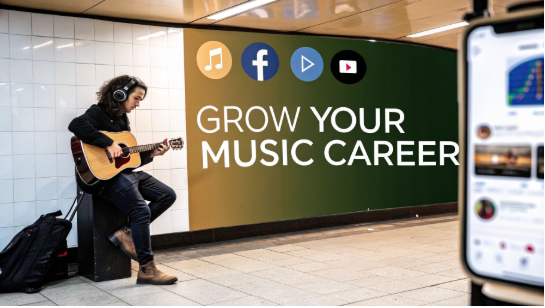
Dropping a high-quality music video isn’t the win it used to be. That’s just the baseline now. The real challenge? Getting the platform to actually show it to people.
You can have a perfect mix, sharp visuals, and a strong concept—but if the recommendation system doesn’t pick it up, the release goes nowhere. That’s the shift. It’s no longer about what you made. It’s about how it moves.
Treat the algorithm like part of your setup. Same as a compressor or EQ. If it’s not tuned right, the output suffers—no matter how good the source is.
What you’re really chasing is momentum. A video needs early interaction the way a track needs the right frequencies in a club. Without that push, it never clears the first filter. With it, you move from a few hundred views into actual discovery.
-
Calibrating the First Signal
Every upload goes through a test phase. The platform shows your video to a small group—usually people who already follow you. What happens next decides everything.
If they scroll past, engagement stalls. The system reads that as a weak signal and cuts distribution. That’s where most independent releases die—quietly, within hours.
To break that pattern, you need activity right away. Not eventually. Not “it’ll pick up later.” Immediately.
This is where strategy kicks in. A lot of creators use flexible Instagram growth bundles to create that initial push—views, likes, early traction. It’s not about faking success. It’s about making sure the system notices the content in the first place.
Once the signal is strong enough, the platform does what it’s built to do: expand reach. Your video gets pushed beyond your circle and into feeds where new listeners—and industry eyes—actually exist.
-
The First Few Hours Matter More Than You Think
That early window? It’s everything.
The first few hours after upload act like a pressure test. The algorithm watches how fast people react—how quickly views come in, how long they stay, whether they engage or drop off.
If interaction spikes, the system flags the video as “worth watching.” If it doesn’t, distribution slows to a crawl.
Two things drive that early momentum:
Signal-to-noise
There’s a flood of content competing for attention. Major labels throw money at visibility. Independent artists don’t have that luxury—so they rely on smart engagement to stay in the game. Done right, it levels the field.
Perception
People react to numbers. A video with thousands of views feels different than one sitting at 73. That visible traction acts as a hook. It makes someone pause. It buys you a few seconds—and those seconds drive retention, which is what the algorithm really cares about.
Momentum feeds itself. But you have to start it.
-
Escaping the “Friends and Family” Loop
Most artists get stuck here.
You post a video. Your immediate circle watches it. Maybe they like it, maybe they share it. Then it stops. The content never reaches beyond that first layer.
That’s not a content problem. It’s a distribution problem.
Think of the algorithm as a filter. Its job is to show people things they’re likely to engage with. If your video doesn’t generate early signals, it never makes it past that filter.
But if it does—if it shows signs of traction—the system starts testing it with new audiences. People who follow similar artists. People who engage with your genre. That’s when discovery actually begins.
At that point, the quality of your work takes over. The music carries it forward. But getting there requires a push.
This is why “overnight success” rarely happens overnight. It’s usually the result of controlled, intentional visibility—making sure the right signals hit at the right time so the system opens the door.
-
Making Your Data Work for You
Talent gets attention. Data keeps it.
When industry professionals—scouts, labels, booking agents—look at your content, they’re not just watching the video. They’re reading the numbers.
Is it growing fast?
Are people sticking around?
Is there consistent engagement?
Those signals tell them whether you’re building momentum or just posting into the void.
A video that shows steady growth looks like an asset. It suggests you understand your audience and know how to move within the system. That matters.
You already fine-tune your sound before releasing a track. Apply the same thinking here. Shape your rollout. Control the early performance. Make the data reflect the effort you’ve put into the work.
Because at that level, perception and performance are tied together.
Mastering the System, Not Fighting It
There’s no mystery to it. Videos don’t go viral by accident—not consistently, anyway.
The artists who break through treat distribution with the same seriousness as production. They don’t just upload and hope. They plan the release. They manage the first wave of engagement. They understand how the system reacts.
And when they need to, they use tools—like flexible Instagram growth bundles—to make sure their content doesn’t stall before it even gets a chance.
The goal isn’t to game the platform. It’s to work with it.
Because the truth is simple:
If the algorithm doesn’t see your video, neither does anyone else.
So don’t leave that part to chance.
Dial it in. Trigger the signal. Let the system carry it further.
Then let the music do what it’s supposed to do.

