


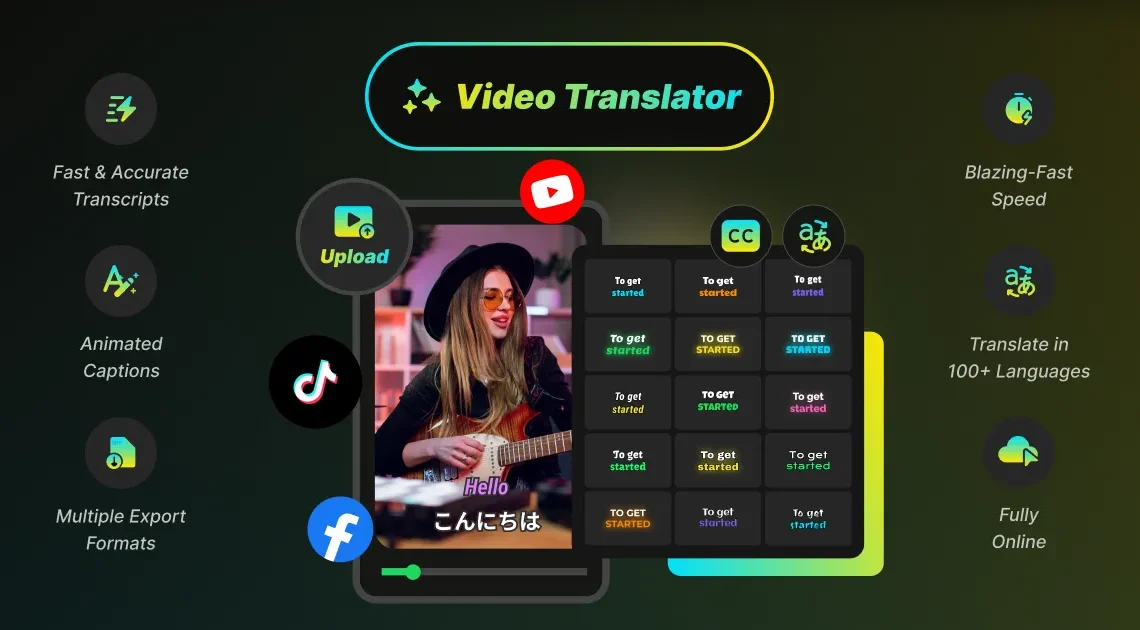
You’ve done the hard part. The video is shot, edited, and published. But without subtitles in other languages, you’re invisible to the billions of viewers who don’t speak yours.
Subtitles aren’t optional anymore. They’re the difference between a video that travels and one that stays local. And the old way of getting them — hiring a human translator, waiting days, reformatting the file, fixing broken timestamps — is too slow and too expensive for most creators to sustain.
An AI subtitle translator changes all of that. Upload your subtitle file, pick your target languages, and download accurate, perfectly timed translations in seconds. No translators. No manual formatting. No waiting.
Here’s how it works, and who’s getting the most out of it.
Why Manual Subtitle Translation Doesn’t Scale
The math on manual subtitle translation is brutal. A 10-minute video might have 150 subtitle segments. Translating each one accurately — preserving meaning, tone, and timing — takes a skilled human translator an hour or more per language. If you want to reach Spanish, French, Japanese, and Arabic audiences simultaneously, you’re looking at four separate translation jobs, four invoices, and four rounds of quality checks before you can upload a single file.
Most creators skip it entirely. Most businesses deprioritize it. And the content stays confined to one language market while global audiences move on.
The problem isn’t motivation — it’s that the traditional process doesn’t fit a modern content production pace. An AI subtitle translator that handles 60+ languages in one pass isn’t just faster. It’s a fundamentally different kind of tool.
What an AI Subtitle Translator Actually Does
An AI subtitle translator takes an existing subtitle file, reads the text and timing data, runs each segment through a neural translation engine, and outputs a new file in the target language — with all original timestamps preserved.
That last detail matters more than it sounds. One of the most common failure modes in subtitle translation is timing drift — where translated text doesn’t align with the video because sentence lengths differ across languages. A good AI subtitle translator preserves the original timing structure exactly, so the translated subtitles stay in sync with the speaker without any manual adjustment.
Tools like AIDubbing’s Subtitle Translator support all major subtitle formats — SRT, VTT, SBV, SUB, SMI, and LRC — and translate into more than 60 languages simultaneously. Upload once, select multiple target languages, and download every translated version in a single session.
The AI engine behind it isn’t just swapping words. It understands context, adjusts for natural phrasing in each target language, and accounts for cultural nuance — producing translated subtitles that read like they were written for native speakers, not converted from a foreign source.
How to Translate Subtitles With AI: Step by Step
The entire process takes under two minutes for most files. Here’s the exact workflow.
Step 1: Upload Your Subtitle File
Go to AIDubbing’s Subtitle Translator in your browser — no account, no installation, no signup required. Upload your subtitle file by clicking or dragging it into the upload area.
Compatible formats include SRT, VTT, SBV, SUB, SMI, and LRC, covering every standard subtitle format used across YouTube, Vimeo, streaming platforms, and professional video production tools. The AI automatically detects the file structure and prepares it for translation.
What to know at this stage:
- Clean, well-formatted subtitle files produce the cleanest translations. If your source file has encoding issues or broken line breaks, fix those before uploading.
- The AI auto-detects the source language, so you don’t need to specify what language your subtitles are written in.
- For long-form content like full courses or feature films, upload chapter by chapter for easier review.
Step 2: Select Your Target Languages
This is where the tool’s real power shows up. You can select up to 8 target languages simultaneously and generate all translations in a single run — no need to repeat the process language by language.
The language library covers 60+ options across every major global market: Spanish, French, German, Italian, Portuguese, Japanese, Korean, Chinese, Arabic, Hindi, Russian, and dozens more. For creators or teams managing large content libraries, this batch capability alone saves hours per video.
Pro tip: Prioritize languages based on your analytics. If 20% of your YouTube watch time is coming from Spanish-speaking countries, Spanish subtitles should be the first thing you generate — and with this tool, it takes the same amount of time as generating one language or eight.
Step 3: Preview, Download, and Deploy
After hitting “Start Subtitle Translation,” the AI processes your file and returns translated versions within seconds. Preview each translation in the interface before downloading — check for any terminology that may need adjustment for your specific industry or audience, and verify that timing looks clean.
When you’re satisfied, download the translated subtitle files instantly. Each file comes back in the same format you uploaded — an SRT in becomes an SRT out — so there’s no reformatting step before you can upload it to YouTube, Vimeo, a course platform, or your video editor.
Every translation is ready to use immediately, with timestamps preserved and formatting intact.
Who’s Using AI Subtitle Translation — and How
The range of people benefiting from a fast, accurate subtitle translator is wider than most expect. Here are the most impactful real-world use cases.
YouTube Creators and Video Publishers
YouTube’s algorithm rewards content that serves viewers in their preferred language. Translated subtitles don’t just help international viewers — they actively improve a video’s discoverability in non-English search results, because YouTube indexes subtitle text as part of the video’s content.
A creator who adds Spanish, Portuguese, and French subtitle tracks to every video isn’t just being considerate. They’re expanding the surface area of every video in three major search ecosystems simultaneously.
Real workflow: A tech tutorial creator uploads each video’s English SRT file to the subtitle translator immediately after publishing. Within two minutes, they have subtitle files in six languages ready to upload to YouTube Studio as additional caption tracks — turning a single piece of content into a globally discoverable asset.
E-Learning Developers and Online Course Creators
Online courses sell globally, but most learners still expect content in their native language. A course without localized subtitles loses students the moment they hit a segment they can’t follow quickly enough.
Translated subtitle files give course creators a fast, affordable path to supporting multilingual learners without re-recording a single lesson. The same video stays in place; the subtitles carry the language weight.
For platforms that display subtitles burned into the video itself, the subtitle file feeds directly into the video editor’s caption workflow — no additional steps required.
Real workflow: An instructional designer uploads the subtitle files from a 20-lesson course to the translator, selects four target languages, and downloads 80 translated files in a single session. The entire localization pass that used to take a week is done before lunch.
Film and Video Production Companies
Post-production subtitle work is one of the most tedious and expensive steps in film localization. Professional subtitle translation typically involves specialized translators with time-code experience, multiple review passes, and format-specific delivery requirements for each distribution platform.
An AI subtitle translator that preserves timestamps exactly and outputs files in the original format compresses that pipeline significantly. For production companies handling international distribution, it provides a high-quality first draft that human translators can review and refine — cutting billable hours without cutting quality.
For short films, web series, and independent productions distributing to international film festivals, it enables full subtitle localization on an indie budget.
Real workflow: A post-production team uses the translator to generate first-draft subtitle files in eight languages for a documentary’s international release. Human translators review the output for technical terminology and cultural references, cutting their workload by roughly 70% compared to translating from scratch.
Corporate and Enterprise Video Teams
Global companies produce enormous amounts of video content — training materials, product announcements, executive communications, customer support videos — and most of it needs to be accessible to a multilingual workforce and customer base.
The traditional localization pipeline at enterprise scale is slow and expensive. Every new video triggers a round of vendor briefings, translation turnarounds, and QA cycles before anything ships. When content needs to be updated, the entire process starts over.
An AI subtitle translator that processes files in seconds transforms that cycle. New training video published today can have subtitle files in 12 languages ready for distribution the same afternoon. An updated product announcement doesn’t sit in a translation queue for a week.
Real workflow: A global SaaS company integrates subtitle translation into their content publishing checklist. Every internal and external video goes through the translator before distribution, ensuring multilingual subtitle coverage is standard practice rather than an afterthought.
Social Media Managers and Content Marketers
Most social video autoplay without sound. Subtitles aren’t just accessibility features on social platforms — they’re primary communication for the majority of viewers who watch on mute.
For marketing teams running content across multiple regions, translating subtitle files into the dominant language of each market is one of the highest-leverage localization tasks available. It’s faster than dubbing, cheaper than reshoot, and directly impacts watch time and engagement metrics.
Real workflow: A social media team creates a single master video for each campaign, then uses the subtitle translator to generate localized subtitle files for their Spanish, Brazilian Portuguese, German, and French market accounts. Every regional account publishes the same video with native-language captions, all on the same day as the global release.
What Makes a Good AI Subtitle Translator
A few specific things separate genuinely useful subtitle translation tools from the ones that waste your time:
Timing preservation. This is non-negotiable. If translated subtitles don’t stay in sync with the original timestamps, every file needs manual adjustment before it’s usable. The best tools treat timing as untouchable — only the text changes.
Format flexibility. SRT is common, but professionals work across SRT, VTT, SBV, and other formats depending on their platform. A tool that only handles one format adds friction to every workflow it touches. AIDubbing supports six formats out of the box.
Language coverage and translation quality. Wide language support is table stakes. What actually matters is whether the translations read naturally in each target language — not word-for-word literal, but contextually accurate and tonally appropriate. Neural translation models trained on real-world subtitle data handle this far better than older machine translation approaches.
Batch capability. Translating one language at a time is fine for a single video. For anyone managing a content library, the ability to generate eight translated files in one pass is the difference between a tool that scales and one that doesn’t.
Zero friction access. No account. No trial. No hidden cost. AIDubbing’s subtitle translator is free, browser-based, and immediate.
The Bottom Line
Subtitles are the fastest, most accessible path to a global audience — and an AI subtitle translator makes the localization step almost invisible. Upload your file, select your languages, download your translations. The whole process takes less time than it used to take just to brief a translator.
For creators, educators, production teams, and marketers who publish video content, there’s no longer a good reason to stay monolingual. The tools exist. They’re fast, accurate, and free.

