

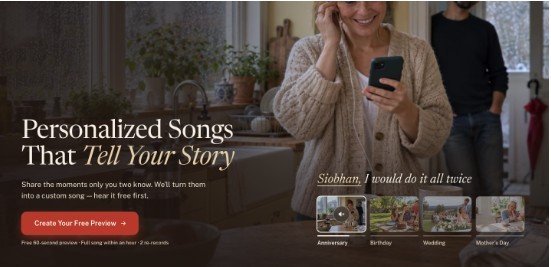
Reusable loops fail a gift the moment another buyer could claim the same file. A Personalized Song has to be hearable as a style before anyone pays for a vocal that might not fit.
The check is small and early. On the sound step, each style card has a play control marked as ten seconds. That clip is the bed, not the finished lyric. If the bed is wrong for the room, you find out before a vocal is locked to it.
A Reusable Loop Can Belong To Anyone
A stock instrumental is priced like a tool you can hand to the next project. That is its virtue in a soundtrack folder, and it is the failure mode in a gift. If the file does not contain a name, a place, or a phrase, nothing stops a second buyer from using the same bed under a different card. The listener may still like the chords. They cannot point to a line that had to be about them. Catalog beds are the correct buy for a ringtone, a vlog underlay, or any clip where the next video must be allowed to reuse the music. The moment the job is “this person, this phrase,” reuse becomes the defect.
A finished gift track has the opposite budget. The words are supposed to come from one order, and the recording is supposed to be new for that order rather than pulled from a library. The money question is not whether a loop is cheaper on a sample site. It is whether you are paying for a bed anyone can license, or for a vocal that would be wrong if the name changed.
Hear Ten Seconds Before You Choose A Style
The sound step asks you to tap play and hear ten seconds of each style. Pop is labeled bright and catchy, and it is marked as popular for birthdays. Acoustic is labeled as guitar, close and gentle. Those two cards are enough to see the decision. One bed pushes the chorus forward. The other leaves room around a spoken kind of line. Country sits nearby as warm and story-first. The row also reaches a lullaby at one end and hip-hop at the other, so the ten-second listen is doing the sorting that a genre menu usually fakes with adjectives.
Reject The Bed Before The Vocal Exists
Play the ten seconds in the room where the file will actually be heard, or on the same small speaker you will use later. A bright pop card can feel right on laptop speakers and harsh in a quiet kitchen. A close guitar card can feel thin if the gathering is loud. The failure is ordinary: the style was chosen from the label, and the ten-second clip was never started. The play button is the whole test. If you skip it, you have not compared anything. You have accepted a caption.
Voice And Language Are Separate Choices
Style does not set the singer. Under the cards, “Who’s singing?” offers a man’s voice or a woman’s voice. That choice is about who should be heard, not about imitating a famous singer. The service is explicit that the track is not a performance by a named artist and is not endorsed by one. Treating the voice buttons as a celebrity menu is how people end up angry at a file that never promised that.
Keep The Lyric In The Language You Pick
Song language is its own row. English is the chip that loads selected, and French, Spanish, and Portuguese sit beside it. Lyrics are written and sung in the language left selected. Leave it on English if the phrase you care about is English. Switching language after the story is written is a good way to get a smooth line that no longer matches the sentence you meant. An optional feeling, such as Heartfelt, can be set on the same screen, and the “sung as” line can be changed if the signature should differ from the name in the verse.
None of those controls write the private detail. They decide the clothes the detail wears. If the story box above them is empty praise, a woman’s voice and a close guitar will still sing a blank. Go back up. The ten-second sample cannot repair a missing fact.
What The Music Model Receives From You
Lyrics on PersonalizedSong are written with DeepSeek V4.1 Flash, reached through OpenRouter, and the music and vocals are produced with MiniMax Music 2.6, run on fal.ai. A second music model, Mureka, is listed only as the fallback when the main music model fails for that order. The split is the useful part. Words and music are not the same pass, and a failed music pass is not quietly replaced with a library track. The fallback is another generation, used when the first music model does not complete.
The text you type is also screened before a model writes anything. A checker called Waffo Prompt Sift decides whether the story is allowed. It does not compose lyrics. A photo on the gift page gets a separate safety check. If the story is refused, there is no track to compare with a loop, which is a different failure from “I disliked the guitar.” You fix the words, or you stop. You do not get a stock bed as a consolation file.
You do not pick MiniMax or Mureka on the sound step. You pick a style, a voice, and a language, and you have already supplied the story. The model names matter when someone asks why two takes of the same brief can differ. They differ because the output is generated, and a take may sound imperfect or not be what you imagined. That is why the ten-second style clip and the later 60-second opening exist before any charge. Hearing a mismatch costs nothing. Paying and then hoping the next take drifts back toward the sample is the expensive version of the same check. A Custom Song is that generated take, not a loop with a name pasted on the title card.
A Side By Side For The Gift File
Put the reusable bed and the generated track on the same questions. The point is not that one column wins every row. A loop is still the right buy when nobody’s name belongs in the music.
| Question | Reusable instrumental bed | Track built from one story |
| Who else could claim it | Any buyer of the same loop | Only this order’s names and details |
| What you hear first | The full bed, with no lyric about them | Ten seconds of the style, then a 60-second sung opening |
| Voice | Whatever was recorded in the pack | A man’s voice or a woman’s voice, chosen apart from the style |
| What the file may do | Whatever that pack’s license allows | Personal giving and sharing, not a streaming release |
| What you pay | The loop’s own price, often reused | $34.99 once for the full song, after a free preview |
Read the last row as a gate, not as a bargain. The $34.99 is a one-time charge for the full song, with the MP3 included and no subscription behind it. It is the wrong spend if the ten-second sample already feels unlike the room. It is a reasonable spend when the opening minute contains the name and the line you required, because you are not buying a bed you could have reused on the next brief.
Personal Use Limits On A Public Post
PersonalizedSong keeps the file for personal giving. You may play it, keep it, and share it with family or on a personal post. You may not sell it, release it on a streaming service, or use it in advertising without written permission. If you post the song on its own in public, say that it is AI-generated, and do not present it as a person’s performance. Runs vary, so the preview is the listen that decides the payment.
Order The Sung Track For A Specific Room
The sung track earns the order when the ten-second sample fits the room and the opening minute still contains the line that made the gift specific. A reusable loop is the better buy when the music must stay interchangeable. Those are different jobs. A desk that needs a bed under many clips should keep buying loops. A desk that needs one vocal with one name in it should not.
PersonalizedSong is the sung side of that split. Use it when a name has to be in the vocal and the file will be given, not resold. Leave it when you needed a bed you can drop under someone else’s picture next week. The sample is there so you can tell those rooms apart before the charge.


