


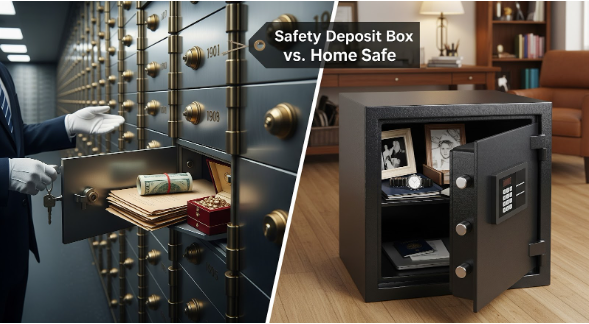
Every one of us has that one place in the house. Perhaps it is a shoebox in the back of the master closet, a heavy fireproof chest under the bed, or a hollowed-out book on a high shelf. The things that are most important are found inside: the engagement ring of your grandmother, the deed to the house, rare coins, or a pocket watch which has survived four generations.
However, it comes with a quiet and nagging sense of anxiety. Whenever you go on a week-long vacation, there is a little voice in the back of your head; the voice wonders, is the house safe?
This makes us think of a safety deposit box or a secure locker. It is the adult thing to do, right? However, the answer is not a simple yes because of monthly charges, limited access time, and the dynamic nature of the banking industry.
We can work out whether off-site storage is really worth you utilizing the off-site storage service or if you would be better off strengthening your home.
Bank Vault Security: The Peace of Mind Premium
When you lease a locker, it is not the metal box that you are purchasing, but sleep.
In case you are living in a place where there are natural disasters such as floods, hurricanes, or wildfires, a home safe may not be sufficient. Even the most expensive home safes that claim to be fireproof are often limited by a specific time and temperature. A house fire can very readily surpass those limits.
Structural integrity in a bank vault or a personal security facility is something that a residential home can never have. These premises are reinforced concrete, have elaborate alarm systems, and are climate controlled. You are also buying freedom from worry when you rent a locker. You need not worry that a burglar will come across the safe code or drag the entire unit out the back door. In the case of items that are irreplaceable, not necessarily costly, that psychological comfort can be worth the rental fee per year.
The Accessibility Trade-Off: Bank Hours vs. Home Access
This is the greatest disadvantage of off-site storage: you are not able to see your stuff.
The heirlooms are usually supposed to be used. In case you put away an old diamond necklace, you may be less likely to wear it due to the inconvenience of driving to the bank and, upon signing in, having to go get it. That is too high a cost to bear for a casual evening dinner on Tuesday. This results in the “out of sight, out of mind” effect.
Moreover, the normal working hours of banks are infamously inconvenient. On a Sunday or a public holiday, you are out of luck because you need a document or a piece of jewelry.
The industry is, however, changing. Although most bank branches in local areas are shutting their vaults to conserve space, the vacuum is being filled by the emergence of private vault companies. These provide general access points which tend to be biometric, have extended opening hours, and occasionally 24/7 access.
Checklist: What to Store in a Safety Deposit Box
All things of value do not necessarily have to be in a vault. It is often about how often the use is versus how bad it will hurt to lose it.
Hard-to-Replace Documents
The best candidates for a locker are original birth certificates, property deeds, car titles, and stock certificates. They are the kind of papers that you almost never have a need for, but that would be a nightmare to go without in case they burnt.
The “Will” Dilemma
A word of caution here: do not include your original Last Will and Testament in a safety deposit box which is purely in your name. In the event of your death, the box is sealed by the bank. Your executor must have the will to demonstrate that they may make use of your assets, but they are unable to acquire the will because it is locked in the very box they are attempting to gain access to. It is an old-fashioned bureaucratic Catch-22. Instead, keep the will with your attorney or in some safe place at home.
Jewelry and Metals
In case you require particular bank lockers, you may discover that the conventional financial institutions are moving from this service and directing individuals to private vault for jewellery services, which deal with the storage of high-value assets.
Investment Assets
To people who possess physical wealth, security is not a matter of discussion. Perhaps you are an investor who enjoys buying silver bullion on the Gold Coast or any other state—but you do not necessarily have the reinforced floor space to keep the heavy bars safe at home. A locker, in this case, is not merely a luxury; it will be a logical need to protect assets.
Do Banks Insure Safety Deposit Boxes? (The Insurance Myth)
It is a common misperception that when one rents a locker at a bank, he/she insures the contents.
This is almost never true.
The money in your checking account is insured by the FDIC (in the US) or government agencies that assure you that you will get your money in the event of the bank collapsing. They leave the diamond ring in the box in the vault unguarded. In case the bank is flooded or is robbed (this does not occur often, but it does happen) the bank will state that there is no liability for the contents of your box, except in a case where negligence can be demonstrated.
When you rent a locker, you will need to reach out to your home insurance carrier or a special purpose insurer and add a so-called floater or a special rider on the items within that box. The only difference is that it is the cheaper way to insure the items that are in a bank vault as compared to the cost of insuring the same items that are stored in your home because the likelihood of them being stolen is minimal.
Cost Analysis: Bank Locker Fees vs. Home Safes
Is it worth the money?
At local banks, small boxes can cost as low as 50-100 a year, and are on the increase. Depending on the box size and the amount of insurance coverage, the cost of the private vault may vary from 300 to over a thousand dollars a year.
As a way to determine whether it is worth it, a little audit (Value vs. Cost) will help:
- Determination of the Replacement Cost: How much is the cost of the items?
- Determine the Emotional Cost: Which of your possessions would you be shattered by losing tomorrow in case your house was broken into?
- Compare and Contrast with Home Security: A home safe of high quality with bolts attached would cost between 300 and 1500 dollars to buy. A locker is a recurring cost.
When you intend to live in the same house over a period of 20 years, a high-end home safe is more affordable in the long run. The home safe will not help in a “gun to the head” demand situation, but the bank vault will.
Final Verdict: Is Off-Site Storage Worth It?
So, is it worth it?
Yes, when: Your belongings are of extreme sentimental or financial value which you seldom use, or you are in a high-crime or disaster-prone neighborhood, or you travel a lot and leave the house unattended. The decreased anxiety is normally worth the yearly fee.
No, when: You would like to wear your jewelry once a week, you are well organized to run a high-security home environment (bolted-to-the-floor with an alarm system), or the objects are valuable yet disposable.
Finally, the renting of a locker is a question of managing your own anxiety. When it is all over a few hundred dollars a year not to be plunging into a frenzy whenever you hear an oddly timed bang below, then that empty metal box is as good as gold.

