

Nuvole Bianche sheet music has become one of the most sought-after piano pieces for intermediate players worldwide. This breathtaking composition by Italian pianist Ludovico Einaudi translates to “White Clouds” in English and captures the serene beauty of clouds drifting across the sky.
Whether you’re a piano student looking to expand your repertoire or an experienced musician seeking an emotional piece, this guide will help you understand everything about obtaining and mastering this timeless composition.
What Is Nuvole Bianche?
Nuvole Bianche is a neoclassical piano composition released in 2004 as part of Ludovico Einaudi’s album “Una Mattina.” The piece was written in Milan during spring 2004 when Einaudi had just purchased his first grand piano.
Looking through his large apartment windows, he watched white clouds passing slowly over the city rooftops like majestic ships sailing across the sky. This visual inspiration became the foundation for one of his most beloved compositions.
The piece belongs to the contemporary classical genre and blends minimalist patterns with emotional depth. It uses a simple four-chord progression that repeats throughout, creating a hypnotic and meditative atmosphere. Despite its apparent simplicity, the piece requires careful attention to dynamics, phrasing, and emotional expression.
Understanding the Composition

The musical structure of Nuvole Bianche follows a carefully crafted progression that builds emotional intensity. Written primarily in F minor, the composition utilizes a chord progression of F minor, D-flat major, A-flat major, and E-flat major.
This progression repeats throughout the entire piece, giving it a cyclical, almost trance-like quality. The left hand maintains an arpeggiated accompaniment pattern while the right hand carries the lyrical melody. As the piece progresses, it builds in complexity and volume, creating waves of emotion that rise and fall like the clouds that inspired it.
The composition runs approximately 5 minutes and 30 seconds at the suggested tempo. It features distinct sections that gradually introduce new melodic variations while maintaining the core harmonic structure. This repetitive nature makes it both accessible for learning and deeply satisfying to perform.
Where to Find Nuvole Bianche Sheet Music
Finding quality sheet music for this popular composition requires knowing where to look. Several reputable sources offer both free and paid versions with varying levels of arrangement difficulty.
Musicnotes remains one of the most reliable commercial sources, offering officially licensed arrangements. They provide digital downloads in PDF format with instant access after purchase. Their versions include both the original arrangement and simplified versions for different skill levels.
Sheet Music Plus offers similar options with interactive features. Their digital sheet music includes playback capabilities and transposition tools. These features help learners understand how the piece should sound and allow key changes for different vocal ranges or instrument combinations.
MuseScore provides a community-driven platform where musicians share arrangements. While quality varies, you can find both official versions and creative interpretations. The platform allows you to listen to the arrangement before downloading and offers MIDI playback for learning purposes.
Free options exist on platforms like Pianoshelf and various educational websites. However, free versions may lack the polish and accuracy of professionally published arrangements. Always verify the source’s legitimacy and compare with recordings to ensure accuracy.
Different Arrangements Available
Sheet music for Nuvole Bianche comes in multiple arrangements suited to different skill levels and purposes. Understanding these variations helps you choose the right version for your abilities.
The original piano solo version maintains Einaudi’s complete vision. This arrangement presents the piece exactly as recorded on the Una Mattina album. It requires intermediate to advanced skills, particularly for maintaining the flowing arpeggios in the left hand while playing the expressive melody in the right.
Simplified beginner versions reduce the technical demands. These arrangements might simplify the left-hand patterns or reduce the range of notes used. While easier to play, they still capture the essence of the original composition. These versions work well for students who want to experience the piece before tackling the full arrangement.
Piano and cello duets offer a different texture. Some arrangements include an optional cello part that adds depth and richness to the performance. The cello often takes portions of the melody or provides harmonic support, creating a chamber music experience.
Piano and orchestra versions exist for advanced players. These arrangements incorporate string sections, adding dramatic weight to the composition. They’re typically used for concert performances or recording projects.
Easy piano versions target absolute beginners. These drastically simplify both hands, sometimes removing the arpeggiated patterns entirely. While they provide a way for novices to play a recognizable version, they sacrifice much of the piece’s character and emotional impact.
Difficulty Level and Skills Required
Nuvole Bianche typically ranks as an intermediate piece, roughly equivalent to Grade 4-5 in classical piano examination systems. However, the difficulty can vary significantly based on the arrangement you choose.
The technical challenges center around several key areas. The left hand requires stamina and consistency for maintaining the arpeggiated patterns throughout the piece. These patterns span wide intervals and must flow smoothly without breaks or hesitations.
Hand independence represents another significant challenge. Your hands must work together while playing completely different rhythmic and melodic patterns. The right hand delivers the singing melody while the left hand provides constant motion and harmonic support.
Dynamic control separates average performances from exceptional ones. The piece demands subtle crescendos and diminuendos that mirror the movement of clouds. You must control volume changes gradually and expressively without disrupting the flowing character.
Pedaling technique requires careful attention. Proper sustain pedal usage helps create the piece’s characteristic resonance and harmonic richness. However, excessive pedaling can muddy the sound, while insufficient pedaling leaves it dry and disconnected.
Physical endurance matters for this relatively long piece. Maintaining consistent quality throughout the full five-and-a-half-minute performance requires both technical stamina and mental focus. Building endurance takes time and regular practice.
For absolute beginners, this piece proves too challenging without significant preparation. Students should have at least 2-3 years of piano experience and comfort with reading both bass and treble clefs. Familiarity with sharps, flats, and basic rhythm patterns is essential.
Intermediate players with solid foundations can usually learn the piece within 4-8 weeks. This timeframe assumes regular practice sessions and proper technical preparation. Advanced beginners might require several months to achieve a performance-ready level.
Learning Resources and Tutorials
Numerous online resources support learning Nuvole Bianche beyond just sheet music. These tools can accelerate your learning process and improve your final performance quality.
YouTube hosts countless tutorial videos ranging from beginner-friendly to advanced interpretations. Channels like Pianote offer detailed breakdowns of the piece’s structure and technique. These videos demonstrate proper hand positioning, pedaling techniques, and interpretive choices.
Synthesia videos provide visual learning support. These “piano roll” style videos show exactly which notes to play and when. While they shouldn’t replace traditional sheet music reading, they help learners understand the timing and flow of difficult passages.
Virtual piano platforms let you practice without an acoustic instrument. Websites like Virtual Piano offer interactive versions where you can use your computer keyboard to play along. This accessibility helps when traveling or without regular instrument access.
Online piano lesson platforms include Nuvole Bianche in their catalogs. Services like Playground Sessions and Simply Piano offer interactive lessons with real-time feedback. These platforms adjust difficulty and provide structured learning paths.
Piano teacher YouTube channels often feature performance tips. Watching multiple interpretations helps you understand different approaches to dynamics, tempo, and expression. Professional pianists share insights about Einaudi’s intentions and emotional impact.
Slow-down software helps isolate difficult passages. Applications that can adjust audio playback speed without changing pitch let you practice along with recordings at your own pace. This technique builds accuracy before increasing to performance tempo.
MIDI files offer another learning tool. Loading MIDI versions into piano learning software provides scrolling sheet music synchronized with audio playback. This visual-audio combination reinforces the connection between notation and sound.
Practice Tips for Mastering the Piece
Effective practice strategies make the difference between struggling through Nuvole Bianche and performing it beautifully. These proven techniques help you progress efficiently.
Start by learning hands separately. Master the left-hand arpeggios until they flow automatically. This foundation lets you focus on the right-hand melody when combining hands. Spend at least several practice sessions on each hand individually.
Break the piece into small sections. Work on 4-8 measure segments until they’re comfortable before moving forward. This prevents the overwhelming feeling of tackling a long, complex piece all at once. Map out logical break points based on phrase structure.
Practice slowly and deliberately at first. Use a metronome set well below the final tempo. Speed comes naturally after you’ve established accurate muscle memory at slower speeds. Rushing this process leads to ingrained mistakes that become harder to fix later.
Focus on consistent rhythmic patterns in the left hand. The arpeggios must maintain steady timing regardless of what the right hand plays. Practice these patterns as exercises, varying the starting notes to build flexibility and consistency across different positions.
Work on dynamic shaping phrase by phrase. Decide where each musical sentence begins and ends. Plan crescendos and diminuendos that enhance the emotional arc. Record yourself playing to evaluate whether your dynamic choices communicate effectively.
Practice difficult transitions repeatedly. Identify spots where your hands must move quickly or where coordination proves challenging. Isolate these measures and practice them 10-20 times before continuing. This targeted practice eliminates stumbling blocks.
Use visualization techniques away from the piano. Mentally rehearse the piece, imagining the feel of the keys and the sound of the notes. This mental practice reinforces learning and can be done anywhere, maximizing your progress between physical practice sessions.
Gradually increase tempo using a metronome. Once you play accurately at a slow speed, bump the tempo up by 5-10 beats per minute. Only increase speed when you can play the current tempo three times perfectly. This methodical approach builds confidence and accuracy.
Record your practice sessions regularly. Listening back reveals issues you might miss while playing. You’ll notice rushed passages, unclear articulation, or missed dynamic opportunities that need attention. This feedback accelerates improvement.
Understanding the Key and Time Signature
Nuvole Bianche’s musical framework provides insight into its character and challenges. Understanding these elements helps you interpret and perform the piece more effectively.
The piece is written in F minor, a key with four flats. The key signature includes B-flat, E-flat, A-flat, and D-flat. This tonality gives the composition its characteristic somber yet beautiful quality. F minor evokes feelings of melancholy and introspection while maintaining a sense of hope.
The time signature varies by arrangement, but most versions use 4/4 time. This common time signature provides a steady pulse that supports the flowing arpeggios. The consistent rhythm helps maintain the piece’s meditative quality throughout its duration.
The tonal center of F minor establishes the emotional foundation. However, Einaudi frequently moves through related keys within the chord progression. The movement to D-flat major, A-flat major, and E-flat major creates harmonic interest while maintaining overall unity.
Understanding the harmonic progression helps with memorization. Since the same four chords repeat throughout the piece with melodic variations, recognizing these patterns accelerates the learning process. Your hands begin to anticipate chord changes automatically.
The piece occasionally incorporates chromatic notes outside the key signature. These passing tones add color and interest to the melody. Recognizing them as decorative rather than structural helps you understand the piece’s harmonic logic.
Einaudi’s use of the minor key differs from traditional classical approaches. Rather than emphasizing the tragic or dramatic aspects often associated with minor keys, he creates a sense of peaceful contemplation. This contemporary treatment of tonality distinguishes his style.
Popular Uses in Media and Culture
Nuvole Bianche has transcended its origins as a solo piano piece to become a cultural phenomenon. Its emotional resonance has made it a favorite choice for various media applications.
The composition gained widespread recognition through its use in film. The movie “Insidious” (2010) featured the piece in several scenes, introducing it to horror film audiences. This unexpected placement demonstrated the music’s versatility and emotional impact.
French film “The Intouchables” (2011) prominently featured Einaudi’s music, including a live performance of Nuvole Bianche. The film’s massive international success brought the composition to millions of new listeners. This exposure significantly increased interest in learning the piece.
British television series incorporated the music effectively. “This Is England ’86” and “Derek” both used Nuvole Bianche to underscore emotional moments. These placements demonstrated the piece’s ability to enhance visual storytelling.
Documentary filmmakers frequently choose this composition. “Blackfish” used it during emotionally powerful sequences about marine life. The music’s contemplative quality suits documentary narratives that require viewers to reflect on serious subjects.
Social media has amplified the piece’s popularity. Piano covers on YouTube have accumulated hundreds of millions of views collectively. Short video platforms like TikTok feature the music in emotional content, introducing it to younger audiences.
Wedding ceremonies often include Nuvole Bianche. Its romantic yet dignified character makes it suitable for processionals or special moments. Many couples choose it for first dances or ceremony interludes.
Meditation and relaxation playlists frequently feature the composition. The repetitive patterns and calm tempo create an ideal atmosphere for yoga, meditation, or study sessions. Streaming platforms have included it in countless curated playlists.
The Story Behind the Composition
Understanding the creative context of Nuvole Bianche enriches your connection to the music. Einaudi’s personal story adds depth to every performance.
Ludovico Einaudi composed this piece in Milan during spring 2004. He had recently acquired his first grand piano, a significant milestone in his career. The instrument occupied a prominent place in his apartment with large windows overlooking the city.
During his practice sessions, Einaudi would watch clouds drift slowly across the sky. These white clouds moving like ships through the air captured his imagination. The piece emerged from this visual inspiration combined with his emotional state at that time.
The composition appeared on Einaudi’s album “Una Mattina,” released in September 2004 on Decca Records. The album represented a personal musical diary of sorts. Einaudi described it as reflecting his current life rather than past experiences.
The album’s title track and other pieces share thematic and harmonic similarities with Nuvole Bianche. Compositions like “Dietro Casa” use the same chord progression, demonstrating how Einaudi explores variations on core musical ideas. This consistency gives the album a unified character.
Einaudi has stated that the piece embodies lightness and suspension. He wanted to create music that floats rather than weighs heavy. This intention explains the piece’s characteristic feeling of peaceful drifting.
Later, vocalist Alessia Tondo added lyrics to Nuvole Bianche. This version appeared on Einaudi’s “Taranta Project” (2013) and “Einaudi Undiscovered” (2020). The vocal adaptation opened new interpretive possibilities while maintaining the original’s essence.
The piece quickly became one of Einaudi’s most recognizable compositions. Its accessibility combined with emotional depth struck a chord with audiences worldwide. It remains a staple of his concert performances and continues attracting new listeners.
Technical Analysis for Advanced Players
Deeper musical analysis reveals the sophisticated simplicity of Nuvole Bianche. Understanding these elements helps advanced players create more nuanced interpretations.
The harmonic structure relies on a four-chord loop: i-VI-III-VII in F minor. This progression (Fm-Db-Ab-Eb) creates a descending bass line that provides forward momentum. The circular nature allows for endless repetition without becoming monotonous.
Voice leading between chords demonstrates Einaudi’s compositional skill. Each chord shares common tones with its neighbors, creating smooth harmonic transitions. This careful voice leading contributes to the piece’s flowing character and makes it sound more complex than its simple foundation suggests.
The melody employs stepwise motion and small intervals primarily. This accessible melodic contour makes the tune memorable and singable. Occasional leaps add interest without disrupting the overall smoothness. The melody often anticipates or delays chord changes, creating gentle dissonances.
Rhythmic displacement creates subtle complexity. The right-hand melody often begins phrases on weak beats, generating a floating sensation. This rhythmic ambiguity reinforces the “clouds drifting” imagery that inspired the composition.
The arpeggiated left-hand pattern provides more than harmonic support. It creates a constant rippling texture that mimics natural phenomena like water or wind. This ostinato technique belongs to minimalist musical traditions.
Dynamic architecture shapes the piece’s emotional journey. Einaudi builds from quiet introspection to passionate climaxes and back again. These waves of intensity mirror natural cycles and emotional experiences. Effective dynamic control transforms the repetitive structure into a compelling narrative.
Pedaling choices significantly impact the sound quality. Half-pedaling techniques allow resonance while maintaining clarity. The sustain pedal must change with each new harmony to avoid muddy sound. Some advanced players use flutter pedaling during sustained passages.
Tempo flexibility within the overall structure adds expressiveness. Slight accelerandos during building passages and ritardandos at phrase endings create natural breathing. These micro-tempo adjustments distinguish mechanical playing from artistic interpretation.
Sheet Music Format Options
Nuvole Bianche sheet music comes in various formats to suit different needs and technologies. Choosing the right format enhances your learning and practice experience.
Traditional printed sheet music remains popular among many pianists. Physical copies allow you to write fingering suggestions, dynamic markings, and practice notes directly on the page. Printed music doesn’t require devices or power, making it reliable for any practice situation.
PDF digital downloads offer convenience and portability. You can store the entire piece on your phone, tablet, or computer. Digital files don’t degrade over time and can be printed whenever needed. Most professional publishers provide watermarked PDFs to prevent unauthorized sharing.
Interactive sheet music apps provide enhanced features. Platforms like Musicnotes and Sheet Music Direct offer apps that display the score while playing along with recordings. These apps often include adjustable tempo playback and the ability to loop difficult sections.
MIDI files enable computer-based practice. These files can be imported into digital audio workstations or music notation software. You can isolate hands, adjust tempo, and even modify the arrangement. MIDI files work well for creating custom practice tracks.
Video sheet music combines notation with performance. These videos scroll the music in sync with someone playing the piece. They help you understand timing and interpretation while providing visual guidance. YouTube hosts many such videos.
MusicXML format allows editing and customization. If you use notation software like Finale, Sibelius, or MuseScore, this format lets you modify the arrangement. You can change key signatures, add your own fingerings, or create simplified versions.
Tablet-friendly formats suit modern practice setups. Many pianists use iPads or other tablets on music stands. Digital sheet music formatted for tablets often includes touch-screen features like annotation tools and bookmark functions.
Large-print versions help visually impaired musicians. These formats increase the size of notes and text, making the music easier to read from a distance. They’re particularly helpful for older players or those with vision challenges.
Comparing Free vs. Paid Sheet Music
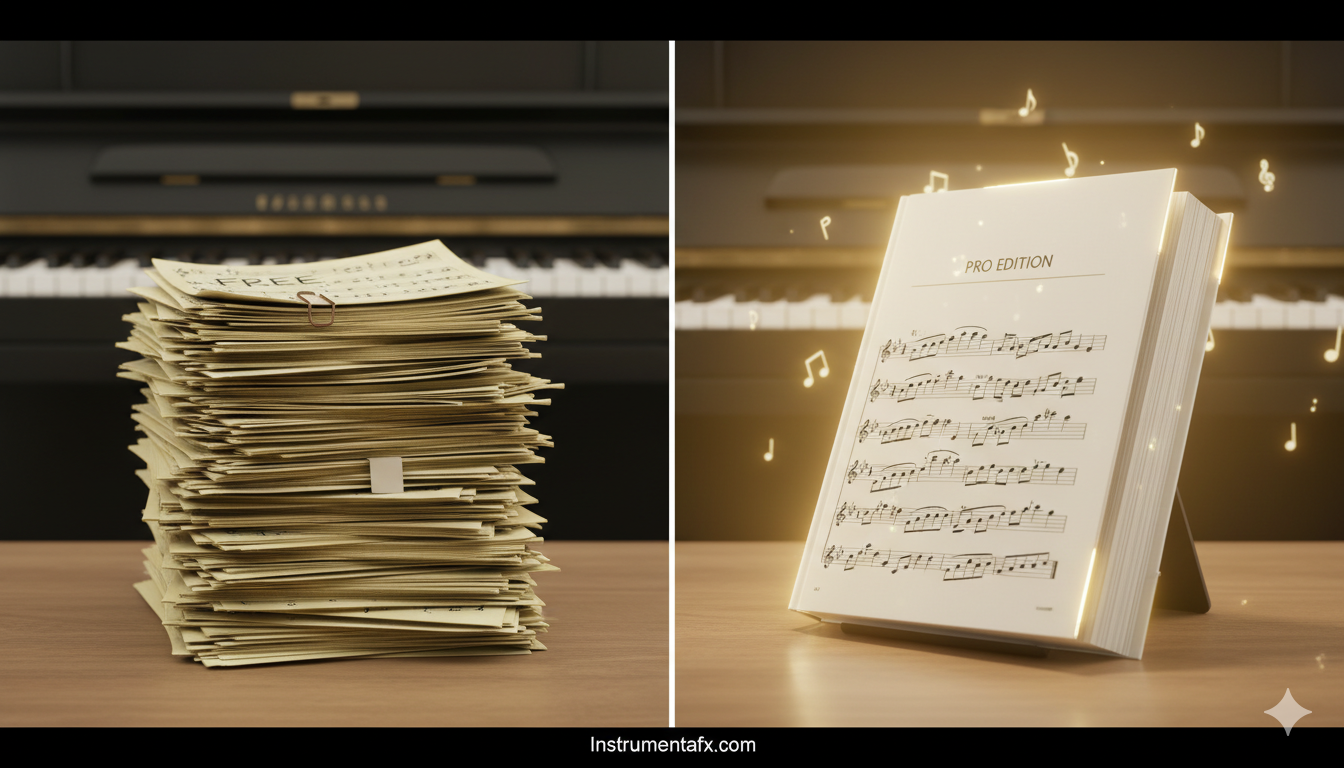
The choice between free and paid sheet music involves several considerations beyond just cost. Understanding the differences helps you make informed decisions.
Paid sheet music typically offers professional quality and accuracy. Publishers employ editors who verify every note against original recordings. This quality control ensures you’re learning the piece correctly. Professional arrangements include appropriate fingering suggestions and performance notes.
Free sheet music varies dramatically in quality. Community-uploaded versions might contain errors in notes, rhythms, or key signatures. While some free arrangements are excellent, others require significant correction. You’ll need musical knowledge to identify and fix mistakes.
Legal considerations matter when choosing sheet music. Paid versions compensate the composer and publisher for their intellectual property rights. Free sheet music of copyrighted works may violate copyright laws unless explicitly authorized. Supporting artists through legitimate purchases encourages continued creative work.
Paid sheet music often includes performance rights. When you purchase from authorized sellers, you typically receive limited performance rights. This matters for recitals, recordings, or public performances. Free versions may not include such permissions.
Customer support distinguishes paid sources. If you encounter problems with digital downloads or need different arrangements, paid platforms provide assistance. Free sources offer no recourse if files are corrupted or incorrect.
Professional arrangements offer multiple difficulty levels. Paid publishers often create several versions of popular pieces, from beginner to advanced. This variety lets you choose the appropriate challenge level. Free sources usually offer limited arrangement options.
Print quality differs between sources. Professional publishers provide high-resolution files that print clearly. Some free PDFs are scanned from physical copies, resulting in lower quality that’s harder to read. Clear notation reduces practice frustration.
Updated editions reflect improvements and corrections. Paid publishers occasionally release revised versions incorporating user feedback. These updates ensure you have the most accurate and playable arrangement. Free versions rarely receive updates.
Playing Nuvole Bianche for Different Occasions
This versatile composition suits numerous performance contexts. Understanding how to adapt your interpretation for different situations maximizes its impact.
Recital performances demand polished, confident execution. In this formal setting, emphasis should fall on technical accuracy and expressive interpretation. Plan your dynamic shaping carefully and practice performing the complete piece without stops. Recital venues often have excellent acoustics, allowing subtle dynamic nuances to shine.
Wedding ceremonies benefit from Nuvole Bianche’s romantic character. The piece works beautifully as processional music or during unity candle ceremonies. For weddings, maintain a steady tempo and avoid extreme dynamics that might overwhelm the intimate moment. Consider using the first half only if timing is limited.
Background music for events requires a different approach. When playing at restaurants, parties, or receptions, blend into the atmosphere rather than commanding attention. Use moderate dynamics throughout and maintain consistent tempo. Focus on creating pleasant ambiance without dramatic interpretation.
YouTube and social media videos need visual appeal. If recording for online sharing, consider camera angles that show your hands clearly. Some performers add visual elements like rain videos or cloud imagery. Ensure your audio quality matches video quality for professional results.
Practice at home allows experimentation. Use practice sessions to try different interpretive choices, tempos, and dynamic ranges. Record these experiments to evaluate what works best. Home practice should focus on technical mastery and musical understanding.
Music therapy settings value the piece’s calming qualities. When playing for therapeutic purposes, emphasize the meditative, repetitive aspects. Maintain gentle dynamics and steady rhythm to support relaxation. The piece’s predictable structure provides comfort in healthcare environments.
Church services or spiritual gatherings find meaning in its contemplative nature. The piece’s emotional depth without religious specificity makes it suitable for various faith traditions. Allow reverberant spaces to enhance the natural resonance, using minimal pedal.
Common Mistakes and How to Avoid Them
Learning Nuvole Bianche presents specific challenges that trip up many pianists. Recognizing these common errors helps you avoid them from the start.
Insufficient dynamic contrast flattens the emotional impact. Some players maintain constant volume throughout, missing opportunities for expression. Mark your score with specific dynamic levels for each section. Practice dynamics separately from notes until they become automatic.
Heavy-handed pedaling muddies the harmonic clarity. Excessive sustain pedal creates a blurred sound where individual notes become indistinguishable. Change pedal with each new chord at minimum. Practice pedaling separately from playing, focusing on precise timing.
Neglecting phrase structure makes the music sound mechanical. Without clear beginnings and endings to musical sentences, the piece loses its narrative quality. Identify phrase boundaries and plan slight tempo adjustments or dynamic changes to articulate them.
Tense shoulders and arms cause fatigue and limit expression. Physical tension prevents the flowing motion necessary for this piece. Check your posture regularly during practice. Drop your shoulders, relax your wrists, and maintain a natural hand position.
Inadequate hand independence creates synchronization problems. When hands don’t work independently, the right-hand melody gets lost in left-hand patterns. Practice each hand extensively before combining. Use separate hand exercises that develop independence.
Memorization without understanding the structure leads to memory slips. Simply drilling the notes without recognizing harmonic patterns creates fragile memory. Study the chord progression and melodic sequences. Understanding the music’s logic makes memorization more secure.
Ignoring the piece’s emotional intention results in lifeless performances. Playing all the right notes technically without conveying feeling misses Einaudi’s purpose. Connect with the visual imagery of clouds drifting peacefully. Let this emotional connection guide your interpretive choices.
Starting at performance tempo too early ingrains mistakes. Building speed before achieving accuracy creates muscle memory of errors that’s hard to correct. Always practice slowly first. Speed naturally develops after establishing correct patterns.
Equipment Recommendations for Learning
Having appropriate tools supports your journey learning Nuvole Bianche. These equipment suggestions enhance your practice experience without requiring enormous investment.
A quality digital piano or acoustic instrument is fundamental. For digital options, ensure it has 88 weighted keys that simulate acoustic piano touch. Brands like Yamaha, Roland, and Kawai offer reliable instruments at various price points. Acoustic pianos provide superior sound but require maintenance.
A music stand positions sheet music at proper height. Adjustable stands work best, allowing customization for sitting or standing positions. Tablet holders attachment to music stands accommodate digital sheet music. Stable stands prevent music from collapsing during practice.
Headphones enable practice without disturbing others. If using a digital piano, invest in comfortable over-ear headphones with good sound quality. Avoid earbuds for extended practice sessions as they cause ear fatigue. Quality headphones reveal details in your playing you might otherwise miss.
A metronome develops consistent tempo and rhythm. Digital metronomes offer more features than mechanical ones, including different sounds and subdivision options. Many metronome apps exist for smartphones, providing free alternatives to dedicated devices.
Recording equipment captures your practice sessions. Even smartphone recordings provide valuable feedback. For better quality, consider a USB microphone connected to your computer. Listening back to recordings reveals issues invisible during playing.
A piano bench with proper height supports good posture. The correct height allows your forearms to be parallel to the floor when hands rest on keys. Adjustable benches accommodate different body types and playing situations.
Adequate lighting prevents eye strain. Ensure your music stand is well-lit, especially for extended practice sessions. LED clip-on lights designed for music stands provide targeted illumination without harsh glare.
A tablet or computer facilitates digital sheet music. Many pianists use iPads on their music stands, allowing instant access to entire libraries. Ensure your device has sufficient screen size for comfortable reading. Consider a stylus for making annotations.
Alternative Versions and Covers
Nuvole Bianche has inspired countless interpretations across different instruments and styles. Exploring these variations broadens your musical perspective.
The vocal version featuring Alessia Tondo adds a haunting human element. Her ethereal voice floats over the piano accompaniment, singing in Italian. This version appears on Einaudi’s “Taranta Project” album and offers a completely different emotional experience.
Guitar interpretations provide intimate acoustic experiences. Classical guitarists have transcribed Nuvole Bianche, adapting the arpeggios to guitar technique. While challenging due to the sustained nature of piano music, guitar versions offer unique timbral qualities.
Orchestra arrangements expand the piece to symphonic proportions. Adding strings, winds, and percussion creates dramatic sweep. These versions often appear in concert settings and film scores. The orchestral treatment amplifies emotional impact through additional colors and dynamics.
Electronic remixes blend classical and modern elements. DJs and producers have incorporated samples of Nuvole Bianche into electronic tracks. These fusion versions introduce the composition to audiences who might not typically listen to classical piano music.
Jazz interpretations add improvisation and syncopation. Jazz pianists sometimes use the chord progression as a foundation for improvisation, taking the piece in unexpected harmonic directions. These versions demonstrate the composition’s versatility as a jazz vehicle.
Harp arrangements showcase the instrument’s ethereal qualities. The harp’s timbre naturally complements the piece’s floating character. These transcriptions require significant adaptation but produce magical results. Harpists often perform Nuvole Bianche at special events.
Solo instrumental versions on violin, cello, or flute adapt the melody. These arrangements strip away the harmonic complexity, focusing on the lyrical melody line. They work well for recitals or as featured solos within larger programs.
Historical Context of Contemporary Classical Music
Nuvole Bianche exists within the broader movement of contemporary classical music. Understanding this context enriches your appreciation of the piece.
The minimalist movement influenced Einaudi’s compositional approach. Composers like Philip Glass and Steve Reich pioneered using repetitive patterns and gradual transformations. Nuvole Bianche employs these techniques while adding romantic emotional expression.
New Age music connections are apparent in the piece’s meditative qualities. The genre emphasizes atmosphere and emotional response over complex musical development. Einaudi bridges classical training with New Age accessibility, creating music that appeals across traditional genre boundaries.
Film music aesthetics shape contemporary classical composition. Einaudi and similar composers often write for cinema, influencing their concert works. The dramatic arc and emotional directness of Nuvole Bianche reflects this cinematic influence.
Postmodern eclecticism allows borrowing from multiple traditions. Unlike modernist composers who rejected tonal music, Einaudi embraces melody and harmony while adding contemporary sensibilities. This inclusive approach makes his music accessible to broader audiences.
The democratization of music through technology changed classical composition. Digital distribution and social media allow contemporary classical composers to reach audiences directly. Pieces like Nuvole Bianche gain popularity through YouTube and streaming rather than traditional concert halls.
Crossover classical artists blur genre boundaries. Einaudi joins composers like Max Richter and Ólafur Arnalds in creating music that defies easy categorization. This crossover appeal brings classical piano to pop music audiences and introduces classical techniques to contemporary listeners.
Preparing for a Performance
Performing Nuvole Bianche publicly requires specific preparation beyond daily practice. These strategies ensure your performance succeeds.
Mental preparation prevents performance anxiety. Visualization techniques help build confidence. Imagine yourself playing successfully in the performance venue. Picture the audience responding positively. This mental rehearsal reduces nervousness and improves actual performance.
Physical warm-ups prepare your body. Before performing, play scales and arpeggios to limber up your fingers. Stretch your arms, shoulders, and back. Physical readiness prevents injury and ensures technical facility during performance.
Dress rehearsals in performance conditions build confidence. Practice playing the complete piece without stops, simulating actual performance. If possible, rehearse in the venue where you’ll perform. Familiarity with the space reduces anxiety.
Managing nervous energy serves performance success. Some nervousness enhances performances by increasing focus and energy. Deep breathing exercises before walking on stage help center yourself. Remember that audiences want you to succeed.
Establishing a pre-performance routine creates consistency. Whether it’s a specific warm-up sequence, meditation, or listening to certain music, routines provide psychological comfort. Following the same ritual before each performance triggers a ready state.
Recovery plans address mistakes gracefully. Even the best pianists occasionally make errors. Practice recovering smoothly without stopping or showing frustration. The audience often doesn’t notice small mistakes unless you react obviously.
Post-performance reflection supports growth. After performing, review what went well and what needs improvement. This honest assessment without excessive self-criticism helps you develop as a musician. Celebrate successes while acknowledging areas for growth.
Recording performances provides valuable documentation. Video or audio recordings let you evaluate your performance objectively. They also create keepsakes of your musical journey. Many performers find their anxiety about recording dissipates with experience.
Teaching Nuvole Bianche to Students

Piano teachers frequently receive requests for this popular piece. Effective teaching strategies help students succeed with this challenging work.
Assessment of student readiness prevents frustration. Before assigning Nuvole Bianche, ensure students have solid intermediate skills. They should read fluently in both clefs, understand key signatures with multiple accidentals, and maintain hand independence. Students lacking these foundations will struggle unnecessarily.
Preparatory exercises build necessary skills. Before starting the actual piece, assign arpeggios in F minor and related keys. Practice hand independence exercises that mirror the piece’s texture. These preliminary studies make learning the actual composition much smoother.
Scaffolded learning breaks the piece into manageable sections. Teach the piece in segments, mastering each before moving forward. Start with the simplest sections to build confidence. Gradually introduce more complex passages as competence grows.
Guided listening develops musical understanding. Have students listen to multiple recordings, discussing interpretive choices. Compare Einaudi’s original with other performances. This analytical listening develops their own artistic voice.
Setting realistic timelines manages expectations. Most intermediate students require 6-10 weeks to learn this piece adequately. Rushing through causes frustration and poor technique. Patient, consistent progress yields better long-term results.
Performance opportunities motivate progress. Schedule a recital or informal performance as a goal. Having a performance date provides motivation for consistent practice. The experience of performing solidifies learning.
Technical troubleshooting addresses common problems. Watch for tension, inconsistent rhythm, or poor pedaling. Provide specific corrective exercises for each issue. Video recording lessons helps students see their technical issues clearly.
The Future of Classical Piano Music
Nuvole Bianche represents trends that shape the future of classical piano composition. Understanding these directions provides context for contemporary works.
Accessibility drives modern composition. Composers increasingly value creating music that general audiences enjoy immediately. This democratic approach contrasts with 20th-century avant-garde music that often challenged listeners. Pieces like Nuvole Bianche succeed commercially while maintaining artistic integrity.
Digital distribution transforms how music reaches audiences. Streaming platforms and YouTube expose millions to contemporary classical piano. This accessibility creates opportunities for composers to build careers outside traditional concert hall circuits.
Cross-genre collaboration expands creative possibilities. Contemporary classical composers regularly work with pop, electronic, and world music artists. These collaborations introduce classical techniques to new audiences while enriching the classical tradition with fresh influences.
Social media shapes music discovery. TikTok, Instagram, and YouTube serve as primary platforms where young listeners discover classical piano music. Viral moments can launch pieces to unprecedented popularity, creating new pathways for musical success.
Interactive technology creates new learning experiences. Apps and software that provide real-time feedback and gamified learning make piano education more engaging. These tools complement traditional teaching methods while making music accessible to self-learners worldwide.
Frequently Asked Questions
What Is the Difficulty Level of Nuvole Bianche Sheet Music?
Nuvole Bianche is classified as an intermediate-level piano piece, typically equivalent to Grade 4-5. The main challenges include maintaining consistent arpeggios in the left hand, achieving hand independence, and executing proper dynamic control throughout the piece’s five-and-a-half-minute duration.
Can Beginners Play Nuvole Bianche?
Absolute beginners cannot play the original arrangement, but simplified versions exist for early-intermediate players. These easier arrangements reduce the technical demands while preserving the piece’s melodic beauty. Students should have at least 2-3 years of piano experience before attempting even simplified versions.
Where Can I Download Free Nuvole Bianche Sheet Music?
Free sheet music is available on platforms like MuseScore, IMSLP, and various piano tutorial websites. However, quality varies significantly, and some free versions may contain errors. For guaranteed accuracy and to support the composer, consider purchasing from Musicnotes or Sheet Music Plus.
How Long Does It Take to Learn Nuvole Bianche?
Intermediate pianists typically require 4-8 weeks to learn Nuvole Bianche with regular daily practice. Advanced beginners might need several months, while advanced players could achieve performance readiness in 2-3 weeks. Learning time depends on your current skill level, practice consistency, and prior experience with similar pieces.
What Key Is Nuvole Bianche Written In?
Nuvole Bianche is written in F minor, which has four flats in the key signature (B-flat, E-flat, A-flat, and D-flat). The piece uses a repeating chord progression of F minor, D-flat major, A-flat major, and E-flat major throughout its structure.
Is Nuvole Bianche Copyright Protected?
Yes, Nuvole Bianche is copyright protected. Ludovico Einaudi composed it in 2004, and the rights are owned by Decca Records and Chester Music. Purchasing sheet music from authorized dealers ensures you’re respecting copyright while compensating the composer for his creative work.
What Does Nuvole Bianche Mean in English?
Nuvole Bianche translates to “White Clouds” in English. Einaudi named the piece after watching white clouds drift across the Milan skyline from his apartment window. This visual imagery inspired both the composition’s title and its floating, peaceful musical character.
Can I Play Nuvole Bianche on a Digital Piano?
Yes, Nuvole Bianche works beautifully on digital pianos. Ensure your digital piano has 88 weighted keys to properly execute the piece’s arpeggios and wide hand spans. Quality digital pianos from brands like Yamaha, Roland, or Kawai provide sufficient touch sensitivity for expressive playing.
What Makes Nuvole Bianche So Popular?
Nuvole Bianche’s popularity stems from its emotional accessibility combined with technical approachability. The piece balances simplicity with profound expression, uses memorable melodies, and has gained exposure through films and social media. Its meditative quality resonates with listeners seeking calming, beautiful piano music.
Are There Different Arrangements of Nuvole Bianche?
Yes, multiple arrangements exist including simplified piano versions, piano-cello duets, string quartet adaptations, orchestral arrangements, and even vocal versions. These arrangements range from easy beginner level to advanced concert versions, allowing pianists of all abilities to experience the piece.
Conclusion
Nuvole Bianche sheet music opens doors to one of contemporary classical piano’s most beloved compositions. This guide has provided comprehensive information about obtaining, understanding, and mastering this beautiful piece.
From its origins as clouds drifting over Milan to its status as a global phenomenon, Nuvole Bianche continues inspiring pianists worldwide.
Whether you’re downloading your first sheet music or preparing for a professional performance, the journey of learning this piece offers rich musical rewards.
Take your time, practice mindfully, and let Einaudi’s white clouds carry you toward musical fulfillment and artistic expression.