


Artificial intelligence and blockchain have become among the technological changes of this decade. Decentralized networks are not only used to process transactions but are also increasingly incorporated into machine learning. This convergence enables systems that are not just capturing data but also interpreting and acting on it. NEAR Protocol is one of the infrastructures that enable this transition. This ecosystem has evolved into NEAR AI, which combines intelligent automation and scalable decentralization. The model reinvents the dynamics of the digital machine by integrating distributed trust and adaptive algorithmics. You see a structural change in which blockchains serve as the computational layer for intelligent agents, rather than a passive ledger. This tendency aligns with the broader trend towards autonomous finance, governance, and identity systems.
The Foundation of NEAR Protocol and Its Architecture
NEAR Protocol is sharded on Nightshade, enabling parallel transactions across many shards. This architecture significantly improves throughput and provides network security. This system uses a Proof of Stake consensus mechanism, in which validators are selected based on their stake. The plan helps reduce energy costs and makes transaction costs more predictable. Smart contracts are self-sovereign and written in Rust and JavaScript-friendly tools. Aurora EVM may be cross-chained with Ethereum-based applications. Complex wallet addresses are also substituted by human-readable accounts, which are easier to use and less painful during onboarding. Scalability and low latency will also be essential to integrating AI, as machine learning systems require rapid data processing. Without proper throughput and cost predictability, AI-based smart contracts would come to a halt after congestion. Architecture, therefore, provides the technical foundation for intelligent on-chain automation.
| Component | Function | Role in AI Integration | Scalability Impact | Developer Benefit |
| Nightshade Sharding | Parallel transaction processing | Supports high AI data throughput | Increases TPS | Reduces congestion |
| Proof of Stake | Network security | Secures AI data execution | Energy efficient | Predictable fees |
| Smart Contracts | Automated logic | Hosts AI-triggered workflows | Flexible | Customizable |
| Aurora EVM | Ethereum compatibility | AI tools interoperability | Cross-chain scaling | Easy migration |
| Human-Readable Accounts | Usability layer | AI identity and agents | Improves UX | Simplifies onboarding |
What Is NEAR AI and How It Works
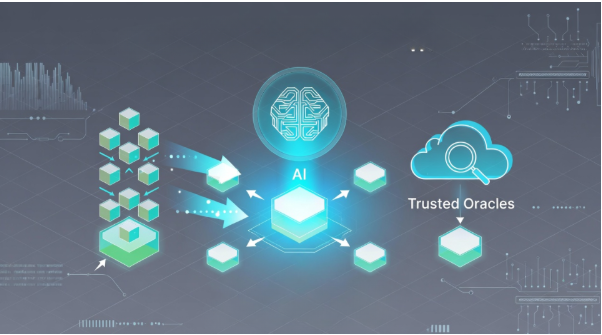
NEAR AI is an AI-augmented platform that is a part of the NEAR ecosystem. It connects machine learning models with the decentralized execution of smart contracts. Trusted oracles analyze on-chain data and external inputs using AI agents. These agents bring automated workflows to the predictive outputs. Smart contracts are deterministic and receive AI-based inputs to execute pre-defined operations. This framework provides visibility into blockchain and flexibility in logic. AI agents can manage liquidity, evaluate governance proposals, and maximize yield. Training datasets are stored in decentralized layers whose integrity can be verified. The developers introduce agents that interact with performance-free shards.
Such ecosystems have attracted traders who have entered them via platforms like the Zoomex Official Site, which offers a list of derivative markets in emerging blockchain sectors. NEAR AI, therefore, links the deterministic code to probabilistic intelligence in a verifiable environment.
Key Technologies Powering AI on Blockchain
- Decentralized AI Inference: Enables AI models to execute across distributed nodes instead of centralized servers. This preserves trust while maintaining resilience and censorship resistance.
- On-Chain Data Validation: Ensures AI-driven outputs remain verifiable through transparent ledger records. Nodes confirm results to prevent tampering or unauthorized manipulation.
- Autonomous Smart Agents: AI-driven agents execute trades, governance votes, and workflow triggers automatically. They operate through predefined permissions and cryptographic authorization.
- Privacy-Preserving Computation: Uses encryption and zero-knowledge proofs to protect sensitive training datasets. Confidential inputs remain secure while outputs stay publicly verifiable.
- Tokenized Incentive Systems: Rewards participants contributing compute power or curated datasets. Economic alignment strengthens reliability and network sustainability.
Real-World Use Cases of AI on NEAR
The implementation of AI generates measurable benefits in decentralized finance, governance, and digital ownership. Predictive models in DeFi refer to automated studies of the flows of liquidity and leverage yield strategies. AI-driven agents are allowed to hedge or rebalance a portfolio without notice. Governance models use sentiment analysis and predictive voting simulations. Increased efficiency is generated through automated screening of proposals and decentralized risk assessment of autonomous organizations. Intelligence layers are also part of NFT ecosystems, offering behavioural pattern metrics and rarity. An identity system is decentralized and authenticates credentials through AI-enhanced anomaly detection. These applications demonstrate that AI is not used to replace blockchain logic but to make it more responsive. You see real-life automation of decentralized networks that adapt to varying situations.
Security, Ethics, and Limitations
New security and ethical issues arise in the field of blockchain AI. Adversarial attacks can manipulate algorithmic results using the training data. Open datasets lacking verification mechanisms increase the risk of data poisoning. Smart contracts have weaknesses that can exacerbate the effects of bad decisions made by AI. Open books enhance the auditability of the models but do not promote model fairness. Ethical considerations apply to autonomous systems when making financial or governance decisions. There is also a need to have responsibility structures to reduce unintended consequences. To mitigate systemic risk, developers must balance automation and human oversight. Scalability is also an issue when the inference tasks are very computationally intensive.

Why AI-Blockchain Convergence Matters for the Future
The interaction of AI and blockchain alters programmable intelligence in digital economies. Decentralized systems acquire the adaptive power of centralized platforms. Economic models are modified when independent players venture directly into markets. It reduces development time since the developers can gain access to open infrastructure, and layers of intelligence are inbuilt. The algorithmic services and decision rights are not the tokens themselves but rather the digital ownership. Companies are researching decentralized AI to prevent the monopolistic data providers. This crossroads results in open automation, in which trust is established by code and consensus. This transformation is not indicative of speculative excitement but structural transformation.
How Zoomex Connects Traders to the AI-Driven Blockchain Era
Zoomex is a cryptocurrency derivatives exchange founded in 2021 by a group of seasoned industry players. Traders can easily access contract markets linked to new ecosystems such as NEAR via Zoomex’s Official Site. The platform emphasizes simplicity, execution performance, and client-oriented infrastructure. No-KYC entry would appeal to global customers who want to remain anonymous when buying and selling digital assets. High-leverage perpetual contracts enable strategic positioning of AI-related tokens. It trades more than 300 highly liquid, low-fee tokens. Copy trading systems help even new investors follow proven strategies. The infrastructure’s trading latency is less than 10ms, which is accurate even during turbulent cycles. Multi-signature wallets can provide additional security for assets in both cold and hot storage. FINTRAC and AUSTRAC regulatory registrations enhance the credibility of operations. Trader, consequently, can access professional-grade output of new AI-blockchain accounts.
Conclusion
NEAR AI is an evolution of smart decentralized systems. Adaptive networks are a machine learning and scalable blockchain infrastructure. Artificial intelligence workloads need the performance floor offered by Nightshade sharding and Proof of Stake. Transparency in automated decisions is provided by decentralized inference and verifiable computation. Efficiency in finance and governance is already being put into practice. Security and ethical environments are also needed to achieve sustainable deployment. AI and blockchain are converging, which is an indicator of a radical technology direction. Through this kind of development, digital economies are, in turn, becoming intelligent, programmable trust systems.

