


MTV music channels shutting down is one of the most talked-about media stories heading into 2026. After 44 years of defining music television worldwide, Paramount Global officially switched off five iconic music-only channels on December 31, 2025.
For millions of fans who grew up watching TRL, countdown shows, and live premieres, the moment feels like the end of an era. But the full story is more nuanced than a simple shutdown.
The main MTV network is still broadcasting — it just no longer plays music. Here is the complete breakdown of what happened, why it happened, and what comes next for one of the most recognizable brands in entertainment history.
What Actually Happened — The Shutdown Explained
On October 10, 2025, MTV’s parent company Paramount Global confirmed that five dedicated music channels would permanently close. The announcement came quietly — but the reaction across social media was anything but quiet.
The shutdown date was set for December 31, 2025. At the stroke of midnight on New Year’s Eve, the channels went dark in the United Kingdom and Ireland first. Sky and Virgin Media removed them from their lineups simultaneously.
In a full-circle moment that fans will remember forever, the very last video played on MTV Music before it shut off was “Video Killed the Radio Star” by The Buggles. That exact same song was the first music video ever aired when MTV launched on August 1, 1981.
The Five Channels That Closed
After the UK and Ireland, the closures rolled out across France, Germany, Austria, Poland, Hungary, Australia, and Brazil. The exact timing varied by market, depending on local broadcast contracts and regulations.
What Is Still Broadcasting — The Main Network Lives On
Here is the detail that caused the most confusion online: MTV did not shut down completely. The main MTV channel — called MTV HD in the UK — is still on the air. But it no longer plays music videos.
The flagship MTV HD channel switched to reality TV and entertainment programming years ago. Shows like Geordie Shore, Teen Mom, Catfish, and Naked Dating UK fill its schedule. Music content was pushed off the main channel all the way back in 2011.
In the United States, the picture is different. As of early 2026, MTV, MTV2, and MTV Classic are all still broadcasting. MTV Classic still plays retro music videos from the 1980s, 1990s, and 2000s. The main US MTV channel airs mostly reality programming, but it has not been shut down.
Paramount also kept several FAST (Free Ad-Supported Streaming TV) channels running on platforms like Pluto TV. These include MTV Biggest Pop, MTV Spankin’ New, Yo! MTV, and MTV Flow Latino — all still streaming music videos completely free.
Bottom line: The music-only channels are gone in most of the world. But the MTV brand, its flagship channel, and several digital music feeds are all still active in 2026.
Why Did the MTV Music Channels Shut Down?
Viewers Moved to Streaming First
The core reason is straightforward: people stopped watching linear music television. YouTube crossed 2.7 billion monthly users. TikTok hit 1.6 billion active users. Spotify and Apple Music replaced the need to “discover” music through a TV channel entirely.
The numbers are stark. MTV’s US flagship averaged just 189,000 prime-time viewers in 2025 — compared to 606,000 a decade earlier. In the UK, the music channels drew a fraction of what they once did during the TRL era.
Paramount’s $500 Million Cost-Cutting Drive
The shutdown did not happen in isolation. Paramount Global set a target of cutting $500 million across its global operations during 2025. The company had already shut down Paramount Television Studios and canceled MTV productions like Gonzo and Fresh Out UK.
Running 24-hour linear channels costs money — staff, licensing, infrastructure, broadcast agreements. When viewership drops below a certain threshold, the math simply stops working.
The Skydance Merger Changed Everything
Paramount’s $8 billion merger with Skydance Media, completed in August 2025, brought new leadership and new priorities. CEO David Ellison moved quickly to streamline. Closing underperforming channels was one of the fastest ways to cut overhead.
The merger also raised questions about MTV’s long-term future. Reports surfaced that Ellison had fielded ideas from music industry heavyweights like Irving Azoff and Lucian Grainge about how to revitalize the MTV brand — possibly as an online streaming service.
Cable TV Is Dying Everywhere
MTV is not the only casualty. Cord-cutting accelerated dramatically through 2024 and 2025. Print giants like Rolling Stone and NME went digital-first years ago. Radio networks are shrinking. Cable subscriptions continue to fall globally.
MTV’s music channels were among the last holdouts of a format that simply does not fit how people consume content anymore. The shutdown is the final act of a transition that started over a decade ago.
MTV: A Timeline From 1981 to 2025
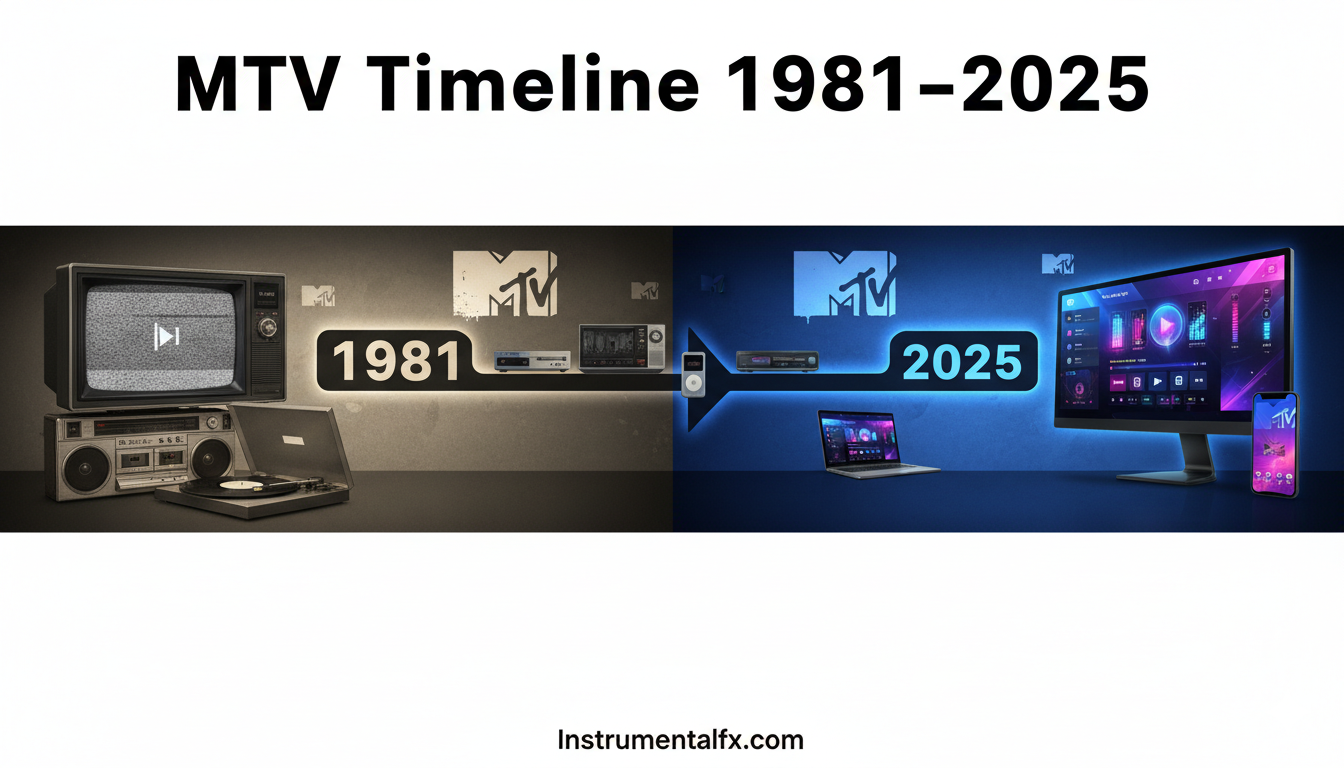

August 1, 1981 — MTV launches in the United States. The very first video played is “Video Killed the Radio Star” by The Buggles. Music television is officially born.
1987 — MTV Europe launches, taking the brand international. Within a decade, MTV will claim 100 to 150 million viewers across the globe.
1997 — MTV UK officially launches as its own regional channel. TRL becomes a daily ritual for an entire generation of teenagers.
Mid-2000s — YouTube launches and begins pulling music audiences away from TV. MTV starts pivoting toward reality shows to keep viewers watching.
2011 — The main MTV channel officially stops airing music videos. All music content is shifted to sister channels like MTV Music, MTV 80s, and MTV 90s.
May 2023 — MTV News shuts down after 36 years. The company cites “broader economic headwinds.” The MTV News website archive is later scrubbed from the internet.
August 2025 — Paramount completes its $8 billion merger with Skydance Media. Aggressive cost-cutting begins across the portfolio.
October 10, 2025 — Paramount officially announces the closure of five MTV music channels by year-end.
December 31, 2025 — MTV Music, MTV 80s, MTV 90s, Club MTV, and MTV Live go dark in the UK. The final video played: “Video Killed the Radio Star.”
How Former MTV VJs and Stars Reacted
The closure hit former MTV personalities hard. Many took to social media to share memories and express real grief over the end of something that shaped their careers.
“We need to support these artists and we all need to dance again and listen to music. MTV was the place where everything came together. So it really does break my heart.”
— Simone Angel, former MTV VJ
Former VJ Jasmine Dotiwala called it the “end of a trailblazing era.” She reminded everyone that MTV was the world’s first 24-hour music broadcaster — a fact younger audiences may not fully appreciate.
Musician Casey Rain was blunt on X: MTV was “culturally and spiritually dead” once it stopped playing music videos. He called it a corporate-led decline of the coolest brand in existence.
Legendary VJ Daisy Fuentes offered perhaps the most measured take. She told PEOPLE: “While it’s a bit sad, it’s been a bit sad for a while. I think MTV had its time and history that time will never repeat, and it’s time to change.”
Why MTV Mattered — The Cultural Legacy
To understand why this shutdown feels so significant, you need to understand what MTV was before it became a reality TV network. In the 1980s and 1990s, MTV was not just a channel. It was the channel.
MTV introduced the world to moments that shaped pop culture forever. Michael Jackson’s Thriller video aired in 1983. Madonna’s controversial Like a Virgin performance happened on the VMAs in 1984. Live Aid was broadcast for 16 straight hours in 1985.
Headbangers Ball gave metal and rock music a dedicated visual home. Yo! MTV Raps brought hip-hop to a global audience at a time when mainstream TV largely ignored the genre. And TRL turned music videos into a participatory event — fans called in daily to vote for their favorites.
MTV was also a fashion and lifestyle force. The VJs were celebrities in their own right. The network’s aesthetic — bold logos, neon colors, fast cuts — influenced graphic design and youth culture for an entire generation.
Where to Watch Music Videos Now — What Replaces MTV
The good news: there are more ways to watch music videos today than at any point in history. The bad news: nothing fully replicates the shared experience of flipping on MTV and seeing what came next.
YouTube and Vevo
YouTube is now the default home for official music videos. Artists upload premieres and behind-the-scenes content directly. Vevo acts as a curated music video hub, partnering with major labels to surface high-quality official content.
TikTok and Instagram Reels
TikTok has become the new discovery engine for music. Short clips go viral before radio stations even notice. Instagram Reels plays a similar role, with artists using it to promote releases through short-form video.
Spotify and Apple Music
Both platforms now include visual elements. Spotify’s Canvas feature loops short video clips attached to songs. Apple Music offers lyric videos and curated video playlists. They are not MTV replacements — but they fill part of the discovery gap.
Pluto TV FAST Channels
Paramount moved several MTV-branded channels onto Pluto TV as free, ad-supported streams. MTV Biggest Pop, MTV Spankin’ New, and Yo! The MTV are all still playing music videos — completely free, no subscription needed.
MTV Rewind (Fan-M
ade)A web developer called Flexasaurus Rex built MTV Rewind — a free streaming site that recreates the classic MTV experience. It pulls from over 33,000 music videos and runs 11 always-on channels styled after different eras of MTV history.
US vs. UK — Why Everyone Was So Confused
One of the biggest sources of confusion after December 31 was the difference between what happened in the UK and Europe versus the United States. Posts claiming “MTV is completely gone” went viral — but that claim was not accurate.
In the UK and Europe, the five dedicated music channels were permanently removed from Sky and Virgin Media. Those channels are gone in those markets — no question.
In the US, the situation is a slow rollback, not an overnight shutdown. MTV, MTV2, and MTV Classic are all still on the air. Regional cable providers are expected to lose music-only feeds as contracts expire over time — but as of early 2026, US viewers still have access.
Snopes published a detailed fact-check rating the widespread claim that “MTV shut down” as a mixture of truth and falsehood. The music channels closed. The network itself did not.
What This Means for the Music Industry
The closure of MTV’s music channels is more than a business decision. It is a cultural punctuation mark — a clear signal that the era of TV-driven music discovery is officially over.
For new artists, this changes nothing in practice. Breaking into music in 2026 has never required MTV. A viral TikTok, a well-timed YouTube premiere, or a Spotify playlist feature can do more in 48 hours than an MTV rotation once did in a month.
For labels and marketing teams, the shift means realigning budgets. Linear TV ad spend keeps shrinking. Social media campaigns, streaming partnerships, and algorithmic optimization are now the primary tools for building an artist’s profile.
For fans and nostalgia seekers, the loss is real. The music MTV played is still accessible everywhere. What is gone is the experience — the shared ritual of gathering around a screen, arguing over countdowns, and feeling like music was something everyone watched together.
Will the MTV Brand Survive?
Despite the channel closures, the MTV brand is far from dead. Paramount has made it clear that MTV will continue as a digital and entertainment brand.
The MTV Video Music Awards (VMAs) remain one of the most-watched music events globally, drawing roughly 5.5 million viewers across platforms each year. The VMAs are expected to keep airing on Paramount+ and affiliated networks.
Earlier in 2025, Paramount did cancel the MTV Europe Music Awards (EMAs) and MTV Latin America’s MIAW Awards as part of cost-cutting. But the VMAs — the brand’s crown jewel — appear safe.
Reports also indicate that new Paramount leadership under David Ellison is actively exploring ways to revitalize MTV as a digital brand. Discussions have included turning MTV into an online streaming service that could compete with YouTube or Spotify in the music video space.
The MTV logo still carries weight in marketing, licensing, and brand partnerships. Paramount is clearly betting that the name itself — 44 years of cultural cachet — is worth more than any single TV channel.
The Social Media Storm — How the Internet Reacted
The moment the clock struck midnight on December 31, 2025, social media exploded. Thousands of posts flooded X (formerly Twitter), Instagram, and Facebook — many claiming that MTV had shut down entirely. Memes showing an MTV tombstone went viral within hours.
The confusion was understandable. Headlines used phrases like “MTV going off the air” and “MTV shutting down on New Year’s Eve.” The actual nuance — that only the music-only channels closed, not the entire brand — was buried deep in most articles.
Gen Xers and Millennials led the charge. For them, MTV was never just a TV channel. It was a shared cultural experience — something that brought people together before social media existed. Seeing it fade, even partially, felt personal.
The backlash was so widespread that fact-checking sites like Snopes and outlets like Esquire published dedicated articles clarifying what actually happened. Esquire’s Dave Holmes called it a “five-alarm information catastrophe” — pointing out how easily misinformation spread on a story this easily verifiable.
The irony was not lost on anyone: a brand that once shaped how the world discovered music was now being mourned through the very digital platforms that replaced it.
The Bigger Picture — What MTV’s Shutdown Says About Media in 2026
MTV music channels shutting down is not just an entertainment story. It is a case study in how traditional media adapts — or fails to adapt — to the digital age.
Cable television built entire industries around the idea of scheduled viewing. You tuned in at a set time, watched what was on, and had no control over what came next. That model powered networks from MTV to CNN to ESPN for decades.
But the internet rewrote the rules. On-demand content, algorithmic recommendations, and user-generated video changed viewer expectations completely. Audiences no longer wait — they search, scroll, and choose in real time.
MTV saw this shift coming earlier than most. It pivoted to reality TV in the early 2000s precisely because music videos were migrating online. But the pivot saved the brand at the cost of its identity. By 2025, the music channels were the last thread connecting MTV to what it originally was.
Other media companies are watching closely. If Paramount can successfully rebrand MTV as a digital-first entertainment brand without its music roots, it could become a blueprint for how legacy TV networks survive the streaming era. If it cannot, MTV may become the cautionary tale that other networks study before making their own moves.
Either way, the closure marks a line in the sand. Before this moment, music television still existed somewhere in the world. After it, that is no longer true — at least not in the way it once was.
Frequently Asked Questions
1. Did MTV completely shut down?
No. Only the five dedicated music-only channels closed on December 31, 2025. The main MTV network and MTV HD are still broadcasting reality and entertainment programming in the UK and worldwide.
2. Which countries were affected by the MTV music channel closures?
The UK and Ireland closed first, followed by France, Germany, Austria, Poland, Hungary, Australia, and Brazil. US channels have not shut down — they are still on the air as of early 2026.
3. Why did Paramount shut down the MTV music channels?
Paramount is executing a $500 million cost-cutting plan after its merger with Skydance Media. Plummeting linear TV viewership and the rise of YouTube and TikTok made these channels financially unsustainable to run.
4. What was the last video ever played on MTV Music?
The final video was “Video Killed the Radio Star” by The Buggles — the exact same song that was the very first music video played when MTV launched on August 1, 1981.
5. Can I still watch MTV in the United States in 2026?
Yes. MTV, MTV2, and MTV Classic are all still broadcasting in the US. MTV Classic still plays retro music videos. Free FAST channels on Pluto TV also stream MTV music content.
6. Will the MTV Video Music Awards still happen?
Yes. The VMAs are expected to continue airing on Paramount+ and partner networks. They remain one of the most-watched annual music events, drawing millions of viewers each year.
7. Where can I watch music videos now that MTV channels are gone?
The best options are YouTube, Vevo, TikTok, and Spotify. Pluto TV also runs free MTV-branded FAST channels that stream music videos at no cost and no subscription required.
8. When did MTV first stop playing music videos on its main channel?
The main MTV channel removed music videos from its regular schedule back in 2011. All music content was shifted to sister channels — the very same ones that closed in December 2025.
9. Is the Paramount and Skydance merger connected to the MTV closures?
Yes. The $8 billion Skydance merger, completed in August 2025, triggered aggressive cost-cutting across Paramount’s entire portfolio. The MTV music channel shutdowns were a direct part of that effort.
10. Did any former MTV VJs speak out about the shutdown?
Simone Angel, Jasmine Dotiwala, Daisy Fuentes, and Neil Cole all shared emotional reactions publicly. Simone Angel said it “breaks her heart.” Daisy Fuentes said it was time to change.
📌 Conclusion
The story of MTV music channels shutting down is ultimately a story about how the world changed — not how MTV failed. For 44 years, MTV was the single most important platform for music television on the planet.
It launched careers, shaped youth culture, and introduced generations to artists they never would have found on their own.
But the rise of YouTube, TikTok, Spotify, and on-demand streaming made linear music channels an endangered species long before Paramount made the call. The main MTV network lives on — just without music at its center.
The VMAs still air. The logo still carries weight. And the spirit of what MTV once represented — the idea that music is best when it is seen, shared, and celebrated together — lives on across every digital platform where fans now gather. MTV did not end. It simply moved.