


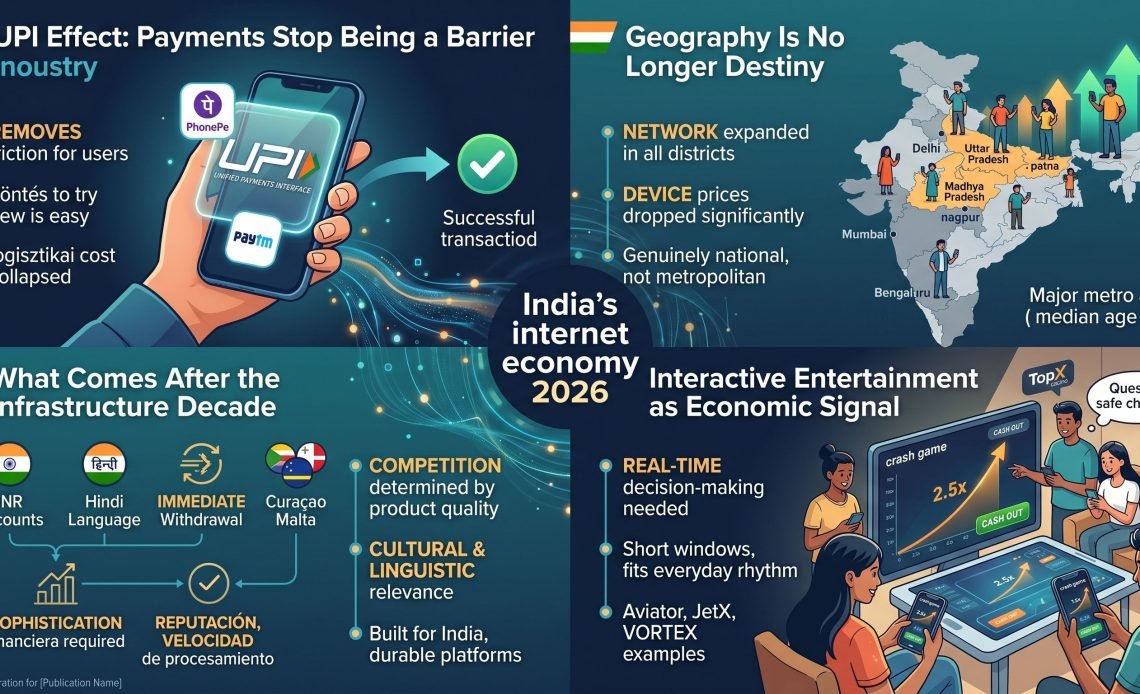
Something significant is happening in India’s digital economy, and it is not concentrated in Bengaluru’s startup corridors or Mumbai’s financial districts. It is happening in Nagpur and Patna, in Tier-2 towns across Uttar Pradesh and Madhya Pradesh, on mid-range Android phones running on Jio data plans that cost less per month than a single cinema ticket. The infrastructure that was painstakingly built over the past decade — UPI, affordable smartphones, cheap mobile data — has reached a point of maturity where it is producing behavioural shifts that are only now becoming fully visible. Platforms like TopX casino — accepting PhonePe, PayTM and UPI in INR, available without an app store download, and supporting Hindi alongside English — are one visible symptom of a much larger transformation in how Indians spend time and money online.
The UPI Effect: When Payments Stop Being a Barrier
To understand what changed in India’s digital economy, start with payments. UPI did not just make transactions faster — it removed the psychological and practical friction that kept large segments of the population from engaging with digital products at all. Before UPI’s dominance, accessing a paid digital platform required a functional credit card, net banking credentials, or familiarity with third-party wallets. Each of those represented a filter that excluded substantial portions of the population.
UPI collapsed that filter almost entirely. Today, a first-time user of any digital platform in India can complete a transaction using the same app they use to pay a street vendor. The decision to try something new no longer carries a meaningful logistical cost. The consequences for digital product adoption have been significant across every category, from e-commerce to entertainment to financial services.
Geography Is No Longer Destiny
The map of India’s digital economy looked very different five years ago. Engagement, spending and product adoption were concentrated in a handful of large metros. The infrastructure gap between a user in Bengaluru and one in a smaller city was real and consequential. That gap has narrowed to the point where, for mobile-native products, it has largely ceased to matter.
Jio’s continued network expansion pushed 4G into districts that previously had unreliable 2G coverage. Device prices have dropped to the point where capable smartphones are accessible across most income brackets. And the products themselves — games, entertainment platforms, financial tools — have been redesigned for the hardware and connectivity profiles that actually characterise most Indian users, not the premium segment that early adopters represented.
The result is a digital economy that is genuinely national in 2026, not merely metropolitan with national aspirations. Growth numbers that look impressive at the aggregate level are even more striking when disaggregated by geography: the fastest-expanding user bases for most major digital product categories are now in cities and towns that barely registered in the data five years ago.
Interactive Entertainment as an Economic Signal
One of the more revealing indicators of where India’s digital economy has arrived is the growth of interactive entertainment — formats where the user is a participant rather than a viewer. Crash games like Aviator, JetX and VORTEX, which require real-time decisions and play out in minutes rather than hours, have built audiences across India that would have been difficult to predict from the viewing and browsing habits that dominated earlier phases of the country’s digital growth.
The expansion of these formats is partly a story about infrastructure — real-time interactive content requires network reliability that was not universally available in India until recently. But it is also a story about user sophistication. The Indian internet user of 2026 is not a newcomer navigating unfamiliar territory. They are a confident, experienced digital consumer with specific preferences, comparison points and expectations that platforms need to meet in order to earn and retain their attention.
What Comes After the Infrastructure Decade
India spent much of the past decade building the foundations of its digital economy. The coming years will be defined by the competition that those foundations enable. With payments solved, connectivity largely solved, and device access substantially solved, the variable that matters now is product quality — and the cultural and linguistic relevance that determines whether a product feels built for India or merely available in India. That distinction, in a market of this size and diversity, is ultimately what separates durable platforms from transient ones.

