


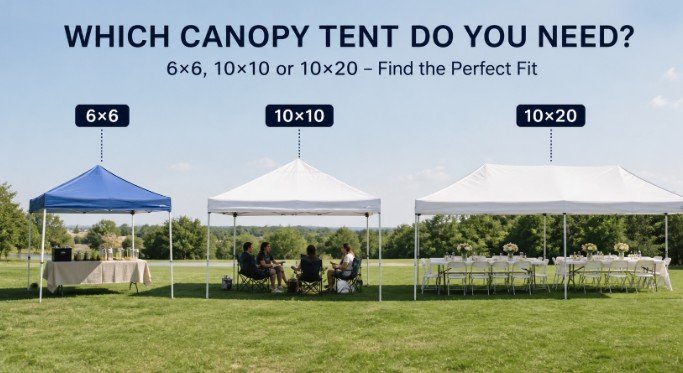
I’ll be upfront with you – I made the wrong call the first time I bought a canopy tent.
Went straight for the 10×10 because that’s what everyone seemed to have at the local farmers market. Thought I was being smart. Showed up to my first outdoor vendor event, popped it open, set up my table, added a small shelving unit on the side… and immediately realized I had about 18 inches of walkable space left. Customers would lean in from outside the tent rather than stepping in. One gust of wind later and I was chasing a display rack across a parking lot.
That experience – embarrassing as it was – taught me more about canopy tent sizing than any product listing ever could.
So if you’re standing at that same crossroads right now, trying to figure out whether a 6×6, 10×10, or 10×20 actually makes sense for what you do, I want to save you that lesson. Let’s talk through this properly.
Why Size Gets Complicated (And Why Most Guides Skip the Real Part)
Most buying guides give you a comparison table and call it a day. “10×10 fits 8 people. 10×20 fits 16.” Cool. But that tells you nothing about how it actually feels to work inside one of those tents for six hours on a Saturday – with your products, your gear, your signage, and a steady stream of people walking through.
Square footage on paper is deceptive. The way you use space matters more than the number itself.
A 10×10 with one folding table feels open. A 10×10 with two tables, a banner stand, a credit card reader station, and three customers browsing at the same time feels like a subway car. Same tent. Completely different reality.
So before I even get into which size is right for you, I want you to do one thing: mentally walk through your actual setup. What goes in the tent? Who else is working with you? Are customers coming inside or just browsing from the front edge? How much breathing room do you need to feel comfortable doing your job?
Answer that, and the size decision gets a lot easier.
The 6×6: Underestimated, and Honestly Kind of Great for the Right Person
Nobody talks about the 6×6 like it deserves. It sits at the bottom of the size chart and people glance past it assuming it’s only useful for a lawn chair and a cooler.
That’s a mistake.
I’ve seen solo photographers use a 6×6 beautifully for outdoor portrait setups – just a backdrop, a stool, and clean shade. I’ve watched jewelry makers run tight, elegant little displays out of them at boutique markets where space is assigned and cramped anyway. For one person with a simple, curated setup, a 6×6 can actually look more intentional than a half-empty 10×10.
The practical advantages are real too. It fits in almost any car – not just SUVs. It weighs next to nothing by canopy standards. You can set it up by yourself in under ten minutes without any of the wrestling match that comes with larger frames. And in a tight spot – a busy street fair, a narrow vendor row – it’s just easier to manage.
Where it genuinely fails you: the moment a second person joins your operation, or you need a full-sized table plus any kind of vertical display, you’ve already outgrown it. There’s no compromising around it. The math just doesn’t work.
If you’re a solo operator with a minimal, well-edited setup, give the 6×6 serious consideration. Most people rule it out too fast.
Who it’s actually built for: solo vendors, individual artists, small market setups, photographers, anyone hauling gear in a regular sedan who values quick setup over maximum space.
The 10×10: The One Most People End Up With – For Good Reason
Let me be direct here: the 10×10 is the standard for outdoor vending and events because it genuinely works for most situations. It’s not a compromise. It’s just the size that hits the most use cases without asking too much of you logistically.
Stand inside a properly laid-out 10×10 and you have room for a table across the back wall, display on both sides, and still maintain a comfortable entry zone where customers actually feel invited to step in rather than hover at the edge. That entry zone matters more than people realize. If customers feel like they’re intruding, they won’t come in.
It’s also the size most event organizers assume you’re using. Booth space at markets and festivals is almost universally designed around a 10×10 footprint, sometimes 10×10 with a 10-foot depth. Going larger often requires a double-booth fee. Going smaller can look underprepared in a professional context.
For personal use – backyard cookouts, graduation parties, tailgating – the 10×10 is the easy answer. It covers enough people to be genuinely useful without requiring a truck to transport it.
One place where the 10×10 really shines is when you invest in branding it properly.
A custom canopy tent at this size, printed with your logo, colors, and a clear tagline, can be one of the most effective physical marketing tools a small business owns. It makes you look established at events, and people remember a visually strong booth in a way they simply don’t remember a generic white tent.
Fair warning on setup: two people makes it easy. One person makes it technically doable but genuinely frustrating, especially with a steel-frame model. If you’re frequently setting up solo, budget for an aluminum frame and practice the setup a few times at home before you’re under pressure at an event.
Who it’s actually built for: single and two-person vendor setups, farmers market regulars, craft fair vendors, tailgaters, backyard party hosts, anyone doing outdoor brand activations.
The 10×20: Serious Space for Serious Setups
I won’t pretend the 10×20 is for everyone, because it isn’t. It’s heavy, it’s a two-vehicle situation for most people, and setting it up requires actual coordination among multiple people. I’ve watched a 10×20 take 45 minutes to go up because the team wasn’t communicating clearly. That’s not a fun start to an event day.
But when you actually need the space? Nothing else comes close.
The thing a 10×20 gives you that a 10×10 never can is the ability to zone your space. Front section for customer browsing. Middle section for checkout and conversation. Back section for storage, prep, or a workspace you don’t want the public walking through. That kind of spatial logic changes the entire customer experience, and it changes how you operate during a busy event.
Food vendors almost universally graduate to this size eventually. Once you add cooking equipment, a prep surface, a serving counter, a cash box, and the two people needed to run it all – a 10×10 becomes a dangerous, overcrowded mess. A 10×20 gives you room to work without bumping into each other every thirty seconds.
For personal events, the 10×20 is the choice when you’ve got a real crowd coming. Thirty people at a backyard graduation party, an outdoor wedding rehearsal dinner, a neighborhood block party – this is where it earns its keep. Anything under twenty people and a 10×10 probably handles it fine.
Wind management is the thing nobody warns you about enough with this size. A 10×20 catches a lot of air. Weight bags, proper staking, and knowing your local weather before you commit to setup are non-negotiable. Don’t skip that step.
Who it’s actually built for: multi-person vendor operations, food vendors, large outdoor gatherings, corporate events, anyone who needs to divide their space into distinct working zones.
The Honest Version of “Which One Should You Buy”
Here’s where I land after watching a lot of people set up a lot of canopy tents over the years:
If you’re solo and lean – 6×6. If you’re a standard vendor or hosting regular outdoor events – 10×10, without overthinking it. If you run a real operation with multiple people or you need genuine room to work – 10×20.
And one more thing. Whatever size you choose, put your money into the frame quality over the fabric. Canopy fabric tears, fades, and gets replaced. A flimsy frame buckles at the worst possible moment – usually mid-event, in front of everyone. Buy the sturdier frame and thank yourself later.
The right tent doesn’t just keep the sun off your head. A well-chosen, well-branded setup builds trust with the people walking past. That part is worth getting right.
FAQs
Q1: Can I set up a 10×10 canopy tent alone?
Yes, but it’s genuinely frustrating the first few times. The frame collapses while you’re extending the legs, the fabric fights you in any breeze, and you end up shuffling between corners like you’re doing some kind of setup dance. If solo use is your reality, buy an aluminum frame – lighter and easier to manage alone – and practice at home before your first event. By the third run you’ll have a rhythm. That first time though, add 20 extra minutes to your schedule.
Q2: My booth space is 10×10 – can I only use a 10×10 tent?
Pretty much, yes. Event organizers assign that footprint for a reason, and vendors beside you are counting on you to stay within it. A 10×10 tent fits that space with legs sitting right at the edges – anything wider causes problems. Some shows let you buy a double booth, which opens the door to a 10×20, but always confirm that before assuming. Don’t be the vendor who crowds their neighbor before the event even opens.
Q3: How do I know if a canopy tent can handle wind?
Check the frame joints and leg thickness first – that’s where budget tents fail before anything else does. Beyond the frame, anchoring matters just as much: stakes for grass, weight bags for concrete, guy lines when wind is steady and strong. Realistically, though, no canopy tent is built to survive 25+ mph gusts unattended. If serious wind rolls in mid-event, take it down. That’s not weakness – that’s just experience talking.
Q4: Are cheap canopy tents on Amazon worth buying?
Depends entirely on how often you use it. Twice a year in calm weather? A budget tent might last you a few seasons without drama. Every weekend at outdoor markets? The connectors loosen, legs wobble, and something gives out at exactly the wrong moment. If a tent is part of how you work or how you regularly host people, buy it like the tool it actually is. Mid-range isn’t exciting, but it’s the decision you stop second-guessing after your first windy Saturday.
Q5: What size should I buy if I’m not sure yet?
Go 10×10 and move on. It handles almost every situation well – vendor events, backyard gatherings, markets, tailgating. You can run a minimal setup inside it or pack it reasonably full and still function comfortably. It fits standard booth spaces, moves without a truck, and if you eventually outgrow it, you’ll know exactly why. The 10×10 is the right starting point for most people, and honestly, there’s no shame in that being the answer.

