


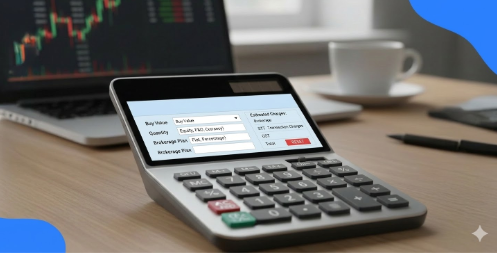
When you trade on the stock exchange, you do not just place an execution, but as part of that execution, you pay certain fees. These are also known as Commissions and include your broker’s fees, stamp tax, trading fees and trading tax. Many people find it difficult to understand the total cost of a trade without using some type of tool to help them calculate the total cost and how much they will make or lose on a trade.
A Brokerage Calculator would help you calculate the total cost of doing business, as well as what value your trade will create or take away, if you use this service prior to placing your order. An example of where this would be important is if you are trading in the NSE exchange, then tracking the SGX Nifty will allow you to forecast how the Indian markets will move and give you the opportunity to place your order at the right time, because you have used this calculator before doing so.
What is a brokerage calculator?
A brokerage calculator is an online tool designed to help investors and traders calculate the total charges involved in a stock market transaction. It provides a detailed breakdown of all trading costs so that traders can understand how much they will pay for executing a trade.
Instead of manually calculating multiple components, the calculator automatically determines the charges once the trade inputs are entered.
These inputs typically include:
- Trade price
- Number of shares or lot size
- Buy or sell transaction
- Market segment such as equity, futures, or options
The calculator then provides the total brokerage amount along with other applicable statutory charges. This transparency helps traders estimate the actual profitability of their trades.
Why traders use a brokerage calculator
In the Indian stock market, several charges apply to each trade. Without calculating them accurately, traders may misjudge the profitability of their transactions. A brokerage calculator helps eliminate this uncertainty.
Accurate cost estimation
The calculator shows the exact charges associated with each trade, including brokerage and government taxes.
Better trade planning
Traders can evaluate potential profit margins before executing trades.
Transparency in trading costs
Investors can clearly see how brokerage firms structure their charges.
Faster decision making
Instead of performing manual calculations, traders can instantly determine the net cost of a trade.
These benefits make brokerage calculators essential tools for both new investors and experienced traders.
Key components included in brokerage calculations
A brokerage calculator includes multiple cost components that apply to trades in the Indian stock market.
Brokerage charges
This is the fee charged by the brokerage firm for executing trades on behalf of the investor.
Securities transaction tax (STT)
STT is a tax levied by the Government of India on securities transactions conducted on recognised stock exchanges.
Exchange transaction charges
Stock exchanges charge a transaction fee for every trade executed on their platform.
Goods and services tax (GST)
GST applies to brokerage charges and certain transaction fees.
SEBI turnover fees
The Securities and Exchange Board of India collects regulatory charges based on the trade turnover.
Stamp duty
Stamp duty is applied according to the regulations of the respective state where the transaction occurs.
A brokerage calculator aggregates all these charges and displays the total transaction cost in a structured format.
How a brokerage calculator works
Using a brokerage calculator is straightforward. Traders only need to enter a few basic details related to their trade.
Step 1: Enter the trade price
The user inputs the price at which the shares are purchased or sold.
Step 2: Enter the quantity of shares
The calculator requires the number of shares involved in the transaction.
Step 3: Select trade type
Traders must specify whether the transaction is a purchase or sale.
Step 4: Choose market segment
Some calculators allow users to select segments such as equity delivery, intraday trading, futures, or options.
Step 5: View cost breakdown
Once the details are entered, the calculator generates a complete breakdown of brokerage, taxes, and other charges.
This quick process allows traders to understand their transaction costs before placing an order.
Role of brokerage calculators in trading strategies
A brokerage calculator does more than simply display charges. It also supports strategic decision-making for traders.
For example, traders who monitor global indicators such as SGX Nifty often anticipate how the Indian market may open the next day. Based on this analysis, they may plan intraday or short-term trades.
However, these trades may involve frequent buying and selling. Without accounting for brokerage and taxes, the final profit from such trades may be lower than expected.
Using a brokerage calculator allows traders to evaluate whether a trade remains profitable after including all charges.
Importance of cost awareness in trading
Many investors focus primarily on price movement while ignoring the impact of transaction costs. However, even small charges can accumulate significantly over time.
For instance, frequent trading can lead to repeated brokerage charges and taxes. If these costs are not calculated beforehand, traders may find that their net gains are lower than expected.
A brokerage calculator helps traders remain aware of these costs. By calculating charges before executing trades, investors can adjust their trading strategies to maintain profitability.
Advantages of using a brokerage calculator
Using a brokerage calculator offers several practical advantages for investors.
Improved financial planning
Traders can estimate the exact cost of each trade and plan their investment strategies accordingly.
Enhanced transparency
The calculator clearly shows how different charges contribute to the overall transaction cost.
Risk management
Knowing the full cost structure helps traders assess whether the trade aligns with their risk tolerance.
Time efficiency
The automated calculation saves time compared with manual computation of multiple charges.
These advantages make brokerage calculators an essential part of modern trading platforms.
Factors that influence brokerage charges
Several factors affect the brokerage amount calculated for a trade.
Type of brokerage plan
Some brokerage firms charge a percentage of the trade value, while others follow a flat-fee model.
Trading segment
Charges may vary depending on whether the trade occurs in equity delivery, intraday trading, or derivatives markets.
Trade frequency
Frequent traders may choose brokerage plans designed for high trading volumes.
Brokerage policies
Each brokerage firm follows its own fee structure within regulatory limits.
A brokerage calculator reflects these variations and provides the applicable charges based on the selected inputs.
Common mistakes traders make when ignoring brokerage costs
Some traders overlook brokerage charges when estimating potential profit from trades. This can lead to several issues.
Overestimating profits
Ignoring brokerage and taxes may result in unrealistic profit expectations.
Excessive trading
Frequent trading without calculating charges can increase overall transaction costs.
Inaccurate strategy evaluation
Traders may believe a strategy is profitable when the actual net returns are lower after costs.
Using a brokerage calculator helps avoid these mistakes and improves decision-making.
Conclusion
A brokerage calculator plays an essential role in helping traders understand the true cost of stock market transactions. By providing a detailed breakdown of brokerage, taxes, and regulatory fees, it allows investors to estimate the exact financial impact of their trades before placing an order.
For traders who track market indicators such as SGX Nifty to anticipate price movements, accurate cost calculations are particularly important. Incorporating brokerage calculations into trading analysis helps investors maintain realistic expectations and make informed decisions in the stock market.

