


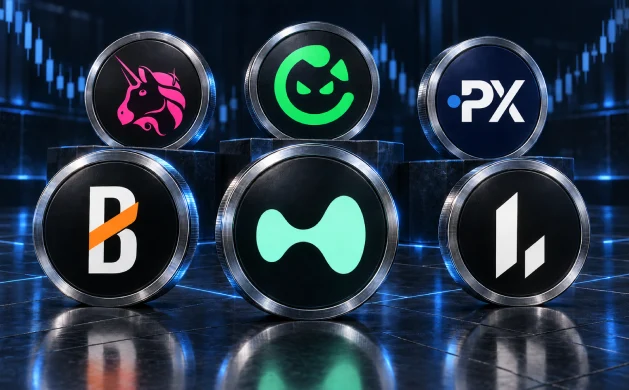
Rankings usually crown a winner without showing the reasoning. This one works like a tournament instead. Eight platforms are paired off in four matchups, each pairing compares two services that overlap in purpose, and the winners then take the top four places overall. You can see exactly why one option beat another.
The usual warning applies: verification rules in crypto change quickly and often without notice. Treat every description as a snapshot, check current terms before sending funds, and keep your local laws in mind.
The bracket
| Matchup | Contender A | Contender B | Deciding factor |
| 1 | Godex | FixedFloat | Everyday simplicity vs. rate certainty |
| 2 | Uniswap | THORChain | Breadth of use vs. cross-chain reach |
| 3 | Hyperliquid | MEXC | Custody vs. market variety |
| 4 | Bisq | Trocador | Independence vs. convenience |
Matchup 1: Godex vs. FixedFloat
Both are account-free swap services, so the comparison comes down to the experience.
Winner: Godex
Godex keeps the process to four moves. You select a pair, review the estimated amount, paste a receiving address, and send the deposit. There is no registration, no login to protect, and no balance left on the platform afterward. The site is https://godex.io.
For a routine conversion, fewer steps mean fewer chances to misread a field or mistype an address, and with irreversible transfers that counts for a lot. Funds go straight to your own wallet, so nothing sits on the platform once the swap completes.
The caveats belong to the whole format. The fee is built into the exchange rate rather than itemized, so on larger amounts it pays to request a second quote. Unusual or flagged deposits can be held for review, and a swap service offers no limit orders, leverage, or order book.
Best for: routine conversions where speed and a small data footprint matter most.
Runner-up: FixedFloat
FixedFloat offers a floating rate that follows the market and a locked rate that fixes your output in advance. The locked option is valuable when you are sending an exact sum or the market is moving fast, usually at the price of a slightly weaker quote.
It lost this round only because most people converting coins value simplicity over rate certainty. Services in this niche have also occasionally dealt with pauses or incidents, so a small test transfer first is sensible.
Best for: swaps where knowing the exact amount matters more than the best possible rate.
Matchup 2: Uniswap vs. THORChain
Both are protocol-based, with no company that can decide to add verification. They differ in what they can reach.
Winner: Uniswap
Uniswap is the long-standing reference for decentralized token swaps. It has deep liquidity on major pairs, years of production history, and a wallet-based flow with no sign-up. For anyone already holding assets on a supported chain, it is the most direct route.
Be realistic about privacy. A wallet address is pseudonymous, not invisible. Every transaction is public, and if your address is ever linked to you, its history becomes readable. Network fees also rise with congestion and can outweigh small trades.
Best for: swapping on-chain tokens from a wallet you control.
Runner-up: THORChain
THORChain enables native cross-chain swaps through liquidity pools, so you can move between blockchains without wrapped tokens or a custodian. That is something Uniswap cannot do.
It lost on usability. Slippage on thin pools, route-dependent fees, and the need for correct transaction memos all raise the cost of a mistake.
Best for: cross-chain swaps by users comfortable with on-chain tools.
Matchup 3: Hyperliquid vs. MEXC
This is the derivatives-and-markets bracket, and the real contest is custody against variety.
Winner: Hyperliquid
Hyperliquid runs perpetual futures on its own chain. You connect a wallet, deposit collateral, and trade without registering, with execution speed close to a centralized exchange. Because you keep your keys, no company holds your funds or decides when to ask for documents.
It assumes experience. Liquidation levels, funding payments, and position sizing are yours to manage, and there is no support desk to undo an error. Leverage magnifies losses as easily as gains.
Best for: experienced traders who want derivatives while keeping custody.
Runner-up: MEXC
MEXC lists new tokens quickly, often before larger competitors, and has historically allowed basic trading with limited verification. For people following early-stage projects, that coverage is the draw.
It lost on privacy and control. Withdrawal limits for unverified accounts can be restrictive, policies may change, and your funds sit in custody on the platform. The tokens that make it interesting are also often the thinnest and most volatile, and a fast listing says nothing about project quality.
Best for: traders who want early access to new listings and accept the added risk.
Matchup 4: Bisq vs. Trocador
One removes the operator entirely, while the other adds a layer of comparison on top of operators.
Winner: Trocador
Trocador is an aggregator. It collects quotes from several swap providers and routes your trade through the one you choose, while showing information about the providers involved. For most people, that saves effort and helps with the question of whom to trust with a transfer.
The trade-off is an added dependency. A problem at the aggregator or the underlying provider can slow a trade down.
Best for: rate comparison without opening multiple tabs.
Runner-up: Bisq
Bisq is open-source desktop software where users trade directly with one another and no company holds funds. That makes it unusually hard to censor, and it supports several payment methods, including some bank-based ones.
It lost on convenience. Trades are slower, the counterparty pool is small, and setup takes effort. For people who put independence first, it remains the strongest option on the list.
Best for: people who rank decentralization above speed.
The final standings
Winners advance to the top four, ordered by how useful they are to an ordinary user. Runner-ups follow in order of their margin of loss.
| Overall | Platform | Category |
| 1 | Godex | Swap service |
| 2 | Uniswap | DEX |
| 3 | Hyperliquid | On-chain perps |
| 4 | Trocador | Swap aggregator |
| 5 | FixedFloat | Swap service |
| 6 | THORChain | Cross-chain DEX |
| 7 | Bisq | Peer-to-peer |
| 8 | MEXC | Tiered exchange |
What the bracket reveals
Simple tools win everyday matchups. In three of the four pairings, the option with fewer steps or fewer decisions advanced. Most people converting coins are not looking for features.
Custody is a recurring tiebreaker. Whenever one contender held your funds and the other did not, the one that did not tended to win. It reduces both data exposure and policy risk.
No one wins on every dimension. Each winner gave something up, whether depth, speed, or flexibility.
A routine that works whichever platform wins
- Open the service from a bookmark you created, not a search ad or shared link.
- Request quotes from two providers for the same pair and amount, then compare what you would actually receive.
- Confirm that the coin and network match on both sides.
- Paste the receiving address and check the first and last characters.
- Check whether the asset needs a memo or tag.
- Send a small test amount first, then the full sum.
- Move proceeds to a wallet you control once the trade completes.
What “no KYC” does and doesn’t give you
It reduces the personal data a company stores about you, which limits the damage if that company is ever breached. It does not make you anonymous. Deposit addresses, receiving addresses, amounts, and timing stay visible on public blockchains. Many services also screen addresses for illicit funds, restrict certain regions, and may pause transactions for review.
Short answers
Are these platforms legal?
It depends on where you live. Many jurisdictions allow them, some restrict them, and tax obligations on gains generally apply either way.
Can a service ask for documents later?
Yes. Swap providers may request information for flagged transactions, and tiered exchanges ask once you reach their limits.
Can I pay by card?
Rarely without verification. Fiat on-ramps are the most regulated part of the industry, so most no KYC options handle crypto-to-crypto trades only.
Why was my swap slower than quoted?
Usually blockchain confirmations or network congestion rather than the service itself.
Final thoughts
Head-to-head comparisons make the trade-offs concrete: simplicity against certainty, reach against usability, custody against variety. For everyday conversions without paperwork, a straightforward no KYC crypto exchange built around instant swaps is the easiest place to start, with a DEX in reserve for trades that need more control. Start small, verify every address, and keep your assets in a wallet you hold.

