


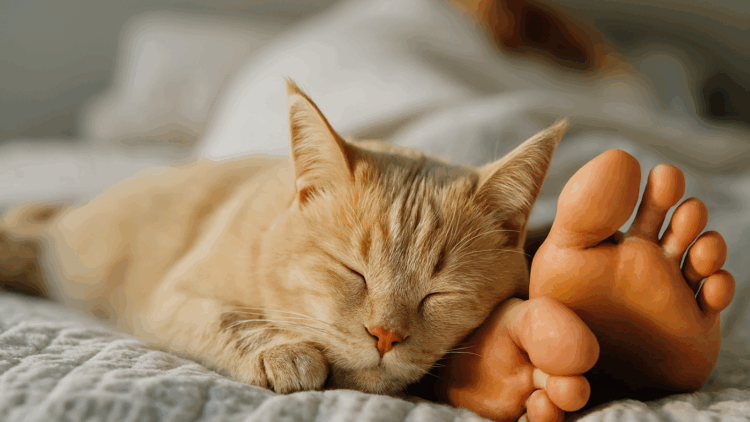
Why does my cat sleep by my feet is one of the most common questions cat owners ask — and the answer reveals something genuinely touching about the feline mind.
Cats do not choose their sleeping spots randomly. Every location they pick is a deliberate decision rooted in instinct, trust, temperature regulation, and territorial behavior.
When your cat curls up at the end of the bed night after night, they are communicating something meaningful.
Understanding How Cats Choose Where to Sleep
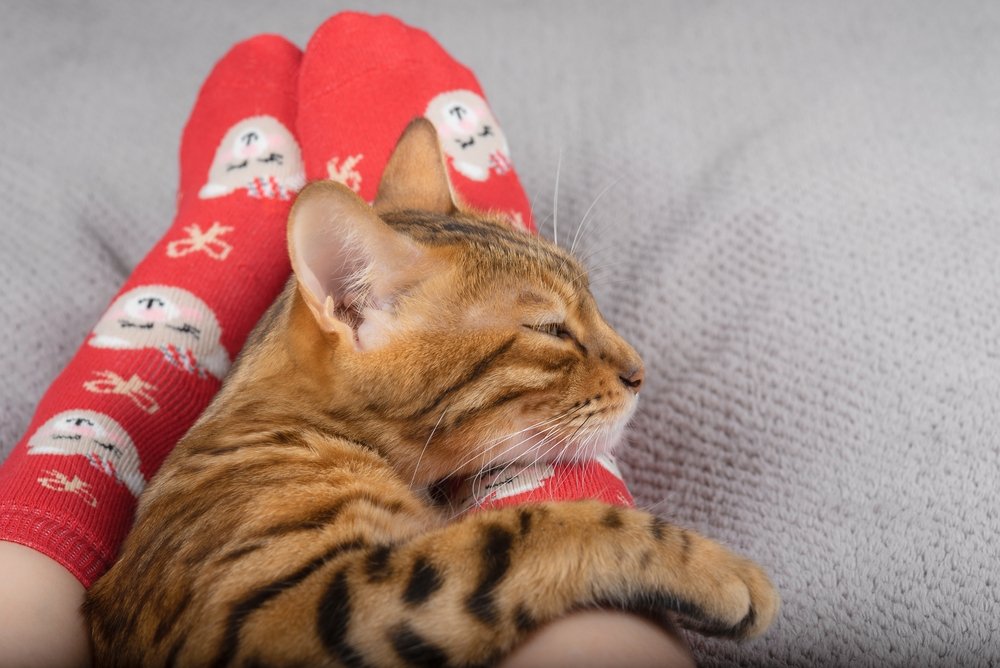
Cats are extraordinarily selective about where they sleep. In the wild, choosing the wrong sleeping spot could mean the difference between life and death.
Even domestic cats carry these hardwired survival instincts. Every sleeping spot must offer warmth, security, a clear view of surroundings, and an easy escape route if needed.
Your bed — and especially your feet — satisfies nearly all of these requirements at once. That is why so many cats gravitate there instinctively, night after night.
How Much Do Cats Actually Sleep
Before diving into the reasons your cat sleeps by your feet, it helps to understand just how central sleep is to a cat’s life.
| Cat Life Stage | Average Daily Sleep |
|---|---|
| Newborn kittens | 20 to 24 hours |
| Young adult cats (1–6 years) | 12 to 16 hours |
| Middle-aged cats (7–10 years) | 13 to 16 hours |
| Senior cats (11+ years) | 16 to 20 hours |
| Indoor-only cats | Generally more than outdoor cats |
Cats have a polyphasic sleep pattern, meaning they take many short naps throughout the day and night rather than sleeping in one long stretch. The average individual cat nap lasts about 78 minutes.
With sleep consuming the majority of their day, where your cat chooses to rest matters enormously to them.
The Top Reasons Your Cat Sleeps by Your Feet
There is rarely just one reason. Most cats sleep by their owner’s feet for a combination of instinctual, emotional, and practical reasons that all reinforce each other.
Safety and Survival Instinct
The primary reason cats sleep at your feet, according to certified feline behavior consultants, is safety. Cats are prey animals as well as predators. In the wild, they face threats from raptors, coyotes, and larger predators.
Sleeping near a trusted human creates a protective circle. Your presence signals that the environment is safe enough to sleep in. Cats reserve deep sleep for places and companions they genuinely trust.
Your feet specifically offer a strategic position. From the foot of the bed, your cat can observe the entire room, monitor entry points, and move quickly in any direction if something startles them.
Your Feet Move Less Than the Rest of Your Body
This is a surprisingly practical reason that many cat owners overlook. Most people shift positions 40 to 50 times during the night. Arms, torsos, and legs move frequently and unpredictably.
The foot area, while it does move, tends to stay more stable than your upper body throughout the night. Your cat learns this quickly — usually within the first few nights of sleeping with you.
A cat that starts at your chest or head often migrates to your feet over time, precisely because it is the least disruptive sleeping zone.
Warmth and Temperature Regulation
Cats are extraordinarily temperature-sensitive. Their preferred environmental temperature ranges from 77 to 86°F (25 to 30°C). This is considerably warmer than most indoor home temperatures.
Your body is a constant, reliable heat source. Your feet emit warmth through blood circulation even while you sleep, providing a cozy, stable temperature that your cat finds deeply comfortable.
This behavior has roots in kittenhood. Kittens huddle together with their siblings and mother for warmth in the first weeks of life. The instinct to seek warm, living heat sources for comfort never fully disappears.
In colder months, you may notice your cat sleeping by your feet more frequently. As temperatures drop, your body heat becomes even more appealing as a sleeping aid.
Scent Marking and Territory
Cats communicate extensively through scent. They have scent glands located in their paws, face, cheeks, and flanks. When a cat sleeps near you consistently, they are actively depositing their scent onto you and your sleeping area.
Your feet, in particular, carry an especially strong and concentrated version of your personal scent from walking around all day. To your cat, your foot scent is a powerful familiarity signal — a constant reminder that this is safe, known territory.
By sleeping at your feet, your cat surrounds itself with your scent signature and simultaneously marks you as part of their social group. According to Dr. John Bradshaw’s research on domestic cat behavior, cats associate sleeping locations with their own scent, and your feet provide a prime location for this familiarity reinforcement.
The act also signals to any other pets in the household that you belong to them. It is territorial communication layered with genuine affection.
Trust and Emotional Bonding
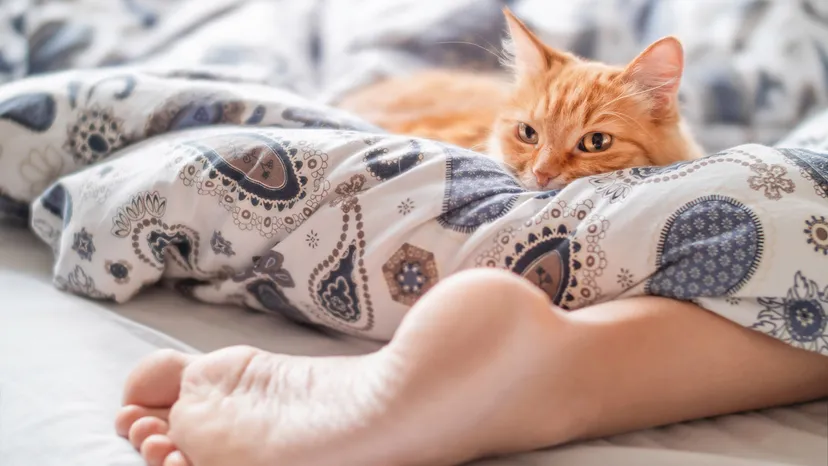
Cats are at their most vulnerable when they are asleep. All animals understand this on an instinctual level. Choosing to sleep near another living being requires a significant level of trust.
Studies on the cat-human bond have shown that cats who have formed a strong attachment to their owners actively seek out their owners for comfort, reassurance, and a sense of security. Sleeping near you is one of the clearest ways a cat demonstrates that you have earned their trust.
When your cat chooses to sleep by your feet rather than alone in another room, they are making an active choice to be near you even during their most vulnerable hours. That is a meaningful expression of attachment in feline terms.
The Need for Independence With Closeness
Cats are fundamentally independent animals, but they are not solitary. They need connection while also needing personal space.
The foot of the bed is the ideal compromise for a cat that loves you but also values autonomy. It keeps them close enough to feel your presence and warmth, but far enough from your face and hands that they are unlikely to be grabbed, hugged, or disturbed.
This balance is uniquely feline. Dogs often press as close as physically possible. Cats prefer proximity with a maintained exit strategy. Your feet give them both.
Protective Instinct Toward You
Some feline behaviorists describe what cats do at your feet as a mild version of a guarding behavior. Positioned at the foot of the bed, your cat has a clear view of the door, windows, and the room at large.
Cats never fully deactivate their alert systems, even in deep sleep. Research confirms that cats maintain partial sensory awareness during most sleep stages. They are always ready to react.
By positioning themselves at your feet, some cats appear to be keeping watch over you while you sleep. This is more instinctual than deliberate, but the protective function is real. Your cat is aware of threats before you would be, and their proximity means they are the first line of response.
Routine and Habit Formation
Cats are creatures of powerful habit. Once a behavior becomes part of a daily routine, they tend to maintain it consistently for years.
The first time your cat slept at your feet, multiple positive factors likely aligned — warmth, safety, familiar scent, and comfortable bedding. The next night, they returned because the experience was positive. Within a week, the behavior is a routine.
Routine itself becomes a source of comfort for cats. Consistency signals stability and predictability, which are psychologically important to felines. Disrupting established routines — including sleeping spots — can cause stress.
Kitten Behavior Carried Into Adulthood
The way a kitten experiences early life shapes much of its adult behavioral patterns. Kittens sleep in piles with their littermates, tangled together for warmth and comfort. Movement from siblings is constant and expected.
Adult cats that grew up in social litters or with loving human contact from an early age often carry this comfort with closeness into adulthood. Sleeping by your feet recreates something of that original communal warmth and security of the litter pile.
It is also worth noting that kittens are accustomed to being stepped over, rolled onto, and generally surrounded by movement during sleep. This may be why adult cats are far less bothered by your nighttime movements than you might expect.
What Different Sleeping Positions Near Your Feet Mean
Not all cats sleep in the same way near your feet. Position, posture, and proximity each carry their own meaning.
| Sleeping Position | What It Likely Means |
|---|---|
| Curled tightly into a ball at your feet | Conserving heat; mildly alert; comfortable but cautious |
| Stretched out loosely across your feet | Deep relaxation; high trust; fully at ease |
| Pressed against the side of your foot | Maximum security-seeking; strong attachment |
| Sitting upright, eyes half-closed, at your feet | Light sleep; in watchful mode; guarding behavior |
| Belly exposed while sleeping at your feet | Absolute trust; fully relaxed; completely secure |
| Facing toward the door while sleeping at your feet | Protective positioning; monitoring the room for threats |
The looser and more relaxed the position, the deeper the trust your cat is expressing. A cat that sleeps belly-up at your feet has placed total confidence in you and their environment.
Why Does My Cat Sleep on My Feet Rather Than Next to Me
Some cats do not just sleep near your feet — they sleep directly on top of them. This is an amplified version of the same behavior with a few extra layers of meaning.
Sleeping on your feet provides maximum warmth transfer. Your foot veins carry warm blood close to the surface, making the top of your foot noticeably warmer than the mattress nearby.
It also intensifies the scent-marking component. Physical contact leaves more of your cat’s scent on you and more of your scent absorbed by them. The bonding signal is stronger.
For cats that feel particularly anxious, stressed by a change in the household, or highly attached to their owner, sleeping directly on top of your feet is a way of maximizing the security they feel.
Why Does My Cat Switch From Sleeping at My Head to My Feet
Many cat owners notice their cat starts the night sleeping at their head or chest and ends up at their feet by morning. This is an extremely common pattern and completely normal.
The explanation is temperature. The upper body — including head, chest, and torso — generates considerably more body heat than the feet. Early in the night, when your body temperature has not fully warmed the bed, your cat seeks your upper body for maximum warmth.
As the night progresses and the bed heats up, your upper body can become uncomfortably warm for a cat. They migrate to the cooler microclimate around your feet while still maintaining closeness and warmth.
This movement also reflects your cat’s ongoing comfort assessment throughout the night. Cats rarely fully lose consciousness in the way humans do and are constantly making small comfort adjustments.
Why Your Cat Might Suddenly Start Sleeping by Your Feet
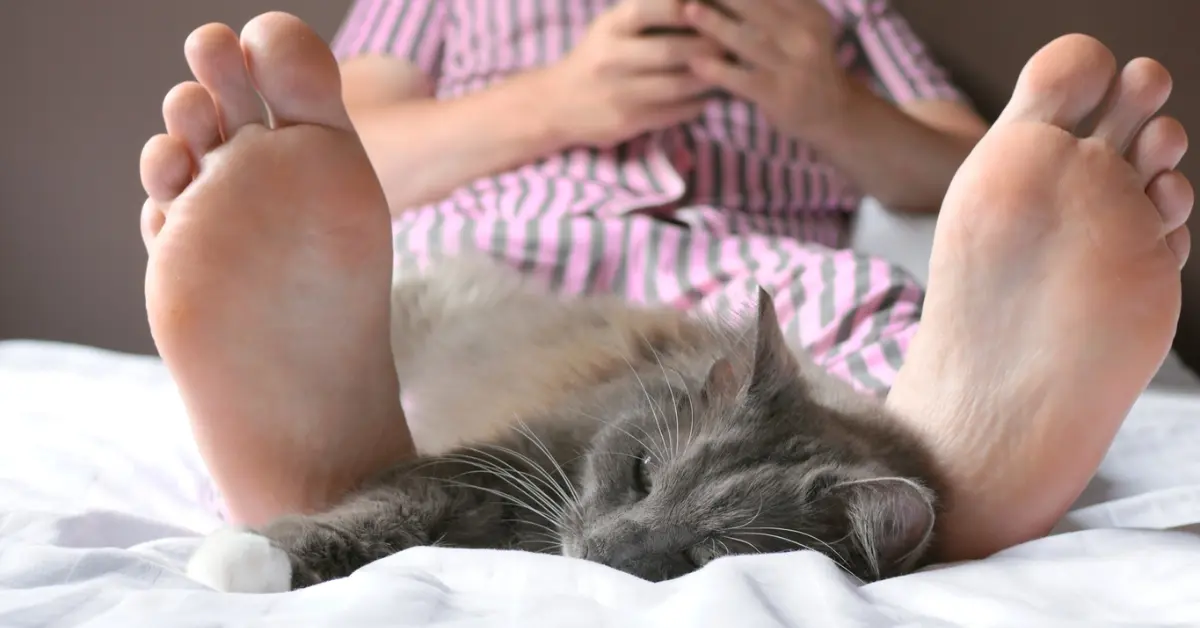
If your cat has not historically slept by your feet and suddenly starts, several factors may be driving the change.
Change in Household Dynamics
A new pet, a new person moving in, a baby, or a family member leaving can all create insecurity in a cat. Seeking proximity to their primary bonding person during sleep is a natural comfort response to disruption.
Your cat may simply need reassurance that their core relationship with you remains stable and unchanged despite the disruption.
Seasonal Temperature Changes
As temperatures drop in autumn and winter, cats seek more warmth during sleep. If your cat was sleeping elsewhere during warmer months and has recently moved to your feet, cold weather is often the explanation.
The reverse is also true — cats sometimes move away from your feet in summer because the ambient temperature makes the additional warmth unnecessary or uncomfortable.
Aging and Increased Need for Warmth
Senior cats lose the ability to regulate body temperature as efficiently as younger cats. They seek warm sleeping spots more urgently and more consistently than they did when younger.
An older cat suddenly favoring your feet every night may simply be responding to an increased biological need for external warmth. This is normal and can be supported with heated cat beds or extra blankets.
Stress or Anxiety
A cat experiencing stress — from loud noises, construction nearby, changes in routine, or illness — may seek more proximity to their trusted human as a coping mechanism.
If the change in sleeping behavior is accompanied by other signs like reduced appetite, hiding, excessive vocalization, or changes in litter box use, a veterinary evaluation is worthwhile.
Should You Let Your Cat Sleep by Your Feet
For most cat owners, allowing their cat to sleep by their feet is completely fine and offers some genuine benefits alongside the considerations.
| Consideration | Details |
|---|---|
| Sleep quality for owners | Some owners sleep undisturbed; others are woken by movement |
| Warmth benefit | Cats provide noticeable warmth, especially in colder months |
| Emotional benefit | Physical proximity to pets is linked to reduced stress and anxiety in humans |
| Allergen concerns | Cat dander in the sleeping area may worsen allergies for sensitive individuals |
| Hygiene | Cats that go outdoors may carry dirt or parasites into the bed |
| Bonding effect | Regular co-sleeping strengthens the cat-human bond over time |
| Independence risk | Overly reinforced co-sleeping can create separation anxiety in some cats |
Research on the human-animal bond consistently shows that sleeping near pets is associated with feelings of comfort, security, and reduced cortisol levels in humans. The warmth and gentle purring vibrations from a nearby cat have measurable calming effects.
If your sleep is being significantly disrupted, you can gently encourage your cat to use a comfortable cat bed placed at the foot of your bed. This maintains the proximity your cat needs while reducing the direct impact on your sleep.
The Science of the Cat-Human Bond and Sleep
Modern research has significantly deepened our understanding of how cats bond with humans and how that bond is expressed through sleep choices.
A landmark study published in the journal Current Biology found that cats form genuine attachment bonds with their owners — not just food-motivated associations. Cats use their owners as secure bases from which to explore and return to for comfort, a behavior previously believed to be exclusive to dogs and human infants.
Sleep proximity is one of the primary ways cats express and reinforce this bond. Choosing to sleep near you every night is your cat’s version of choosing to spend time with you. It is an intentional act of companionship.
Cats are also crepuscular by nature — most active at dawn and dusk. Their sleep cycles align differently from human sleep cycles. When they choose to match your sleeping schedule and sleep through the night with you, it represents a significant behavioral adaptation made out of their attachment to you.
Cat Sleeping Positions on Your Bed — Complete Guide
Where your cat sleeps on the bed beyond just the feet area also carries meaning and varies by the strength and style of your bond.
| Sleeping Location on Bed | Primary Meaning |
|---|---|
| At your feet | Safety, warmth, trust, independence |
| Against your legs | Strong attachment, additional warmth-seeking |
| On your chest or stomach | Deep trust, high attachment, wants your heartbeat proximity |
| On your pillow near your face | Extreme trust and bonding; also head movement is minimal |
| Next to you but not touching | Comfortable proximity; independent cat with genuine affection |
| At the edge of the bed, separate | Still values being in your space but prioritizes independence |
No position is better or more loving than another. Each reflects your individual cat’s personality, their level of attachment, and their comfort preferences.
What It Means When Your Cat Purrs While Sleeping by Your Feet
Purring while sleeping at your feet is one of the most positive behavioral signals a cat can give you. Cats purr in several contexts — contentment, self-soothing, and even healing — but purring during restful sleep near their owner almost exclusively signals deep relaxation and satisfaction.
Cats produce purring vibrations at frequencies between 25 and 150 Hz. Research suggests these vibrations have physiological benefits, including promoting bone density and tissue healing in the cats themselves.
For you, the rhythmic sound of a purring cat nearby has documented relaxation effects, reducing heart rate and lowering cortisol levels. Your cat sleeping and purring at your feet is genuinely good for both of you.
How to Make Your Cat More Comfortable Sleeping by Your Feet
If you enjoy having your cat sleep by your feet and want to encourage the habit, a few simple adjustments make the experience better for both of you.
Keep the end of the bed consistently accessible. Cats are creatures of habit — if they find the bed blocked or changed, they may seek alternatives.
Provide soft, warm bedding at the foot of the bed. An extra blanket or a small cat blanket placed there gives your cat a dedicated spot they can scent-mark and return to reliably.
Avoid sudden movements when waking. Cats sleeping lightly at your feet can be startled by abrupt motion. A slow, gentle wake-up routine helps your cat remain calm and associate the sleeping spot with positive experiences.
If you share the bed with a partner, make sure your cat has enough space and feels secure around both people. Cats that feel crowded or uncertain about one person in the bed may abandon the feet-sleeping habit.
When to Be Concerned About Changes in Where Your Cat Sleeps
Most changes in cat sleeping location are normal responses to temperature, routine, or emotional needs. However, some changes can signal health issues worth investigating.
See a veterinarian if your cat:
Suddenly stops sleeping in any of their established spots and hides instead — hiding is a common sign of illness or pain in cats. Begins sleeping exclusively in unusual locations like the litter box, bathtub, or cool tile floors, which can indicate fever, kidney issues, or other medical concerns. Shows any change in sleeping behavior alongside changes in appetite, water intake, litter box habits, or activity levels. Sleeps significantly more than their usual baseline and becomes difficult to rouse.
A sudden and unexplained move away from sleeping near you can sometimes reflect that your cat is experiencing discomfort and is instinctively withdrawing. This deserves attention.
Frequently Asked Questions (FAQs)
H4: Why does my cat sleep by my feet every night?
Your cat has found that your feet offer warmth, safety, familiar scent, and closeness without disruption. Once established as part of their routine, they return to the same spot every night out of comfort and habit.
H4: Does my cat sleeping by my feet mean they love me?
Yes, it is a strong sign of trust and affection. Cats only sleep deeply near beings they feel genuinely safe with, and choosing your feet over sleeping alone is an intentional act of closeness.
H4: Why does my cat sleep on my feet instead of next to me?
Sleeping directly on your feet maximizes warmth transfer and scent exchange. It is a more intense version of the same bonding behavior — your cat wants maximum contact with the safest, warmest spot near you.
H4: Is it okay to let my cat sleep by my feet every night?
For most owners, yes. The main considerations are allergies, hygiene for outdoor cats, and whether the movement disrupts your sleep. The bonding and warmth benefits are real for both you and your cat.
H4: Why did my cat suddenly start sleeping by my feet?
A change in household, seasonal temperature drop, aging, or increased stress can all trigger this shift. It is usually a sign your cat is seeking more comfort and security from your presence.
H4: Why does my cat move from my head to my feet during the night?
Your upper body generates more heat than your feet. As the bed warms up overnight, your cat migrates to the cooler microclimate at your feet while still staying close enough for warmth and reassurance.
H4: Do cats guard their owners while sleeping at their feet?
Partially. Cats at the foot of the bed have a full view of the room and maintain partial sensory alertness even during sleep. They will wake and react to threats before you would — this is an instinctual protective function.
H4: Why does my cat only sleep by my feet and not my partner’s?
Cats bond more strongly with one person at a time in most households. Your cat has identified you as their primary attachment figure and seeks closeness with you specifically during their most vulnerable moments.
H4: What does it mean if my cat purrs while sleeping by my feet?
Purring during restful sleep near you is an extremely positive sign. It signals deep contentment, full relaxation, and a sense of complete security — your cat is communicating that they are genuinely happy.
H4: Should I move my cat if sleeping by my feet disrupts my sleep?
You can gently redirect them to a comfortable cat bed placed at the foot of your bed. This maintains the closeness they need while reducing disruption to your sleep without damaging your bond.
Conclusion
Why does my cat sleep by my feet is a question with a beautifully layered answer. It is not one thing — it is warmth, trust, safety, scent, instinct, routine, and love all working together in a way that is uniquely feline.
Your cat has chosen your feet because they are warm, familiar, stable, and close to the one being they trust most in their world.
Every night they return to that spot, they are reinforcing a bond built on genuine attachment. M
odern feline behavioral research in 2026 confirms what cat lovers have always suspected — cats form deep emotional connections with their owners, and sleep is one of the primary arenas where that bond is expressed and maintained.
Whether your cat curls up gently at your feet or sprawls directly across them, the message is the same: you are their safe place, and they want to stay near you even in sleep.


