


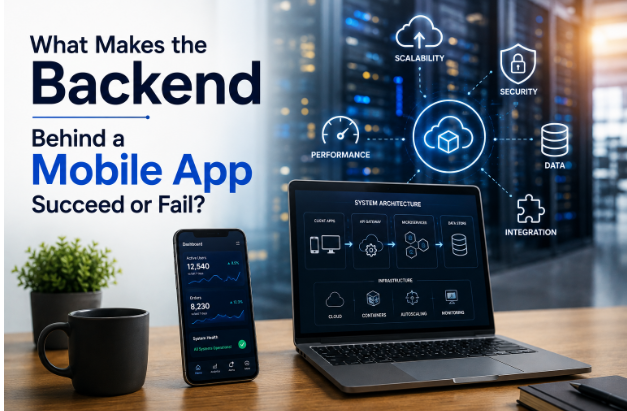
Most conversations about mobile apps begin with the screen. Design reviews focus on layout, animation, and onboarding flow, because that is what stakeholders can see and react to. Yet when a mobile product stalls at scale, the cause is rarely the interface. It is almost always the backend: the servers, databases, APIs, and infrastructure quietly carrying every tap the user makes.
Backend weakness is a slow failure. An app performs well with a few thousand users, then begins to show cracks as adoption grows. Response times stretch. Sync errors appear. Push notifications arrive late. Support tickets rise faster than the user base. By the time leadership notices, the engineering team is spending most of its capacity keeping the system upright rather than shipping new capability. This is why growing organizations increasingly evaluate backend strategy at the same time they evaluate their investment in custom AI Software development services, since data pipelines, model serving, and core application logic all rest on the same infrastructure decisions.
The distinction that matters is not whether an app works today. It is whether the system underneath it can absorb ten times the load, a new market, a new integration, or a new business model without a rebuild.
What Defines an Enterprise-Grade Mobile Backend
Companies that commission custom mobile application development services with long-term growth in mind tend to specify the backend against five characteristics rather than a feature list.
Scalability. The system should handle growth by adding resources, not by rewriting logic. Horizontal scaling, stateless services, and properly indexed data layers make growth an operational decision instead of an engineering emergency.
Security. Mobile apps move sensitive data across untrusted networks and devices. Token-based authentication, encrypted transport and storage, rate limiting, and disciplined secrets management belong in the original architecture, not in a later hardening sprint.
Performance. Users judge an app in milliseconds. Payload size, caching strategy, database query design, and API chattiness matter more to perceived speed than the client framework used to build the screen.
Reliability. Outages are inevitable. Systems that degrade gracefully, retry safely, and fail without data loss protect revenue in ways that uptime dashboards alone do not capture.
Integration capability. Very few apps are self-contained. Payments, CRM, ERP, analytics, and identity providers all need clean, versioned interfaces that can change without breaking the mobile client.
Key Pillars for Long-Term Growth
Modular architecture. The microservices versus monolith debate is often framed as ideological. In practice it is a question of organizational size and change velocity. A well-structured modular monolith serves a small team far better than a distributed system it cannot operate. What matters is clear internal boundaries, so that any component can be replaced or scaled independently later.
Cloud-native development. Containerization, managed databases, and infrastructure as code turn environment differences into configuration rather than firefighting. They also make cost visible, which allows spending to follow usage instead of guesswork.
Data-driven decision making. A backend should be instrumented from day one. Structured logging, distributed tracing, and event capture give product and engineering leaders a shared factual basis for prioritization.
Automation and AI readiness. Systems that already collect clean, well-modeled event data can adopt intelligent features later without a data migration project. Those that do not will pay for that gap twice.
Common Mistakes Businesses Make
The most expensive mistake is the short-term development mindset: building for launch rather than for the eighteen months after launch. Speed to market is a valid priority, but shortcuts should be recorded and scheduled for repayment rather than forgotten.
The second is deferring scalability entirely. Nobody needs to build for a million users on day one. Teams do need to know where the ceiling is and what breaks first when it is reached.
The third is choosing a technology stack for the wrong reasons. Novelty, developer preference, and vendor marketing are poor selection criteria. Talent availability, ecosystem maturity, operational tooling, and long-term support matter far more over a five-year horizon.
Best Practices for Building Future-Ready Applications
Start with architectural planning before writing code. A short discovery phase covering expected load, data model, integration surface, and compliance requirements repeatedly proves cheaper than a mid-project correction.
Choose a development partner who asks about the business before the technology. The right questions early are worth more than the fastest delivery estimate.
Treat optimization as continuous. Load testing, dependency updates, and periodic architecture reviews should be scheduled work, not reactions to incidents.
A Practical Example
Consider a regional retail brand whose mobile app performed well through its first year and then slowed sharply during a holiday promotion. The root cause was not traffic volume. It was a single monolithic service handling catalog, checkout, and loyalty logic against one database.
The remedy did not require a rewrite. The team separated checkout into its own service with a dedicated data store, introduced caching for catalog reads, and moved loyalty calculations to asynchronous processing. Peak response times fell substantially, checkout abandonment declined, and the following year the same promotion ran without additional infrastructure spend. The improvement came from architecture, not from more servers.
Conclusion
The backend behind a mobile app succeeds when it is treated as a long-term business asset rather than a delivery cost. Scalability, security, performance, reliability, and clean integration are not technical luxuries. They are the conditions under which a product can keep growing without repeatedly consuming its own engineering budget.
NewAgeSysIT works with organizations facing exactly this transition, helping them design backend systems that hold up as usage, data, and business complexity increase. Based in New Jersey and serving clients across the United States, the company focuses on architecture-led delivery for enterprises that expect their applications to remain viable for years rather than quarters. For decision-makers weighing a new build or a modernization effort, the most valuable step is usually the earliest one: an honest assessment of whether the current foundation can carry where the business intends to go.