


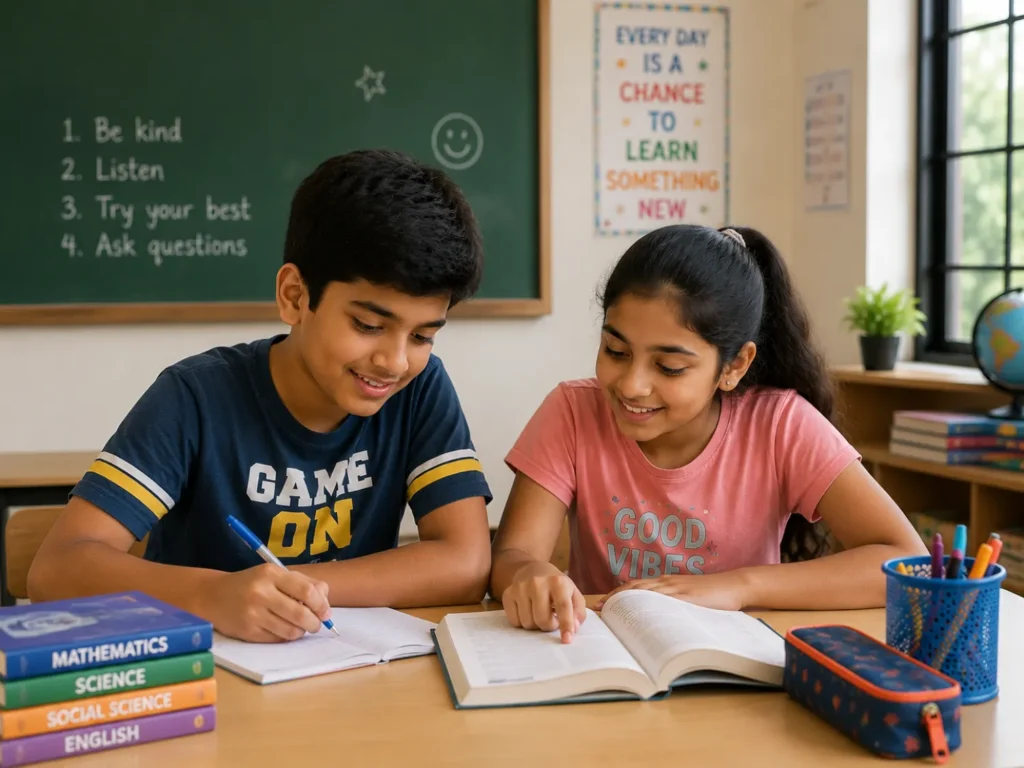
Selecting a school is an important decision because the learning environment can influence how children think, communicate, explore, and respond to new challenges. Parents today often consider more than academic results when evaluating educational options, looking closely at teaching approaches, classroom experiences, student participation, and opportunities for overall development. In this context, the best CBSE schools in Kukatpally are distinguished not only by academic performance but also by the learning practices they use to make education meaningful and engaging. Conceptual understanding, experiential activities, collaborative learning, purposeful technology use, and constructive feedback can all contribute to a stronger educational experience.
Understanding these practices can help parents assess whether a school’s approach aligns with their child’s learning needs and long-term development.
1. Concept-Based Learning Encourages Deeper Understanding
One of the most valuable learning practices is teaching concepts rather than encouraging students to rely primarily on memorisation. When children understand why something works, they are better equipped to apply that knowledge in unfamiliar situations.
For example, instead of simply remembering a mathematical formula, students can explore how and when it is used. Similarly, science concepts become more meaningful when learners connect classroom explanations with observations and experiments.
Concept-based learning can strengthen reasoning, retention, and problem-solving because students are encouraged to understand relationships between ideas rather than treat every topic as isolated information.
2. Experiential Learning Connects Lessons With Real Life
Children often understand concepts more effectively when they can experience or apply them. Experiential learning can include experiments, projects, demonstrations, practical activities, research tasks, and collaborative exercises.
This approach gives students opportunities to ask questions, test ideas, make observations, and learn from outcomes. It also makes classroom learning more purposeful by showing how academic concepts relate to everyday situations.
A school that incorporates experiential opportunities into regular teaching can help students become active participants rather than passive recipients of information.
3. Interactive Teaching Makes Students Active Participants
The teacher’s role has evolved beyond simply delivering information. Effective classroom practices encourage discussion, questioning, peer interaction, presentations, and reflection.
Interactive teaching gives students opportunities to express their understanding and listen to different perspectives. It can also help teachers identify misconceptions and provide support where needed.
Classroom conversations are particularly valuable because they encourage children to articulate their reasoning. Over time, this can contribute to stronger communication skills and greater confidence in expressing ideas.
4. Technology Should Enhance, Not Replace, Teaching
Digital tools can make lessons more visual, interactive, and accessible when used purposefully. Technology-enabled classrooms may support multimedia explanations, digital resources, presentations, simulations, and collaborative learning activities.
However, effective technology integration is not simply about having devices in the classroom. The important question is whether technology improves understanding.
The best approach combines digital resources with teacher guidance, discussion, practical activities, reading, writing, and hands-on learning. This ensures that technology remains a learning aid rather than becoming the focus of the lesson itself.
5. Collaborative Learning Builds More Than Academic Skills
Learning with peers can help children develop skills that are difficult to build through individual study alone. Group projects, discussions, team challenges, and peer activities encourage students to listen, negotiate, contribute, and take responsibility.
These experiences can also expose children to different approaches to solving a problem. A student may discover that there is more than one effective way to approach a task, encouraging flexibility and open-mindedness.
For this reason, parents comparing schools in kukatpally should consider whether students have meaningful opportunities to collaborate and participate rather than spending most of their time working individually.
6. Assessment Should Support Learning, Not Just Measure It
Examinations are an important part of academic education, but assessment can serve a broader purpose. Regular quizzes, assignments, projects, classroom observations, presentations, and feedback can help teachers understand where students are progressing and where additional support is required.
Useful feedback also helps children recognise their strengths and identify areas for improvement. Instead of viewing mistakes only as failures, students can learn to treat them as opportunities to refine their understanding.
A balanced assessment approach therefore supports continuous learning while helping students prepare responsibly for formal examinations.
7. Co-Curricular Experiences Strengthen Holistic Development
Academic learning is only one part of a child’s school experience. Sports, performing arts, creative activities, clubs, and other structured opportunities can contribute to confidence, discipline, teamwork, creativity, and self-expression.
Physical activities can encourage fitness and cooperation, while creative pursuits provide opportunities for imagination and communication. Leadership and participation experiences can further help students become more comfortable taking initiative.
Schools that integrate these opportunities into student life can provide a more balanced environment in which children can discover interests and abilities beyond conventional academic subjects.
8. Social-Emotional Learning Supports Confident Learners
A productive learning environment also considers how children feel, interact, and respond to challenges. Social-emotional learning can help students develop self-awareness, empathy, communication, emotional regulation, and positive relationships.
These abilities matter in the classroom because students who feel supported are often better positioned to participate, ask questions, manage setbacks, and work with others.
A supportive school culture should therefore complement academic expectations with appropriate attention to students’ overall wellbeing.
9. Learning Spaces Should Encourage Exploration
The physical environment can influence how children interact with learning. Laboratories, libraries, sports facilities, creative spaces, activity areas, and technology-enabled classrooms can provide different settings for different types of learning.
The value of infrastructure, however, lies in how effectively students use it. A laboratory becomes meaningful when children conduct investigations; a sports facility becomes valuable when students develop skills through regular participation; and a creative space matters when it enables genuine experimentation and expression.
Parents should therefore evaluate not only what facilities a school offers but also how those facilities contribute to everyday learning.
Conclusion
The strongest learning practices combine academic rigour with curiosity, application, collaboration, creativity, and personal development. For parents exploring the best CBSE schools in Kukatpally, understanding how a school approaches everyday learning can provide a clearer picture of the experience their child is likely to receive.
EuroSchool follows a balanced learning approach that combines CBSE academics with interactive teaching, technology-enabled classrooms, sports, performing arts, laboratories, creative spaces, and opportunities for broader student development. For families exploring educational options in the area, EuroSchool offers an environment designed to support academic clarity, confidence, skills, and holistic growth.