


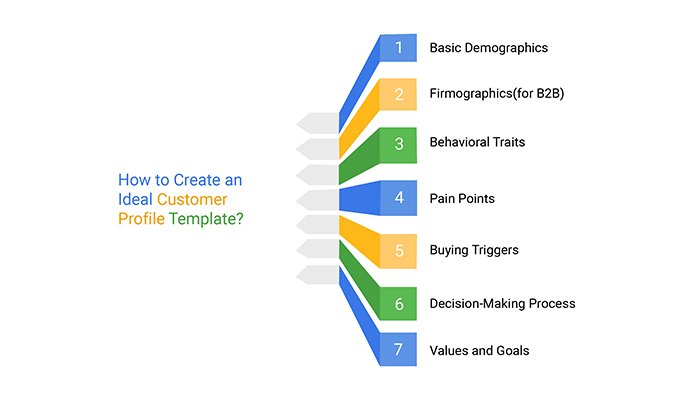
In the realm of business and technology, understanding your customer base is crucial. Creating an Ideal Customer Profile (ICP) helps businesses target their marketing efforts more effectively and maximize ROI. This article explores seven tools that are instrumental in developing a comprehensive ICP. Each tool is chosen based on its ability to analyze data, manage customer relationships, and extract valuable insights. We’ll delve into how these tools can aid businesses in refining their marketing strategies and making data-driven decisions.
Defining the Ideal Customer Profile in Marketing Strategy
An Ideal Customer Profile is a detailed description of the perfect customer for your product or service. It includes demographic, geographic, and behavioral characteristics. This concept serves marketing professionals by providing a clear direction for targeting and engagement strategies. The Ideal Customer Profile is essential as it aligns marketing efforts with customer needs, ensuring more efficient resource allocation. One key attribute of the ICP is its adaptability to various market segments, allowing for a tailored approach in diverse business environments.
Creating an Ideal Customer Profile involves analyzing existing customer data to identify patterns and preferences. Businesses often integrate this profile within their marketing strategies to enhance customer acquisition and retention rates. A limitation of the ICP is that it requires accurate and comprehensive data, which can be challenging for companies with limited data collection capabilities. However, tools that support data integration can mitigate this challenge by consolidating customer insights from multiple sources.
Key Features to Look for in Customer Profile Tools
When selecting tools for creating an Ideal Customer Profile, businesses should consider features such as data integration, real-time analytics, and user-friendly interfaces. These tools serve marketing teams by streamlining the process of customer profiling and enabling data-driven decision-making. A noteworthy feature is the inclusion of an API Gateway, which facilitates seamless data exchange between systems, enhancing the tool’s utility.
Tools with robust data integration capabilities allow companies to leverage data from various touchpoints, providing a holistic view of customer behavior. This integration can lead to more accurate profiling, but it may also come with higher costs due to advanced technology requirements. Additionally, tools offering customizable dashboards can set themselves apart by enabling marketers to tailor insights to their specific needs. A trade-off might be the complexity in setting up these features, which requires technical expertise.
Analyzing Customer Data with Advanced Analytics Platforms
Advanced analytics platforms like Tableau are pivotal in transforming raw data into actionable insights. These platforms cater to data analysts and marketers within businesses by providing comprehensive visualization tools. Tableau qualifies for inclusion in this list due to its powerful data visualization capabilities and its compatibility with various data sources, including Data Fabric, ensuring seamless data integration.
Businesses using Tableau can identify trends and patterns in customer behavior, enhancing their ability to create accurate Ideal Customer Profiles. The platform’s pricing model varies depending on the number of users and data sources, which may be a consideration for smaller companies. However, its ability to integrate with existing data systems offers a significant advantage, enabling businesses to leverage their existing infrastructure. A use case scenario includes deploying Tableau to analyze sales data, revealing insights that guide marketing strategies.
Utilizing CRM Software for Profile Creation and Management
CRM software like Salesforce is essential for managing customer interactions and data throughout the customer lifecycle. It serves sales and marketing teams by offering tools for customer relationship management and data analysis. Salesforce is recognized for its extensive functionality, including a Microservices Architecture that facilitates scalable and flexible system design.
Salesforce’s CRM capabilities allow businesses to maintain detailed customer records, aiding the creation of precise Ideal Customer Profiles. The platform’s subscription-based pricing model offers scalability for companies of all sizes. However, some users may find the system’s complexity a barrier to full adoption. A distinguishing feature of Salesforce is its ability to integrate with other business applications, streamlining workflows and enhancing data accuracy. This integration is vital for businesses aiming to unify their customer data across platforms.
Leveraging Social Media Insights for Target Audience Understanding
Social media analytics tools such as Hootsuite Insights provide valuable data on customer preferences and online behavior. These tools are used by social media managers and marketers to gain insights into audience engagement and sentiment. Hootsuite Insights is included in this list due to its capability to analyze social media conversations across platforms and identify trends.
Utilizing social media insights helps businesses tailor their marketing messages to resonate with their target audience. Hootsuite offers a range of pricing options, making it accessible to businesses with varying budgets. However, the tool’s effectiveness is contingent on the volume and quality of social media data available. A key advantage of Hootsuite is its integration with popular social media platforms, allowing for real-time monitoring and engagement. This integration can be particularly beneficial in industries that rely heavily on social media for customer interaction.
Implementing Survey Tools for Direct Customer Feedback
Survey tools like SurveyMonkey are instrumental in collecting direct feedback from customers. These tools are typically utilized by market researchers and customer experience teams to gather insights on customer satisfaction and preferences. SurveyMonkey is included due to its user-friendly interface and robust analytics features, which enable businesses to interpret survey data effectively.
Implementing SurveyMonkey allows businesses to directly ask customers about their needs and expectations, providing valuable data for creating an Ideal Customer Profile. The tool offers various pricing tiers, accommodating different levels of survey complexity and audience size. A potential limitation is the response rate, which can vary based on the survey design and distribution method. Nonetheless, SurveyMonkey’s customizable survey templates offer a significant advantage, allowing businesses to tailor questions to specific customer segments.
Integrating AI Solutions for Enhanced Customer Profiling
AI solutions like IBM Watson offer advanced capabilities for customer profiling through machine learning and natural language processing. These solutions serve data scientists and marketing analysts by providing predictive analytics and automated insights. IBM Watson is noteworthy for its application of Federated Learning, which allows for secure, decentralized data processing.
Integrating IBM Watson into customer profiling processes enables businesses to predict customer behavior and personalize marketing efforts. The platform’s pricing structure is based on usage and data complexity, which may influence budget considerations. A distinguishing feature of IBM Watson is its ability to learn from diverse data sets, enhancing the accuracy of customer profiles over time. One trade-off is the potential need for technical expertise to fully leverage its capabilities. Despite this, its predictive analytics can offer significant competitive advantages in rapidly changing markets.
Conclusion
The selection of tools for creating an Ideal Customer Profile hinges on their ability to integrate data, provide insights, and enhance decision-making processes. By leveraging advanced analytics, CRM software, social media insights, survey tools, and AI solutions, businesses can refine their customer understanding and optimize their marketing strategies. These tools are essential in the ever-evolving landscape of business and technology, enabling companies to stay ahead by accurately targeting and engaging their ideal customers.