


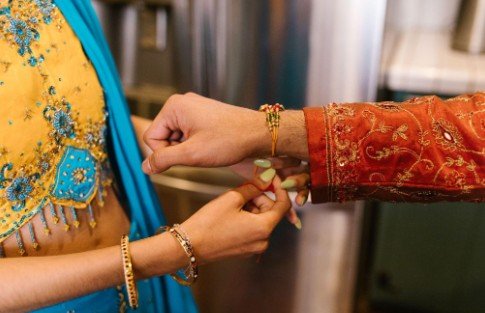
Raksha Bandhan is one of the most cherished festivals in India, with deep mythological associations. This sacred festival is all about the knot of protection where the lovely bond between siblings is celebrated. Sisters tie the Rakhi or sacred thread on the wrists of their brothers, while praying for their long life and wellbeing.
Brothers, on the other hand, vow to protect and support their sisters throughout their lifetime. There are also traditions like exchanging the Rakhi gift, feasting on traditional delicacies together and spending time amidst busy schedules. Let us learn more about the unique traditions of this incredible festival below.
Raksha Bandhan Traditions that Add a Special Touch to the Festival
There are several special traditions linked to Raksha Bandhan that are worth knowing more about. They include:
Sacred Pooja Ceremonies
This celebration traditionally begins early in the morning at households celebrating Raksha Bandhan. A household Pooja takes place to mark the occasion. Sisters prepare ceremonial plates which contain the sacred Rakhi thread, rice grains (akshat), vermillion (Kumkum) powder and the Aarti lamp, along with sweets.
As a part of the ceremony, the sister will then apply the Tilak on the forehead of her brother and perform the religious Aarti to ward off any evil or harm. Thereafter, she will tie the Rakhi on the right wrist of her brother.
Exchanging Gifts & Vows
After the thread is tied, brothers take a vow to protect and support their sisters throughout their entire lifetime. Then, they present special gifts for Rakhi to their sisters, including money and other presents. Sisters also present gifts to their brothers, before feeding them tasty traditional delights like Barfis and Laddoos.
Variations in Raksha Bandhan Celebrations Throughout India
There are several subtle variations in the traditions and celebrations involving Raksha Bandhan across India. For example, the core symbolism stays the same, although unique cultural flavours come into play throughout various Indian states. For example, West Bengal often celebrates the day as Jhulan Purnima, with special prayers to Radha and Lord Krishna. In Maharashtra and several coastal regions, it is called Narali Purnima or Rakhi Purnima. Fishing communities may offer coconuts to Varuna, the Sea God, with a prayer to bless them and their livelihoods, before the Rakhis are tied.
In Gujarat, sisters-in-law may also participate in the festival by exchanging what is known as the Lumba Rakhi. This is tied on the wrist of the brother’s wife or her bangles to enhance the bonds of love in the family. In Southern Indian states like Tamil Nadu, it is known as Avani Avittam. This is a sacred occasion where men change holy threads and offer prayers for their ancestors.
No Biological Borders
One of the special traditions of Raksha Bandhan is that there are no biological obstacles to the celebration. For ages, Raksha Bandhan is celebrated among not just biological brothers and sisters, but also cousins, family members, extended relatives, close friends, neighbours and even colleagues. Rakhis have also been used historically to express solidarity and foster harmonious relationships among various communities in India.
Myths and Legends Related to Raksha Bandhan in India
There are several fascinating myths and legends that surround Raksha Bandhan in India. One of them originates from the epic Mahabharata. Lord Krishna once cut his finger, leading to Draupadi tearing some cloth from her saree and tying it on his finger to stop the bleeding. From then onwards, this piece of cloth turned into a sacred thread symbolic of love and protection, i.e. what Raksha Bandhan means.
Another legend narrates how the actual tradition began in the country. King Bali was devoted to Lord Vishnu, leading to the deity leaving his own abode and protecting Bali’s kingdom. Goddess Lakshmi, Lord Vishnu’s wife, could not bear this distance. Hence, she adopted a Brahmin refugee’s disguise and tied a Rakhi on King Bali’s wrist on the auspicious occasion of Shravan Purnima. Touched by this incident, King Bali requested Lord Vishnu to accompany Goddess Lakshmi back to Vaikuntha. It then became a tradition to invite siblings on Shravan Purnima for tying the auspicious Raksha Bandhan thread.
Along with Krishna’s brotherly love for Draupadi and how he safeguarded her later in the epic, there is another story about Roxana and King Porus. Alexander the Great invaded India in approximately 326 BCE. Being worried about his safety, his wife Roxana sent the king of the Pauravas, King Porus, a Rakhi. She pleaded with him not to harm her husband on the battlefield. During the Battle of the Hydaspes River, the king saw the Rakhi on his wrist, reminding of his promise to Roxana. He did not attack Alexander and lost the battle, although he won his adversary’s honour and respect.
Celebrate the Sacred Bonds of Love and Companionship on Raksha Bandhan
Raksha Bandhan is all about commemorating the sacred bonds of love and companionship among siblings. It is a day when you should celebrate with your brothers and sisters, exchanging gifts, feasting on local delicacies and spending time together on the auspicious day.