


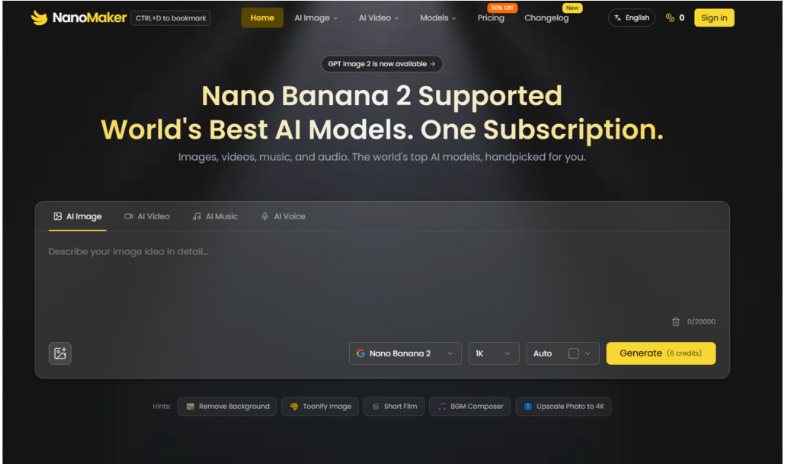
The math has never worked. A subscription here for image generation, another there for video, a third for music, and suddenly you’re looking at a monthly bill that rivals a full Adobe Creative Cloud suite—except you’re not getting integration, you’re getting fragmentation. The real cost isn’t just the money; it’s the time lost moving assets between platforms, the creative momentum killed by context switching, and the mental overhead of remembering which tool does what. This is the problem that Nanobanana maker solves not by building yet another AI model, but by doing something far more practical: putting all the models you actually need under one roof, with one login, one workflow, and one bill.
The Hidden Tax of the Multi-Tool Workflow
Most creators don’t realize how much friction they’ve normalized. Open Sora for video. Switch to Veo for a different take. Export. Open Suno for music. Export again. Open ElevenLabs for voice. By the time you’ve assembled all the pieces, the original idea has cooled. The platform’s core insight is that creative work is fluid, and the tools should be too. Instead of forcing creators to adapt to fragmented interfaces, it adapts the interfaces to the creative flow. Generate an image with Nano Banana, turn it into a video with Gemini Veo or Sora 2, add background music, and export—all without leaving the page. This isn’t a feature list; it’s a fundamentally different way of working.
What Consolidation Actually Looks Like in Practice
From Image to Video to Audio: The Seamless Pipeline
The most underrated feature of an integrated platform is what doesn’t happen: you don’t lose momentum. When an image needs to become a video, the transition is instantaneous. When that video needs a soundtrack, the music generation is right there. The platform’s claim that you can “create everything on a single page without switching tabs or refreshing” sounds like marketing until you experience it. Then it sounds like common sense.
One Prompt Language, Not Dozens
Different AI models speak different prompt languages. What works for image generation often fails for video. What works for video rarely translates to music. The platform’s unified interface abstracts away these differences. You describe what you want in natural language, and the system routes your request to the appropriate model. The learning curve flattens dramatically when you’re not relearning syntax for every tool.
The Commercial License That Actually Matters
For professionals, the commercial use license included with every paid plan is not a nice-to-have—it’s a requirement. Many free or cheap AI tools restrict commercial usage or require attribution. The platform’s approach removes that uncertainty. Generate assets, use them in client work, sell products featuring them—the license covers it.

The Real Question: Is the Quality There?
Consolidation is worthless if the underlying models are mediocre. This is where the platform’s strategy of integrating best-in-class models rather than building its own pays off. Nano Banana, powered by Google Gemini Flash, handles image generation and editing. Gemini Veo and Sora 2 handle video. Suno handles music. ElevenLabs handles audio. The platform isn’t asking you to compromise on quality for convenience—it’s asking you to stop paying separately for the same quality.
In testing, the image transformations delivered results that were specific and usable. The LinkedIn profile photo generator maintained facial identity while upgrading setting and styling. The 3D figurine transformation preserved recognizable features while adding a playful miniature aesthetic. The style transfers—line drawing, emoji generation, coloring pages, retro photography—each produced outputs that felt authentic to their respective genres rather than like generic filters.
The video generation, while not outperforming dedicated video models in isolation, benefits from being part of a unified workflow. The value is not in being the best at one thing but in being good enough at everything, with the integration making the whole greater than the sum of parts.
The Pricing Reality: What You Actually Get
The platform’s pricing is refreshingly straightforward:
- Free: 6 credits upon first sign-in, commercial use license included
- Basic: $4.9/month ($58.8/year) for 3,000 credits annually
- Standard: $7.9/month ($94.8/year) for 12,000 credits annually
- Professional: $19.9/month ($238.8/year) for 45,000 credits annually
The credit system warrants attention. Different models consume different credit amounts—usage varies by model and generation type. But the rough math is clear: 3,000 credits translates to approximately 600 images, 176 videos, 150 songs, or 300 audio generations. For a professional creating daily content, the Professional tier at under $20 per month compares favorably to paying separately for each model’s subscription.
The “Cancel anytime — Unused credits roll over” policy adds a layer of flexibility that many subscription services lack. You’re not penalized for taking a month off or for having a slow creative period.
Who This Actually Works For
The platform’s applications map cleanly to real-world needs:
Marketers and businesses can generate ad visuals, product demo videos, and branded content from a single platform, producing consistent assets without a design team. Content creators and YouTubers can design thumbnails and custom graphics that keep audiences engaged, turning rough concepts into polished visuals. Social media managers can quickly create posts, stories, and Reels optimized for each platform while maintaining brand consistency. Designers and artists can accelerate their workflow with AI-powered concept art and rapid iterations, spending less time on repetitive tasks. E-commerce sellers can create professional product photography without expensive studio sessions.
User feedback reflects this pragmatic value. One user notes that “one subscription gets me access to Nano Banana, Veo, Sora, and all the top AI models—I used to pay for these separately”. A freelance designer adds that “the consistency across edits is legit. I use prompts to iterate on client concepts in real-time during calls”. A startup founder reports using the platform to create product launch images, then turning them into videos with Sora 2 and adding royalty-free music—all in one platform.
What to Keep in Mind
The platform has real constraints. Prompt quality significantly affects output quality—vague prompts produce vague results. Complex scenes with multiple distinct elements may require multiple generations. Consistency across generations is good but not perfect; generating the same subject multiple times may produce variations in expression or lighting. The video capabilities, while integrated and convenient, do not outperform dedicated video models in isolation.

The Bottom Line
The question isn’t whether the platform is the best at any single task. The question is whether the sum of its parts—integration, workflow, pricing, and quality—delivers more value than paying separately for best-in-class tools. For most creators, the answer appears to be yes. The platform doesn’t ask you to choose between convenience and quality. It asks you to stop pretending that fragmentation is acceptable.
NanoMaker represents a pragmatic response to a real problem: too many tools, too many subscriptions, too much friction. In a landscape where every new AI model demands its own login and its own payment method, a platform that consolidates access without sacrificing capability is not just convenient—it’s increasingly essential. The creative flow should be the priority, not the tool management. This platform finally makes that possible.