


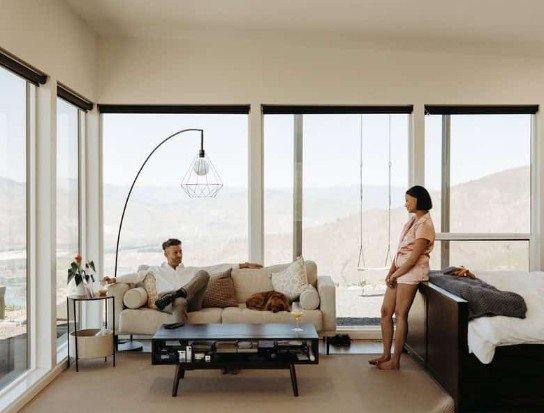
There is a photo genre nobody plans but everybody has: the picture taken at home. A mirror in the bedroom, a couch corner, a kitchen bench with last night’s dishes just out of frame. On dating apps these photos do double duty, because the viewer is reading two things at once. The face, and the room behind it.
Most people obsess over the first and never think about the second. Interior-minded people know better. A room is never neutral. It is either working for the person standing in it or quietly working against them.
The Background Is a Second Bio
Ask anyone who swipes regularly and they will confirm it: the room gets judged. Unmade bed, harsh ceiling light, a bare wall with a single sad poster, the bathroom mirror with the toothpaste-flecked glass. None of it is disqualifying on its own, but it all reads as information, and it reads fast.
The reverse is also true. A warm lamp instead of a downlight, a plant that is visibly alive, a bookshelf with actual books, a kitchen that suggests someone cooks in it. These details do the work a bio paragraph claims to do, except the room cannot exaggerate. That is precisely why viewers trust it more than the text.
The principle will be familiar to anyone who has staged a home for sale. Buyers are not evaluating the furniture. They are evaluating the life the furniture implies. A dating profile photo taken at home is a staging exercise with identical rules and a smaller lens.
There is a reason real estate agents insist the lamps be on before the listing photos are taken, and it applies one-to-one here. Overhead light says nobody thought about this room. Layered lamp light says somebody lives here on purpose. A profile viewer processes that distinction in under a second, without ever being able to articulate it, and the swipe follows the feeling.
Why Home Photos Beat the Beach Photo Anyway
Here is the counterintuitive part. The holiday photo with the perfect backdrop performs worse than most people expect, because everyone has one and it says nothing specific. A photo inside a real, lived-in, cared-for space is rarer and more informative. It shows taste, which is the thing people are actually trying to assess before a first date.
The problem is that almost nobody has good photos of themselves at home. Camera rolls fill up at events and on trips, where someone else is holding the phone. At home there is no photographer, so home photos default to mirror selfies and awkward arm’s-length angles that flatten the face and ignore the room entirely.
This is an inventory gap, not a styling failure. The well-lit corner exists. The photo of a person actually in it does not.
Working With the Light You Already Own
For anyone attempting the photos the manual way, the fixes are the same ones interior photographers use. Shoot in the hour when window light comes in low and warm, never under a ceiling downlight, which shadows the eyes and yellows the skin. Face the window, or sit at ninety degrees to it. Turn on every lamp in the room and turn off the overheads. Clear the surfaces within frame, because a camera notices clutter that eyes have learned to skip.
And recruit a tripod or a patient friend, because the arm’s-length selfie wastes the one advantage a home photo has: the room. A photo cropped to a face in front of a blurred wall could have been taken anywhere. The point is the setting.
The Generated Alternative
The newer route skips the tripod entirely. Tools that generate ai dating photos take a batch of existing selfies and return 80 to 180 images of the same person across roughly 45 scenes, and a large share of those scenes are exactly the domestic settings missing from most camera rolls: the kitchen, the reading chair, the balcony, the morning-light living room. A run takes twenty to thirty minutes and costs a one-time $29 to $79, against several hundred for a photographer to spend an afternoon in the actual apartment.
DatePhotos, an AI dating photo generator built for Tinder, Bumble and Hinge, scores each output from 0 to 100 on how natural it looks, with 85 as the suggested cutoff. The score matters because generated interiors are convincing but not always coherent, and the number lets a user discard the frames where the light falls wrong without inspecting two hundred images by hand.
The honest limit applies here with a twist an interiors audience will appreciate: the generated room is not your room. As a portrait backdrop that is usually fine, since the viewer is reading atmosphere rather than checking floor plans. But the person in the photo still has to look like the person who shows up to the date, and the tools that score for naturalness rather than glamour are enforcing the right boundary.
A Small Audit Worth Doing
The practical takeaway fits in one exercise. Open the profile, or the camera roll that would become one, and look only at backgrounds. Count how many photos were taken somewhere that says something true: a home that is cared for, a hobby in progress, a table someone actually eats at. If the answer is none, the profile is running entirely on peak moments and borrowed backdrops.
The fix is not a better beach. It is one good photo in a real room, made either with window light and patience or generated from the selfies already on the phone. Rooms tell the truth about people. That is exactly why the right one, photographed properly, is the strongest image a profile can carry.