


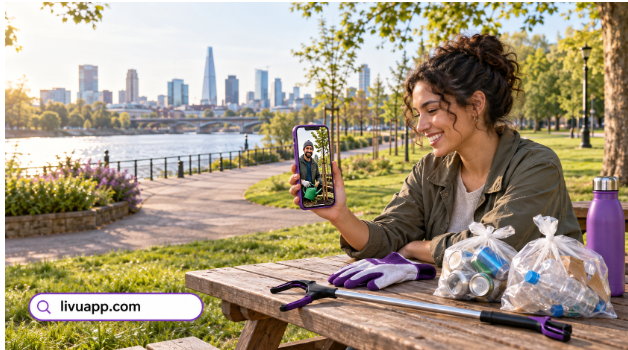
Conversations about community life often focus on large events, major problems, or famous organizations. Yet neighborhoods are also shaped by smaller actions: picking up litter, sharing unused items, watering a young tree, checking on an older neighbor, or helping someone understand a local service.
A live you app conversation can use these everyday acts as a thoughtful alternative to routine introductory questions. People can share what cooperation looks like where they live without presenting themselves as heroes or revealing sensitive information about others.
Through livu – make friends, community care can become a bridge between different cultures and lifestyles. One person may participate in organized volunteering, while another contributes through informal habits that rarely receive public attention.
Begin With the Neighborhood, Not Personal Achievement
Asking, “What volunteer work do you do?” may make the other person feel that they need an impressive answer. A broader question is more welcoming:
- “What is one small way people help each other where you live?”
- “Is there a shared space that residents take care of?”
- “Do neighbors exchange things they no longer need?”
- “What makes your area feel cooperative?”
- “Have you noticed a small act of kindness recently?”
These prompts include people who do not belong to formal organizations. They also place attention on the community rather than individual status.
Recognize Informal Forms of Care
Not all community support has a name, schedule, or membership form. Someone may collect packages for a neighbor, translate a notice, lend a tool, refill a public water bowl, or help keep a shared hallway clean.
These actions can be easy to overlook because they are woven into everyday life. Ask who usually notices that something needs to be done and how people coordinate.
The answer may reveal local communication habits. Some communities use group messages, while others rely on face-to-face conversations, noticeboards, or long-standing personal relationships.
Share the Story of a Public Space
Parks, gardens, libraries, courtyards, and walking paths often depend on both official services and considerate public behavior.
Ask whether there is a place nearby that residents value and what helps keep it welcoming. Perhaps volunteers plant flowers, visitors separate waste, or local groups organize occasional maintenance days.
Focus on the space and the cooperation surrounding it. There is no need to request an exact address or encourage someone to reveal where they live.
Talk About Repair and Reuse
Community care can involve extending the life of useful objects. Tool libraries, repair events, clothing exchanges, book swaps, and shared shelves reduce waste while creating opportunities for neighbors to meet.
Possible questions include:
- “Do people exchange used items in your area?”
- “Is there something you repaired instead of replacing?”
- “Would you borrow a tool from a community collection?”
- “What object is commonly passed between families?”
- “Do people leave books or plants for others to take?”
These topics connect practical problem-solving with stories about trust and resourcefulness.
Compare Organized and Spontaneous Help
Some forms of support are carefully planned. Others appear in response to a sudden need, such as extreme weather, a power failure, or a blocked road.
Ask how people learn that help is needed and who normally takes the first step. The discussion can reveal the strengths of both organized systems and informal networks.
Avoid requesting details about traumatic incidents. The conversation can focus on coordination, preparation, and human cooperation without turning another person’s hardship into entertainment.
Keep the Tone Humble
Community involvement can become uncomfortable when it is described mainly as proof of personal goodness. Use language that emphasizes teamwork, learning, and practical results.
Instead of saying, “I saved the park,” say, “A group of us spent the afternoon collecting recyclables, and I learned how much work maintenance requires.”
It is also helpful to acknowledge limits. One person cannot solve every problem, and not everyone has the same time, money, health, or mobility available for volunteering.
Ask What the Experience Taught Them
The most interesting part of a community activity is not always the visible result. It may be what participants learned about their neighbors, local systems, or their own assumptions.
Try asking:
- “Did anything surprise you?”
- “What was harder than expected?”
- “Did you meet someone you would not normally encounter?”
- “Would you do anything differently next time?”
- “What made people work well together?”
These questions invite reflection without demanding praise.
Respect Privacy and Dignity
Stories about mutual aid may involve people experiencing financial difficulty, illness, housing insecurity, or another vulnerable situation. Their identities and circumstances should not be shared casually.
Avoid showing faces, names, documents, addresses, or identifiable locations without permission. Do not ask someone to display the people receiving support during a call.
A respectful story centers the activity and what was learned, not private details about those who needed assistance.
Avoid Turning Differences Into Moral Rankings
Communities organize support in different ways. A practice common in one place may be handled by public services, religious groups, families, nonprofits, or informal networks elsewhere.
Do not conclude that one community is more caring simply because its methods are more visible. Local laws, resources, infrastructure, and cultural expectations all influence how people help.
Ask how the system works before deciding what it means.
Find Accessible Ways to Participate
Physical cleanup or planting activities are only some forms of contribution. People can also help through remote coordination, translation, teaching, design, phone calls, donations, administrative work, or sharing accurate information.
Someone with limited mobility may make a major contribution that is not visible in a photograph. A busy person may only have a few minutes available, while another can commit an entire afternoon.
The conversation should recognize usefulness in many forms rather than praising only physically demanding work.
Share Skills Without Taking Control
Communities benefit when people share what they know, but help should respond to actual needs. Arriving with an unrequested solution can create more work or ignore the experience of local residents.
Ask how volunteers determine priorities. Do they consult the people who use the space? Is there an organizer? Are safety rules or specialist skills required?
Listening before acting is often one of the most important forms of support.
Keep Activities Safe
Public cleanup requires appropriate gloves, safe tools, waste separation, and attention to traffic or hazardous materials. Unknown sharp objects, chemicals, or medical waste should be left to trained services.
Tree planting and environmental work may also require permission, suitable species, and ongoing care. Planting something without a maintenance plan is not always helpful.
During a call, finish the physical task first and move to a safe resting place. Do not handle a phone while using tools, walking near roads, or carrying heavy items.
End With One Realistic Idea
A community conversation can conclude with a small possibility rather than a grand promise.
Each person might identify one realistic action: returning an item they borrowed, bringing a reusable container, checking a community noticeboard, or learning about a local event.
The purpose is not to pressure anyone into immediate volunteering. It is simply to notice that useful participation often begins with attention.
Connection Through Shared Responsibility
Community care reveals what people value in the places around them. It can show patience, practical creativity, gratitude, and respect for shared resources.
A live you app conversation becomes more substantial when participants discuss small actions that improve ordinary life. In the same way, livu – make friends can connect people through honest stories of cooperation without turning kindness into a performance.
Stronger communities are rarely built by one dramatic gesture. More often, they grow through many modest actions repeated by people who notice what needs care.